The chart sets the stop’s place; your risk per trade sets the size. Never the other way round.
Every order should carry a stop; the ticket warns when the loss is not limited.
Move a stop only in your favour, and only for a reason on the chart.
The stop marks where you are wrong
A stop loss is not a number you can afford; it is the price at which your reason for the trade no longer holds. If you buy at support because buyers defended it, the trade is wrong once price closes clearly below that support.
Choosing the stop from the money first, for example “I will risk 10 pips because that is cheap”, puts it wherever it happens to land, often inside normal noise. Choose the place from the chart, then fit the size to it.
Three ways to find the place
- Beyond structure. Below the last higher low or the support zone for a buy; above the last lower high or resistance for a sell.
- Plus an ATR buffer. Add half to one ATR beyond the structure, so an ordinary wick does not reach the stop.
- Not on a round number. Levels such as 1.0800 or 2,400 attract orders. Place the stop a little beyond them, not on them.
Avoid stops at a fixed distance on every trade. Ten pips on a quiet morning and ten pips around a busy session open are not the same risk.
A worked example on gold
XAUUSD trades at 2,380 in an uptrend on 4h. Support sits at 2,370–2,374, and the 1h ATR is about $6. You plan a buy at 2,380. The structure says the idea fails below 2,370; half an ATR beyond that gives a stop at 2,367, which is $13 of price below the entry.
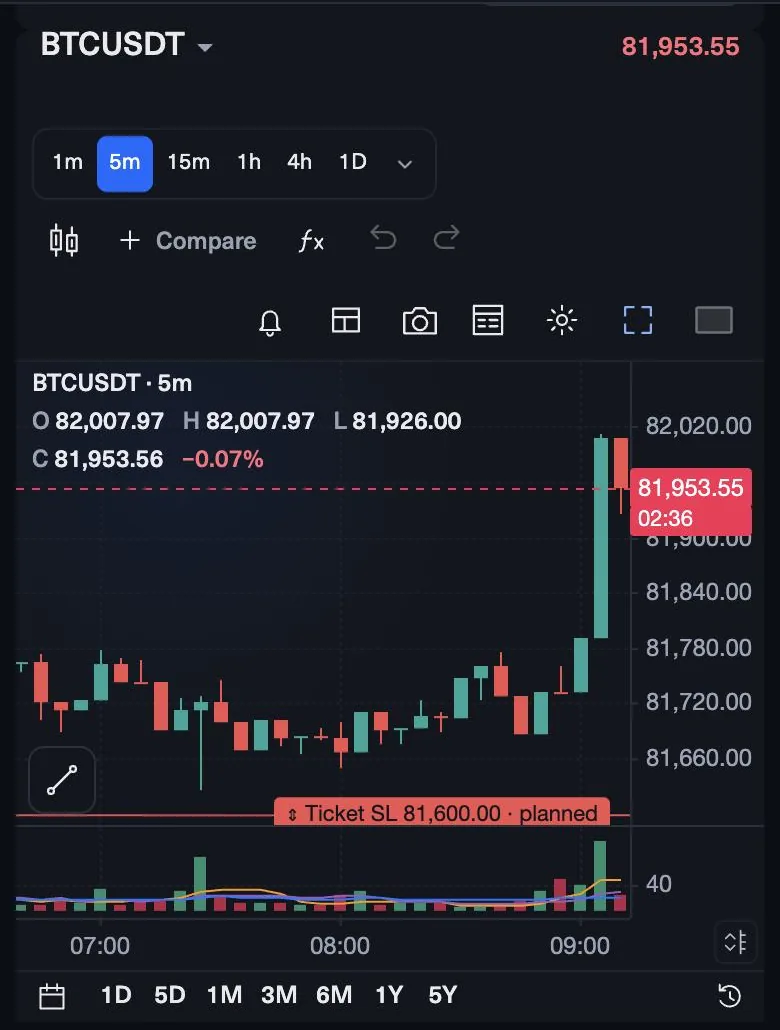
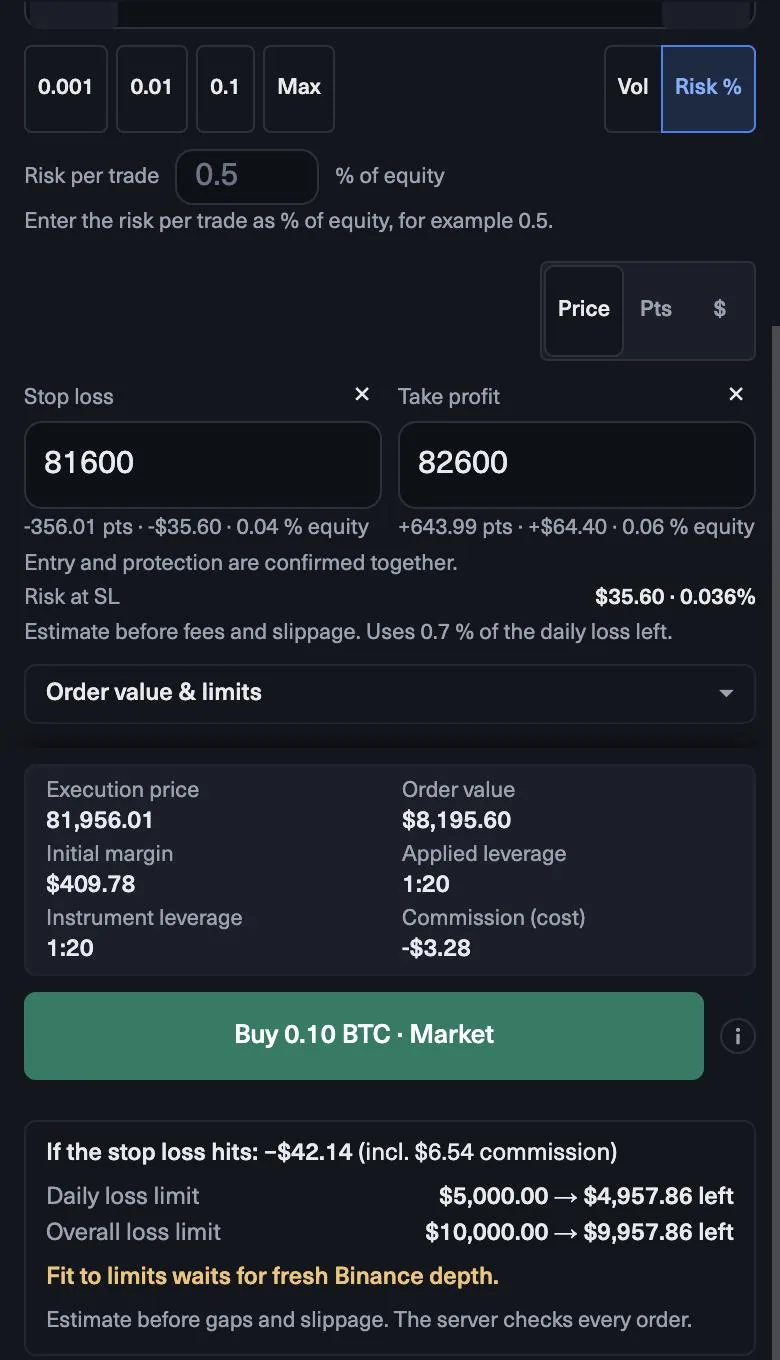
In the ticket, choose Risk % and enter 0.5. Press + Stop loss and enter 2,367 as a price. The ticket works out the volume for you, so you do not need to know the contract details: on a $10,000 account, Risk at SL should show about $50. On the chart a line marked Ticket SL … planned appears at 2,367, so you can check that it sits beyond the zone.
What the ticket shows
- The money you lose at the stop and Risk at SL.
- The share of the daily loss left that this order would use.
- A box If the stop loss hits with the daily loss limit and the overall loss limit before and after.
- Without a stop, a warning: “No stop loss: this order’s loss is not limited before your daily and overall loss limits.”
Read that warning literally. Without a stop, the only thing between one trade and your daily loss limit, $500 on a $10,000 1-Step Challenge account, is you watching the screen.
Moving the stop
Never widen a stop because price is coming close. That turns a planned −1R loss into an unplanned one. If the idea still looks good after the stop hits, you can plan a new trade with a new stop and the same risk.
Moving a stop in your favour is fine when the chart gives a reason, for example after price forms a new higher low above your entry. In fast markets and gaps a stop can fill beyond its price, so keep your risk per trade small enough to absorb that.
Quiz
Check yourself
0 / 4
Lesson complete
Nice work. … of 15 lessons in Trading basics in the MyFundedCapital Terminal done.
MyFundedCapital School
Trading basics in the MyFundedCapital Terminal checklist
Rules as of 17 Oct 2026. Tick each line before your next session.
1. What is the difference between market, limit and stop orders?
- A market order buys at the ask and sells at the bid, so you pay the spread the moment you enter.
- A limit waits for a better price; a stop waits for price to prove a move. Neither is sure to fill.
- Add a stop loss before you send any order; the ticket shows what it costs against both loss limits.
2. How do you read a price chart?
- Each candle is one period: its body runs from open to close, its wicks to the high and low.
- Read top-down: direction on 1D or 4h, structure on 1h, entry on 15m or lower.
- Your planned stop shows on the chart as a line, so you see the risk before you send.
3. Which candlestick patterns should a beginner know?
- Body = open to close, wicks = the extremes. Long wicks show where price was rejected.
- A pattern counts only after its candle closes, and only at a level you marked earlier.
- Put the stop beyond the pattern’s wick and size the trade from that distance.
4. What are support and resistance levels?
- Mark levels on 1D and 4h first; they carry more weight than levels found on 1m.
- A broken resistance often turns into support on the retest, and the other way round.
- Stops go beyond the zone with a buffer; a stop on the line is where many others sit too.
5. How do you identify a trend in trading?
- Structure first: higher highs and higher lows up, lower highs and lower lows down.
- The higher timeframe sets the direction; the lower one only times the entry.
- A break of the last higher low puts an uptrend in question; it does not prove a reversal.
6. What are moving averages and how do you use them?
- The period counts candles, not days: a 50 EMA on 1h averages the last 50 hourly closes.
- Use the slope for direction and the line as a zone in pullbacks, not as a precise signal.
- Moving averages lag. Your stop still goes beyond structure, never just past the line.
7. What is the RSI indicator and how do you read it?
- RSI measures momentum, not value. “Overbought” is not a sell signal by itself.
- In an uptrend RSI tends to hold above the middle; in a downtrend below it.
- Use RSI to confirm a setup at a level in the trend direction, never alone.
8. What is the MACD indicator and how does it work?
- Above zero, the faster average is above the slower one: the trend leans up. Below zero, down.
- A shrinking histogram warns that momentum is fading before a crossover appears.
- MACD is built from moving averages, so it confirms; it does not predict.
9. How do you use the ATR indicator to set a stop loss?
- ATR measures how far price usually moves per candle. It says nothing about direction.
- A stop tighter than one normal candle is often hit by noise, not by a failed idea.
- When ATR rises, the stop widens and the volume shrinks. The dollars at risk stay the same.
10. How do you confirm a trading signal before you enter?
- A signal needs context, location and a trigger. One of the three alone is a guess.
- Use one tool per job; three oscillators agreeing are one opinion, not three.
- Expert advisors and trading bots are allowed only by agreement: write to support first.
11. What is the risk-reward ratio in trading?
- R:R = distance to the stop : distance to the take profit. Both come from the chart.
- At 1:2 about one winner in three breaks even before costs; at 1:1 you need one in two.
- Set the target at the next level. A ratio you want is not a ratio the chart offers.
12. Where should you place a stop loss?
- The chart sets the stop’s place; your risk per trade sets the size. Never the other way round.
- Every order should carry a stop; the ticket warns when the loss is not limited.
- Move a stop only in your favour, and only for a reason on the chart.
13. How do you size a position in the MyFundedCapital Terminal?
- Size from the stop and a fixed risk; the volume is the result, not the starting point.
- Risk % mode sizes from a share of equity and shows Risk at SL before you send.
- Fit to limits is a ceiling. Your own risk per trade is usually far below it.
14. What should you record in a trading journal for every trade?
- Write the reason before you enter; reasons written afterwards tend to fit the result.
- Measure results in R, so trades of different sizes and markets compare fairly.
- Review once a week on a day you are not trading, and change one thing at a time.
15. How do you place your first trade step by step?
- Rehearse in the free demo: live prices and the real rules, no sign-up, orders switched off.
- Plan on the chart first; open the ticket only when entry, stop and target are clear.
- Read Risk at SL and the daily and overall limits before and after, then send.
myfundedcapital.com/learn/
Questions
Is a mental stop good enough?
No. Put the stop in the ticket. A stop you only plan to act on depends on you being at the screen and acting calmly at the worst moment.
Why can a stop fill worse than its price?
In a fast move or a gap there may be no trades at your exact price, so the order fills at the next available price. Small risk per trade leaves room for that.
Related lessons
- How do you use the ATR indicator to set a stop loss?Trading basics in the MyFundedCapital TerminalIntermediate3 min
- What are support and resistance levels?Trading basics in the MyFundedCapital TerminalEssential3 min
- How do you place an order with a stop loss and take profit?MyFundedCapital TerminalBeginner3 min
Tools and rules
Rules shown here come from the help center and the live rulebook; your program terms apply.