

Choosing the largest account and highest profit split is weak advice if your strategy can't survive the loss rules or qualify for a withdrawal. You'll learn how to compare funding models, dollar risk, payouts and execution against your own trading record. Trading involves risk of loss. This is educational content, not financial advice.
What to Compare Before You Pick a Firm
Prop firm comparison snapshot
| What you compare | MyFundedCapital | Record this at another firm |
|---|---|---|
| Funding paths | Instant Funding, 1-Step Challenge, or 2-Step Challenge | Phase count, profit target and time limit |
| Account size | $5K to $100K, scaling paths up to $500K | Stated size versus usable loss budget |
| Daily loss | Flat 5% | Percent, equity or balance, reset time and floating-loss treatment |
| Maximum drawdown | Up to 10% | Static or trailing, and the high-water mark |
| Profit split | Starts at 80%; 90% or 95% with the split add-on | Base split, upgrade cost and consistency rule |
| Payout cadence | Every 7–14 days or on demand; average processing 1:46h; bank or crypto | Minimum days, fees and payment method |
| Challenge and reset fee | Entry and reset prices are set by account size; compare the listed prices and refund terms for the size you select | Entry price, reset price and refund rule |
| Platforms | MyFundedCapital Terminal (web, computer and phone) | Server time, EA policy and copy-trading policy |
| Instruments | 750+ forex, index, crypto and commodity markets (plus 1,500+ US stocks in the Stocks program) | News, weekend and overnight restrictions |
| Account environment | Demo with real market quotes | Simulated evaluation versus live firm capital |
Headline account size is the weakest standalone comparison point. What matters is whether your strategy can withstand the firm's loss rules and whether profits meet its payout conditions.
MyFundedCapital is a reference point, not a universal recommendation. Its Instant Funding route offers immediate live-style simulated trading; its 1-Step and 2-Step Challenge routes require an evaluation. At other firms, compare each phase's target and deadline separately. Fewer phases do not automatically mean an easier route.
Compare expected tradability
Expected tradability describes whether your method can operate within a firm's rules, survive its normal losing sequences and qualify for payouts. It is not a measured probability of passing. Assess it against your own trade replay.
The ASIC's CFD consultation reports that 68% of Australian retail CFD clients lost money in 2023–24. That finding concerns retail CFD clients, not prop-firm challenge outcomes; it underscores why risk allocation deserves scrutiny.
- Funding model Distinguish immediate access from evaluation requirements, then compare total fees.
- Risk mechanics Find the enforceable loss floor, not just the headline percentage.
- Eligibility Check which rules could disqualify an otherwise profitable withdrawal.
MFC evaluations and funded accounts run in demo environments using real market quotes. Advertised capital is not personal brokerage cash available for withdrawal. Compare each firm by how its rules interact with your actual method, not by the size of its account label.
Turn Loss Limits Into Dollars and Test
Dollar loss budget by account size
These are calculated examples using the stated comparison limits. A selected program with a smaller maximum allowance needs its own calculation.
| Account size | 5% daily loss | 10% max drawdown |
|---|---|---|
| $5,000 | $250 | $500 |
| $10,000 | $500 | $1,000 |
| $25,000 | $1,250 | $2,500 |
| $50,000 | $2,500 | $5,000 |
| $100,000 | $5,000 | $10,000 |
Daily dollar cap = account size × daily-loss percentage. Overall loss capacity follows the same arithmetic, but the relevant account value may change under a trailing rule.
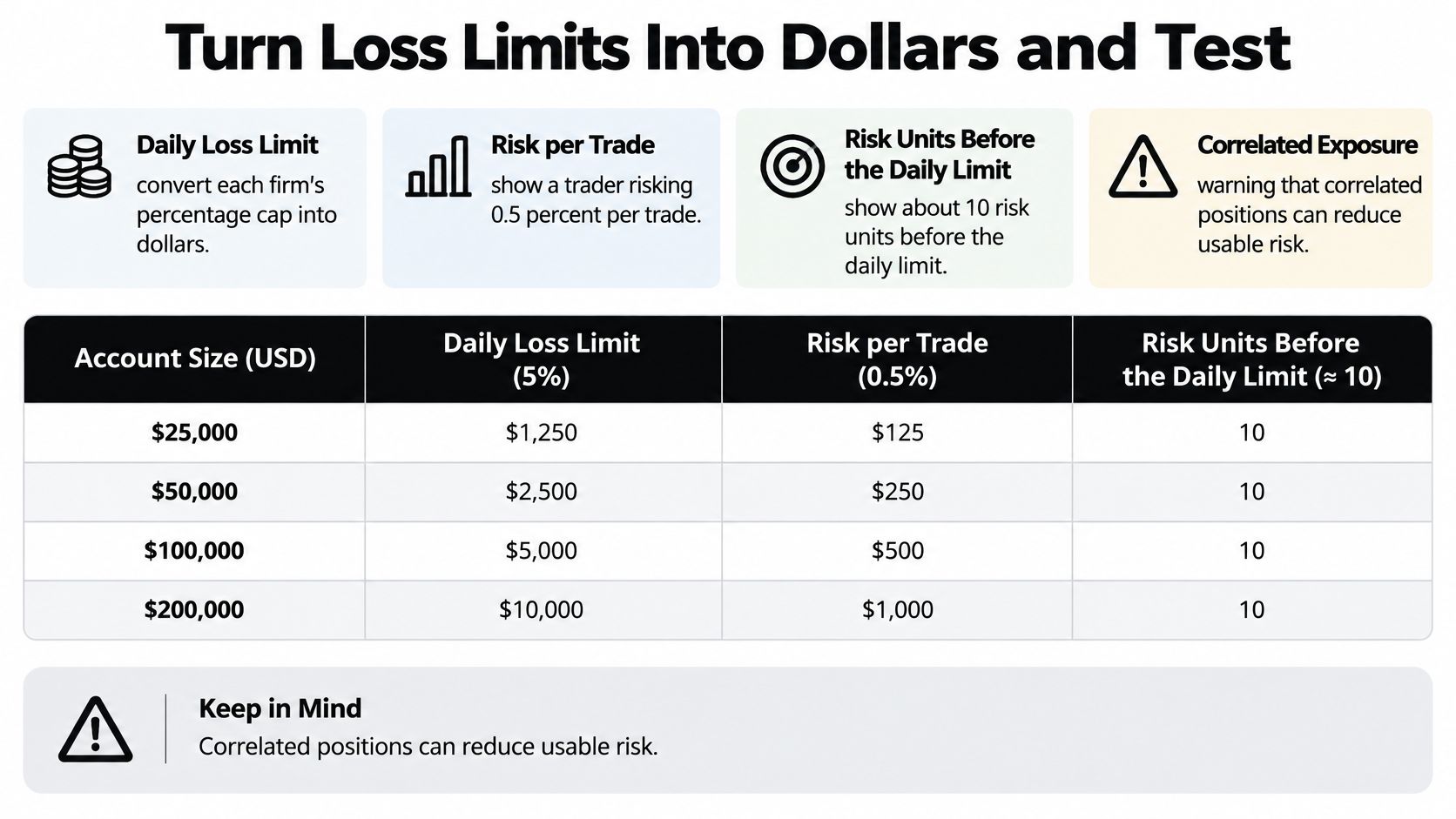
In a hypothetical strategy risking 0.5% per trade, a 5% daily cap contains about 10 risk units before costs. That isn't permission to take ten losing trades. Correlated positions, widened spreads, gaps and slippage can consume more than the planned stop-loss amount.
Consider a hypothetical $50,000 account with a $5,000 overall allowance. Three separate losing days of 1%, measured against starting size, cost $1,500, or 30% of that allowance. None reaches the $2,500 daily cap, yet the remaining cushion is materially smaller.
Understand the calculation before sizing
The SEC's margin-account bulletin explains that financed brokerage positions can produce losses beyond initial capital and lead to liquidation or demands for additional funds. Don't confuse that brokerage arrangement with a simulated program's contractual breach process. Establish whether a breach closes positions, terminates access or triggers a review.
A static drawdown holds the reference floor fixed under its stated formula. A trailing drawdown raises the floor as the relevant balance or equity reaches a new high. If unrealized gains can raise that floor, a profitable open position may leave less room for a retracement than your closed-trade history suggests.
Review the at-risk limitation rules alongside the selected account's terms. Write down the reset clock and calculation basis before placing an order.
Run a replay with explicit rejection criteria
The SEC's day-trading guidance warns that day trading is highly risky and that borrowed money can increase losses. Use a replay to reject incompatible programs, not to manufacture confidence from a favorable sample.
Replay at least 20 trades. Use historical or demo orders with spread, commission, adverse slippage, swaps and overlapping positions included. Treat this as an initial screening sample, not statistical proof. Pass only if the sample survives both loss caps after costs.
Reconstruct intratrade equity. Record equity versus balance measurement, floating-loss treatment, reset time and the static or trailing formula. Closed-trade results alone can conceal a breach. Fail if the calculation is ambiguous or intratrade equity crosses the floor.
Flag restricted holding periods. Mark news-window entries, release-time exits and weekend positions. Price any required add-on or remove those setups and rerun the strategy. Pass only if the permitted version remains workable.
Match methods to clauses. Check expert advisors, trade copiers, account copying and prohibited strategies against your actual order behavior. Fail if the method needs an exception that isn't documented.
Simulate payout eligibility. List minimum days, consistency caps, profit thresholds, fees and review time. Pass only when the replay produces withdrawable profit, not merely positive profit.
Compare fees after survival. Record entry, reset and upgrade costs separately. Fail if repeated attempts would exceed the amount you can comfortably lose.
Keep the risk ceiling conservative. For this screening method, reject a program if reaching its target within the deadline requires more than 0.5% risk per trade. This is a chosen risk filter, not a universal trading rule. Pass only without increasing risk to rescue the target.
Sizing rule: Treat the smaller of the remaining daily allowance and remaining overall allowance as the hard ceiling, then keep planned exposure below it with room for execution costs.
Keep performance measurement separate from eligibility testing. Fintrack's guide to measure investment growth in 2026 can help organize return calculations, but an attractive return doesn't establish that an account stayed inside its rules.
Profit Splits and How Fast You Get Paid
A profit split is a share of eligible generated profit, not a salary. Start the comparison with a hypothetical profit that has already cleared every trading and withdrawal condition.
Split payout on a hypothetical $2,000 profit
| Split | Payout on $2,000 |
|---|---|
| 80% base | $1,600 |
| 90% or 95% upgrade | $1,800 |
| 100% upgrade | $2,000 |
This is arithmetic, not a forecast. MFC's base split and upgrade options determine the share, but they don't establish whether a trader will generate qualifying profit. An evaluation can end without any payout.
Use the profit-sharing examples to distinguish the amount earned under a split from the requirements for requesting it. An upgrade should be assessed as an expense against eligible payouts, not against an imagined best month.
Separate eligibility from processing
MyFundedCapital states that eligible payouts are available every 7 to 14 days or on demand, through bank or crypto, with average processing of 1:46h. A faster-payout add-on is available. Confirm which schedule applies to the selected account rather than combining every advertised option into one assumed entitlement.
A withdrawal window, review period and payment settlement are different stages. Ask when the processing clock starts, whether verification must already be complete and what happens when the receiving bank or crypto network delays delivery.
For another firm, obtain written answers to these questions:
- Minimum activity Which trading days count toward eligibility?
- Consistency Can an unusually strong day delay a request?
- Profit threshold Must you retain a buffer after withdrawing?
- Deductions Are upgrade, conversion or payout fees charged?
- Breach treatment Can a violation void the entire cycle?
Compare realizable proceeds
A higher split can produce less usable income if the rules exclude the trades that generate your edge. A restrictive trailing floor, incompatible news policy or unclear review process can matter more than the advertised share.
A larger percentage of profit you can't withdraw has no cash value to you.
Write one comparison line:
Replay-qualified profit × applicable split − upgrade fees − payout fees.
Only include months in which the replay stayed within both loss caps and met payout conditions. Keep challenge and reset costs visible in a separate total-cost calculation.
Don't call that figure expected income without a defensible model of future performance. It's a comparison scenario, useful for exposing an upgrade that costs more than the additional share it would have produced.
Platforms News Rules and Failed Fills
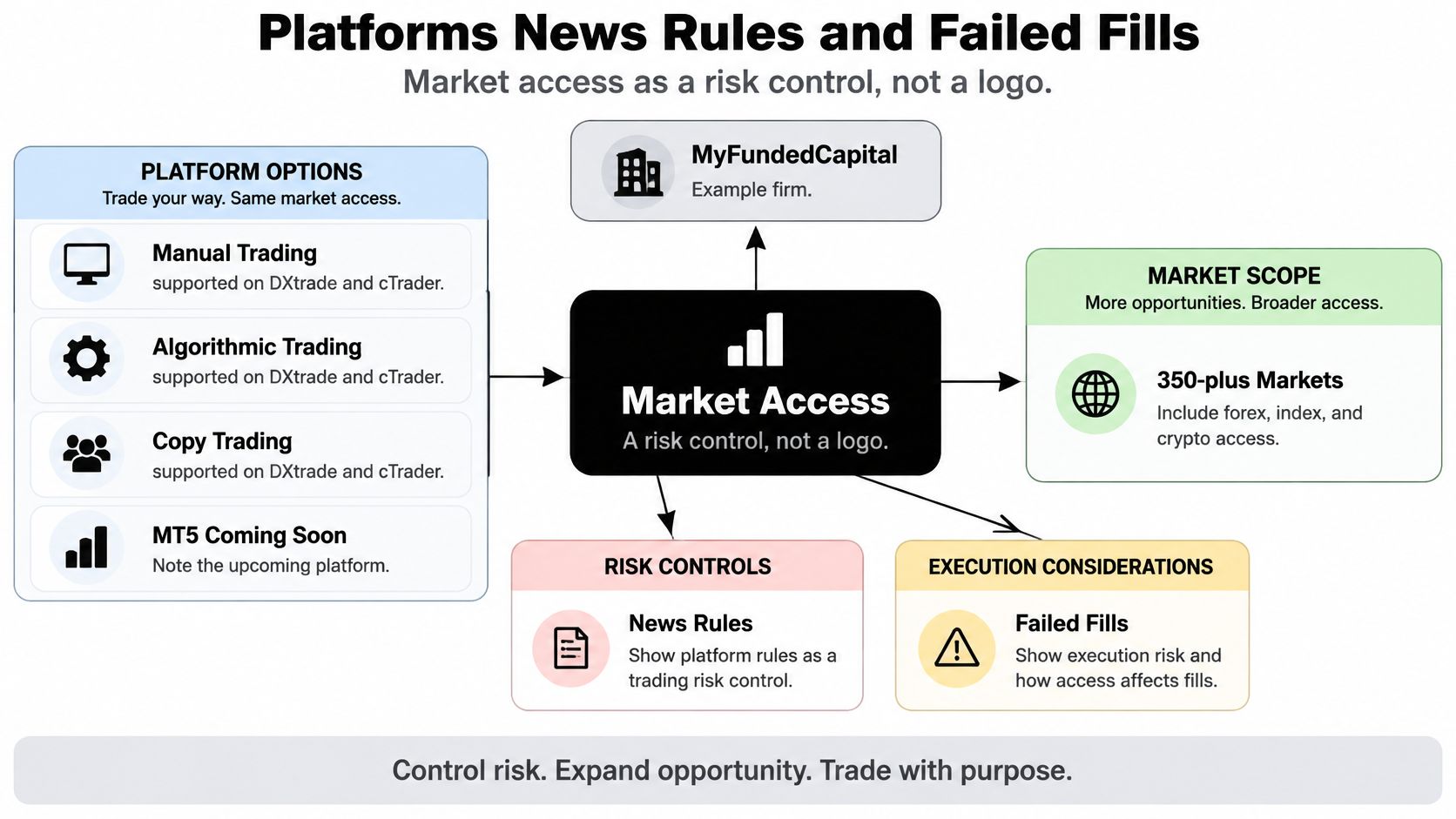
MyFundedCapital accounts trade in the MyFundedCapital Terminal across 750+ forex, index, crypto and commodity markets (plus 1,500+ US stocks in the Stocks program) (plus 1,500+ US stocks in the Stocks program); EAs need an agreement with support, and copy trading is allowed between your own accounts and from other traders or signal services, as long as every trade follows the trading rules. MetaTrader isn’t offered there, so don’t choose an account on the assumption that your MT5 setup will carry over.
Platform compatibility isn't enough. A familiar interface still fails your comparison if the provider prohibits your expert advisor, copying arrangement or execution method.
Compare execution rather than logos
The BIS paper on foreign-exchange liquidity describes liquidity in practical terms: executing the intended transaction quickly, at reasonable cost and without materially affecting the prevailing price. For a simulated account, inspect the provider's execution model rather than assuming orders access that liquidity directly.
Compare the quoted spread with your realized round-trip cost. Include entry and exit execution, commission and adverse slippage without double-counting costs already reflected in the fills.
A scalper with a small average target needs especially careful testing. Use the slippage explanation to understand why a stop order's trigger price and execution price may differ, then record that difference in the demo journal.
- Normal sessions Log spreads and fill behavior during the hours you trade.
- Fast conditions Check stop execution, rejected orders and partial fills where applicable.
- Position size Test the intended order size, not only the smallest available trade.
Permission doesn't guarantee execution
News trading and weekend holding are optional add-ons, not default permission. Holding through a release can still produce adverse execution and an equity-based breach.
Before a high-impact announcement, record its time in the platform's server timezone, reduce exposure and define the spread at which you won't enter. Set a slippage allowance for sizing, while recognizing that you can't guarantee the eventual fill will stay within it.
Crypto's continuous trading schedule doesn't override contractual weekend restrictions. If the strategy holds through weekends, confirm the required add-on and model thin-liquidity price moves.
Ask the provider how technical failures are handled:
- Specifications Obtain server time, contract size, trading sessions and symbol details.
- Incidents Identify the emergency contact and incident-notification channel.
- Disputes Request the order-rejection policy and evidence needed for review.
- Affected trades Confirm whether challenge results or breaches can be reassessed.
If the provider can't explain that process, you can't price the operational risk. Platform choice is a risk-control decision, not an interface preference.
Which Trader Each Funding Path Fits
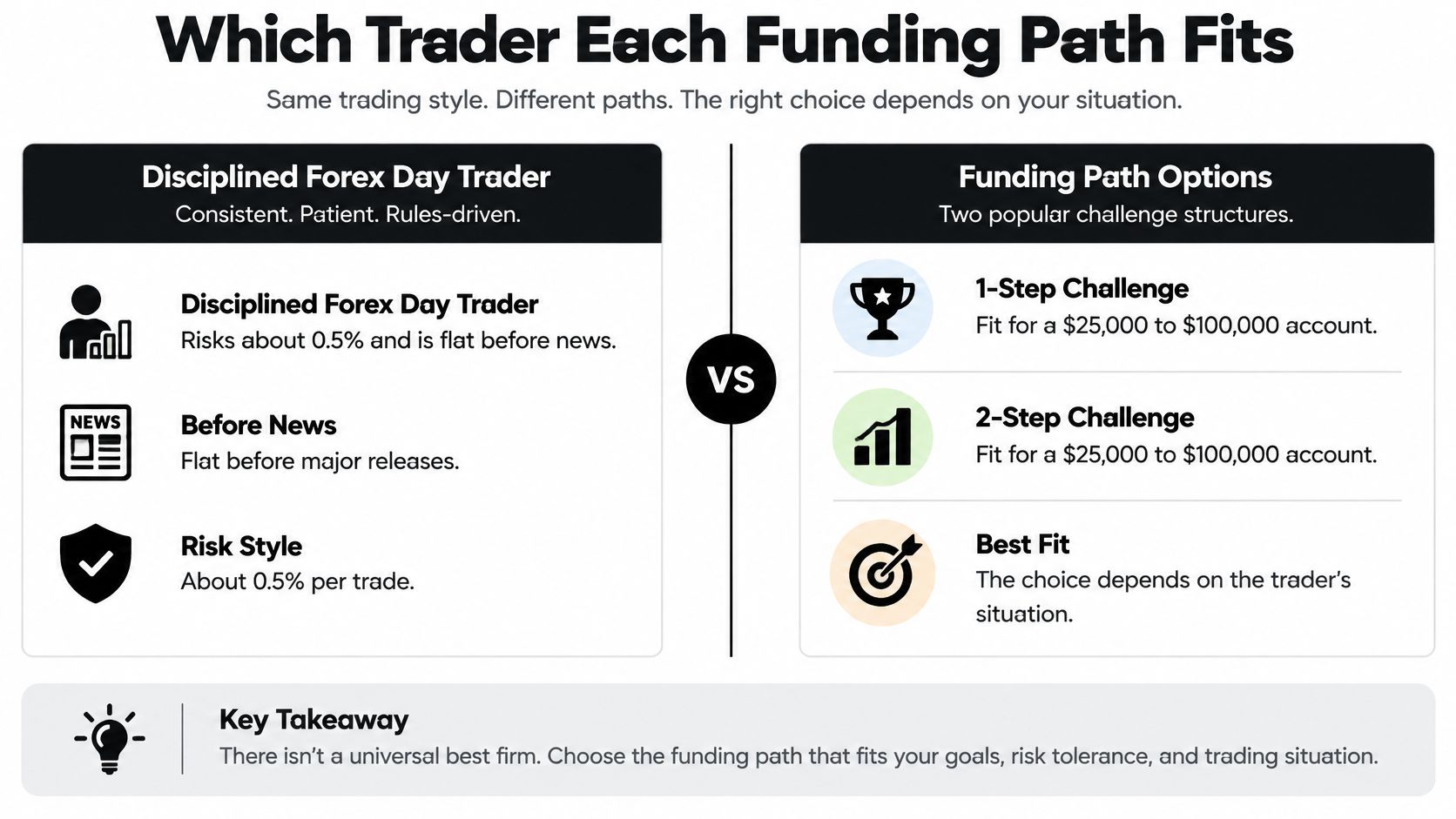
Choose a route by the behavior in your trading journal, not by the badge attached to the account. These are situational screening choices, not predictions of passing or profitability.
Day traders and aspiring traders
A disciplined forex day trader can compare a 1-Step or 2-Step Challenge in the $25,000 to $100,000 range as a hypothetical sizing exercise. At roughly 0.5% planned risk, the daily allowance offers about 10 nominal risk units, before execution costs and correlated exposure. A regular payout window may suit the trader's review routine, but it mustn't become a deadline to force trades. Disqualifier: the replay requires holding through prohibited news or increasing risk to meet the target.
An aspiring trader can use the $5,000 to $10,000 2-Step path as a smaller-scale way to practice the process before considering a larger evaluation. More evaluation stages don't make a strategy safer, but they can provide a deliberate checkpoint for understanding resets, floating losses and position sizing. Disqualifier: the trader can't explain the account's loss calculation or can't afford to lose the entry fee.
Established methods and specialist strategies
A profitable self-funded trader with documented results can consider Instant Funding for immediate live-style simulated access. The relevant evidence is a repeatable playbook, including losing periods, rather than confidence after a strong run. Skipping evaluation doesn't excuse weak execution discipline. Disqualifier: the trader has no credible record or changes the method once nominal account size increases.
Algorithmic, EA and copy traders need explicit permission for the exact arrangement they intend to use. Run the strategy on the selected firm’s platform and inspect symbol mapping, order rejection, duplicated exposure and copier behavior. Disqualifier: the method relies on prohibited execution behavior, unsupported automation or unclear copying permissions.
Crypto and swing traders need holding permissions that match their exit logic. Include weekend holding and news-trading add-ons where necessary, then test whether financing and adverse execution alter the strategy's viability. Disqualifier: staying compliant requires closing positions before the method's normal exit.
- Martingale and grid users Don't force a fit where increasing exposure conflicts with risk or prohibited-strategy clauses.
- Concentrated-profit traders Reject a consistency requirement that your legitimate return pattern can't satisfy.
- Scaling candidates Treat additional allocation as conditional, not as a reason to increase risk now.
The best path is the one your last 20 trades would have survived, not the one with the largest badge.
Scaling paths toward $500,000 are a later possibility, not a timetable or entitlement. Keep the same discipline when assessing additional allocation rather than treating it as permission to recover losses faster.
Common Questions After You Compare Firms
Are funded accounts the firm's live cash in your name?
No. At MyFundedCapital, evaluations and funded accounts run in demo environments with real market quotes, not a personal brokerage account containing withdrawable principal. Breaching the applicable daily or overall loss rule can still end access.
Does a full profit split beat the base split?
Only when the strategy reaches an eligible payout and the upgrade's additional proceeds exceed its cost. A larger share doesn't compensate for a drawdown formula, news restriction or consistency condition that prevents withdrawal.
Can you use EAs or copy trading?
MFC allows manual trading, EAs by agreement with support, and copy trading between your own accounts and from other traders or signal services, within the trading rules; confirm that the specific strategy isn’t prohibited. Test fills and symbol specifications in the MyFundedCapital Terminal demo before committing.
How fast are payouts?
The stated options are every 7 to 14 days or on demand, via bank or crypto, with average processing of 1:46h, subject to written conditions. Eligibility, review and receipt aren't the same event, so don't budget around a guaranteed arrival time.
Retail trading has a documented history of substantial losses. Clear rules reduce avoidable surprises, but they don't guarantee a pass, profit or payment.
Choose a Funding Path and Start Carefully
If your 20-trade screening replay survived the selected account's loss limits, choose the route it supports. Instant Funding provides immediate live-style simulated access; the 1-Step and 2-Step routes require evaluation. If the replay failed, adjust the method or reject the program rather than buying a larger account.
Make the purchase match the evidence
- Choose the smallest suitable size Match the dollar risk budget to the tested method.
- Buy only necessary add-ons Include weekend, news or faster-payout options only when the trading plan justifies them.
- Save the written terms Keep the applicable rules and selected options with your trading journal.
These remain demo accounts with real quotes. Profit shares apply to generated profits that meet the rules, and payout schedules aren't guaranteed income. Past demo results don't predict funded results, and trading involves risk of loss.
Compare account types before purchasing, read the rule page once more and start only the challenge or instant account your test supported. Nothing here is financial advice.
MyFundedCapital offers Instant Funding, 1-Step and 2-Step paths for traders comparing simulated funding against their own risk limits. Visit MyFundedCapital to compare account types, check the applicable rules and choose the smallest path your replay supports.
