You've just made a profitable week, but the amount reaching your account isn't the same as your gross trading result. The profit split, fees, payout schedule, funded balance, and daily-loss or maximum-drawdown rules can change the outcome more than the headline percentage suggests. These seven profit sharing examples use worked calculations to compare funding paths, behavioral risks, payout timing, and account growth. Trading involves risk of loss, so treat the scenarios as educational rather than financial advice. For the accounting distinction between operating profit and financial position, see this guide to P&L and balance sheets.
Free resources: the free Payout Date Calculator.
1. 80/20 Profit Split as the Standard Entry-Level Arrangement
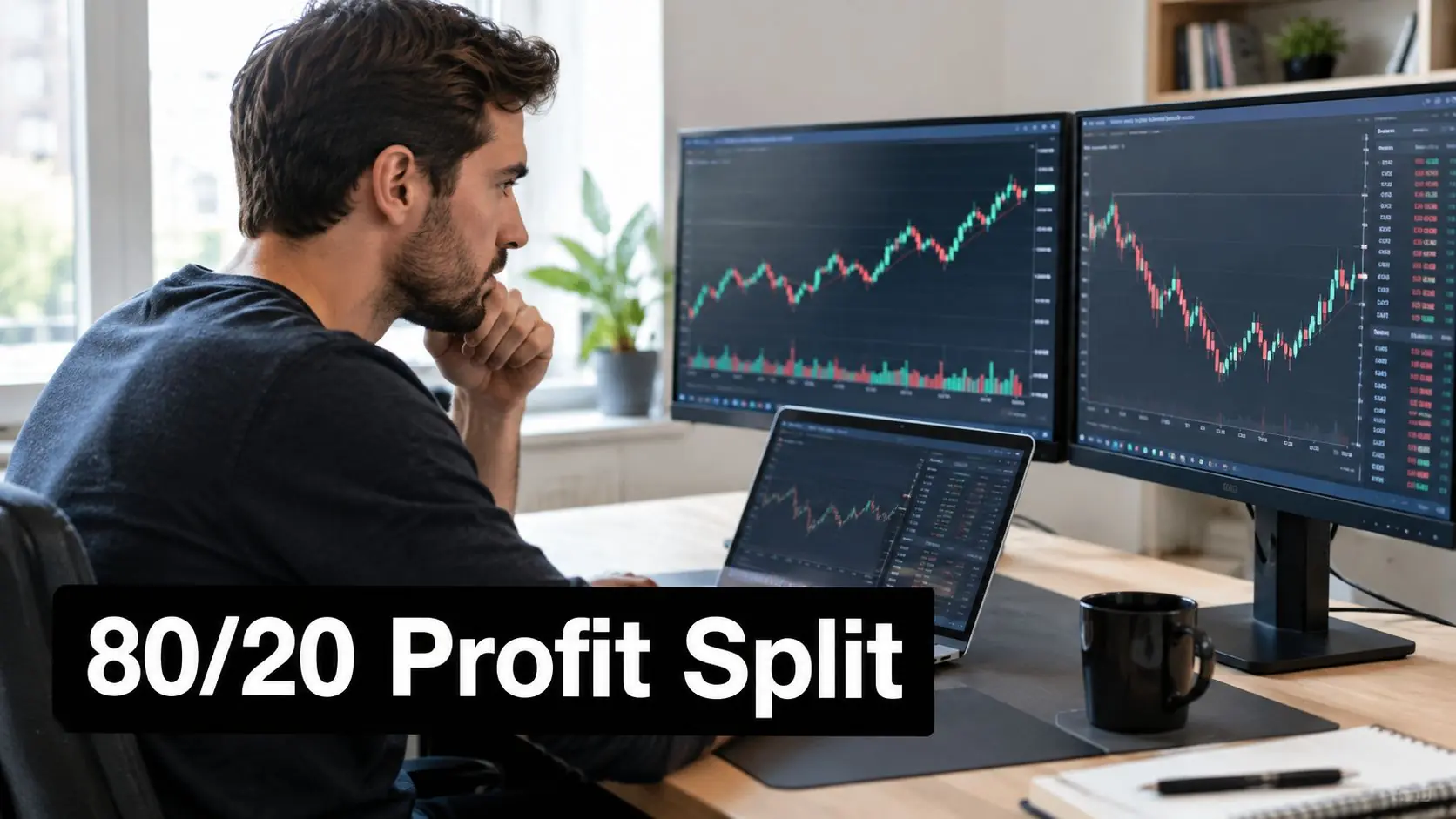
An 80/20 profit split means the trader keeps 80% of the eligible profit and the firm retains 20%. It's a straightforward starting point because the calculation is easy to audit, but the split alone doesn't tell you whether the account suits your strategy. Platform costs, spreads, commissions, payout rules, and loss limits still determine whether a grossly profitable trading approach produces a usable withdrawal.
Suppose a day trader generates $1,000 in weekly profit. The trader's share is:
- Gross profit: $1,000
- Trader allocation: $1,000 × 80% = $800
- Firm allocation: $1,000 × 20% = $200
That calculation excludes any trading costs or account fees. If a trader needs $2,000 per month before personal expenses, the required gross profit under this split is $2,500, because $2,500 × 80% = $2,000. The correct workflow is to calculate the withdrawal target first, then work backward to the required trading result.
Who should use this model
MyFundedCapital's standard structure is presented in the supplied product information as starting at 80/20, with funded account sizes ranging from $5K to $100K and scaling paths that can reach $500K. A smaller account can help a newer trader test execution, platform behavior, and emotional discipline before seeking a higher tier. The firm's stated risk parameters include a flat 5% daily loss limit and up to 10% maximum drawdown, so a trader must judge the strategy against those rules, not just against the profit target.
Use this arrangement as a proving ground. Track your actual return, slippage, commissions, average holding time, and drawdown. A trader who focuses only on the 80% headline may increase position size to compensate for the firm's share, which can bring the account closer to its loss limits.
Practical rule: A higher split improves a profitable strategy. It doesn't repair an unstable one.
2. 90/10 Profit Split for High-Performing Traders
The 90/10 model changes the payout, not the market risk. If a trader produces $500 in weekly profit, the personal share rises from $400 under 80/20 to $450 under 90/10. The difference is $50 per week, before fees and taxes. That makes the upgrade useful only after the trader has demonstrated repeatable profitability.
For an algorithmic trader generating a 2% monthly return on a $50K account, the gross result is $1,000. Under 80/20, the trader receives $800. Under 90/10, the trader receives $900. The extra $100 comes from the split difference, not from greater market performance.
A higher split can also change behavior. Traders may feel pressure to qualify quickly, trade more frequently, or increase their position size during a quiet month. That's a poor trade if the attempt to reach a higher tier causes a drawdown breach.
How to evaluate an upgrade
Keep a performance file containing trade records, daily results, realized and unrealized P&L, fees, and rule compliance. MyFundedCapital's product information describes profit splits that can progress from 80/20 to 90/10 or 95/5 with an add-on. The exact eligibility conditions should be confirmed before opening an account because a promotional upgrade and a contractual entitlement aren't the same thing.
A trader averaging 90% of gross profit instead of 80% receives more from every profitable period, but the account still needs enough room for normal losing trades. Ask these questions before prioritizing the upgrade:
- Eligibility Is the upgrade based on time, profit, consistency, or a discretionary review?
- Payout basis Is the split calculated before or after commissions, spreads, and other charges?
- Timing Does the new split apply immediately, or only from the next payout window?
- Reversal risk Can the split fall if performance slows?
The 90/10 tier should reward discipline already present. It shouldn't become a reason to abandon it.
3. 100% Profit Split for Elite Traders
A 100% profit split appears simple because the trader keeps the entire eligible profit. The difficult question is what the trader must do to reach and retain that arrangement. If a trader on a $100K account produces a 3% monthly return, the gross calculation is $100,000 × 3% = $3,000. At a 100% split, the trader's allocation is $3,000, before trading costs and any applicable fees.
That result is attractive, but it doesn't mean the trader controls or owns $100K of personal capital. The account remains subject to the firm's risk rules, payout conditions, and permitted trading methods. A strategy that produces gains but regularly approaches the daily-loss limit may be unsuitable even when the nominal profit share is generous.
Build evidence before asking for the top tier
A thorough evaluation should cover different market conditions, including trends, ranges, volatility changes, and quiet sessions. Keep records that show not only winning returns but also how the strategy handles losses, news events, overnight exposure, weekend holding, and slippage. This matters particularly for crypto swing traders and automated systems, where a profitable backtest may not reflect live execution conditions.
A staged approach is more defensible than immediately demanding the maximum share:
- Start with a proven tier Establish a clean record under an 80/20 or 90/10 arrangement.
- Request defined terms Ask whether 100% applies to all profits, selected account types, or an add-on.
- Test the rule set Confirm whether commissions, spreads, platform costs, and withdrawal charges remain payable.
- Protect the process Don't increase risk because more of the upside is yours.
The firm's supplied information says that profit splits may reach 95% with an add-on. Confirm the applicable terms in writing. A nominal 100% share can be less useful than a lower split with clearer payout rules and a strategy-compatible drawdown limit.

4. Instant Funding With Tiered Splits
Instant Funding removes the evaluation stage, but it doesn't remove the need to prove that your strategy can operate inside the account rules. A trader moving from a retail broker might choose a $10K Instant Funding account, produce a 2% return in the first week, and then seek a higher split after demonstrating controlled execution. The gross result would be $200, and an 80/20 allocation would leave the trader with $160, before fees.
Consider a second scenario. A trader makes $300 over three weeks on a $5K account. Under 80/20, the trader's share is $240. If the stated first payout window is 10 days, the trader must still verify whether that clock begins at the first trade, the payout request, or another defined event. Payout timing is a contract detail, not an assumption based on the word “instant.”
For traders comparing platforms, the Instant Funding program should be assessed through its account rules, permitted instruments, platform, payout process, and fee schedule. MyFundedCapital's supplied product information says it supports manual, algorithmic (by agreement with support), and copy trading across forex, crypto, and commodities, with DXtrade and cTrader listed as supported platforms.
Use immediate access cautiously
Start with the smallest account that lets you test the strategy. Review spreads, commissions, execution, news restrictions, weekend rules, and maximum drawdown before placing normal-size trades. A scalper may care more about transaction costs and execution quality than about a later split upgrade, while a swing trader may care more about holding permissions and payout timing.
Keep a daily record for the first month:
- Execution Log entry, exit, spread, slippage, and commission.
- Risk Record the largest intraday loss and distance from the daily limit.
- Payouts Note eligibility date, request date, approval, and receipt.
- Behavior Flag revenge trades, oversized positions, and rule-driven exits.
Immediate access is useful when speed matters. It's dangerous when speed replaces verification.
5. Challenge-Based Profit Splits With One-Step and Two-Step Routes
A challenge-based account exchanges immediate access for an evaluation process. The trader pays the challenge fee, follows the stated rules, and earns access to a funded arrangement only after meeting the evaluation conditions. That fee is a real cost even if the challenge fails, so the expected payout should never be calculated without including it.
In one supplied scenario, a trader enters Phase 1 of a MyFundedCapital 2-Step Challenge on a $10K account, targets an 8% profit, and must remain within a 10% maximum drawdown. Passing at 9% profit would mean a gross evaluation result of $900, calculated as $10,000 × 9%. The trader then receives access to a $50K funded account at an 80/20 split, subject to the applicable terms.
A separate two-step path uses 5% profit in Phase 1 on a $25K account, followed by 3% in Phase 2 on a $50K account, before access to a $100K account. These figures describe the supplied example, not a universal industry standard. Always verify the current rules for the specific account.
Match the route to your evidence
A one-step route can reduce evaluation stages, but it may require a concentrated performance period. A two-step route gives the trader another phase to demonstrate consistency, while also introducing another opportunity to breach a rule. Neither is automatically safer.
Before paying, check:
- Practice record Rehearse the strategy on demo for 2–3 weeks, as suggested in the scenario, before purchasing.
- Time pressure Set a personal 50-day deadline while leaving room for setbacks, rather than forcing trades near the end of an evaluation.
- Drawdown method Confirm whether losses are measured by equity, balance, intraday high-water mark, or another method.
- Payout terms Ask when the first withdrawal becomes available after the first funded trade.
The guide to what a step challenge is can help clarify the general structure. For event-based market contracts, a separate Polymarket profit calculator guide illustrates why gross return and net outcome should be separated. The same principle applies here: subtract every relevant cost before deciding whether a challenge is worthwhile.
6. Performance-Tiered Splits Based on Returns
A performance-tiered model changes the split according to the trader's return during a defined period. It can reward consistency, but it also creates a temptation to chase a threshold. The difference between a careful month and a forced month may be more important than the extra percentage retained.
Use the supplied hypothetical model on a $50K account. Trader A earns 2.5% monthly, producing $1,250 in gross profit, because $50,000 × 2.5% = $1,250. At an 85/15 tier, the trader receives $1,062.50. Trader B earns 0.8%, producing $400, and at an 80/20 tier receives $320. The difference in personal allocation is $742.50, even though the gross profit difference is $850.
The split explains only part of the difference. Trader A also produced the larger return. A trader shouldn't conclude that reaching the next tier is the main objective.
Model the threshold before trading it
An algorithmic trader with a $100K account might face tiers of 80/20 from 0% to 1.5%, 85/15 from 1.5% to 3%, and 90/10 above 3%. At a 2.8% monthly return, gross profit is $2,800, and the 85/15 allocation is $2,380. The calculation assumes the entire period's profit receives the applicable tier, but some contracts may apply marginal tiers instead. That distinction must be confirmed.
Don't increase leverage to cross a split threshold. A missed upgrade is cheaper than a drawdown breach caused by threshold chasing.
Ask the provider to explain whether:
- The tier is retroactive Does the higher split apply to all period profit or only profit above the threshold?
- The measurement period is fixed Is the calculation monthly, quarterly, or tied to each payout?
- Losses carry forward Can a losing period reduce the next period's tier?
- Fees are deducted first Is the percentage applied to gross or net eligible profit?
Track weekly progress, but make decisions from the strategy's risk limits. A tier should be an outcome of repeatable execution, not a target that dictates trade selection.
7. Scaling Account Splits Through Capital Progression
Scaling combines two variables, account size and profit split. A trader may begin with $10K at 80/20, progress to $25K at 80/20, then move to $50K at 90/10 and $100K at 90/10. The larger balance can increase the dollar value of the same return, but it also increases the emotional and operational consequences of a mistake.
Assume a trader earns a consistent 2% monthly return. On a $10K account, gross profit is $200, and an 80/20 split leaves $160. On a $50K account at 90/10, gross profit is $1,000, and the trader receives $900. The personal allocation is higher because both account size and split changed. This isn't evidence that scaling will produce the same return, since liquidity, execution, confidence, and strategy capacity can all change.
The supplied scaling path also mentions potential progression through $250K and $500K tiers. Those are account-size examples, not guaranteed allocations. The trader must confirm eligibility, risk limits, permitted strategies, and whether several accounts can be operated simultaneously.
Build a scaling map with failure points
Create a written roadmap covering each intended account tier, the return assumption, payout plan, and maximum acceptable loss. Include a fallback rule for a losing month. Without one, traders often treat scaling as a one-way staircase and respond to setbacks by increasing risk.
A practical progression plan includes:
- Stable base Keep one account running a strategy you've already validated instead of moving every account at once.
- Separate experiments Test new algorithms or instruments on a clearly defined account rather than risking the core process.
- Profit allocation Decide in advance how much goes to living costs, reserves, fees, and future account access.
- Quarterly review Compare realized returns, drawdown, payout reliability, and rule compliance before requesting growth.
- Capacity check Confirm that the strategy can handle the larger account without excessive concentration or execution slippage.
The prop firm scaling plan is relevant for traders evaluating this progression. Account growth doesn't automatically widen the daily-loss or maximum-drawdown limits. It may increase the dollar value of the same percentage rule.
7-Point Profit-Sharing Comparison
| Model | Implementation Complexity 🔄 | Resource Requirements ⚡ | Expected Outcomes ⭐📊 | Ideal Use Cases 💡 | Key Advantages ⭐ |
|---|---|---|---|---|---|
| 80/20 Profit Split: The Standard Entry-Level Arrangement | 🔄 Low, standard onboarding, immediate activation | ⚡ Low, small accounts ($5K–$25K); firm covers tech/regulatory costs | 📊 Moderate earnings; predictable payouts (trader keeps 80% of net profits) | 💡 New traders proving skill or building capital | ⭐ Accessible baseline; transparent calculations; low trader overhead |
| 90/10 Profit Split: The High-Performer Tier | 🔄 Moderate, requires upgrade process and performance verification | ⚡ Medium, larger accounts ($25K–$100K); consistent track record needed | 📊 Higher recurring earnings (90% retention); better compounding potential | 💡 Intermediate/advanced traders scaling capital after proving consistency | ⭐ Significantly higher personal retention; gateway to 100% |
| 100% Profit Split: Maximum Earnings for Elite Traders | 🔄 High, strict qualification (months of proven performance) | ⚡ High, largest accounts ($100K+) and sustained profit history required | 📊 Maximum earnings (all net profits to trader); elite long-term upside | 💡 Elite traders with long, consistent track records and low drawdowns | ⭐ Full alignment and maximum wealth accumulation potential |
| Instant Funding with Tiered Splits: Immediate Access Without Challenges | 🔄 Low–Moderate, fast activation; automated upgrade rules | ⚡ Low initial capital ($5K–$25K); weekly/on-demand payouts; faster processing | 📊 Quick access to live trading; smaller initial payouts but rapid upgrade path | 💡 Experienced traders wanting immediate funded access or cash flow | ⭐ Fast time-to-market; lower psychological barrier; frequent payouts |
| Challenge-Based Profit Splits (1‑Step and 2‑Step): Earn‑In Models | 🔄 Moderate, structured 1‑ or 2‑phase evaluation over weeks | ⚡ Low fee ($49–$299) but high time cost (4–12 weeks); defined pass criteria | 📊 Access to larger funded accounts after pass; delayed initial payout | 💡 Traders who prefer clear targets and staged progression | ⭐ Clear rules, low capital risk (only fee), scalable funding on pass |
| Performance‑Tiered Splits: Dynamic Profit Sharing Based on Returns | 🔄 High, periodic recalculation and tier management | ⚡ Medium, requires regular performance tracking and admin reconciliation | 📊 Variable earnings tied to monthly/quarterly returns; rewards consistency | 💡 Consistent performers aiming to maximize rewards without a one‑time upgrade | ⭐ Fair, incentive-aligned model that motivates sustained outperformance |
| Scaling Account Splits with Capital Progression: Earning More Through Account Growth | 🔄 High, multi-tier progression with qualifying gates per tier | ⚡ High, prolonged time, multiple qualification rounds, and capital reinvestment | 📊 Exponential earnings potential over months as account size and splits improve | 💡 Long-term traders focused on compounding capital and gradual scaling | ⭐ Structured growth path; risk-managed scaling; compounding & retention benefits |
Turn the Numbers Into a Safer Funding Decision
The best profit sharing examples don't end with the highest percentage. They show how the split interacts with gross return, fees, payout timing, account size, and loss rules. An 80/20 account with reliable withdrawals may be more practical than a 100% arrangement with restrictive conditions. A larger account may produce a larger nominal payout, but it can also encourage larger positions and faster rule violations.
Use this checklist before choosing a funding path:
- Calculate net profit Start with gross P&L, apply the stated split, then subtract commissions, spreads, platform charges, challenge fees, and withdrawal costs where applicable.
- Confirm loss rules Read the daily-loss and maximum-drawdown definitions, including whether they use balance, equity, or a high-water mark.
- Verify payout timing Confirm the first eligible payout, recurring schedule, minimum withdrawal conditions, and processing method.
- Test account fit Check whether the account size, instruments, trading hours, news rules, weekend permissions, and execution environment suit the strategy.
- Avoid tier chasing Don't increase your position size or trade frequency just to reach a higher split or larger account.
- Record behavior Review losing trades, rule proximity, emotional decisions, and execution costs, not just the final percentage return.
Frequently asked questions
Do profit splits apply before or after fees?
You need to confirm this in the account agreement. The examples above apply the split to the stated gross profit, then identify fees as a separate cost. A provider may define eligible profit differently, so ask whether commissions, spreads, platform costs, challenge fees, or withdrawal charges are deducted before the split is calculated.
How does 80/20 compare with 90/10?
At $1,000 gross profit, 80/20 gives the trader $800, while 90/10 gives $900. The additional $100 only exists when the trader is profitable, and it doesn't change the account's drawdown rules or the risk of loss.
When may payouts become available?
Payout timing depends on the account type and agreement. MyFundedCapital's supplied product information describes payouts every 7 or 14 days, depending on the program, with faster cycles available as add-ons. Confirm the exact first-payout rule and eligibility conditions before relying on a withdrawal for personal expenses.
Does scaling change loss limits?
Not necessarily. A larger account can retain the same percentage-based daily-loss and maximum-drawdown rules, meaning the dollar allowance changes while the risk framework remains. Read the new account's terms instead of assuming that growth provides extra flexibility.
Trading involves risk of loss. These calculations are educational only and aren't financial advice. Before committing money, compare the full rule set, total fees, execution conditions, payout process, and whether the strategy can operate without forcing trades.
MyFundedCapital offers Instant Funding as well as 1-Step and 2-Step Challenge routes, with profit-sharing structures that can progress through account growth or eligible add-ons. Visit MyFundedCapital to learn about the funding programs, compare account types, and decide whether starting a challenge fits your risk plan.