Between 74% and 89% of retail CFD accounts lost money in ESMA's analyses, a warning about margin-based trading, not a prop-challenge failure rate (ESMA's retail CFD findings). A funded account prop firm doesn't remove that difficulty, it packages access around written rules. Learn to evaluate those rules, translate drawdown into trade-level risk, and check whether the payout agreement is worth the fee.
What a Funded Account Prop Firm Actually Sells
A funded-account firm sells access governed by its written rules, not a withdrawable balance. The firm may provide a simulated allocation rather than place live capital in an account you control. Your potential payout depends on the agreement, your results, and continued compliance.
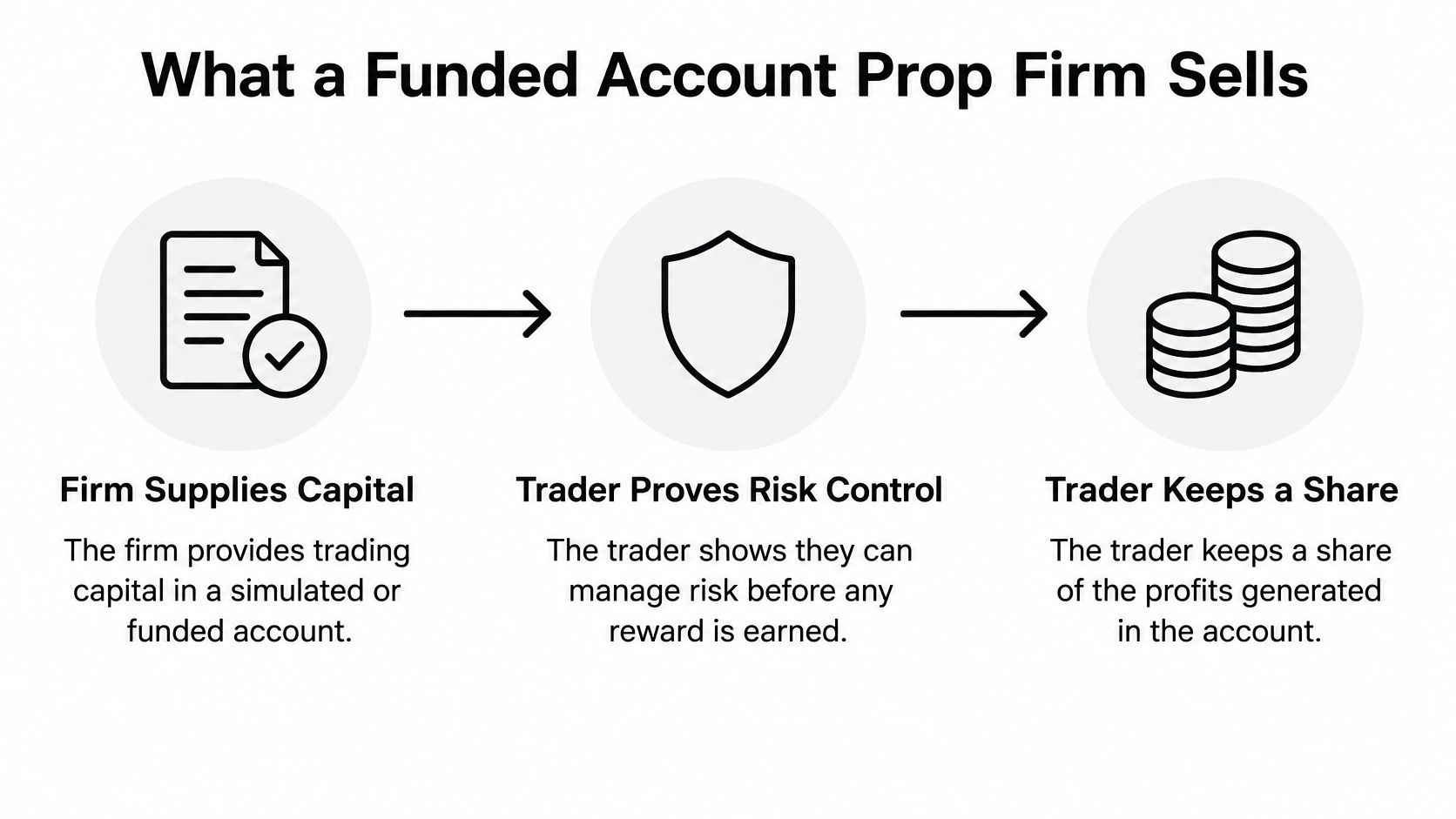
Follow the money through the process
MyFundedCapital describes its simulated-account model, starting split and payout schedule on its funding-program website. The steps show what you pay for and what the firm promises in return:
- Buy an evaluation or Instant Funding access. Your payment is the first real transfer of money. Treat the fee as money at risk, not a refundable deposit unless the terms explicitly say otherwise.
- Trade in a demo environment using real market quotes. Real quotes alone do not establish that your orders reach an independent market. Check what the firm says about execution.
- Meet the challenge target while respecting the rules. This applies to evaluation paths. A target does not cancel a drawdown breach.
- Receive funded-account access. In this model, the funded stage also uses simulated capital. Read its agreement separately; do not assume evaluation terms carry over unchanged.
- Keep an eligible share of generated profits. The stated starting split is 80/20, subject to the applicable program agreement.
- Request an eligible payout. The stated options are every 7–14 days or on demand, depending on the account and conditions.
A profitable dashboard is not proof that every displayed dollar is payable. Confirm the conditions for eligible profits and withdrawals in the agreement before paying.
The rules are the product
Judge the contract before the headline balance. A large allocation means little if your normal strategy breaches its loss boundaries or depends on prohibited execution methods. For example, a 5% daily loss limit can be translated into losing trades: with a 1% risk per trade, five full losses reach that limit; with a 0.5% risk, ten do. Those are examples, not safe targets, since slippage, open positions and the firm's loss calculation can bring a breach sooner.
Practical rule: Choose a rule set your existing strategy can survive. If you need to change your risk habits just to qualify, the fee and risk of losing access may outweigh the advertised balance.
Simulation itself is not the main red flag. Firms may use simulated accounts, but they should disclose that clearly and explain how execution, rule enforcement and payouts work. Treat vague claims about live trading or order handling as a reason to pause, not as proof of market access.
Structured evaluations can test discipline, yet passing does not remove exposure to margin, slippage, concentrated positions or behavioral mistakes. Trading involves risk of loss, including fees for access and retries.
“Prop” means proprietary trading. Look past the label and establish what capital, execution model and payout arrangement the contract really provides.
Instant Funding and Challenge Paths Compared
A 5% daily loss limit can be reached after five losing trades that each risk 1% of the account, before fees or slippage. That is why the written rules matter more than a route's label. The publisher's Instant Funding and challenge options list these paths and parameters. Check the current terms before paying.
| Path | Account sizes | Profit target | Daily loss and drawdown | Best fit |
|---|---|---|---|---|
| Instant Funding | $5K to $100K | None, no evaluation phase | 5% daily, up to 10% maximum drawdown | Traders with a verifiable record who want to skip evaluation |
| 1-Step Challenge | $5K to $100K | Confirm the current single-phase target | 5% daily, up to 10% maximum drawdown | Traders who want one profit target and a shorter route |
| 2-Step Challenge | $5K to $100K | Confirm the separate Phase 1 and Phase 2 targets | 5% daily, up to 10% maximum drawdown | Traders who want to demonstrate consistency across two phases |
Choose by trading behavior
Instant Funding skips evaluation, not risk controls. Choose it only if your journal shows that you can follow your sizing plan and stop after losses. The risk is paying for access before confirming that your strategy fits the account's limits.
The 1-Step Challenge has one evaluation target. Fewer stages may suit traders who prefer a shorter assessment, but rushing the target by increasing position size can put a workable strategy over the daily loss limit.
The 2-Step Challenge requires performance across two phases. That gives you another assessment period, while also keeping you under evaluation conditions for longer. Check each phase's target, time requirements and trading permissions. Don't assume they match.
Translate the target into trading risk
As an illustration, a 10% target on a $50,000 account means $5,000 of profit. This is an arithmetic example, not a claim about the current target. Verify the actual target in the rules, then compare it with your trading record. If reaching it requires bigger positions or unusually favorable conditions, choose another path or don't buy yet.
A 5% daily limit also needs translating into your own trade size. At 1% risk per trade, five full losses can reach that limit; fees and slippage may bring the breach sooner. Set a personal stop below the firm's boundary. That reduces the chance of a rule breach, though it can also mean stopping before your intended daily setup is complete.
Check these points before paying:
- Daily-loss behavior Test your strategy against the limit in a journal or simulation. A paid challenge is a costly way to find out that normal losing streaks breach the rules.
- Target-driven oversizing If slow progress makes you increase risk, avoid evaluation access until you can follow fixed sizing. A profit target does not increase your loss allowance.
- Fees and resets Confirm the purchase fee, reset terms and optional charges. A low entry fee can lead to higher total costs if you keep retrying.
- Execution disclosure Simulation alone is not the main warning sign. Treat undisclosed simulation, vague execution descriptions or unclear handling of orders as red flags. Ask what environment your trades use and how the written rules apply before buying.
Choose the path that fits your existing trading behavior, and accept the trade-off: skipping evaluation costs access upfront, while challenges add assessment requirements and more opportunities to breach their rules.
Account Sizes, Profit Splits and Payout Timing
The split determines how much of a profit you keep. The linked profit-sharing examples describe a starting 80/20 split, upgrades to 90/10, and options reaching 100% for the trader. These calculations show how each split applies to example profits, not expected earnings.
| Split, trader/firm | Trader keeps from $5,000 | Firm keeps from $5,000 | Trader keeps from $20,000 |
|---|---|---|---|
| 80/20 | $4,000 | $1,000 | $16,000 |
| 90/10 | $4,500 | $500 | $18,000 |
| 100/0 | $5,000 | $0 | $20,000 |
A higher split only helps if you meet its conditions and the account remains worthwhile after any upgrade charges. Before paying for an upgrade, confirm its cost, eligibility rules, and which profits qualify. The stated scaling paths reach up to $500K, subject to program conditions. Treat that as conditional access, not an automatic increase or a promise of higher income.
Separate account size from usable loss capacity
A $100,000 starting balance with a 10% static maximum drawdown leaves a $90,000 floor. This example assumes the limit is calculated from the starting balance and does not trail upward. The account's headline size is not the amount you can afford to lose.
A trailing drawdown changes the calculation: its boundary rises with gains according to the firm's formula. Get the firm to specify whether it tracks balance or equity, when it updates, and whether it eventually stops moving.
A headline account balance tells you the nominal allocation. The drawdown formula tells you how much room you actually have.
Check the withdrawal rules against that boundary. Ask whether a payout reduces the cushion above the breach level and whether the firm requires a minimum remaining balance. A payout that leaves too little room can put the account at risk.
Check eligibility separately from processing
Bank and crypto are the stated payment methods, and payout processing is described as averaging around 24 hours in the publisher's payout information. That average is not a guaranteed arrival time. Processing time also says nothing about when you become eligible to request a payout.
Get answers in writing before you trade:
- Profit calculation Does the split apply to gross gains or net profit after commissions, swaps, and other charges? Unclear deductions can lower your payment.
- Upgrade eligibility What qualifies you for a higher split, and does it require an additional purchase? The advertised rate may be conditional.
- Withdrawal costs Are transfer, conversion, or withdrawal fees charged? The amount received may be lower than the approved payout.
- Balance requirements What minimum profit, remaining cushion, and review conditions apply? Confirm that a withdrawal will not push the account toward a breach.
Risk Rules That Decide Whether You Stay Funded
A 5% daily loss limit on a $100,000 nominal account equals $5,000. At 1% risk per trade, five full losing trades reach that boundary before additional spreads, commissions or slippage. These are illustrative calculations using the position-level risk framework associated with the NFA's forex risk-management requirements, not a guaranteed number of trades you can safely take.
Losing trades before the daily limit on a $100,000 account
| Risk per trade | Dollar risk on $100K | Losses to reach $5K limit | Budget left after three losses |
|---|---|---|---|
| 1.00% | $1,000 | 5 | $2,000 |
| 0.50% | $500 | 10 | $3,500 |
| 0.25% | $250 | 20 | $4,250 |
The table assumes fixed initial dollar risk, full stop-loss outcomes and no additional costs. It is not a safe-trade allowance. Actual fills, floating losses and the firm's breach definition can leave less room.
Size for survival, not maximum permission
My preferred starting framework is 0.25%–0.50% initial risk per trade, paired with a cap on total open risk. Those levels come from the risk-budget example above, not a universal prescription. Smaller trades leave more room for losing sequences, but they don't turn a negative-expectancy strategy into a profitable one.
Set a personal daily stop inside the firm's boundary and reduce exposure as the remaining cushion shrinks. The trade-off is slower progress toward a target. Accept that rather than using the firm's terminal limit as your normal stopping point.

Several positions can consume the same budget simultaneously. Multiple USD trades or closely related equity indices may amount to one concentrated directional view, despite appearing as separate tickets.
Professional exposure monitoring considers volatility, borrowed capital, concentration and correlation, not merely closed losses. Your own dashboard should do the same, especially if floating losses count toward the firm's daily rule.
Margin is not the amount you can afford to lose
The CFTC illustrates that a 2% margin requirement lets $2,000 control a $100,000 forex position, and warns that losses can exceed the initial deposit in some retail forex arrangements (CFTC forex advisory). That retail example explains borrowed-exposure mechanics, not personal liability under every simulated-account contract.
Calculate size from your stop distance, instrument specifications and permitted dollar risk. If volatility requires a wider stop, reduce size rather than increasing the amount at stake without noticing.
Copy this pre-trade checklist
- Instrument Confirm contract size, tick value and trading hours.
- Entry Record the intended price and the reason for entering.
- Stop Define invalidation and allow for execution uncertainty.
- Position size Calculate from stop distance, not habit.
- Dollar risk Include relevant costs and aggregate related positions.
- Remaining daily capacity Check equity, floating exposure and the applicable reset time before submitting the order.
Leverage, Instruments and Automated Trading Limits
Regulatory leverage benchmarks are not firm rules
The limits in ESMA's CFD intervention framework and the FCA's retail CFD margin rules provide a comparison, not a promise about a funded account's settings.
| Asset class | Max leverage, ESMA | Minimum margin, FCA |
|---|---|---|
| Major currency pairs | 30:1 | 3.33% |
| Non-major pairs, gold, major indices | 20:1 | 5% |
| Other commodities, non-major indices | 10:1 | 10% |
| Individual equities | 5:1 | Not specified in the cited extract |
| Cryptocurrencies | 2:1 | Not specified in the cited extract |
Using those ratios, an illustrative 2% adverse move costs about 4% of posted margin at 2:1, compared with about 60% at 30:1, before costs. The calculation divides the percentage move by the margin fraction.
Do not size a trade from the maximum margin available. A platform can allow a position that leaves little room for an adverse move. ESMA also sets margin close-out at 50% of the minimum required initial margin for covered retail CFD accounts (ESMA's intervention FAQ). Confirm whether the firm's own breach or liquidation rule could act sooner.
Confirm what the firm actually allows
The firm's agreement, not a platform list or regulatory benchmark, determines your leverage, lot caps and automation permissions. Confirm each in writing before paying. If the agreement does not specify a limit or restriction clearly, treat that as a reason to pause.
The section's instrument and platform claims also need direct confirmation from the firm. Ask which instruments are currently available on your chosen platform, whether contract specifications differ by platform, and whether any listed integration is already live. Do not rely on a planned platform addition.
Ask the firm to spell out whether it allows EAs, copy trading, copying between accounts, news trading and weekend holding. Check whether add-ons change those permissions or payout terms, and save the applicable agreement. Permission to hold a position does not remove gap, spread-widening or financing risk.
Test automated trading before scaling
Automation permission is not automation compatibility. IOSCO's copy-trading review identifies risks including unmonitored copying, timing and pricing differences, borrowed exposure, trading costs and technical failures.
Before increasing risk, test the setup under the firm's actual rules:
- Start small A controlled test limits the cost of finding a sizing mismatch, but cannot remove execution risk.
- Compare fills Check copied and lead-account prices. A profitable lead trade can still produce a worse result for the follower.
- Measure latency and slippage Include volatile sessions, not only quiet conditions.
- Check correlated exposure Test simultaneous losses against the remaining daily loss budget.
- Document outages Confirm what happens to stops, pending orders and duplicate signals if a connection fails.
Get written answers on maximum lots, prohibited execution methods and copy-trading restrictions. An EA can work technically and still breach the agreement.
How to Vet Prop Firm Rules and Transparency
A 5% daily loss limit can leave less room than it appears. If your planned risk is 1% per trade, five full losses would reach that limit before allowing for commissions, spreads, slippage, or floating losses. Treat the written rule as the product: calculate how it works against your strategy before paying.
Simulation itself isn't disqualifying. Undisclosed simulation and ambiguous execution claims are. A firm can offer a simulated account, but it must state plainly whether each stage is simulated or live, how trades are handled, and what conditions apply to payouts. Real market quotes alone don't prove live execution or identify who owes eligible payouts. Ask for those details in the agreement, including the legal entity responsible.
Demand evidence rather than controversy
Do not rely on controversy or marketing claims to assess a firm. Check the contracting entity, jurisdiction, written rules, and payout conditions directly. Obtain the agreement and save the version that applies to your account. Use this prop-firm legitimacy checklist to guide your review, then make sure the contract answers each relevant question.
Transparency checklist for any prop firm
| Criterion | What to verify | Red flag |
|---|---|---|
| Simulation status | Whether evaluation and funded stages are simulated or live | Claims of real funded capital without clear disclosure |
| Counterparty | Which entity executes trades and holds the account | No named entity or jurisdiction |
| Drawdown calculation | Balance or equity basis, and whether floating losses count | Rule not written down in full |
| Costs in breach maths | Whether spreads, commissions, swaps and slippage affect the limit | Costs excluded from the breach definition |
| News and weekend rules | Restrictions and required add-ons | Rules changed after purchase without notice |
| Payout policy | Split, frequency, method, fees and processing time | Terms available only in chat |
| Firm longevity | Operating history and payout record | Frequent unexplained name or entity changes |
A rule must be precise enough to model. “Equity-based drawdown” is incomplete without its reference point, reset convention, and treatment of withdrawals. Ask how those details affect the loss limit, then test the rule against a realistic sequence of losing trades.
Check payout records for dated evidence that identifies the contracting entity. Selected screenshots are not enough to establish a consistent payment record. Past payments don't guarantee future payouts, but unsupported marketing gives you even less to assess.
Allow for business risk
Brokeree Solutions reported that 71 of 82 comparable prop-trading firms remained operational by Q4 2024, an 86.6% survival rate, meaning roughly one in seven in that sample had closed (Brokeree's prop-firm survival analysis). This is a historical sample, not a forecast for an individual firm. Check the provider's operating history, and don't risk money you cannot afford to lose on access fees.
If you can't summarize a key rule in a clear sentence, don't pay until the firm clarifies it in writing.
Keep the agreement, transaction receipts, and trading exports. Those records can support a dispute, but they cannot prevent a firm from closing or guarantee that you'll recover your money.
Decide If a Funded Account Fits Your Trading
A 5% daily loss limit can leave little room for a losing streak. If your risk per trade is 1% of the relevant balance, five full-risk losses can reach that limit before fees or slippage. Check how the firm calculates daily loss, what balance it uses, and when the limit resets. The written rule, not the advertised account size, determines whether your strategy fits.
Weigh the exchange honestly
Potential advantages
- Lower upfront capital requirement You avoid funding the full nominal balance, but fees remain at risk.
- Written operating limits Clear constraints can support discipline, though they may cut off a strategy during its normal losing sequence.
- Performance-based payouts A favorable split can improve your share after costs, but payout eligibility and the firm's ability to pay still matter.
- Structured assessment An evaluation tests how you trade under its rules. Passing alone does not establish lasting profitability.
Costs and limitations
- Evaluation fees and resets A breach can cost you the fee, and retrying means paying again.
- Shared profits Your share is lower than the eligible gain before the split.
- Trading friction Spreads, commissions and other costs reduce returns and the room available before a loss limit.
- Counterparty dependence You rely on the contract and the firm's ability to pay, even when your trades follow the rules.
My verdict: this model suits a tested strategy, a written risk plan and a trader willing to accept constrained discretion. It is a poor fit if you need quick income, move stops routinely, increase size after losses or keep trading after your plan says to stop.
Before paying, follow this order:
- Read the agreement and confirm the drawdown method, including its reference point and reset.
- Backtest and demo-test the strategy against the actual daily-loss calculation, fees and realistic execution.
- Compare Instant Funding and challenge routes against your usual trading behavior.
- Risk only money you can afford to lose, including any planned retry fees.
Frequently Asked Questions
Is a funded account always live capital?
No. Confirm whether each stage uses simulated trading and what contract governs payouts. The word “funded” does not establish that trades reach a live market.
What percentage of traders fail challenges?
The evidence discussed here does not establish a universal challenge failure rate. Retail CFD loss figures describe a different group and should not be presented as challenge statistics.
Can a profitable strategy still fail an evaluation?
Yes. Positive overall returns do not prevent a breach of daily loss, drawdown, execution or holding rules. Test the full sequence of trades against the agreement, not just the final return.
This content is educational only, not financial advice. Trading involves risk of loss, and past performance does not guarantee future results.