Balance counts closed trades; equity adds open profit and loss.
Limits are checked on equity, so open losses can end an account.
Lots and pips turn a risk in dollars into an order size.
Account terms
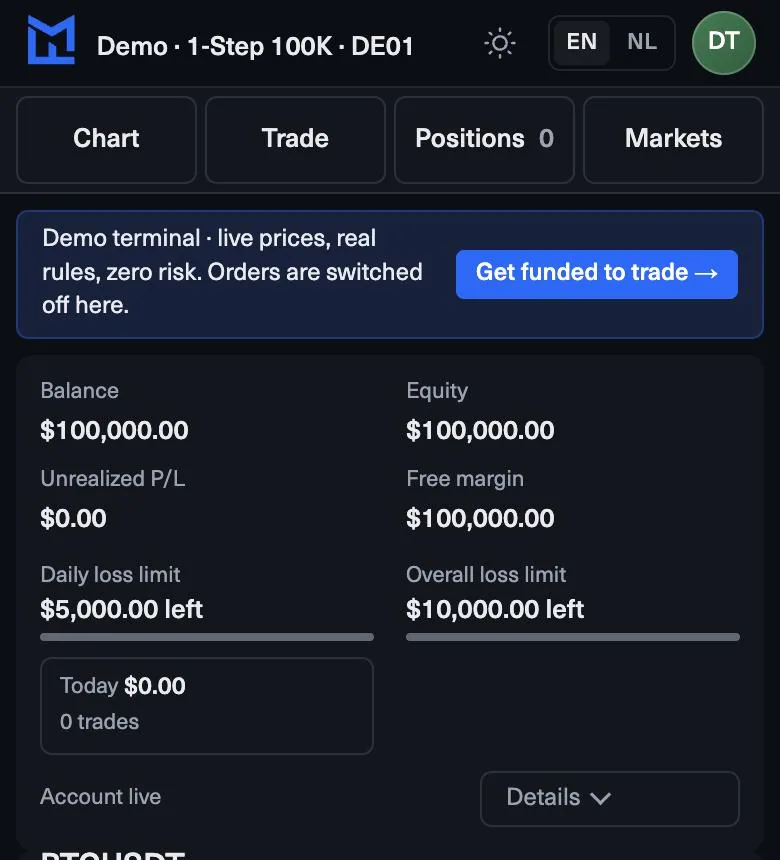
- Balance: the account value from closed trades and booked adjustments. It does not move while a trade is open.
- Equity: balance plus or minus the profit and loss of open positions. A $10,000 balance with a $300 open loss is $9,700 equity.
- Drawdown: how far equity has fallen from a reference point, such as the starting balance or yesterday’s close. A $10,000 account at $9,600 equity is in a $400 drawdown from its start.
Rules usually set the floor from a balance and test it against equity, so you need both numbers in view while a trade is open.
Limit terms
- Daily loss limit: the most equity may fall in one trading day, measured from the previous day’s closing balance. It is 5% on the 1-Step and resets at 17:00 New York time. On MFC Stocks it is a daily pause: trading stops for the day, the account stays open.
- Maximum loss: the lowest equity may ever reach. A static floor stays where it started (2-Step); a trailing floor rises with your best balance (1-Step, Instant Funded, MFC Stocks, Prediction Markets).
- Hard breach: a rule break that ends the account, such as equity touching a floor or no trade for 30 days.
Evaluation and funded terms
- Phase: one stage of an evaluation. The 2-Step has 2, the 1-Step 1, Instant Funded none.
- Profit target: the gain that completes a phase, for example 10% on the 1-Step, or $1,000 on $10,000.
- Profit split: your share of eligible profit on a funded account, 80% at the start on the 1-Step.
- Payout cycle: the interval between payout requests, such as every 14 days on the 2-Step. The first request has its own waiting period, counted from the first funded trade.
- Consistency rule: on funded accounts, no single day may make up more than 35% of total profit. With $5,000 of total profit, the best day may be at most $1,750.
- Add-on: an option chosen at checkout that changes one condition, such as a higher split, news trading or weekend holding. It does not widen the loss limits.
Order terms
- Lot: the unit of order size. A standard lot is 1.00, a mini lot 0.10, a micro lot 0.01. The instrument details in the Terminal show the contract size behind one lot.
- Pip: the standard price step on a forex pair, 0.0001 on EURUSD. One standard lot of EURUSD moves about $10 per pip.
- Leverage: how much position a given margin controls, for example 1:50 on 1-Step forex. It changes the margin a trade needs, not what you lose when the stop is hit.
Put three of these together and you can size any trade: risk in dollars ÷ (stop in pips × value per pip) = lots. With $50 of risk and a 25-pip stop on EURUSD, that is 0.20 lots.
Quiz
Check yourself
0 / 3
Lesson complete
Nice work. … of 5 lessons in Start here done.
MyFundedCapital School
Start here checklist
Rules as of 17 Oct 2026. Tick each line before your next session.
| Rule | 1-Step Challenge | 2-Step Challenge | Instant Funded | MFC Stocks | Prediction Markets |
|---|---|---|---|---|---|
| Profit target | 10% | 8% + 5% | — | 7% | 10% |
| Daily loss limit | 5% | 5% | 3% | 2% daily pause | 3% |
| Maximum loss | 10% · trailing | 10% · static | 6% · trailing | 5% · trailing | 6% · trailing |
| Consistency | 35% | 35% | 35% | 35% | 35% |
| First payout | after 7 days | after 14 days | after 14 days | after 14 days | after 7 days |
| Then every | 7 days | 14 days | 7 days | 14 days | 7 days |
| Profit split | 80% → 95% | 80% → 95% | 70% → 80% | 70% → 80% | 75% → 90% |
1. How does a prop firm challenge work?
- The fee is the most you can lose: you deposit no trading capital.
- Two loss limits apply at once, and open losses count toward both.
- Passing starts a review and verification; payouts follow a fixed schedule.
2. What is the difference between a prop firm account and a broker account?
- A broker holds your deposit; a prop firm sells access to an account for a fee.
- At a prop firm the fee caps your loss, but the rules decide how long the account lives.
- A withdrawal is your money; a payout is your share of eligible profit.
3. Which funded account program fits you?
- Your market narrows the choice before any rule does.
- Lower entry price usually means more phases; no phases means tighter limits.
- Compare the daily limit in dollars, not the headline account size.
4. How do you choose a funded account size?
- Rules are percentages, so a bigger account is not easier, only larger.
- Pick the size where 0.5% risk in dollars feels routine to you.
- Small accounts meet payout minimums later; large ones meet the cap sooner.
5. What do prop trading terms like drawdown and equity mean?
- Balance counts closed trades; equity adds open profit and loss.
- Limits are checked on equity, so open losses can end an account.
- Lots and pips turn a risk in dollars into an order size.
myfundedcapital.com/learn/
Questions
Why do the rules use closing balance and equity at the same time?
The closing balance sets where the floor sits for the day; current equity is what gets tested against it. That way an open loss can breach the account, but open profit does not raise your floor.
Is a stop loss required?
The 1-Step and 2-Step do not require one, but the loss limits still apply, and a stop is the simplest way to keep each trade inside them.
Related lessons
Tools and rules
Rules shown here come from the help center and the live rulebook; your program terms apply.