Write today’s daily floor in dollars before you look at a chart.
Mark high-impact news times; the 1-Step, 2-Step and Instant Funded have a news window.
Decide your maximum number of trades and your personal stop before the open.
Why a routine matters
The first trade of the day sets the tone. If you open the platform and react to the first candle, you trade the market’s mood instead of your plan. A short, fixed routine moves the important decisions to a calm moment, before money is at risk.
Keep it under ten minutes. A routine you skip on busy days is worse than a short one you always do.
Think of a pilot’s checklist. Pilots do not use it because they forget how to fly; they use it because one missed item is expensive. Your account works the same way: one forgotten news release or one open position you did not notice can cost more than a month of good trades.
The checklist
- Limits in dollars. Your daily loss limit is measured from the previous end-of-day closed balance and resets at 17:00 New York time. On a $10,000 1-Step account that closed yesterday at $10,000, today’s floor is $9,500. Write the number down.
- Maximum-loss floor. Note where it sits today. On a trailing account it may have moved up since last week.
- News. List the day’s high-impact releases and their times in your time zone. On the 1-Step, 2-Step and Instant Funded, opening new FX and metals positions is blocked from 2 minutes before to 2 minutes after high-impact news unless you bought the News Trading add-on.
- Open risk. Any positions from yesterday? Their open loss already counts toward today’s limit.
- Plan. Two or three levels or setups you plan to trade, with entry, stop and size decided in advance.
- Stop rule. Your maximum number of trades and your personal daily stop, for example half the daily limit.
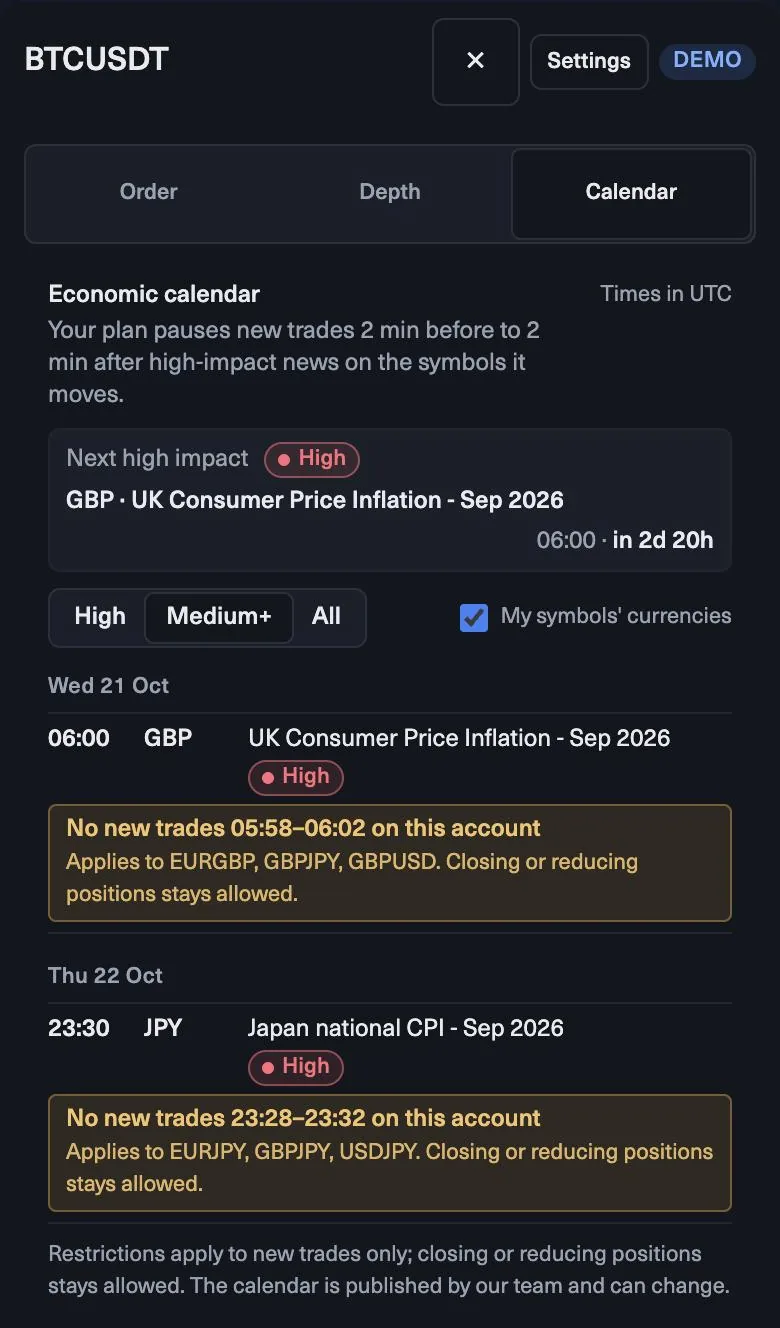
Checking the plan against the rules
Before the session, run each planned trade through one question: if the stop hits, how much of each limit is left? The MyFundedCapital Terminal shows the loss at your stop and what is left of the daily and overall limits in the order ticket, so you can answer it in seconds.
If two planned trades could both lose on the same news, count them as one bigger trade. Correlated positions are the quiet way traders exceed their own risk plan.
On Fridays, add one more check: holding a position over the weekend needs the Weekend Holding add-on. Without it, plan to be flat before the session ends.
After the session
The routine has a second half that takes two minutes:
- One line on what you did well.
- One line on any rule you bent, and why.
- Tomorrow’s first note: a level to watch or a news event to avoid.
These lines feed your trading journal and the weekly review. Over a month they show you which part of the routine actually protects your account.
If you broke a rule, write which item on the checklist would have caught it. If none would, add one. That is how the checklist grows from your own mistakes instead of a generic template.
Quiz
Check yourself
0 / 3
Lesson complete
Nice work. … of 5 lessons in Psychology & routine done.
MyFundedCapital School
Psychology & routine checklist
Rules as of 17 Oct 2026. Tick each line before your next session.
| Rule | 1-Step Challenge | 2-Step Challenge | Instant Funded | MFC Stocks | Prediction Markets |
|---|---|---|---|---|---|
| Profit target | 10% | 8% + 5% | — | 7% | 10% |
| Daily loss limit | 5% | 5% | 3% | 2% daily pause | 3% |
| Maximum loss | 10% · trailing | 10% · static | 6% · trailing | 5% · trailing | 6% · trailing |
| Consistency | 35% | 35% | 35% | 35% | 35% |
| First payout | after 7 days | after 14 days | after 14 days | after 14 days | after 7 days |
| Then every | 7 days | 14 days | 7 days | 14 days | 7 days |
| Profit split | 80% → 95% | 80% → 95% | 70% → 80% | 70% → 80% | 75% → 90% |
1. How do funded traders stay disciplined after a loss or a big win?
- Decide your reaction to a loss, a big win and a missed trade before the session starts.
- Stop for the day at roughly half the daily loss limit, then close the platform.
- Keep risk per trade unchanged after a strong week; profit is not extra room.
2. How long does it take to pass a challenge at a steady pace?
- Target ÷ daily average = trading days. Pick an average you can repeat, not your best day.
- The 1-Step and 2-Step have no time limit, so speed buys you nothing.
- Keep the same size near the target; most challenges are lost in the last week.
3. What should a pre-market routine checklist include?
- Write today’s daily floor in dollars before you look at a chart.
- Mark high-impact news times; the 1-Step, 2-Step and Instant Funded have a news window.
- Decide your maximum number of trades and your personal stop before the open.
4. What should a prop trader record in a trading journal?
- Log the plan before the trade and the result after it; the gap between them is the lesson.
- Measure results in R (multiples of risk) so different sizes compare fairly.
- Track your best-day share so the consistency rule never surprises you at payout.
5. How do you stop revenge trading on a funded account?
- Revenge trading is raising risk to recover a loss; it turns a bad day into a breach.
- Use three circuit breakers: a personal daily stop, a cooldown, and fixed size.
- At 0.5% risk you can absorb many losses; at 2% only a couple fit under the daily limit.
myfundedcapital.com/learn/
Questions
How long before the market opens should I start?
Ten to fifteen minutes is enough. Start early enough that you can read the news calendar and write your limits without rushing.
Do I need a routine if I trade only a few times a week?
Yes, and it matters more. Infrequent traders forget limits and rule changes, so the checklist stops old assumptions from reaching the order ticket.
Related lessons
Tools and rules
Rules shown here come from the help center and the live rulebook; your program terms apply.