You've found a trader whose results look attractive, linked your account, and watched the first position appear automatically. Then your fill is worse than the leader's, the loss is larger than expected, or a profitable provider pushes your account into a prop-firm drawdown breach. Copy trading forex can simplify execution, but it doesn't remove market risk or operational risk.
Introduction to Copy Trading Forex and What You Will Learn
Copy trading forex lets you connect your account to another trader and automatically replicate that trader's currency positions. The appeal is obvious. You can follow an established process without sitting at charts all day, but you still need to understand what the platform is doing with your money and risk limits.
The central mistake is treating a leader's account history as if it were your own future result. Your account may have a different balance, broker, spread, server location, minimum lot size, and execution route. Those differences can turn a profitable trade for the leader into a smaller gain, a loss, or a rule violation for you.
Copy trading has grown well beyond a niche feature. One industry estimate values the social trading platform market at USD 3.8 billion in 2026, with a projection of USD 8.26 billion by 2035 at a 9% CAGR. A separate estimate places the copy trading platform segment at USD 2.09 billion in 2026, projecting USD 10.5 billion by 2034 at a 22.4% CAGR. (OMR Global's social trading market estimate, Intel Market Research's copy trading platform estimate)
This guide focuses on what matters after the marketing page: how trades are replicated, how PAMM, MAM, and API models differ, where slippage enters, how behavior changes under social influence, and how to assess a copied strategy against prop-firm rules. You'll also find practical checks for choosing a provider and deciding whether a copied system belongs in a funded account.
For a broader introduction to the mechanics, this explanation of copy trading with Colibri Trader offers useful background. Trading involves risk of loss, and this article is educational only, not financial advice.
How Copy Trading Forex Actually Works Behind the Scenes
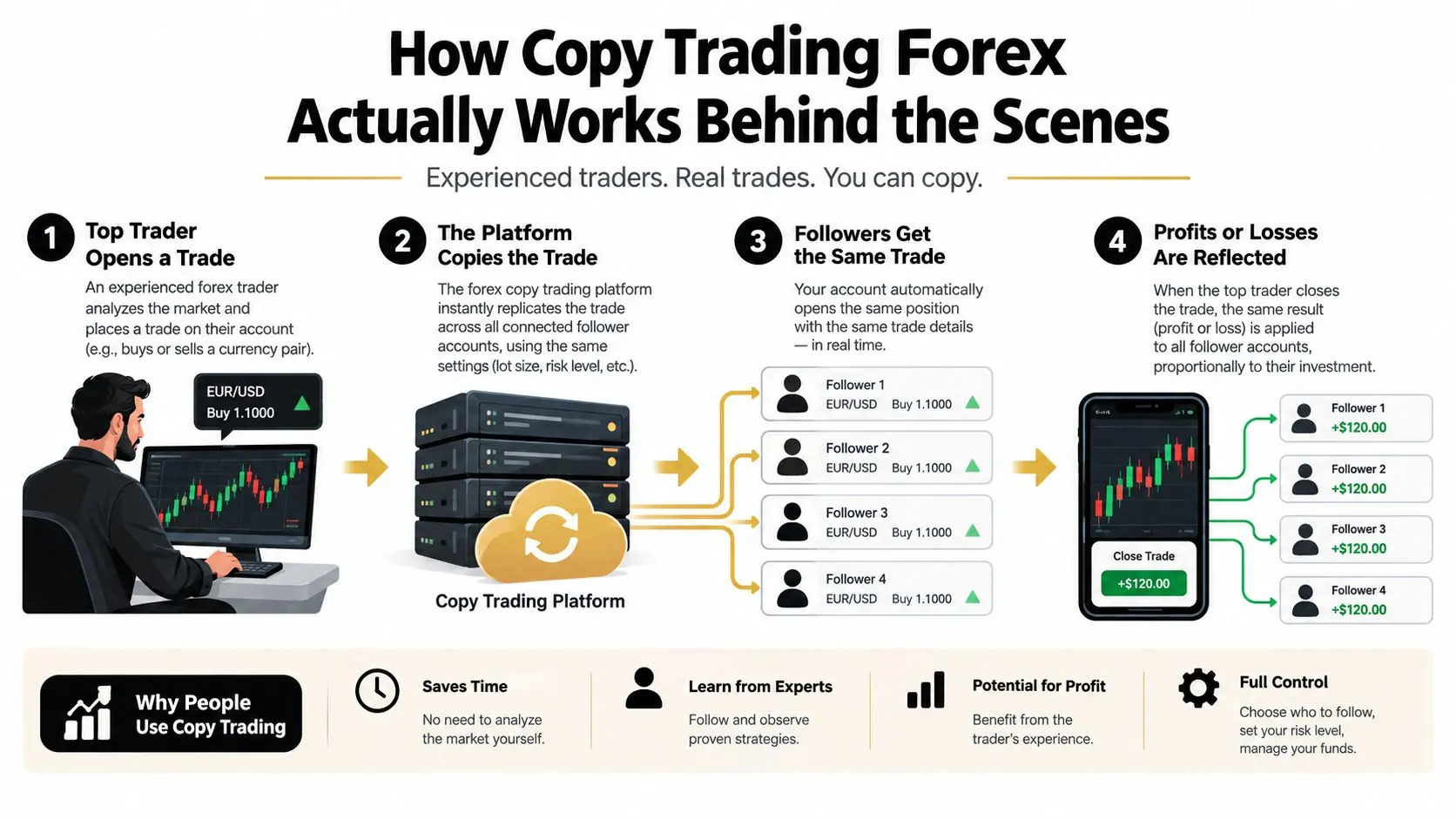
Think of the master account as a driver and follower accounts as cars receiving instructions through a dispatch system. The driver turns the wheel first, but each car still has its own engine, road conditions, and reaction time. The follower doesn't receive the master's exact fill. It receives an instruction that must travel through software and reach a broker.
The process usually follows four practical stages:
- Signal generation The master trader opens, modifies, or closes a forex position.
- Trade detection A copy engine identifies the instrument, direction, volume, order type, and relevant changes.
- Allocation calculation The system determines the follower's position size using equity, balance, fixed lots, or another selected rule.
- Follower execution The platform or bridge sends the order to the follower's broker, which fills it under current market conditions.
Why proportional sizing causes confusion
Suppose a provider buys 1 lot of EUR/USD and your account has half the equity used by the provider. A proportional system might assign 0.5 lots to your account. That example reflects the general scaling logic described in this guide to proportional copy trading.
The calculation can become less precise when your balance is small. A technical guide notes that many retail MetaTrader and cTrader execution bridges can't route orders smaller than 0.01 lots, equal to 1,000 units of base currency. (FXNX's explanation of copied order execution) If the calculated position falls below that threshold, the platform may round it, skip it, or apply its own minimum-order behavior.
That matters because rounding changes risk. A position that should be tiny may become proportionally large relative to your account, especially when several trades are open at once.
The platform is part of the strategy
Copy trading isn't only about selecting a person. It also depends on the connection between the provider, copy engine, bridge, and broker. Platform compatibility, account permissions, symbol naming, volume rules, and whether stop-loss or take-profit changes are mirrored can all affect the final result.
If you're comparing tools, review the practical differences between a dedicated copy trading app and other approaches. Traders who also follow digital-asset strategies may benefit from understanding how copy trading strategies in crypto use similar replication concepts while facing different market conditions.
Practical rule: Treat the copied trade as a new order with its own execution risk, not as a guaranteed duplicate of the master's position.
PAMM MAM and API Copy Compared for Forex Traders
The labels can sound interchangeable, but they describe different control and ownership structures. The most important questions are simple: Where does the money stay? Who controls allocation? How quickly can you stop? What can you verify?
Comparison at a glance
| Feature | PAMM | MAM | API Copy |
|---|---|---|---|
| Where funds remain | Usually pooled or allocated to a manager structure | Separate investor accounts under a manager | Follower's own connected account |
| Allocation control | Usually controlled by the manager or model | More flexible, with selectable allocation rules | Often set by the follower through platform parameters |
| Transparency | Depends on the provider and reporting system | Often provides account-level reporting | Can offer detailed order-by-order visibility |
| Follower intervention | Limited compared with direct copying | Moderate, depending on permissions | Usually easy to pause, disconnect, or adjust |
| Typical fit | Hands-off managed exposure | Managed accounts needing flexible allocation | Traders wanting direct account control and automated mirroring |
| Main concern | Limited personal control and pooled-structure complexity | More settings can mean more room for configuration errors | Bridge latency, API permissions, and broker execution differences |
PAMM for hands-off allocation
A PAMM, or Percentage Allocation Management Module, generally groups investor capital under a manager's trading structure. You're delegating more of the operational decision-making, so the provider's reporting, withdrawal terms, fee model, and regulatory status deserve close attention.
This model can suit someone who wants minimal interaction. It may be less suitable for a trader who needs precise control over copied risk, individual positions, or immediate disconnection.
MAM for managed accounts with more flexibility
A MAM, or Multi-Account Manager, normally keeps client accounts separate while allowing a manager to trade across them. Allocation methods can be more varied than in a basic pooled setup, including proportional or fixed-lot approaches.
That flexibility helps experienced users, but it also creates more settings to check. Before connecting, confirm whether the manager can override your lot sizing, whether you can close individual positions, and how the system handles partial fills.
API or platform copy for direct control
API and platform-based copying usually connects your account to a provider through software, a broker integration, or a trading terminal. You typically retain custody of the account and can pause the connection, change allocation, or close positions yourself.
That control doesn't make the setup risk-free. It moves more responsibility to you. You must check permissions, platform compatibility, symbol mapping, order modification behavior, and the process for handling outages.
For prop-firm traders, this distinction matters. A system that works on a personal broker account may not be permitted on a funded account, and a platform that allows copying may still impose separate limits on the source of trades or account relationships.
Real Costs Slippage and Execution Risks You Must Measure
Your copied trade can lose while the leader's trade makes money. The difference is often the hidden execution gap between the leader's recorded order and your filled order. It begins with the master account's fill, passes through the copy bridge, and ends at your broker. A delay of 100 to 200 milliseconds can worsen entry or exit prices, especially for scalping or news trading. FXNX's guide to copy trading slippage
During liquid hours, major-pair copying may show around 0.5 to 2 pips of slippage. Around news events, the gap can widen to 5 to 10 pips or more. Those costs can turn a small expected edge into a loss, particularly when a strategy takes frequent trades.
Where the execution gap comes from
Suppose a provider enters EUR/USD at one quoted price. Your system detects the order, sends the instruction, and requests a fill from your broker. During that process, the bid and ask may move, the spread may widen, or the broker may reject and requote the order. The follower account then holds a different trade, even though both accounts followed the same signal.
Other sources of divergence include:
- Latency The signal takes time to travel from the master account to the follower account.
- Spread markups Your broker may quote a wider spread than the provider's broker.
- Quote mismatch Separate liquidity feeds can display slightly different prices.
- Lot rounding The platform may adjust the position to meet minimum volume rules.
- Partial or rejected execution You may receive a different fill or no fill.
- Order modification timing A stop-loss or take-profit update may arrive after the market has moved.
How to measure your real result
Keep a comparison log for every copied trade. Record the master's entry and exit, your entry and exit, both order timestamps, spread conditions, and whether the order was rounded, partially filled, or rejected.
After collecting enough observations, separate ordinary liquid-market slippage from event-driven slippage. A displayed return is not the result your account necessarily receives. Compare the actual prices and costs, then ask whether your account could reproduce the strategy under the same execution conditions.
A low-latency VPS near the broker's server may reduce avoidable delay, but it cannot stop market movement. Broker and server alignment, clear maximum-slippage settings, and a rule to pause copying during unsuitable news conditions can make the process easier to control.
The explanation of slippage in trading clarifies why a quoted price and a filled price can differ.
Execution reality: A leader can finish profitable while your follower account loses because the two accounts did not receive the same prices.
How to Evaluate Providers and Read Performance Metrics Correctly
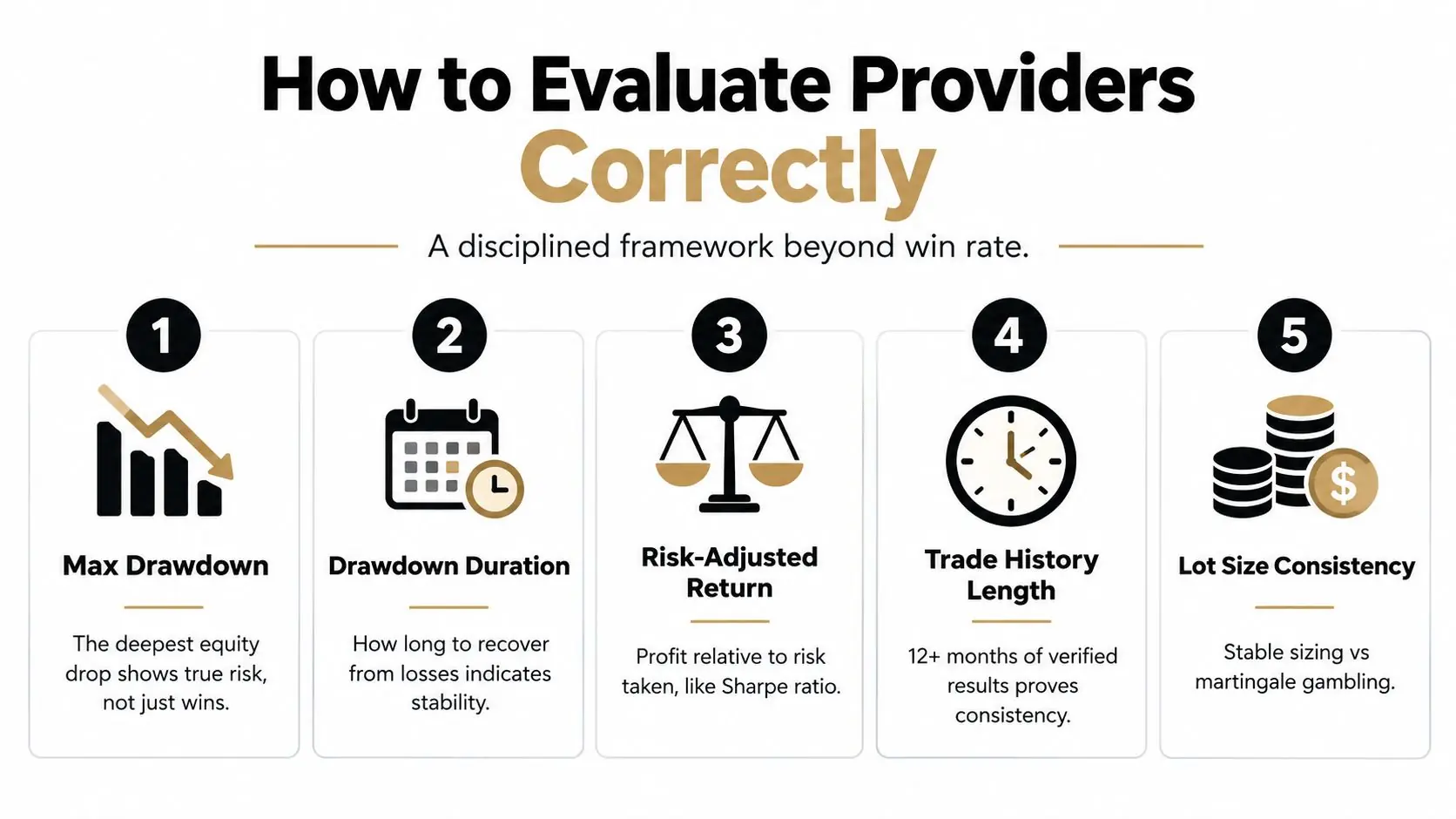
A provider's headline return is only one line in a much larger risk report. The useful question isn't “How much did this trader make?” It's “What path did the trader take, what size did they use, and could my account survive the same path after execution costs?”
Begin with the equity curve, not the promotional ranking. A smooth-looking balance curve can hide open losses, aggressive averaging, or a few unusually large positions.
The metrics that deserve attention
- Maximum drawdown Find the deepest decline from a previous equity high. This shows the stress you might experience, not just the profitable endpoint.
- Drawdown duration Check how long the account took to recover. A shallow loss that lasts a long time can be psychologically and financially difficult.
- Risk-adjusted return Compare gains with the risk taken to produce them. A large return achieved through oversized positions may be less useful than a smaller return with controlled exposure.
- Trade history Look for a verified record spanning different market conditions. A brief winning run tells you little about how the provider handles stress.
- Lot-size consistency Examine whether position sizes remain coherent or increase sharply after losses. Sudden increases can signal dangerous averaging or martingale-like behavior.
- Outcome dispersion Review the difference between average wins and average losses, as well as clusters of losing trades. Win rate alone can conceal poor payoff structure.
A practical review process
First, verify that the history is live or independently verified rather than based only on screenshots. Next, identify the provider's normal instruments, holding period, multiplier usage, and use of stop-losses. Then compare the provider's largest position with your own account's risk limits.
Academic experimental evidence raises another concern. Researchers found that showing participants other people's success increased risk-taking, while giving them the ability to copy increased it further. The study concludes that copy trading can lead to excessive risk-taking. (Experimental research on copy trading and risk-taking)
That finding changes how you should size an allocation. You aren't only copying trade entries. You may also absorb the provider's confidence, tolerance for losses, and willingness to increase exposure.
Use written stop-copy rules before you connect:
- Pause copying if drawdown reaches your predefined limit.
- Stop if the provider changes instruments or position sizing without explanation.
- Reduce allocation after a material execution gap appears.
- Review every open trade before restarting after a platform outage.
- Never increase size because the provider recently had a winning streak.
A separate study found that the option to copy shifted asset choice toward riskier assets, while a 90-day multi-exchange study reported that 48.48% of copy traders were profitable. (Research repository on copy trading behavior) The lesson isn't that one result predicts your account. It's that copying can encourage riskier decisions while leaving followers exposed to outcomes they may not fully understand.
Using Copy Trading Forex Inside Prop Firm Accounts Safely
A prop-firm account adds a second layer of risk. You're not only trying to produce a positive trading result. You're trying to do it without crossing fixed loss thresholds, and copied execution can breach those thresholds even when the source trader remains profitable.
For example, MyFundedCapital describes support for manual, algorithmic, and copy trading on DXtrade and cTrader, provided the method complies with its risk rules and doesn't exploit platform vulnerabilities. Review the current terms before connecting any provider, because permitted tools and account conditions can change. (MyFundedCapital's page on prop firms that allow copy trading)
Translate the strategy into rule-compatible risk
The supplied account rules include a 5% daily loss limit on its Challenges (3% on Instant Funding) and up to 10% maximum drawdown. Those limits are not targets. They are boundaries that copied trades can reach faster if the leader uses larger positions, holds correlated pairs, or trades during volatile events.
Use this checklist before scaling:
- Confirm permission: Read the firm's current copy-trading, EA, account-linking, and third-party signal conditions.
- Match platforms: Check that the provider and follower accounts use compatible symbols, order types, and volume rules on DXtrade or cTrader.
- Start on demo: Test signal delivery, order modifications, stop-loss behavior, rounding, and disconnection before risking an evaluation fee.
- Reduce allocation: Size copied positions below the provider's nominal risk so execution differences have room to work against you.
- Set a personal stop: Stop copying well before the firm's daily and maximum drawdown thresholds.
- Review event exposure: News trading and weekend holding may require optional add-ons, so verify eligibility before leaving positions open.
- Watch correlated trades: Several dollar-linked pairs can create one large combined exposure rather than genuine diversification.
Don't assume a $5K, $10K, or $100K account can use the same settings as the source account. A copied strategy must be tested against the follower account's equity, minimum lot size, margin, and loss rules.
Prop-firm evaluations and funded accounts can operate in demo environments with real market quotes. That structure still creates real consequences for your fees, eligibility, and performance process. Trading involves risk of loss, so discipline matters more than the convenience of automation.
Conclusion FAQs and Next Steps With MyFundedCapital
Copy trading forex is a risk-transfer tool, not a profit guarantee. You transfer trade selection to a provider, but you retain responsibility for allocation, platform choice, execution quality, and the decision to stop. The leader's return doesn't belong to you automatically because your fills, costs, account size, and rules can differ.
Three checks should guide any decision:
- Execution Can your account reproduce the provider's trades after latency, spread, rounding, and news conditions?
- Behavior Does the provider use controlled sizing, or does copying tempt you to accept risk you wouldn't take manually?
- Compatibility Does the strategy fit your broker, platform, drawdown limits, holding rules, and permitted automation?
Frequently asked questions
Is copy trading forex regulated?
It can fall under regulated investment management or portfolio management, depending on how the follower makes decisions and how the service operates. The UK FCA says copy trading may be classified as portfolio or investment management when the account holder isn't making clear manual decisions. IOSCO also advises firms to assess whether the activity falls under investment advice, individual portfolio management, or another regulated category. (UK FCA guidance on copy trading)
Can a profitable leader still cause my account to lose?
Yes. Replication lag, slippage, quote differences, lot rounding, and different spreads can change your realized result. A leader can also use a drawdown profile that doesn't fit your account, especially if your prop firm applies tighter loss limits.
Which platform should I use?
Choose the platform that supports the provider's order types, your risk controls, and the account rules you must follow. DXtrade and cTrader may both support relevant workflows, but compatibility must be tested trade by trade rather than assumed from the platform name.
Trading involves risk of loss. This article is educational content, not financial advice. Review the provider, platform, broker, and prop-firm terms carefully before committing capital.
MyFundedCapital offers Instant Funding and 1-Step or 2-Step Challenges, with account options from $5K to $100K and stated scaling paths up to $500K. If you're considering copy trading forex, visit MyFundedCapital to review the current funding programs, compare account types, and start a challenge only after your strategy has passed a controlled platform and risk test.