ES
ES
 DE
DE
 FR
FR
 AR
AR
 IT
IT
 NL
NL
 PL
PL
 SV
SV

If you already know how to trade but do not have enough capital to scale, a copy trading app can look like an obvious shortcut. It can also wreck a funded account fast if you copy the wrong provider, use the wrong sizing model, or ignore execution quality.
Used properly, copy trading is just trade replication technology. It lets you mirror a strategy, diversify into markets you do not trade yourself, or distribute your own trades to follower accounts. In a prop environment, that changes the job. You are not only judging returns. You are judging whether the app, the provider, and your settings can survive hard risk rules on a simulated funded account.
Introduction
A lot of traders arrive at copy trading from one of two places. They either have skill but not enough capital, or they have capital access through a prop firm and want to add diversification without manually trading every session.
A copy trading app solves a real problem. It lets one account act as the lead and other accounts follow automatically. That is useful, but only if you treat it like infrastructure, not a profit button.
In prop trading, the details matter more than the marketing. A retail setup can survive sloppy execution, oversized lots, or loose monitoring for a while. A funded account with fixed drawdown rules usually cannot. The practical question is not whether copy trading works. The question is whether your setup works under funded-account constraints.
How a Copy Trading App Works
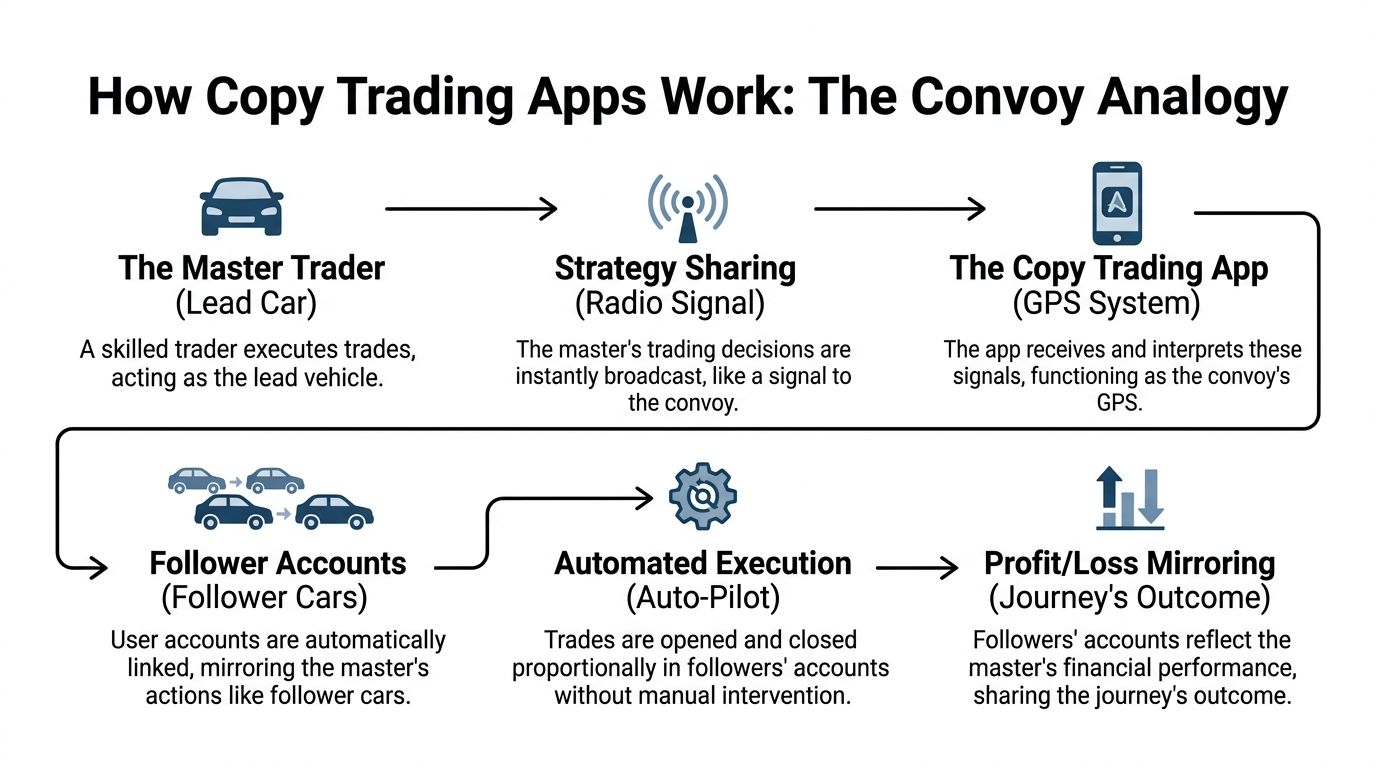
The simplest way to think about a copy trading app is a convoy.
One vehicle leads. The rest follow the same route. If the lead car turns, the others turn. If the lead car brakes late, the followers may not stop at the exact same point. That gap is where copy trading either stays efficient or starts leaking performance.
The two roles that matter
A copy trading system has two core participants:
- Strategy provider. This is the master trader. They place the original trade.
- Follower. This account receives and mirrors the trade according to the allocation settings.
That sounds simple, but the workflow has several moving parts:
- The provider opens a trade in their platform.
- The app or server captures the signal.
- The copy engine translates the trade for each linked follower account.
- Each follower account executes based on its own balance, risk settings, and broker or platform conditions.
- The follower position opens and closes automatically unless filters or overrides block it.
The history matters because it shows this is no longer a fringe tool. Over 60% of new retail investors in 2025 use copy trading platforms as their primary way to enter the financial markets, and ZuluTrade, launched in 2007, connects to over 100 brokers worldwide with 10,000+ signal providers by 2025 according to XBTFX’s overview of copy trading growth.
Where the app earns its keep
A good copy trading app does not just pass trades from one account to another. It handles translation problems:
- Position sizing
- Symbol mapping
- Execution timing
- Risk filters
- Account-specific rules
Many traders underestimate the technical side here. If the master account trades one size and the follower account blindly uses the same lot size, the copied result is not really the same strategy. It is a different risk profile.
That is why I judge copy technology more like operational software than like a social feature. If you have worked around institutional dashboards or trading customer portal software, the logic is similar. The interface matters less than reliable data flow, permissions, and accurate account-level handling.
Why execution quality changes the result
The app does not guarantee identical fills. It only tries to replicate the provider’s trade path as closely as the infrastructure allows.
That gap becomes larger when:
- markets move quickly
- the provider uses short holding times
- the app routes through weaker infrastructure
- your follower account sits on a different platform or environment
A swing trader holding for days can tolerate some mismatch. A fast intraday strategy usually cannot. That is one reason traders looking at automation also compare app-based copying with options like automatic forex trade workflows before committing capital.
Practical takeaway: A copy trading app is not one thing. It is signal capture, routing, sizing, and risk translation. If any one of those fails, your copied strategy becomes a different strategy.
Evaluating Critical App Features for Performance
Most traders choose a copy trading app by scrolling leaderboards. That is backwards.
First judge the plumbing. Then judge the trader.
Execution speed and slippage
Latency is not a nice-to-have metric. It changes the strategy you are running.
Professional copy trading platforms achieve trade replication speeds between 50-200 milliseconds, while specialized tools can deliver execution under 20ms. A 150ms delay during volatile conditions can create a 3-pip slippage on a EUR/USD trade, according to QuantVPS on copy trading platform latency.
For a higher-timeframe trader, that may be tolerable. For scalping, it can turn a valid edge into a negative one. In a prop setup, slippage has a second effect. It eats into your daily loss allowance even when the provider is doing their job.
Use this checklist when testing execution quality:
- Check holding time first If the provider closes trades quickly, latency matters more.
- Look for cloud-based infrastructure Local relay tools tend to break down faster during volatility.
- Review fill consistency One bad fill is noise. A pattern of bad fills means the app is not fit for that strategy.
- Test during active sessions Quiet-market execution tells you almost nothing about how the app behaves when spreads widen and price moves hard.
Platform compatibility and environment fit
Compatibility is not just “does it connect.”
It means the copy trading app can work cleanly with your trading platform, account permissions, and symbol structure. Prop traders need to be especially strict here because platform mismatch creates avoidable errors:
- wrong symbol copied
- wrong contract sizing
- missed trades
- partial fills
- blocked orders due to risk settings
If your funded path relies on DXtrade or cTrader, your app should support those environments without workarounds. I avoid setups that need too many bridges, manual file relays, or local machine dependencies unless the operator understands exactly how to maintain them.
A solid app should also give you control over:
| Feature | Why it matters |
|---|---|
| Account linking | Prevents copying to the wrong destination |
| Symbol mapping | Reduces mismatch between instruments |
| Trade filters | Lets you exclude products you do not want |
| Allocation controls | Keeps account risk proportional |
| Pause or kill switch | Stops replication when conditions change |
Permissioning and account-level control
Retail guides often skip the question that matters most in funded trading. Who is in control when the provider does something you do not like?
A useful copy trading app lets the follower define hard limits before the first trade arrives. That includes:
- Maximum allocation
- Instrument restrictions
- Direction restrictions if supported
- Personal stop conditions
- Auto-pause after drawdown or unusual behavior
If an app only offers blind mirroring, I do not use it for a rule-bound account.
Tip: The best copy setup feels restrictive at first. That is good. Prop trading rewards hard limits more than convenience.
Integrating Copy Trading with Prop Firm Accounts
At this point, copy trading stops being a generic investing feature and becomes a risk-management exercise.
A prop account has rules. The copy trading app must fit those rules exactly. If it does not, the setup fails even when the provider is profitable.
The main conflict between retail copying and prop rules
Retail users often focus on return ranking. Prop traders should focus on breach risk.
Proprietary trading firms often have strict risk parameters like a 5% daily loss limit. Copy trading platforms with proportional scaling are essential, as they ensure a follower with a $100K account risks the same percentage of capital as a master with a $50K account. Using a fixed lot size by mistake could double the intended risk. The same source also notes a 60-70% failure rate for automated strategies in prop challenges due to unadjusted settings, based on Goat Funded Trader’s review of copy trading platforms for prop use.
That one point changes everything. In a funded account, proportional scaling is essential.
If the provider risks a fixed amount and your account is larger or smaller, your copied trade should adjust to your own equity. If it does not, you are not copying the strategy. You are copying the entry and creating your own risk mistake.
What prop traders should demand from the app
A funded-account copy setup needs more control than a retail setup.
Look for these functions before you connect anything:
- Proportional sizing This is the first filter. Without it, move on.
- Maximum exposure controls You need account-level brakes.
- Trade filtering Exclude instruments or styles that conflict with your rules.
- Pause controls You need the ability to stop copying fast.
- Clear reporting You should be able to audit what was copied and why.
This is also where platform architecture matters. Traders often ask what sits behind these systems and why some apps feel solid while others feel fragile. If you want a sense of how these products are designed, this overview of fintech app development services gives useful context around security, integration, and data handling in financial apps.
Vetting the provider for a funded environment
A profitable provider can still be wrong for your account.
You want a provider whose behavior matches funded-account constraints:
- Controlled drawdown
- Stable position sizing
- No sudden style shifts
- No habit of stacking correlated trades
- Reasonable trade frequency for the app’s execution quality
Do not copy someone just because their chart looks aggressive and exciting. In prop trading, a lower-drama equity curve is usually easier to keep funded.
One practical route is to use a prop-friendly environment that already supports copy trading alongside manual and algo execution. MyFundedCapital supports copy trading across DXtrade and cTrader in its simulated funded structure, which is why traders often compare it with other prop firms that allow copy trading before choosing where to run a setup.
Two setup checklists that prevent common mistakes
Follower checklist
- Confirm the app supports your platform Do this before reviewing providers.
- Use proportional allocation only Never default to fixed lot sizing.
- Set hard limits first Daily stop, account stop, and max exposure.
- Start with narrow scope One provider is easier to audit than several at once.
- Review copied trades manually The first batch tells you whether mapping and sizing are correct.
Strategy provider checklist
- Use a stable master account setup Avoid frequent platform or symbol changes.
- Keep execution style consistent Followers need predictable behavior.
- Disclose the method Scalping, swing, news sensitivity, and typical hold time all matter.
- Avoid vanity risk Big swings attract attention but usually lose trust fast in funded trading.
- Monitor follower-side replication Your job is not only trading well. It is trading in a way others can copy accurately.
Many providers fail at this point. They present returns, but they do not present copy quality.
What good setup discipline looks like
Good setup is boring on purpose. Followers know their max loss before the first copied trade. Providers know whether their method survives delayed execution and different symbol feeds. Both sides know what happens if the prop firm’s limits get close.
In retail copy trading, a rough setup can survive for a while. In a funded account, small errors get amplified by hard drawdown rules and scaling targets. The cleanest setups are the ones that can pass a simple test. If a trade copies late, slightly larger, or on a different symbol suffix, does the account still stay inside the rules?
Practical rule: If you cannot explain how the provider’s trades fit your prop firm’s loss limits, exposure limits, and execution conditions, do not connect the account yet.
Advanced Risk Management for Copy Traders
A copy relationship can pass for weeks, then fail in one session because the provider hits size harder, correlations tighten, or your prop firm’s daily loss limit gets too close. That is why risk management for copy trading has to be account-first, not provider-first.
In a retail account, a rough week is unpleasant. In a funded account, the same week can end the evaluation or breach a live account. The job is not just finding traders with a good record. The job is controlling how their behavior translates into your specific rule set.
Diversify by behavior, not by trader count
Copying three providers who all trade GBPUSD momentum during London open is still concentrated risk. The names are different. The exposure is not.
A better approach is to spread risk across behaviors that are less likely to lose at the same time. Useful points of separation include:
- Holding period short intraday trades versus multi-session holds
- Market exposure forex, indices, metals, or crypto
- Session timing London, New York, or mixed participation
- Risk expression steady sizing versus more aggressive pyramiding
- Event sensitivity traders who avoid news versus traders who trade through it
The target is not variety for its own sake. The target is lower correlation. In prop accounts, that matters because several small losing trades from similar providers can trip a daily drawdown limit faster than one larger but isolated loss.
Keep the mix simple. If you cannot explain why each provider belongs in the portfolio and how their losses are likely to differ, the portfolio is already too messy to manage well.
Set hard limits before the provider needs them
Good copy risk control starts with follower-side limits. Providers control entries and exits. You control how much damage one provider can do to the account.
Set limits at three levels:
- Per trade cap the maximum loss allowed on any copied position
- Per provider cap the maximum share of total account risk assigned to one strategy
- Portfolio cap the total open risk across all copied positions
For prop firms, these limits should sit comfortably inside the firm’s rule thresholds. If the firm allows a 5% daily loss, do not build a copy setup that can realistically hit 4.5% on a volatile morning. Leave room for slippage, commissions, and mistakes.
This is also where fixed allocation often beats proportional optimism. A provider may be profitable and still unsuitable at your current account size if their normal stop distance creates oversized swings relative to your drawdown ceiling.
Know when to cut, reduce, or pause
Followers usually wait too long because the provider has not fully broken down yet. That is poor risk practice in a funded environment.
Reduce or stop copying when you see:
- Style drift the trader changes holding time, setup quality, or market focus
- Risk inflation average position size or trade frequency rises without a clear process change
- Correlation build-up multiple providers start leaning the same way in the same market
- Follower degradation your fills, spreads, or exits no longer resemble the master account closely enough
- Rule conflict the provider’s trades now increase the odds of breaching your firm’s limits
A clean review process helps here. These forex risk management strategies for funded traders are useful for turning general discipline into account-level rules you can enforce.
Review on schedule. Weekly works for slower swing providers. Daily is safer for intraday copying in a prop account.
Prop firm rules change the math
Generic copy trading advice usually stops at diversification and stop losses. Prop firms add constraints that force tighter control.
Two examples matter:
First, trailing drawdown changes how you size copied trades. A provider can recover from a drawdown on their own account with no issue. Your funded account may have less room because the loss limit moves with equity or has a strict daily reset rule.
Second, scaling plans can tempt traders to raise allocation too early. Passing one phase or one payout cycle does not prove the copy setup is stable. Increase size only after the provider’s behavior has remained consistent through different volatility conditions and your follower account has shown clean execution.
The practical trade-off is simple. Slower growth with rule compliance beats faster growth with a higher breach probability.
Common mistakes that damage funded accounts
Copying recent returns instead of process
A strong month is not enough. The provider needs a repeatable method, stable sizing, and behavior that survives your execution conditions.
Letting one provider dominate open risk
This can happen gradually. A follower starts with sensible allocation, the provider performs well, then copied exposure grows into a level that can decide the whole day.
Ignoring correlated positions
Two providers can look different on paper and still stack the same directional risk. Check the actual positions, not just the profile description.
Treating slippage as a minor detail
In prop trading, slippage is risk. A setup that looks acceptable on the master account can become rule-breaking on the follower account if entries are late and stops are wider in practice.
A monitoring routine that holds up under prop rules
Use a review process you can execute even after a bad session:
| Review point | What to check |
|---|---|
| Provider consistency | Same instruments, same hold times, same general trade behavior |
| Allocation control | No provider has grown into an outsized share of account risk |
| Correlation | Open trades are not clustering in one direction or one theme |
| Follower execution | Fill quality, stop placement, and exit timing remain acceptable |
| Rule proximity | Open and realized loss stay well inside daily and overall drawdown limits |
| Platform health | Connection, trade mapping, and permissions still work correctly |
Boring routines keep accounts alive. In copy trading under prop firm rules, that is the edge that matters.
Frequently Asked Questions About Copy Trading
| Question | Answer |
|---|---|
| Can a copy trading app help me pass a prop challenge? | It can help with execution and diversification, but it does not remove the need for discipline. The main issue is not whether the provider is profitable. The issue is whether your settings, sizing model, and copied behavior fit the challenge rules. |
| Is proportional sizing really that important? | Yes. In a funded account, it is one of the first things to verify. Without it, the same trade can carry very different risk on the follower account, which is how traders breach rules even when the provider trades normally. |
| Should I copy one trader or several? | Usually several, but only after you can monitor them properly. A small basket with different styles often gives a smoother result than relying on one person. Too many providers, though, can make oversight messy. |
| Can I set and forget a copy trading app? | No. The app automates order flow, not risk judgment. Providers change, market conditions change, and execution quality changes. Ongoing review is part of the job. |
Conclusion Is Copy Trading Right for Your Prop Journey
A copy trading app can be useful for scaling, diversification, and strategy distribution. It can also fail fast when traders ignore execution quality, account permissions, or sizing logic.
The best setups are boring in the right way. They use clean platform support, strict proportional allocation, hard follower-side limits, and regular monitoring. In a prop environment, that discipline matters more than leaderboard returns.
Trading involves risk of loss. Copy trading adds convenience, not certainty. Use it as a tool, not an excuse to stop thinking.
If you want to apply this in a funded environment, explore the account options at MyFundedCapital and compare the challenge, instant funding, and platform choices before connecting any copy trading setup.