The popular advice is simple: find the trader with the highest return and copy them. That's also how many accounts get damaged. A durable copy trading strategy starts with risk-adjusted selection, follower-level sizing, and rules that can survive a bad session, a delayed fill, and the pressure of a leaderboard.
The Hidden Behavioral Trap of Social Trading
Copying a profitable trader doesn't transfer that trader's risk management to your account. It transfers positions, and sometimes only imperfectly. You still have different account equity, buying power, execution conditions, stop-out rules, and tolerance for losses.
Experimental evidence from the University of Essex found that social information increased risk-taking, while the increase was larger when participants could directly copy another trader. The researchers concluded that copy trading can produce excessive risk-taking rather than merely transfer trading skill. The result is documented in the experimental market study.
That finding matters because a leaderboard shows outcomes, not the decisions behind them. A strong return may come from aggressive borrowing, concentrated exposure, delayed loss realization, or a recovery method that looks stable until several positions move against it. Automated replication can make those risks feel safer because the software handles the clicks.
Practical rule: Treat every copied position as your own exposure. If you wouldn't accept its size, leverage, and exit conditions manually, don't copy it automatically.
Why visible success changes behavior
Social proof creates a dangerous feedback loop. A trader appears near the top of a ranking, followers allocate capital, and the growing crowd interprets popularity as confirmation. The follower then increases allocation after a winning period, precisely when the underlying strategy may be most exposed to reversal.
This is closely related to FOMO in trading. The problem isn't only that you might select a risky leader. You may also become more willing to override your own limits because other traders appear to be making money with larger positions.
Your first filter, therefore, shouldn't be return. It should be survival:
- Exposure Identify the instruments, directions, borrowed capital, and average position size.
- Loss tolerance Decide the maximum amount your account can lose before copying pauses.
- Account fit Compare the leader's behavior with your own drawdown and stop-out constraints.
- Oversight Require regular review, even if the platform describes copying as automated.
A copy trading strategy is useful only when the follower remains in control of allocation and risk. Historical performance can help you investigate a trader, but it can't establish suitability for your account. Trading involves risk of loss, and copy trading doesn't remove market, execution, or behavioral risk.
Evaluating Leaders Beyond Headline Returns
The leader with the highest return may be the wrong choice for a funded account. A large gain can hide a fragile process, while a moderate result may reflect controlled exposure and repeatable execution. Treat selection as a risk review rather than a popularity contest.
IOSCO's 2025 report warns that followers may receive inadequate information about risks, costs, conflicts of interest, remuneration structures, and the lead trader's strategy. It also notes that automated imitation can expose users to trades inconsistent with their objectives or loss tolerance. Read the IOSCO report on investor protection in copy trading before treating a public performance page as complete due diligence.
A risk-adjusted leader scorecard
| Metric | Red Flag (Avoid) | Green Flag (Target) |
|---|---|---|
| Rolling returns | Results depend on one short winning window | Performance remains understandable across changing conditions |
| Maximum drawdown | Deep losses followed by aggressive recovery trades | Drawdowns stay compatible with your account limits |
| Drawdown duration | Recovery requires prolonged exposure or escalating size | Loss periods have defined, controlled recovery behavior |
| Profit factor | A few large winners hide frequent or costly losses | Gross wins consistently outweigh gross losses after costs |
| Trade duration | Holding time changes sharply without explanation | The current style matches the displayed history |
| Instrument exposure | Concentration in one pair, coin, index, or event | Exposure is deliberate and compatible with your risk plan |
| Position size | Oversized trades or sudden increases in borrowed exposure | Position sizing remains stable relative to equity |
| Losing-trade behavior | Averaging down, grid expansion, or unclear exits | Losses are closed according to a repeatable process |
| Costs and execution | Frequent trades with no evidence of net-cost control | Results remain credible after spreads, slippage, and financing |
| Regime dependence | Returns appear tied to one market environment | The strategy's strengths and weaknesses are identifiable |
Read the path, not just the endpoint
Review rolling returns alongside total return. A leader who earned most of the displayed profit during one volatile phase carries a different risk profile from one who produced steadier results across multiple conditions. That distinction matters when an account has a fixed drawdown boundary and little room for recovery.
Drawdown duration adds another layer. Two leaders may show a similar maximum drawdown, yet one recovers through disciplined position reduction while the other increases exposure. The headline figure cannot explain that mechanism.
Profit factor becomes useful when paired with average win, average loss, worst trade, and exposure. A high win rate can coexist with poor payoff structure when occasional losses greatly exceed ordinary gains. Check whether the record depends on a small number of trades, since one exceptional outcome can distort the apparent quality of the process.
Questions to answer before allocation
- What exactly is being copied? Confirm whether the record includes open positions, closed trades, fees, and financing.
- How concentrated is the book? Three providers trading the same instrument in the same direction may represent one risk rather than three independent positions.
- How does the leader lose? Look for stop-outs, averaging, position stacking, and long recovery periods. These behaviors often reveal more than a winning month.
- Does the strategy fit your rules? A strategy can be profitable in isolation and still be unusable under a fixed daily loss limit.
- Can your account replicate it? Different balances, margin settings, execution venues, and copying latency can materially change the result.
A public ranking is a screening tool, not a risk framework. Allocate only after you can explain the process behind the return, the conditions that support it, and the signal that would invalidate it. That standard keeps attention on account survival, where a leader's headline performance has limited value.
Position Sizing for Funded Account Survival
A copy trade can look small on the leader's account and still threaten yours. Fixed-lot copying ignores differences in equity, margin use, volatility, and drawdown rules. Proportional copying narrows that gap, but it does not replace a separate cap set from the follower's account.
Start with the loss your account can withstand. The provider's preferred risk comes second.
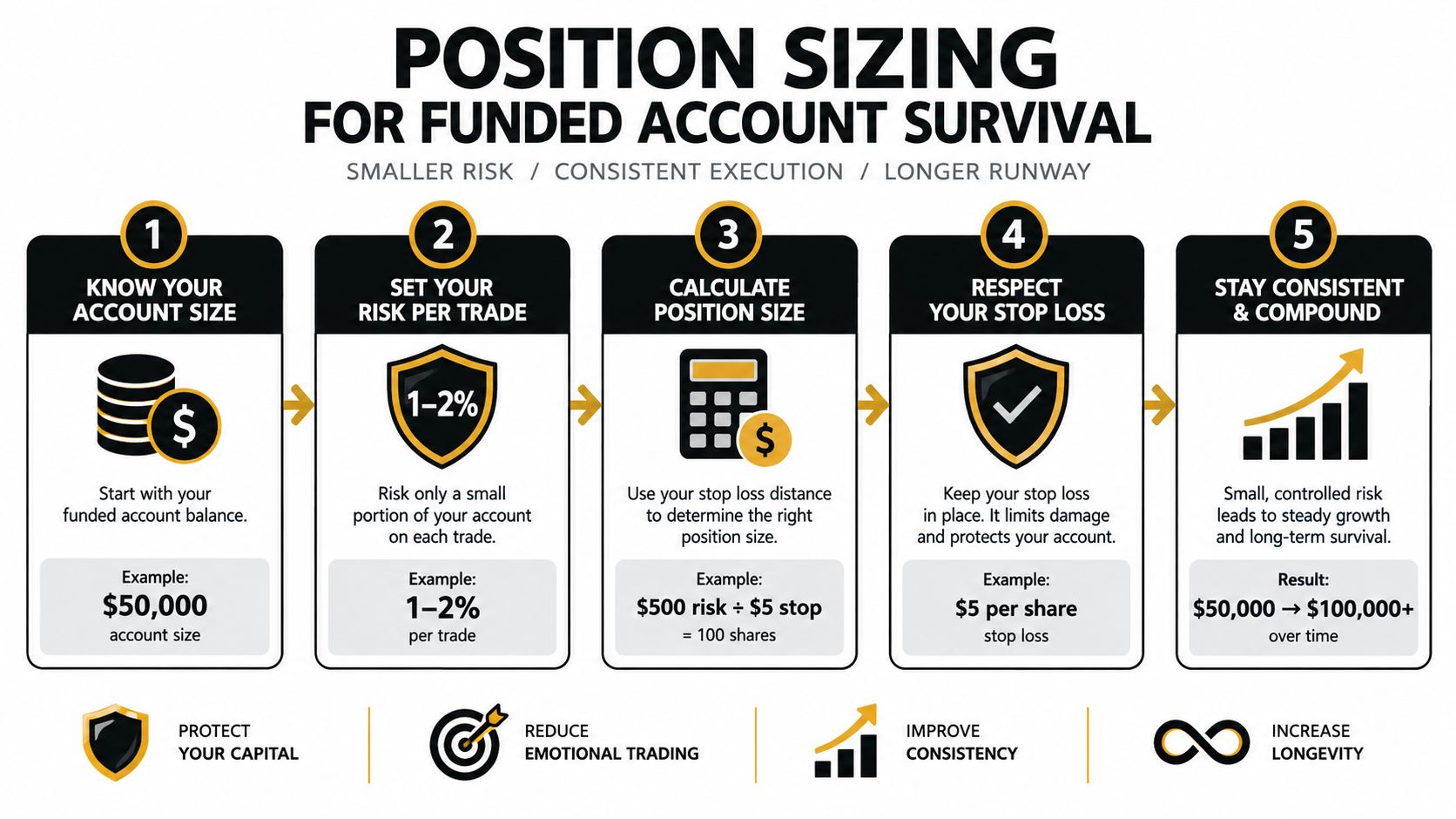
Step 1, define the follower risk budget
Set three limits before copying:
- Per-trade risk, the amount you accept losing if a copied position reaches its protective stop.
- Daily loss budget, the maximum combined loss from copied and manual positions during one trading day.
- Maximum account drawdown, the level that pauses the entire copy system for review.
A prop account leaves little room for sizing errors. MyFundedCapital publishes account parameters that include a flat 5% daily loss limit and up to 10% maximum drawdown, so copied trades should remain well inside those boundaries. Account types may have different terms, so verify the current conditions before trading.
Step 2, calculate a personal risk multiplier
Use this framework:
Follower risk multiplier = your permitted risk per copied trade ÷ leader-equivalent risk per trade
Reduce the copied size when the provider's trade would exceed your budget. If stops or position sizes are hidden, the leader's actual risk cannot be measured reliably. Treat that trade as unquantified, use the smallest practical allocation, or leave it uncopied.
Account size still matters. A proportional position can be too large when the instrument has a wide stop, high volatility, or expensive financing. Check the calculation with a position size calculator before enabling automated replication.
Step 3, cap correlated exposure
Apply the daily budget to the combined portfolio. Several leaders may open trades that react to the same economic event, so add their potential losses together. Giving each provider a separate full-risk allowance can exhaust the account when one market move affects every copied position.
Step 4, add a follower-level stop
The provider's stop cannot protect you from execution differences or losses elsewhere in the account. Set a personal equity stop that pauses copying when your predefined loss threshold is reached. It functions as a system brake rather than a forecast of the market's next turn.
Step 5, test before scaling
Run the copier at reduced size and compare the leader's fills with yours. Confirm whether the platform uses proportional sizing, fixed lots, or a multiplier. Test its handling of partial fills, rejected orders, closed trades, and positions opened before copying began.
Survival beats symmetry. Your account does not need to mirror the leader perfectly. It needs enough room to remain solvent when the leader's assumptions fail.
Keep unused capacity below the formal loss limits. Treat the daily limit as an emergency boundary you never approach, never as a target to spend. News spikes, slippage, correlated positions, and delayed exits can turn an apparently acceptable setup into a rule violation. Trading involves risk of loss, and one poorly sized session can invalidate a challenge or funded account.
Portfolio Construction and Pre-Committed Kill Rules
Copying several leaders doesn't automatically diversify you. Three providers who trade EURUSD during the London session may express the same macro view with different entry patterns. Their profiles look separate, but one currency move can pressure all three positions at once.
Build the portfolio by risk driver, not by follower count. Compare instruments, direction, trading window, holding period, borrowing, and reaction to news. A forex scalper, an index swing trader, and a crypto trend strategy may still correlate during a major risk event, so diversification should be treated as a hypothesis that requires monitoring.
Allocate by behavior
Start with a small group you can observe. For each leader, record:
- Primary market Which instruments drive the results?
- Trading window Does the provider concentrate exposure in one session?
- Holding period Are trades closed quickly, or can risk remain open through news and weekends?
- Loss pattern Does the strategy stop, hedge, average down, or add to losing positions?
- Correlation Would the providers likely lose under the same market shock?
A portfolio of uncorrelated strategies may reduce concentration, but it won't eliminate loss. Keep a portion of your risk budget unused so a new signal doesn't automatically consume capacity created by an earlier winner.
Write the kill rules before the drawdown
Exposure to top-trader outcomes can increase risk-taking and the share of risky assets. That makes pre-committed kill rules and automatic risk brakes important. The rule must be written while you're calm, not improvised while watching a losing position.
Use triggers such as:
- Pause copying after your follower-level drawdown reaches the limit you selected.
- Reduce allocation after a material increase in financial exposure, instrument diversity, turnover, or holding time.
- Stop and review when the leader begins averaging losses or abandons the exit behavior that justified selection.
- Override the system only to reduce risk, close exposure, or protect the account, never to widen a loss limit.
- Take a non-copying period when the leader's current behavior no longer matches the original thesis.
Normal variance means the strategy is losing within its expected process. Degradation means the process itself has changed. A few losing trades don't prove failure, but an unexplained shift in size, instruments, or recovery behavior deserves immediate attention.
The most disciplined action may be to copy nobody for a period. Adding another popular leader often increases exposure when the better decision is to reduce it.
Monitoring Execution Latency and Strategy Drift
A verified leader can still produce a poor follower outcome if your fills arrive later, your spread is wider, or your platform handles rapid orders differently. The displayed record belongs to the leader's execution path. Your result belongs to yours.
Followers often prefer riskier, high-volatility assets and trade more frequently, yet research has associated that behavior with more negative returns because of timing problems and hidden costs such as spreads, slippage, and financing charges. The findings are discussed in research on social trading behavior and retail returns.
Build an execution log
For every copied trade, record the leader's visible entry, your fill, the time difference, spread, commission, financing, and exit difference. You don't need a complex analytics stack at first. A spreadsheet with one row per trade can reveal whether the copier systematically enters late or exits at worse prices.
Review these questions each week:
- Latency Does your order arrive after the provider's price has already moved?
- Slippage Is the difference occasional, or does it widen during the strategy's most important trades?
- Trade frequency Does the strategy's turnover make costs consume much of the gross result?
- Position handling Does the platform copy partial closes, stop modifications, and rapid exits correctly?
- Instrument conditions Are spreads and financing still compatible with the provider's holding period?
You can learn more about the mechanics in this guide to slippage in trading. The point isn't to eliminate every difference. It's to determine whether the difference changes the strategy's expectancy.
Detect drift with a weekly comparison
Compare the leader's current behavior with the profile you approved:
- instrument list,
- average holding time,
- position size,
- borrowed capital,
- entry frequency,
- losing-trade response,
- exposure during major news,
- open-risk concentration.
A strategy drift alert should trigger when several of these change together. A provider who historically traded small swing positions but now opens frequent high-exposure trades isn't running the same process, even if the leaderboard still displays the earlier record.
The copier is part of the strategy. If execution costs change the distribution of wins and losses, the follower is no longer trading the leader's published edge.
Don't evaluate only by account equity. Measure net performance after all costs and compare it with the risk taken to achieve it. If the leader remains profitable while your copied result deteriorates, investigate execution before increasing allocation. If both results deteriorate and the provider's behavior has changed, use the kill rule rather than hoping the old record returns.
Common Friction Points and Next Steps
The first difficult moment usually arrives when a copied trade loses and the leader keeps it open. One trader closes manually, another widens the stop, and a third adds size because the leaderboard still looks attractive. None of those reactions is a risk plan.
Your response should already be defined. If the follower-level stop is reached, pause. If the leader's behavior still matches the approved process and the loss remains within normal variance, continue only at the size your rules allow. Don't manually override a system to turn a controlled loss into an uncontrolled one.
Social comparison creates another problem. Laboratory experiments reported by France's financial-markets regulator found increased risk-taking among participants, including those who didn't actively copy. The regulator's laboratory note on gamification and copy trading also illustrates how short performance windows can influence selection.
A practical transition into a prop environment
Before using a copier in a funded account, run a controlled test and document:
- the exact provider and authorization to use the tool,
- the platform and account connection,
- proportional sizing settings,
- maximum combined exposure,
- daily loss and drawdown brakes,
- news and weekend rules,
- the procedure for stopping every copied position.
Read the firm's current rules carefully. A copier must remain under your exclusive control where required, and the account remains subject to all risk and trading restrictions. A strategy that works on a personal account may fail under a flat daily limit because several apparently separate positions can lose together.
The right objective isn't to win a leaderboard. It's to preserve decision quality when the leaderboard turns against you. Trading involves risk of loss, and this article is educational only, not financial advice.
MyFundedCapital offers simulated funded accounts with Instant Funding and 1-Step or 2-Step Challenges, supports manual, algorithmic, and copy trading across its stated platforms and instruments, and applies defined daily-loss and maximum-drawdown rules. Review the current account types and copier conditions at MyFundedCapital before starting a challenge or comparing funding options.