Copy trading isn't a shortcut around market risk. A follower can receive worse fills, inherit hidden borrowed exposure, and breach account rules before understanding what happened. These eight copy trading risks explain how trader selection, execution, sizing, platform conditions, correlation, regulation, and psychology affect real account outcomes, followed by practical controls for testing the approach against stated prop-firm limits. Trading involves risk of loss. This article is educational only and isn't financial advice.
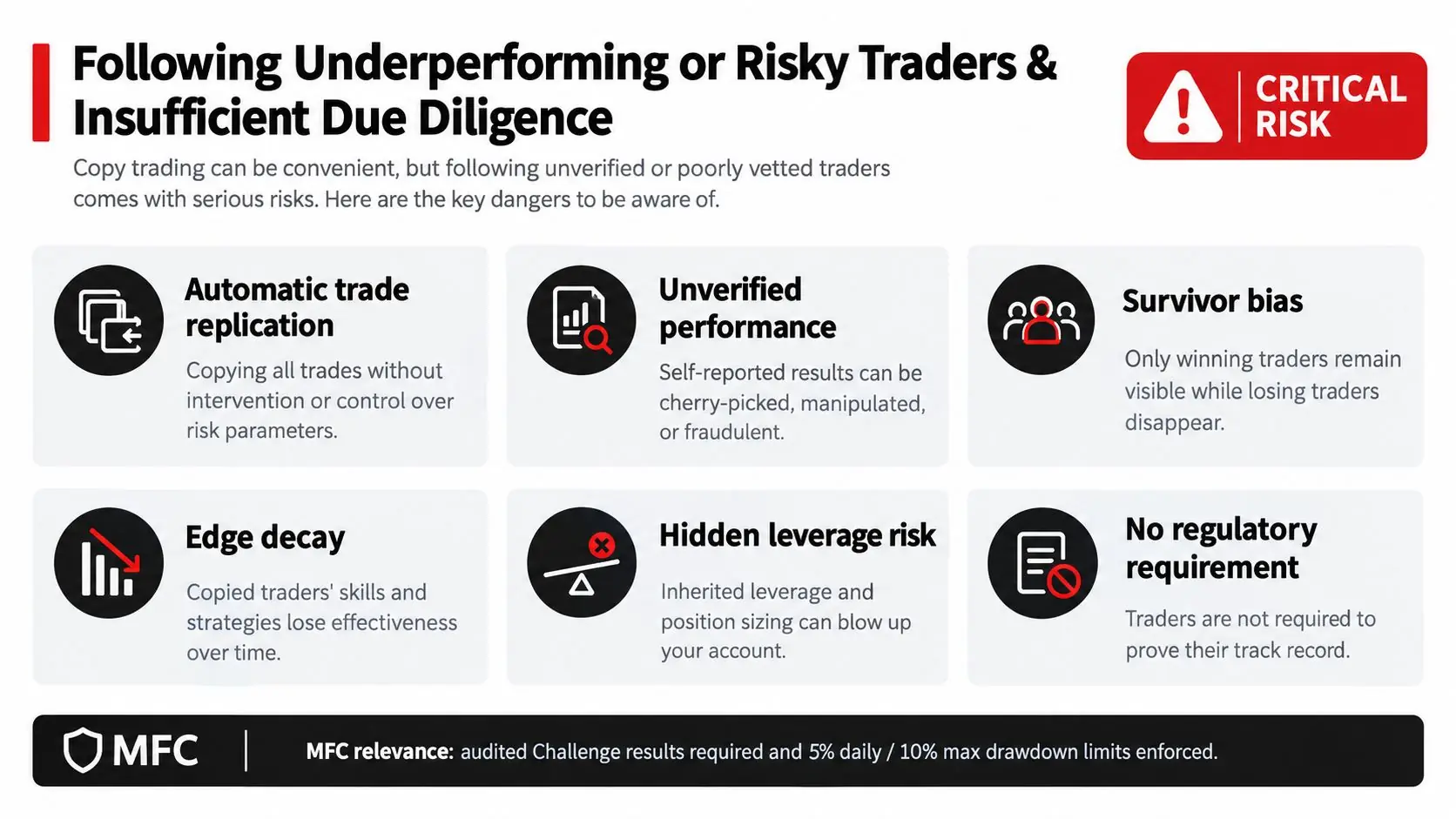
1. Following Underperforming or Risky Traders and Insufficient Due Diligence
Copy trading transfers decisions, but it doesn't transfer judgment. If the trader you mirror uses excessive borrowed capital, chases losses, or presents an incomplete record, your account can reproduce the same damage without giving you the context behind each position.
A winning streak can hide fragile risk. For example, a trader might display repeated profitable trades, then respond to a drawdown by boosting position size. Your account follows the new behavior automatically, even though your balance, broker, execution conditions, and loss limits may differ.
Social-media screenshots are especially weak evidence. They rarely show losing periods, open exposure, borrowed funds, or the complete trade history. A self-reported record can make luck look like skill, while a trader who refuses verification gives you no reliable way to distinguish a repeatable process from selective presentation.
What to verify before allocating capital
Look for a complete record across changing market conditions rather than a short burst of attractive results. Ask for trade-level information and examine how the trader behaves when positions move against them.
- Review a sustained record Prefer a verified history covering a meaningful period, not only recent winners.
- Request independent evidence Look for broker-verified records, audited statements, or transparent platforms such as MyFxBook and TradingView.
- Inspect the trade log Check entries, exits, margin, position size, holding time, and concurrent positions.
- Study losing sequences Calculate the average win, average loss, and longest losing run yourself.
- Start with a limited allocation Use a small portion of the account until execution and behavior have been tested.
Practical rule: Treat a trader's risk process as more important than a leaderboard position. A polished return page doesn't tell you how the account behaves under stress.
Use the MyFundedCapital guides to review trading and risk-management concepts before copying a strategy. The same principle applies to due diligence after a deal, because verification matters before exposure, not after losses appear.
2. Slippage and Execution Delays in Fast Markets
The source trader's fill isn't your fill. Copying creates a chain between the original order and the follower's order, and that chain can include platform processing, broker routing, network latency, liquidity changes, and price movement.
The difference matters most when the strategy depends on tight stops or small gains. A source trader may enter at a price that still makes the setup valid, while your order arrives after the market has moved. A stop that was sensible for the source account can become too close for yours, turning a small planned loss into a larger one.
IOSCO's work on online imitative trading identifies timing and pricing risk as a direct concern. When a lead trader has many followers, copied demand can also affect execution in fast or illiquid markets, causing follower orders to receive materially worse prices than the original signal. IOSCO's review of imitative trading also highlights platform glitches and cyber incidents as operational risks that can translate into investor losses.
Build an execution test before going live
Don't judge a copying system only by its advertised synchronization. Test it in the market conditions where the strategy normally operates.
- Compare broker fills Check spreads, execution speed, rejected orders, and average slippage for the instruments you plan to copy.
- Avoid fragile timing Be cautious with scalping around CPI, NFP, ECB meetings, and other major releases.
- Test connectivity A stable wired connection can reduce local network problems, but it can't eliminate broker or platform delays.
- Set slippage controls Binance Spot Copy Trading guidance illustrates the mechanic clearly. Users can set acceptable slippage up to 3%, with default caps of 0.3% for BTC/USDT and ETH/USDT and 0.5% for other pairs. Binance's copy-trading guidance shows why price drift must be treated as part of the strategy.
- Scale entries carefully Where the platform allows it, avoid committing full size before confirming that the copied position is being filled as expected.
3. Lack of Transparency in Strategy and Position Sizing
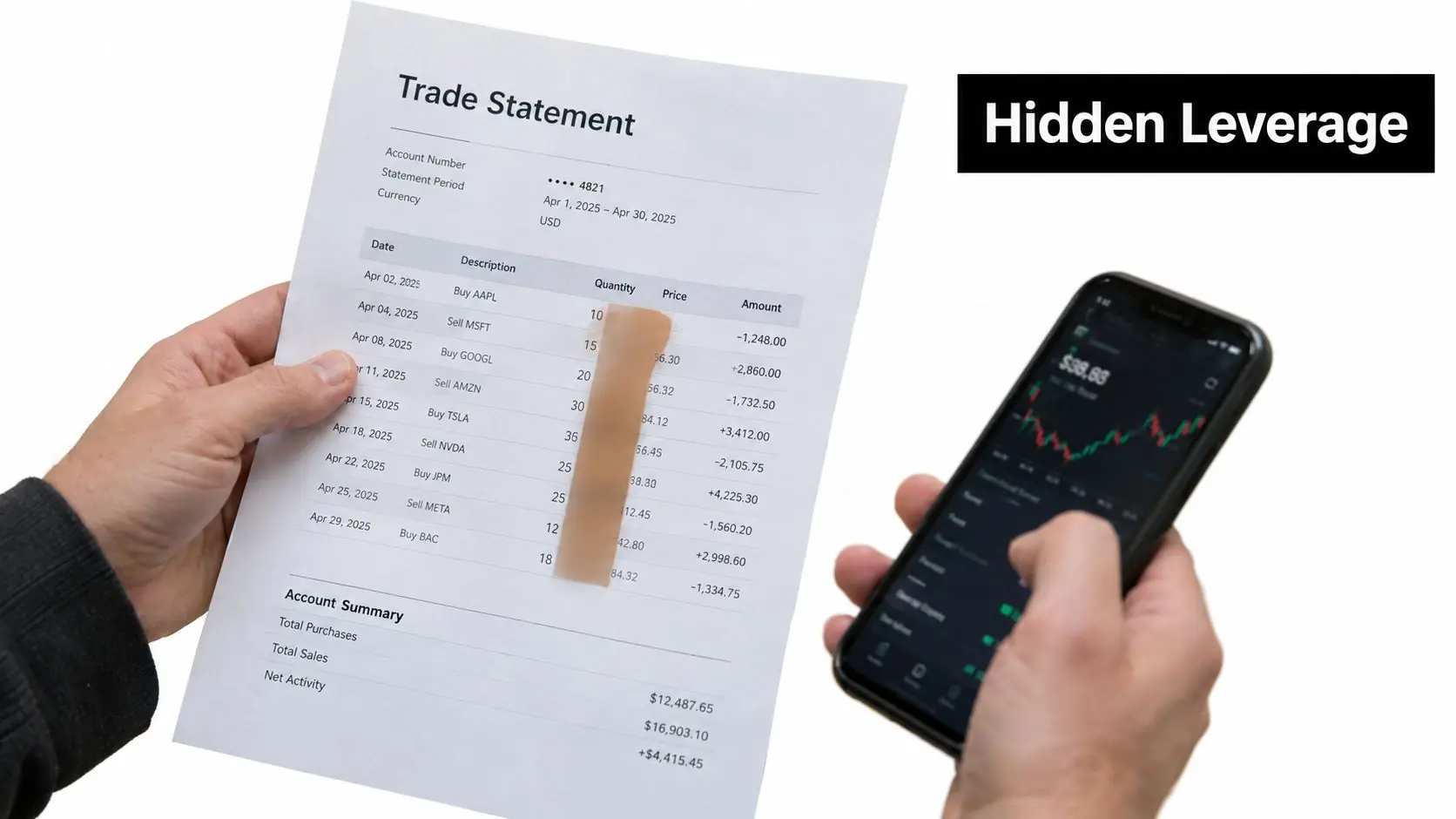
A return percentage doesn't reveal the exposure that produced it. Two traders can show similar gains while taking completely different risks, one through controlled sizing and another through concentrated positions, amplified exposure, or a sequence of trades that leaves little room for error.
This makes position sizing a central copy trading risk. If the source trader operates with a larger balance, a different margin structure, or greater tolerance for drawdown, copying absolute trade sizes can distort the intended risk. A position that looks modest on the source account may consume too much of a smaller follower account.
The problem also appears when a trader combines several methods without labeling them. An account might mix systematic entries with discretionary trades taken after a loss. The headline performance hides the fact that the most damaging positions may come from behavior the follower never intended to copy.
Convert copied trades into your own risk limits
Before enabling replication, ask the trader how risk is calculated and how positions change as the account grows or declines. If the answer is vague, the strategy isn't transparent enough for disciplined allocation.
- Ask direct questions What is the average risk per trade? What position size multiplier is used? How many positions can remain open together?
- Use proportional sizing Match each copied position to your balance and risk budget instead of blindly mirroring volume.
- Set a personal ceiling A 2% risk-per-trade rule can serve as a planning reference, but you must adapt it to the account's actual rules and your tolerance.
- Check aggregate exposure Several individually acceptable trades can still create excessive exposure to one currency, sector, or market event.
- Test before scaling Run the strategy in a Challenge environment and observe how its sizing interacts with drawdown rules.
A prop account adds a second layer. MyFundedCapital states that it supports manual, algorithmic, and copy trading, subject to its risk rules and a prohibition on exploiting platform vulnerabilities. Its stated limits include a 5% daily loss limit and up to 10% maximum drawdown, so a sizing model that appears acceptable in a personal account may be unsuitable in an evaluation or funded environment.

4. Platform and Liquidity Mismatches Between Source and Copied Accounts
Copying works best when both accounts can access comparable instruments, spreads, liquidity, and order types. A source trader using one broker's pricing and infrastructure may obtain an entry that a follower cannot reproduce on another platform.
Spread differences can remove the edge from a short-term setup before the market moves. Instrument mismatches create a more serious problem. If the follower's broker doesn't support the symbol, the order may be rejected, skipped, or handled differently, leaving the copied account out of sync with the source.
The platform also affects recovery. A disconnected copier, rejected order, or delayed close can leave a position open after the source trader has exited. That isn't merely a technical inconvenience. It changes the account's market exposure and can invalidate the original stop, target, or risk calculation.
Compare the trading environment, not just the trader
Build a like-for-like checklist before copying across brokers or platforms.
- Match instruments Confirm that both accounts offer the same symbols, contract specifications, trading hours, and order types.
- Compare live spreads Observe the instruments during normal and volatile sessions instead of relying on a static marketing page.
- Test rejected orders Check what happens when an order can't be placed, partially fills, or loses connection.
- Review infrastructure Platforms such as cTrader and DXtrade may provide different workflows and execution conditions, so compare the features relevant to your strategy in cTrader versus MT5.
- Adjust expectations If the follower consistently pays a wider spread, profit targets and stop placement may need to account for that cost.
Avoid assuming that a popular platform guarantees equivalent execution. The source trader's apparent edge may depend on liquidity access or pricing that your account doesn't share. A copier should be evaluated as its own execution system, with its own fills and failure modes.
5. Correlation and Concentration Risk Across Multiple Copied Traders
Following several traders can create the appearance of diversification while leaving the account exposed to one underlying bet. Five different profiles may all trade the same currency direction, use the same breakout logic, or react to the same economic event.
That hidden correlation becomes visible during a regime change. If multiple traders hold related long positions and the market reverses, the account doesn't experience several independent losses. It experiences one concentrated loss through several channels. The follower may also receive repeated entries and exits around the same price level, increasing costs and exhausting the available loss buffer.
A similar issue affects timeframes. Several scalpers may respond to the same short-term signal, while swing traders may hold related exposure for longer. Combining them can create a larger net position than the account owner intended.
Map the portfolio before calling it diversified
Analyze the behavior of the group, not only each trader's profile.
- Group by asset Record whether traders repeatedly use the same pairs, indices, crypto assets, or commodities.
- Group by method Separate trend, mean-reversion, breakout, scalping, and discretionary approaches.
- Check timeframes A short-term and longer-term trader can still be correlated if both depend on the same directional move.
- Cap individual exposure Set a maximum allocation to each trader and review the combined open risk.
- Stress the basket Model how simultaneous positions would behave after an adverse market move before enabling full-size copying.
Don't rely on a numerical correlation threshold as a substitute for judgment. Correlations can change precisely when markets become stressed, and a historical matrix may not capture borrowed exposure, stop clustering, or shared event risk. Diversification is useful only when the positions and decision rules are truly different.
6. Strategy Decay and Edge Erosion Over Time
A trader's past edge belongs to a particular market environment. Volatility, liquidity, spreads, participant behavior, and crowded positioning can all change, leaving a once-effective setup less reliable.
The follower often notices the deterioration late because leaderboards emphasize accumulated performance. A trader may still rank highly after the underlying method has weakened. Meanwhile, automatic copying continues to compound the new, lower-quality signals.
The risk isn't limited to a trader becoming less skilled. A strategy can decay because its conditions disappear. A breakout approach may struggle when ranges tighten, while a low-liquidity crypto method may lose its advantage after activity moves into more liquid assets. The source trader might adapt, but the follower won't know whether the rules, instruments, or risk profile have changed unless they monitor the account.
Create a review system
A review routine should compare current behavior with the reasons you selected the trader.
- Track rolling performance Review returns, win rate, average loss, holding time, and drawdown over several months.
- Monitor behavior changes Note new instruments, larger positions, longer holding periods, or more frequent trades.
- Set a decay trigger If performance falls materially below its normal range for a sustained period, reduce the allocation or pause copying.
- Ask for an explanation A legitimate strategy change should be documented, not discovered only through a large loss.
- Re-test periodically Use a Challenge environment to see whether the current approach still fits the account's rules.
A good historical record is evidence of what happened. It isn't proof that the same process will work in the next market regime.
Re-evaluate copied traders on a scheduled basis rather than after an emotional loss. The review should cover both performance and process. A smaller return with consistent risk may be more compatible with a prop account than an aggressive strategy that repeatedly approaches the drawdown boundary.
7. Regulatory and Tax Complexity in Global Copy Trading
Copy trading can cross several legal and operational boundaries at once. The platform may be in one jurisdiction, the lead trader in another, the broker somewhere else, and the follower subject to local rules that none of the other parties explain clearly.
The classification of the service matters. The European Securities and Markets Authority's supervisory briefing on copy trading explains that copy trading can fall under portfolio management or investment advice, bringing suitability requirements under MiFID II. That means firms offering automated copying may need to consider whether the service and underlying trades are appropriate for each client.
Protection also depends on the provider and jurisdiction. A lightly regulated broker may offer fewer safeguards or less practical recourse if the platform fails, freezes withdrawals, or disputes a transaction. Tax treatment can likewise vary according to the instrument, account structure, realization of gains, and local reporting rules.
Document the legal and tax position
Do this research before funding the account, not after receiving a statement.
- Check the provider Confirm the broker's authorization, client-money arrangements, complaints process, and applicable regulator.
- Ask about the service Determine whether copying is treated as advice, portfolio management, execution-only trading, or another category.
- Keep complete records Save trade confirmations, entries, exits, fees, deposits, withdrawals, and account statements.
- Confirm tax treatment Speak with a qualified tax professional who understands the relevant forex, CFD, or crypto rules in your country.
- Verify the lead trader If local law requires licensing or restrictions on solicitation, check whether the trader and platform comply.
Don't assume that a platform's global availability means it offers the same protection everywhere. The legal environment affects what happens when execution fails, a provider becomes insolvent, or a dispute arises.
8. Emotional Contagion and Over-Reliance on Copy Trading
Automation can reduce decision fatigue, but it can also reduce awareness. When a follower doesn't understand why a position was opened, a normal losing trade can feel like a sudden betrayal, while a winning streak can create unjustified confidence.
Research on copy trading found that showing people others' success increased risk-taking, with a stronger effect when they could directly copy trades. The work concluded that copy trading can encourage excessive risk-taking and lower ex-ante welfare. The research on copy trading and risk-taking supports a practical warning: visible success can change the follower's behavior before the strategy has proved suitable for their account.
The source trader's emotions can propagate too. A trader who increases exposure after losses or becomes aggressive during a strong trend may pull the follower into the same behavior. If the follower then stops copying at the worst moment, the result combines the source trader's risk with the follower's panic.
Keep control of the account
Copy trading should remain an allocation decision, not a surrender of responsibility.
- Review trades weekly Understand the instruments, direction, sizing, and reason for major positions.
- Set a stop-copying rule Define in advance what drawdown, behavior change, or process failure will trigger a pause.
- Use limited exposure Keep enough capital outside the copied strategy to avoid making one trader's decisions your entire plan.
- Set alerts Investigate large losses, rejected orders, and unusual position sizes before allowing further replication.
- Keep a journal Record why you chose the trader and what evidence would make you change the decision.
For structured practice, review trading psychology drills and test how you respond to losses before increasing exposure. A copier that can't explain its risk limits isn't ready for live allocation, regardless of how attractive the leader's recent results look.
8-Point Copy Trading Risk Comparison
| Issue | Implementation complexity 🔄 | Resource requirements 💡 | Expected outcomes ⭐ / 📊 | Ideal use cases ⚡ | Key advantages & mitigations |
|---|---|---|---|---|---|
| Following Underperforming or Risky Traders & Insufficient Due Diligence | Very high, continuous vetting and verification needed 🔄🔄🔄 | Extensive: audited performance, full trade logs, small pilot capital, third‑party verification | Low predictability; high downside; Risk: Critical ⭐ (low) 📊 (high downside) | Only when trader has audited, long-term track record; otherwise avoid | Passive income potential if verified; mitigate with 10–20% pilot allocation, request 6–12 months audited records 💡 |
| Slippage and Execution Delays in Fast Markets | Medium, technical testing and platform selection required 🔄🔄 | Low–medium: low‑latency platform, broker slippage stats, wired internet, testing window | Performance erosion for tight-stop/scalps; outcome variance ↑ in news events ⭐ (variable) 📊 (fill quality sensitive) | Best for non‑scalp, slower strategies; avoid during high‑volatility news ⚡ | Automates entries (fewer manual errors); mitigate by using low‑latency platforms, avoiding scalps at news, pre‑testing slippage 💡⚡ |
| Lack of Transparency in Strategy and Position Sizing | Very high, opaque metrics make risk assessment difficult 🔄🔄🔄 | High: request position sizing rules, leverage disclosure, detailed trade logs, position sizing tools | Hidden leverage → catastrophic loss; Risk: Critical ⭐ (poor visibility) 📊 (large tail risk) | Only when trader publicly documents risk rules and sizes | Reduces cognitive load if transparent; mitigate by asking risk% per trade, scaling to 2% rule, refusing opaque traders 💡 |
| Platform and Liquidity Mismatches Between Source and Copied Accounts | Medium-high, matching platforms/brokers often required 🔄🔄🔄 | Medium: same platform/broker, spread comparisons, instrument parity, uptime SLA | Worsened fills and costs; missed instruments; Risk: High ⭐ (depends on match) 📊 (execution/edge impact) | Ideal when both source and copier use institutional-grade platforms (cTrader, DXtrade) | Better execution if matched; mitigate by verifying instruments/spreads, using same platform, testing live spreads 💡 |
| Correlation and Concentration Risk Across Multiple Copied Traders | Medium, requires portfolio‑level analysis 🔄🔄 | Medium: correlation tools, diversification across assets & strategies, exposure caps | Diversification may be illusory; correlated drawdowns can be severe; Risk: High ⭐ (diversification questionable) 📊 (aggregate exposure risk) | Use when traders are genuinely uncorrelated; avoid copying many similar-strategy traders | Simpler monitoring if correlated; mitigate with correlation heatmaps, limit % per trader, stress‑testing combined positions 💡 |
| Strategy Decay and Edge Erosion Over Time | Medium, requires ongoing monitoring and alerts 🔄🔄 | Low–medium: performance tracking, decay alerts, quarterly re‑eval, diversification | Gradual loss of edge; delayed detection → compounding losses; Risk: Medium‑High ⭐ (time‑sensitive) 📊 (performance drift) | Best when trader actively adapts strategies and you re‑evaluate regularly | Passive while edge holds; mitigate with decay alerts, 3‑month re‑evaluations, reduce size when returns fall >20% vs average 💡 |
| Regulatory and Tax Complexity in Global Copy Trading | High, legal/tax research and compliance necessary 🔄🔄🔄 | High: regulated broker selection, tax advisor, record keeping, jurisdiction checks | Potential for legal/tax surprises and limited recourse; Risk: Medium ⭐ (compliance dependent) 📊 (reporting/recourse impact) | When seeking global trader access but using regulated intermediaries | Access to global talent; mitigate by using FCA/CySEC/ASIC brokers, keeping detailed statements, consulting tax pros 💡 |
| Emotional Contagion and Over‑Reliance on Copy Trading | Low–medium, behavioral controls and rules required 🔄🔄 | Low: monitoring routine, stop‑copy rules, portioned account for own trades, alerts | Loss of trading agency; poor responses to drawdown; Risk: Medium ⭐ (psychological) 📊 (behavioral cost) | Suitable for users wanting passive exposure but retaining oversight | Low cognitive load if trusted; mitigate with predetermined stop‑copy rules, limit copy % (50–70%) and keep own capital for learning 💡 |
Build a Copy Trading Risk Checklist
Copy trading is best treated as an execution-and-risk-control problem, not just a trader-selection exercise. A skilled source trader can still produce a poor follower outcome when the follower receives worse pricing, uses unsuitable sizing, faces different liquidity, or reaches an account limit before the original trade is closed.
Use a compact checklist before and during allocation:
- Verify the record: Look for complete, independently supported performance and inspect losing periods, not just visible winners.
- Inspect borrowing and sizing: Confirm average risk per trade, concurrent exposure, margin use, and how position sizes change.
- Test execution: Compare spreads, fills, synchronization, rejected-order handling, and disconnect recovery between source and copied accounts.
- Cap aggregate exposure: Review all copied positions together, including shared currencies, indices, crypto assets, and event risk.
- Monitor strategy decay: Schedule performance and process reviews, then reduce or pause copying when the method changes or deteriorates.
- Check jurisdictional duties: Confirm provider regulation, suitability implications, recordkeeping requirements, and local tax treatment.
- Match prop-firm rules: If copying in a prop environment, test the strategy against daily loss, maximum drawdown, news, weekend, instrument, and platform requirements before scaling.
IOSCO's evidence base warns that copy trading can expose retail investors to misleading disclosure, loss of control, complex or volatile products, and technical or cyber-related failures. Its broader message is simple: copying doesn't remove market exposure. It can reproduce the original trader's loss while adding delays, slippage, and operational problems. IOSCO's report on online imitative trading is therefore useful as a risk framework, not as a promise that any platform or trader is safe.
Independent market evidence points in the same direction. A 90-day study of 100,236 copier outcomes found that 48.48% were profitable and 51.52% ended in losses. Although 97% of leader accounts were green, only 43.61% of follower returns were positive, showing why leader performance doesn't automatically transfer to the copier. The study of copier outcomes reinforces the need to evaluate execution, fees, sizing, and concentration alongside the source trader's record.
Frequently asked questions
Is copy trading safe?
No trading method is risk-free. Copy trading can expose you to the source trader's losses, execution differences, magnified positions, platform failures, concentration, and changes in strategy. It becomes more controlled when you verify the record, limit allocation, test execution, and monitor the account, but no platform feature removes the risk of loss.
How should you choose a trader to copy?
Choose based on transparent process and compatible risk, not short-term returns alone. Review the complete record, maximum drawdown, borrowed capital exposure, trade frequency, instruments, position sizing, losing sequences, and evidence of independent verification. The trader must also fit your broker, account size, objectives, and applicable rules.
How does slippage affect copied trades?
Slippage is the difference between the source trader's execution price and your fill. Delays, liquidity conditions, spreads, and platform issues can turn a profitable source trade into a smaller gain or a loss for the follower. Test the copier during normal and volatile sessions, compare broker conditions, and use available slippage controls.
How do prop-firm limits change copy-trading risk?
A prop firm can impose rules that make aggregate exposure and execution timing more important. MyFundedCapital states a 5% daily loss limit and up to 10% maximum drawdown, so a strategy that survives in a personal account may still breach the firm's limits when copied trades arrive late, overlap, or use unsuitable sizing. Review the firm's current rules and test the copier before committing to an evaluation or funded account.
MyFundedCapital offers Instant Funding and 1-Step or 2-Step Challenges, with copy trading supported subject to its risk rules and platform-vulnerability restrictions. Visit MyFundedCapital to learn about the funding programs, compare account types, and review the stated limits before deciding whether the conditions suit your strategy.