

The most striking clue about the best copy trading platform in USA isn't a platform feature: 29% of U.S. investors used social media or message boards for investment decisions, according to the FINRA Foundation's 2024 National Financial Capability Study. Copy trading puts that social influence closer to the execution button, so a sensible comparison must look beyond leaderboards and advertised returns.
The key distinction is whether a service lets you observe a trader's activity, helps you decide what to trade, or automatically places trades in your account. Those are different products, with different costs, controls and regulatory questions. Funded-account programs are different again: traders use firm capital under program rules rather than copying trades in a personal brokerage account.
Top US Copy Trading Platforms at a Glance
| Platform | US access | Copy method | Cost basis | Best starting point |
|---|---|---|---|---|
| eToro CopyTrader | Through its US broker-dealer | Copy a selected trader | Read the provider's fee schedule before funding | Investors wanting a regulated broker's copy feed |
| Robinhood Social | Available to US users | Follow verified traders; no automatic copying | Read the fee schedule for trades you place yourself | Observers who decide each trade themselves |
| cTrader-based copy | Through a broker offering the service | Copy through the cTrader ecosystem | Performance, management and volume charges set by each strategy or broker | Traders comparing outcome-based costs |
| MyFundedCapital | MyFundedCapital Terminal only | Copy trading within trading rules | 0.01% per side, $0.50 minimum per side, no platform fee | Traders seeking funded accounts with prop-friendly rules |
This table works as a filter. A follow-only social feed suits someone who wants to make each decision personally, yet it cannot serve a trader who needs automated execution. A broker-based copier differs again from a funded program, where firm rules rather than account-holder preference determine how trades can be placed.
eToro CopyTrader operates in the U.S. through its broker-dealer. It is a potential starting point for investors seeking a broker-based copy feed, though the fees and instruments on offer should be checked against the terms of the U.S. account specifically.
Robinhood Social lets users follow verified traders without automatic copying. It works better as a way to discover or observe trading activity than as a hands-off copier, so the cost question reduces to what you pay on trades you place yourself.
cTrader-based copying is offered through brokers that support the cTrader ecosystem. The fee structure can combine performance, management and volume charges, with the exact mix depending on the strategy and broker you choose. Compare the full cost rather than one headline figure.
MyFundedCapital runs its programs only on the MyFundedCapital Terminal, a web platform opened from the dashboard after purchase. Copy trading is permitted between a trader's own accounts and from other traders or signal services, provided the account avoids martingale, opposite trades across accounts or firms, and all-in bets. That makes it a funded-account product with its own rulebook, a different category from a conventional brokerage copy service.
Social discovery can also expose investors to questionable promotions. For a separate checklist on checking token safety before buying, focus on whether a project's claims and risks can be independently assessed, rather than treating online popularity as proof of quality.
Each row solves a different problem: who can open the account, whether trades copy automatically, what a position costs in full and whom the product suits.
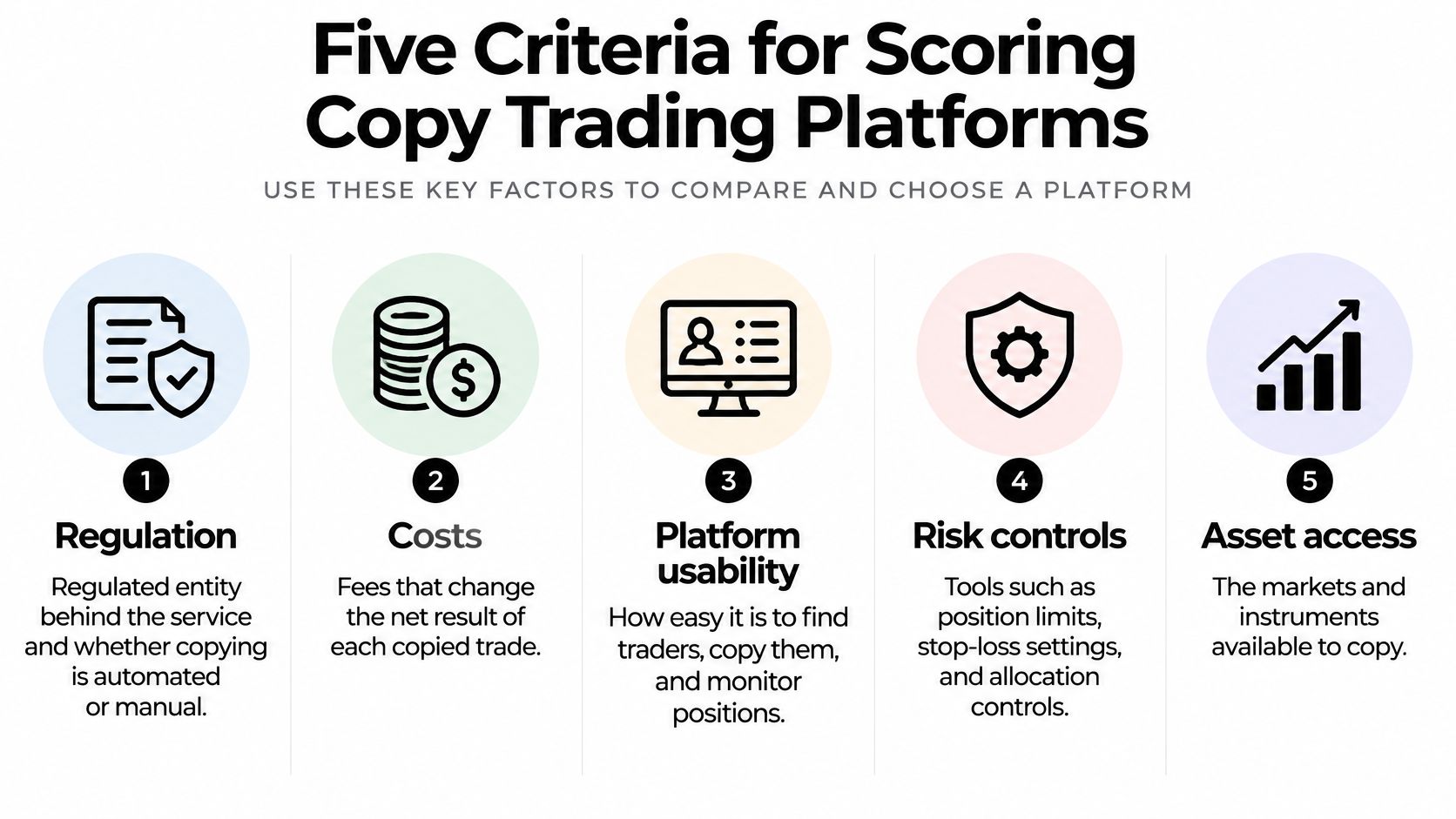
Five Criteria for Scoring Copy Trading Platforms
A useful comparison needs to measure what happens between a trader's decision and your account's fill, not just how a strategy appears on a ranking page. These five criteria provide a consistent way to assess each option.
Regulation. Identify the legal entity behind the service and determine whether you're viewing signals, copying automatically or giving another party discretion over trades. Check the relevant registration status with the SEC, FINRA, CFTC or NFA where applicable.
Fees. Add performance, management and volume charges to spreads, trading commissions and slippage. Compare the result as a net cost, not as a single advertised rate.
Instruments. Confirm which assets can be copied in your U.S. account, and check the trading terms that apply. A global platform's menu doesn't establish that every product is available to U.S. residents.
Latency. Compare the leader's fill with the follower's fill on the same trade. A leaderboard can't tell you whether delayed entries materially change a strategy's outcome.
Social features. Look for clear trader vetting, verifiable performance evidence, usable exposure limits and a simple way to stop copying.
Advertised return isn't a scoring criterion. FINRA defines auto-trading as a third party sending trading instructions directly to a brokerage account for immediate execution. Its guidance on auto-trading and unregistered entities points to more useful tests: order-routing latency, slippage, rejected-order rates, position-sizing controls, stop-loss enforcement and audit logs. FINRA also warns that unregistered services don't carry the regulatory oversight and investor protections that apply to registered investment advisers.
A platform that can't explain its controls shouldn't be treated as equivalent to one that can, even if its leaderboard displays higher returns. Check whether you can set a fixed-dollar or percentage allocation, cap copied exposure, set an equity drawdown stop and disable copying immediately. The later evidence test focuses on the quality of trader records, not their promotional ranking.
Regulation and Who Executes Your Copies
Who executes the copy, and under which entity's terms? That's the question to answer before comparing assets or funding an account. Merely displaying another trader's activity differs from automatically transmitting trades, exercising discretion or managing positions. The legal and operational questions change with the service.
FINRA notes that securities copy trading can raise questions about whether a provider is acting as a broker-dealer or investment adviser. For retail forex, the CFTC's foreign-currency trading guidance says that people who solicit orders, exercise discretionary trading authority or operate forex pools may need registration in an appropriate category, such as introducing broker, commodity trading advisor or commodity pool operator.
| Asset or product | Copy trading allowed | Regulated entity to check | What to verify |
|---|---|---|---|
| U.S. stocks and ETFs | Yes, through eToro's U.S. broker-dealer | Broker-dealer registered with the SEC and FINRA | Copy rules and the account's regulated entity |
| Options | Not established here; confirm availability | Broker or clearing entity | Options approval level on the copying account |
| Crypto | Not established here; confirm availability | Entity named in the terms | Custody and licensing status |
| CFDs | Not established here; verify whether offered to U.S. residents | Entity offering CFDs to the reader's residence | Whether the product is available to U.S. residents |
| Forex | Depends on the intermediary | Introducing broker or CFTC-registered entity | Deposit requirements and the applicable leverage framework |
| Funded program trading | Yes, within program rules | The firm providing capital under its terms | Daily loss limit and drawdown rules in the terms |
For retail forex, the federal security-deposit framework requires at least 2% of notional value for major currency pairs, equivalent to 50:1 ratio, and 5% for other pairs, equivalent to 20:1 ratio, under the CFTC's retail forex rules. Check that the broker or intermediary operates within the applicable U.S. framework and provides the required forex risk disclosures.
A funded-account product has a different relationship from copying trades in a personal brokerage account: the trader operates with the firm's capital under the firm's rules. Read the terms to identify the actual counterparty and the conditions governing the account. A broker-selection checklist for traders can help frame the questions, but registration alone doesn't remove trading risk. Before depositing or buying a program, name the entity in the terms and confirm that the product is available to you.
Fees and Net Cost per Copied Trade
A headline fee understates what copying costs. Spreads, slippage and per-trade charges sit on top of it, so compare options at the same account size and holding period, then model low, medium and high trading activity. That shows whether a strategy's trade frequency or execution delay moves the total enough to change the decision.
| Platform | Performance fee | Management fee | Volume or trading cost | Net-cost check |
|---|---|---|---|---|
| cTrader-based copy, documented | Up to 40% | Up to 10% a year | Volume fees | Model all three charges at your expected trade count |
| MyFundedCapital | No copying fee stated; profit split of up to 95% is a payout share | Not stated | 0.01% per side, $0.50 minimum per side, no platform fee | Add the one-time program price to expected costs |
| eToro CopyTrader | See the provider's current fee schedule | See the provider's current fee schedule | See the provider's current fee schedule | Model spread and slippage on top of quoted charges |
| Robinhood Social | Not applicable to automatic copying | Not applicable to automatic copying | Check charges for the trades you place | No automatic copy, so assess only what you trade |
The cTrader Copy fee documentation lists three potential charges: performance fees, annual management fees and volume fees. Costs can also include spreads, commissions and slippage. Slippage matters because your entry may arrive after the lead trader's, changing your entry price, drawdown or stop-loss outcome. Review how spreads in trading affect the gap between the price you see and the price at which an order executes.
A worked example makes the arithmetic concrete. On a copied trade representing $10,000 in traded value, 0.01% per side costs $1 on entry and $1 on exit, before any effect from slippage. The Instant Funded program carries a separate one-time price of $95 for a $5,000 account, $189 for $10,000, $409 for $25,000, $599 for $50,000 and $999 for $100,000. Keep the program price apart from per-trade costs when estimating your total outlay.
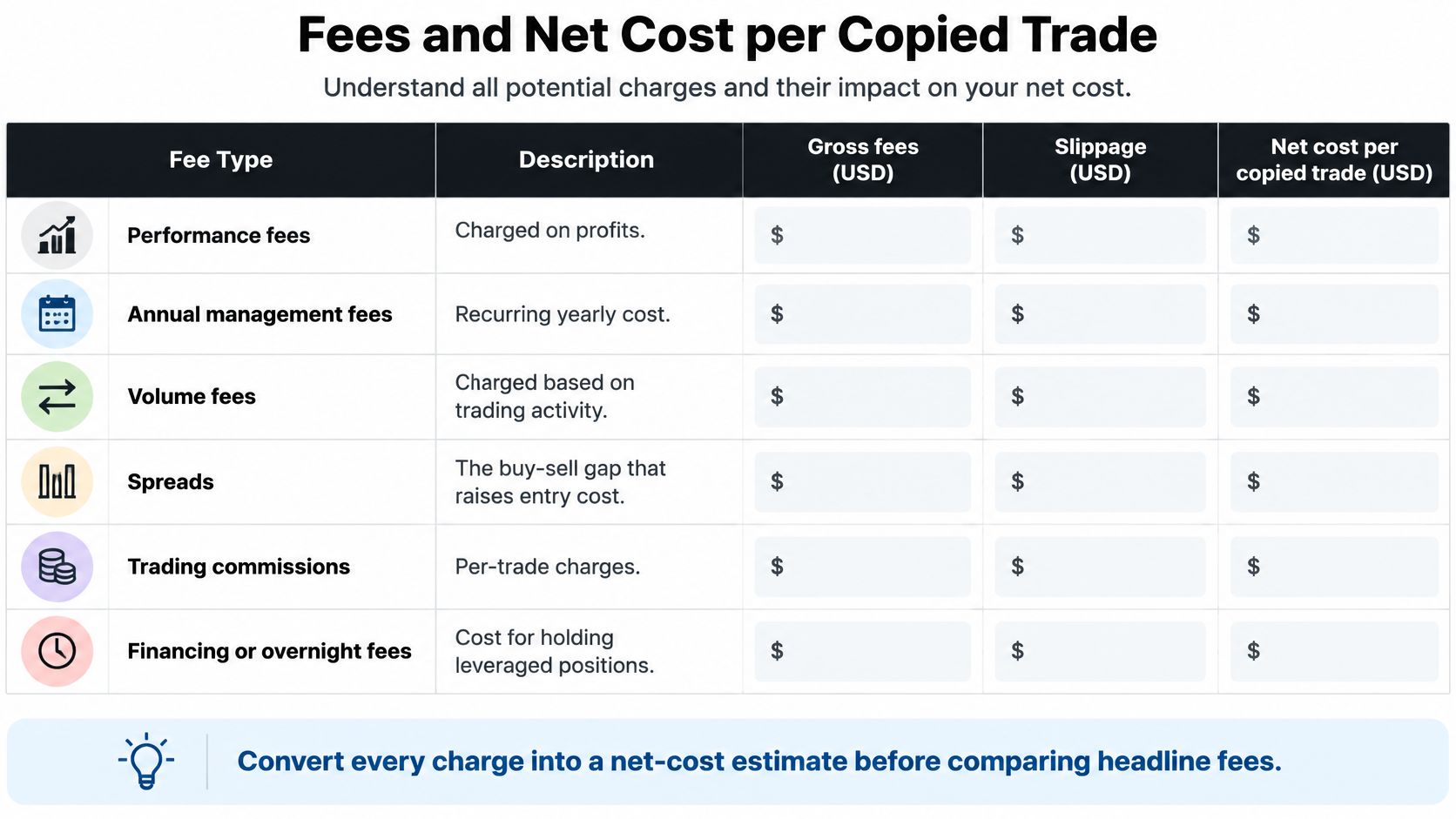
Compare the net figure at your expected trade count, not the lowest advertised fee. The effect of any charge depends on what you trade, how often you trade and how long positions stay open.
Markets, Leverage and Copy Latency
High exposure can disqualify an option before its market breadth becomes relevant. For U.S. retail forex, the deposit framework is equivalent to a maximum of 50:1 for major pairs and 20:1 for other pairs, based on the CFTC retail forex requirements. A program advertising a higher ratio needs careful scrutiny for U.S. eligibility.
| Platform | Markets | Forex leverage |
|---|---|---|
| MyFundedCapital Terminal | 750+ markets, including FX, metals, crypto, indices, U.S. stocks and Prediction Markets | 1:30 Instant Funded, 1:50 1-Step, 1:100 2-Step |
| MFC Stocks | 1,500+ U.S. stocks and ETFs with full consolidated SIP prices | Not applicable |
| eToro CopyTrader | Confirm instruments available to the U.S. account | Not established here |
| cTrader-based copy | Set by the broker offering cTrader | Set by the broker |
| Robinhood Social | Confirm instruments available to the U.S. account | Not applicable |
The MyFundedCapital Terminal offers access to 750+ markets, including FX, metals, crypto, indices, U.S. stocks and Prediction Markets, with the same limits on every trade. Traders can switch markets without opening a new account. MFC Stocks covers 1,500+ U.S. stocks and ETFs and streams full consolidated SIP prices from every U.S. exchange.
Forex trading is 1:30 for Instant Funded, 1:50 for 1-Step and 1:100 for 2-Step. Because the 2-Step figure is above the U.S. retail forex cap for major pairs, a U.S. resident should confirm eligibility and program availability for their residence before assuming that these terms apply. Market access and margin limits are separate checks, not interchangeable assurances.
Latency needs its own evidence. Timestamp the leader's fill and the follower's fill on the same trade across multiple sessions, including volatile hours. Ask for measured figures rather than accepting phrases such as “no delay,” and compare the percentage of trades that were successfully copied.
Practical rule: Market coverage is worthless if copies arrive late on the instruments you actually trade.
A copy-trading risk checklist can help identify execution and exposure questions to resolve before choosing a strategy. The relevant comparison is not how many markets a platform lists, but whether the instruments you need are available under your account's rules and the copies reach your account in usable time.
Social Features and Performance Evidence to Trust
A leaderboard can make a strategy look safer than it is. In one experiment, participants who saw other traders' success took more risk, and the increase was larger when they could copy those traders. The authors concluded that copy trading can encourage excessive risk-taking in a study published in Management Science.
A social feed and a copy engine are different products. A feed can show a trader's activity while leaving each order to you; automatic copying delegates timing, sizing and execution. The evidence you need changes accordingly. A feed needs an auditable history. A copy service also needs follower-level outcomes.
Judge a record by risk and implementation, not cumulative return. Start with maximum drawdown, downside deviation and recovery time. Then examine profit factor, trade-level expectancy and turnover, because a high return built on a few outsized positions carries different risk from a steadier record. Prefer time-stamped trade histories with dates, sizes and outcomes over a chart or ranking without enough underlying detail.
Reporting format matters as much as the number. To compare investment reporting methods, check whether a platform separates realized from unrealized P&L, states drawdown on the same basis as return, and lets you export or independently verify the record. A ranking is promotional material; a complete trade history is evidence.
Social promotion adds a second problem: the trader you follow may benefit from attention. Paid promotions by social-media personalities can raise conflict-of-interest and fraud concerns, so check how any leader is compensated and whether conflicts are disclosed. Treat rankings, testimonials and referral campaigns as prompts for scrutiny. Historical performance does not guarantee future results.
Before following any leader, ask four questions:
- How are you paid? Identify performance compensation, referral incentives or other conflicts.
- What was your worst drawdown? Ask for the underlying record, not only a displayed ranking.
- Can I cap my exposure? Set an allocation limit that fits your own risk tolerance.
- Can I stop copying in one step? Find the control before enabling the strategy.
Matching a Platform to Your Style and Final Pick
The right choice separates three different products: watching other traders, having their trades replicated automatically, and trading a firm's capital under its rules. Start with the product that fits your goal, then apply the condition that could rule it out.
A beginner who wants a broker-based copy feed: eToro CopyTrader is a starting point to investigate, given its U.S. broker-dealer route. It may not fit if its U.S. account terms don't cover the instruments you want or if its complete cost is unclear.
A reader who wants to watch, not automate: Robinhood Social fits someone who wants to follow verified traders and make each decision personally. It doesn't suit someone expecting the platform to replicate trades automatically.
An algorithmic or expert-advisor trader: MyFundedCapital allows copy trading from other traders or signal services within its rules, and prohibits martingale, opposite trades across accounts or firms, and all-in bets. Expert advisors and trading bots are allowed by agreement, so contact support before running one. The product trades only in the MyFundedCapital Terminal, so it won't fit a trader who requires a different platform. Traders can switch markets inside the Terminal without opening a new account.
A trader seeking firm capital: Compare Instant Funded with a 1-Step or 2-Step challenge, and check the dollar loss room shown at purchase before choosing. Read the full trading rules. For MFC Stocks, the 2% daily loss limit pauses the account without closing it, while the 5% trailing maximum drawdown locks at the starting balance.
Final pick: choose the option whose regulated entity you can name, whose net cost makes sense at your expected trade count and whose instruments match your actual trading. Before funding, confirm the entity in the terms, test the disable control at a small size and request time-stamped trade history. Review the current plan prices before buying a funded program. No platform guarantees returns, so size each position to an amount you can afford to lose.
MyFundedCapital offers a funded-account route with trading through its own MyFundedCapital Terminal, including copy trading within program rules. If that structure fits your approach, review the available options at MyFundedCapital before choosing a plan.
