ES
ES
 DE
DE
 FR
FR
 AR
AR
 IT
IT
 NL
NL
 PL
PL
 SV
SV

Ever opened a trade only to see it immediately start in the red? That instant loss isn't a glitch—it's the spread, a fundamental cost of trading you can't ignore. This guide will show you exactly how spreads in trading work, their real impact on your profits, and practical steps to minimize them.
Free resources: Forex & Prop Trading Glossary (drawdown, breach, lot, pip and the rest in plain words).
What Spreads in Trading Really Mean for Your Bottom Line

Simply put, the spread is the gap between the highest price a buyer will pay for an asset (the bid) and the lowest price a seller will accept (the ask). The ask is always a touch higher than the bid, and that gap is how your broker or liquidity provider makes their money. Before your trade can turn a profit, the market must move enough in your favor just to cover this cost.
How Spreads Are Measured
Spreads are measured in tiny units of price movement that are specific to the asset you're trading. Understanding these is crucial for calculating your real costs.
- Pips In forex, the standard unit is the pip (percentage in point). For most currency pairs, a pip is the fourth decimal place. For example, if EUR/USD moves from 1.0755 to 1.0756, that's a one-pip move.
- Points When trading indices or commodities, spreads are often measured in points. A point represents a whole number move, like the S&P 500 moving from 5,000 to 5,001.
If a broker quotes EUR/USD with a bid price of 1.0755 and an ask price of 1.0756, the spread is 1 pip. These small increments add up quickly, especially for active traders.
The Real Impact On Your Profits
Treating spreads as an afterthought is a critical error. A 1-pip spread on a single trade might seem tiny, but for an active trader, these costs compound into a significant drag on performance. Learning how to improve profit margins is essential in any business, and in trading, mastering spread costs is one of the most direct ways to do it.
This becomes absolutely critical for anyone taking on a funded trading challenge. Every pip you pay in spreads is a pip that works directly against your profit target and chips away at your drawdown limit. A disciplined trader doesn't just hunt for good entries—they hunt for good entries at a low cost.
Choosing Between Fixed and Variable Spreads
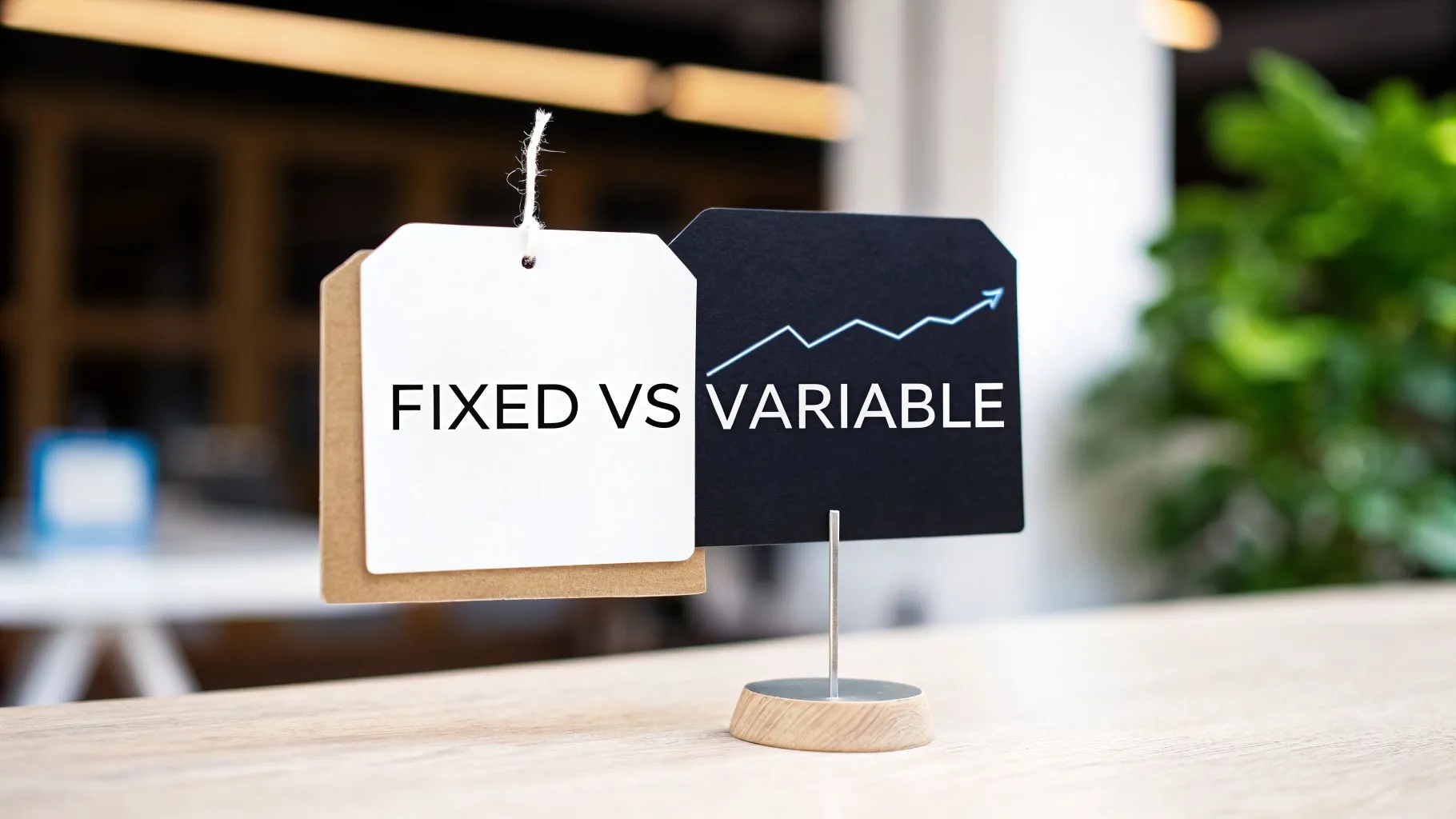
Brokers typically offer one of two models—fixed or variable—and your choice directly impacts your trading costs and strategy.
A fixed spread is locked in, regardless of market conditions. In contrast, a variable spread (or floating spread) constantly changes, tightening when the market is calm and widening when volatility strikes.
The Case for Fixed Spreads
The biggest advantage of fixed spreads is predictability. You know your exact transaction cost upfront.
- Best for Beginners, news traders, and long-term position holders.
- Benefit Predictable costs make budgeting and risk management simpler, especially during volatile news events when variable spreads can explode.
- The Trade-off Fixed spreads are almost always wider than the best-case variable spread. You pay a small premium for that stability.
The Power and Peril of Variable Spreads
Variable spreads are the industry standard for a reason. In liquid markets, they can be incredibly tight—sometimes near zero on major forex pairs.
- Best for Scalpers, algorithmic traders, and those trading during peak liquidity hours.
- Benefit The potential for razor-thin entry costs gives short-term strategies a massive advantage. Platforms like cTrader and DXtrade are popular for this reason.
- The Danger Unpredictable widening. A sudden news event can instantly blow up your entry cost, turning a promising setup into an immediate loser. This can also take an unexpected bite out of your drawdown limit.
For a real-world example, you can explore historical spread data and see how major events affect trading costs.
What Factors Influence Spreads in Trading?
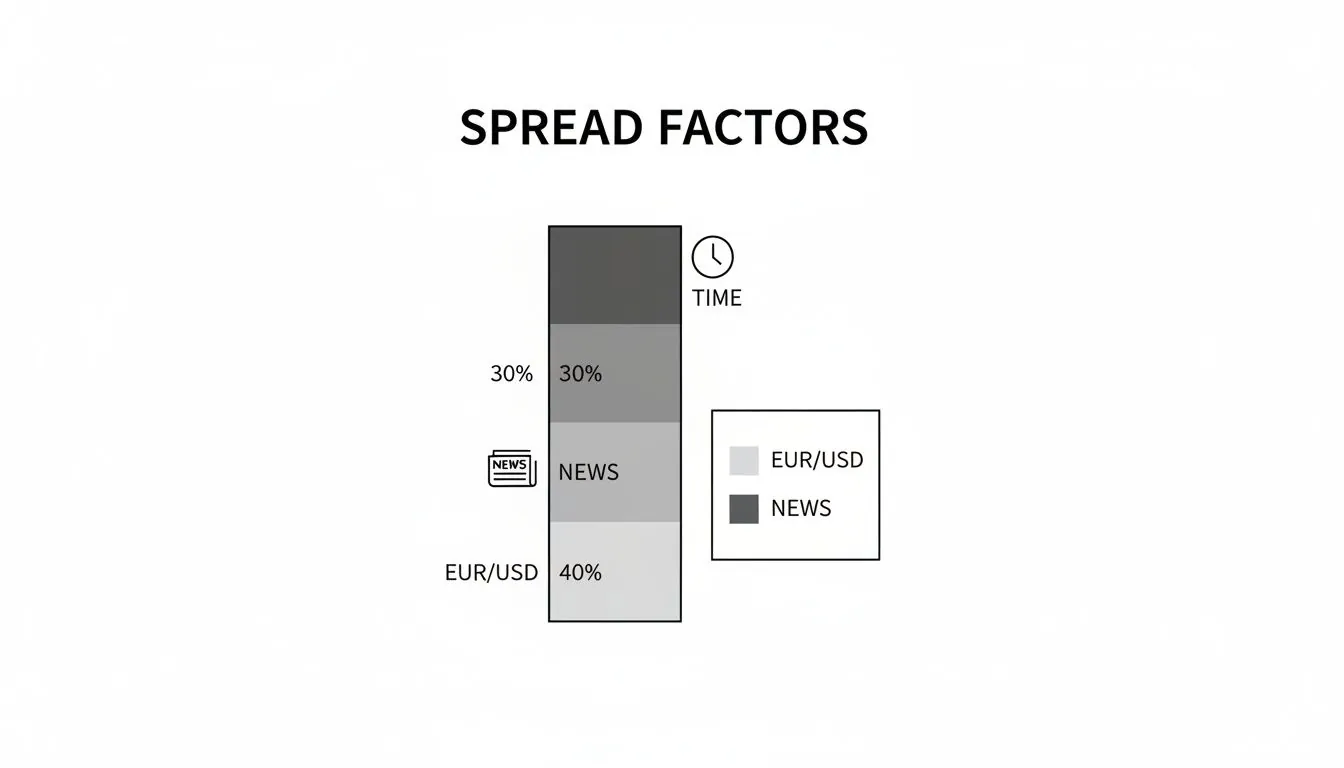
Spreads are dynamic. They expand and contract based on market conditions, much like surge pricing on a ride-sharing app. Three main factors drive these changes.
1. Market Liquidity
Liquidity—the volume of buyers and sellers in the market—is the single most important factor. High liquidity means more competition and tighter spreads.
- Major vs. Exotic Pairs: A major pair like EUR/USD has immense liquidity, forcing brokers to offer razor-thin spreads, often less than 1 pip. In contrast, an exotic pair like USD/TRY has a thinner market, leading to much wider spreads to compensate for the higher risk.
2. Volatility and News
Volatility creates opportunity, but it also increases risk for market makers, who widen spreads to protect themselves. This is most obvious around major news events like the U.S. Non-Farm Payrolls (NFP) report.
A classic, extreme example was the Brexit vote. The EUR/GBP spread, normally around 1.2 pips, exploded to over 45 pips at the peak of the chaos—a 3,600% increase in cost. You can see historical examples on tools like OANDA's spread analysis tool.
3. Time of Day
The forex market is open 24 hours, but activity isn't consistent. Spreads vary depending on which global trading sessions are open.
- The London-New York Overlap (8 AM to 12 PM EST) This is prime time. Maximum liquidity means spreads on major pairs are at their absolute tightest, often averaging 0.8 pips or less.
- The Asian Session This session is quieter. The same EUR/USD spreads might widen to 2.5 pips or more due to lower volume.
For a deeper dive into how volume influences price, our guide on what VWAP is and how it works is a great resource.
How Spreads Directly Impact Your Trading Strategy
The spread isn't just a fee; it's a dynamic hurdle that can make or break a strategy. What’s manageable for a long-term investor could be fatal for a scalper.
The Scalper’s Dilemma
For scalpers hunting for tiny profits, the spread is the primary opponent. A wide spread can easily consume most of your potential profit.
Let's say a scalper targets a 5-pip profit:
- With a 0.5-pip spread The market needs to move 5.5 pips in your favor.
- With a 2.0-pip spread You now need a 7-pip move to hit the same target, making the trade nearly 30% harder.
Tight spreads aren't a luxury for this high-frequency approach; they're essential. Learn more in our detailed scalping strategy forex guide.
Swing Trading and Position Sizing
Swing traders have more breathing room since they target larger moves (100+ pips). However, ignoring the spread is still a mistake. It subtly alters your risk-to-reward ratio. If you don't account for the spread when setting your stop-loss, your actual risk is always slightly higher than planned.
Algorithmic Trading and The Backtesting Trap
Many automated strategies fail in live markets because their backtests didn't account for real-world variable spreads. A profitable backtest is pure fantasy if it doesn't factor in realistic trading costs. An algorithm must be stress-tested with historical data that includes the widening spreads that happen during news and low liquidity.
Actionable Tips to Minimize Your Spread Costs
Understanding spreads is the first step; actively reducing them is how you gain an edge. Here are four practical steps you can take today.
1. Time Your Trades with Market Liquidity
This is the easiest win. Trade when everyone else is trading to get the tightest spreads.
- Trade the Overlaps Focus on the London-New York session overlap (roughly 8 AM to 12 PM EST) for major forex pairs.
- Avoid the Quiet Zones Be cautious trading late in the Asian session or on weekends. Liquidity dries up and spreads widen, increasing your costs unnecessarily.
2. Focus on High-Liquidity Instruments
Stick to assets that are cheaper to trade. For most traders, this means major currency pairs like EUR/USD, GBP/USD, and USD/JPY. The immense daily volume forces brokers to compete on price, giving you a better deal.
3. Use Limit Orders to Your Advantage
A market order accepts the current spread, whatever it may be. A Limit Order, however, lets you name your price. By placing a buy limit order below the current price (or a sell limit above it), you dictate the terms of your entry. This enforces discipline and helps you avoid paying a widened spread during a temporary spike.
4. Choose Your Trading Partner Wisely
Your broker or prop firm's cost structure directly impacts your bottom line. Look for firms offering raw or near-raw spreads on modern platforms like cTrader, DXtrade, or Match-Trader. Even a tiny difference of 0.1 pips adds up massively over time.
Frequently Asked Questions About Trading Spreads
Here are answers to common questions about spreads in trading.
Are "zero spread" accounts really free?
No. Accounts advertised with "zero spreads" or "raw spreads" are not free. They charge a separate, fixed commission for each trade instead of building the cost into the bid-ask price. To find your true cost, you must add the commission to the spread. This model can be cheaper for active scalpers, but you must do the math to compare.
How do spreads affect my prop firm drawdown?
Spreads impact your drawdown instantly. The moment you enter a trade, your account equity drops by the full spread cost. For funded traders, this is critical. You must factor this initial cost into your position sizing to ensure the immediate drop doesn't push you too close to your daily or maximum drawdown limit.
Can a spread change after I place a trade?
The spread on your entry is locked in the moment you execute the trade. However, if you are on a variable spread account, the spread to close your position could be different. The cost to exit your trade will depend on market conditions at that time.
Do I have to calculate spread costs on every single trade?
No, you don't need to manually calculate the cost every time. Modern platforms like cTrader and DXtrade show the live spread on the order ticket. The key is to develop an awareness of the typical spread for your instrument and mentally factor it into your trade plan. Your profit target must be large enough to overcome both your risk and this guaranteed transaction cost.
Put Your Spread Knowledge into Practice
Ignoring spreads is not an option for serious traders. They are the first hurdle in every trade, and learning to minimize them is a key skill that protects your capital and improves your net results. The best traders are obsessively aware of this cost and actively work to reduce it.
If you have a solid grasp on managing these costs and can consistently execute a winning strategy, it may be time to prove your skills.
At MyFundedCapital, we provide the capital for you to do just that. Explore our funding programs and take on a challenge to show us you have what it takes to be a funded trader.