ES
ES
 DE
DE
 FR
FR
 AR
AR
 IT
IT
 NL
NL
 PL
PL
 SV
SV

You've watched an EA enter a trade, cancel it, widen its stop, and then struggle during a news spike. The confusing part is that the strategy may be right while the execution, liquidity, or risk controls are wrong. This guide explains how algorithmic trading firms operate, what professional risk managers inspect, and how to test an automated system before connecting it to funded capital.
What Algorithmic Trading Firms Really Do
A retail trader often sees only the final action: an expert advisor places or cancels an order on a one-minute chart. Behind that action, a professional operation may be processing market data, checking exposure, selecting an order type, routing to a venue, and recording the result for later analysis.
An algorithmic trading firm is a business that uses software to make trading decisions, execute orders, or both. A discretionary desk relies primarily on a human trader's judgment. An algorithmic desk converts rules, models, and limits into a repeatable process that can respond consistently.
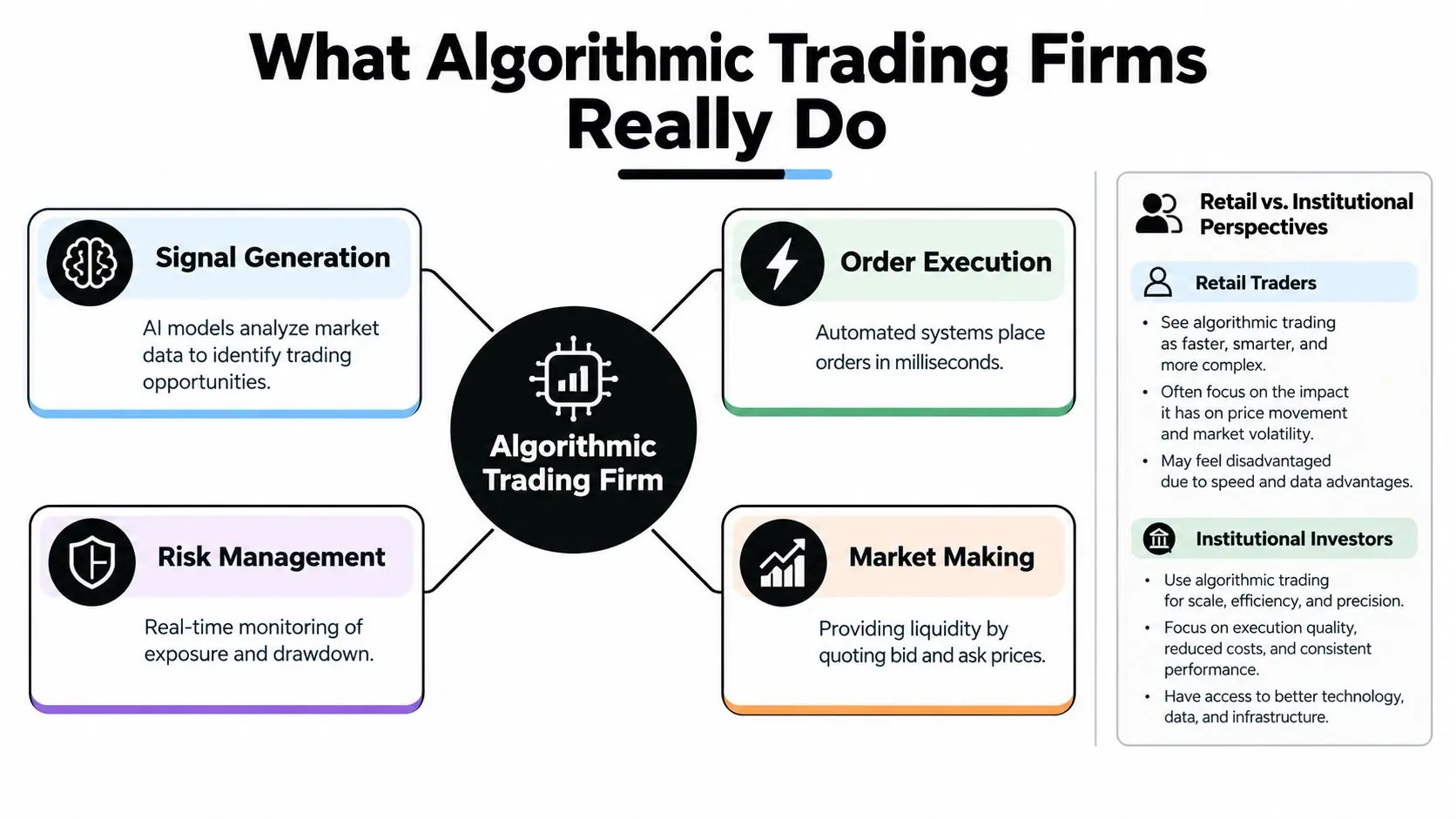
Four jobs behind the label
The label covers several different businesses:
- Market making The firm continuously quotes buy and sell prices, seeking to provide liquidity while controlling inventory and exposure.
- Statistical execution The system breaks a large order into smaller pieces or chooses execution tactics designed to reduce market impact.
- Arbitrage The software identifies related prices that have diverged and attempts to trade the difference across venues or instruments.
- Directional trading A model generates buy or sell signals based on momentum, mean reversion, order flow, macro data, or other inputs.
These firms range from large institutional operations to small specialist teams. The same basic mental model applies whether you're studying a global market maker or a five-person quantitative shop: data enters, a model produces an action, risk controls approve or reject it, and an execution system sends the order.
Algorithmic activity became a structural part of U.S. equity markets well before the 2010s. A 2011 academic overview estimated that more than 50% of trades were executed algorithmically, while algorithmic activity represented at least 30% of total trading volume, or roughly 360 billion shares out of an annual 750 billion shares in the 2011 overview of algorithmic trading. Those figures differ because large institutional trades can contain many shares but count as relatively few transactions.
Working definition: An algorithmic trading firm isn't simply a company with a fast computer. It's an operation that treats signals, execution, risk, and monitoring as one connected system.
How an Algorithmic Trade Reaches the Market
Consider a mean-reversion bot watching EUR/USD. It detects a 3-pip deviation from the reference relationship it expects to normalize. That observation is only the beginning. The trade still has to pass through several distinct decisions before it becomes a fill.
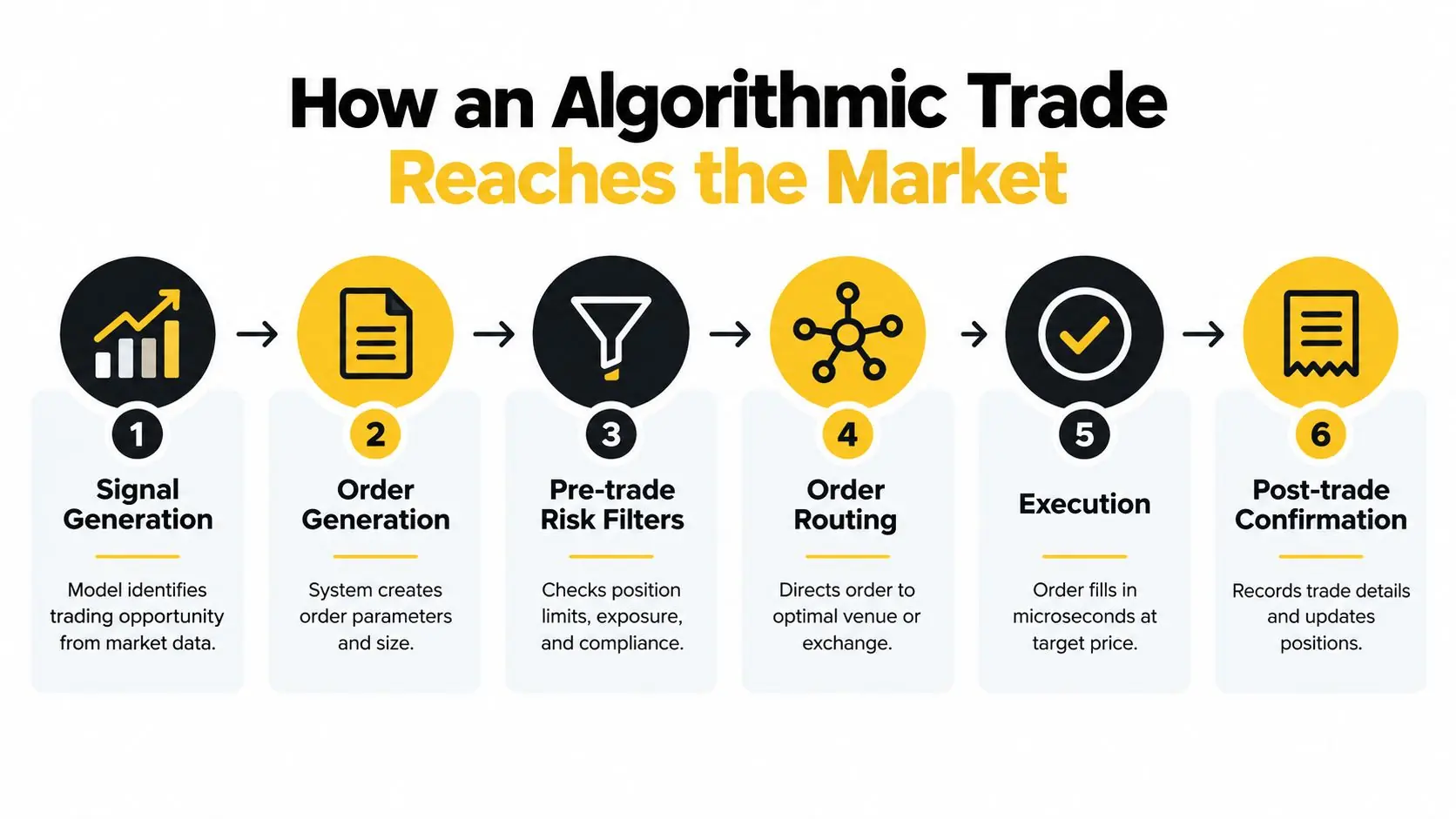
From model output to order
Signal generation: The model reads prices, volumes, spreads, or other permitted data and produces a proposed action. A signal might say that EUR/USD has moved far enough from its reference level to justify a long position.
Order generation: The execution module decides whether to use a market or limit order, calculates size, and sets instructions such as time-in-force or maximum price deviation.
Pre-trade risk filters: The system checks current exposure, symbol limits, order size, price collars, trading hours, and account-level restrictions. A valid signal can still be rejected if the account is already too exposed.
Order routing: The order travels to a broker, liquidity provider, exchange, or another venue. The route affects available liquidity, queue position, and the price you ultimately receive.
Matching and execution: The venue matches the order against available bids or offers. In this example, the order may receive a partial fill because only part of the requested size is available at the intended price.
Post-trade reporting: The system records the decision price, submission time, acknowledgments, fills, cancellations, fees, and resulting position. It then updates exposure and allows later analysis of implementation shortfall.
Retail traders rarely compete with institutional firms on raw speed. They still experience latency through slippage, rejected orders, delayed confirmations, and missed fills. A strategy can forecast direction correctly and lose because the price moved before the order arrived.
For a deeper explanation of how buying and selling pressure appears in the market, review this guide to order flow analysis. The practical question isn't just whether your EA predicted the next move. It's whether the system entered at a price that left enough room for spread, slippage, and adverse selection.
The Three Main Types of Firms and Where You Fit
Not every firm using algorithms has the same objective. A proprietary trading firm risks its own capital, a hedge fund manages money for investors, and an execution-only firm serves clients that want orders handled efficiently.
| Firm Type | Capital Source | Primary Objective | Typical Trader Relationship |
|---|---|---|---|
| Proprietary trading firm | Firm capital or simulated program capital | Generate controlled returns while protecting the firm's risk limits | Traders operate within defined rules and may receive a share of results |
| Hedge fund with algorithmic mandates | Investor capital | Produce risk-adjusted, preferably uncorrelated returns | Researchers and portfolio managers contribute to a larger investment process |
| Execution-only firm | Institutional client orders | Reduce market impact and improve execution quality | Traders and algorithms serve client flow rather than take independent directional risk |
Proprietary trading firms
A prop firm cares about repeatability and survival. A trader who produces a strong month but repeatedly breaches daily-loss or drawdown rules creates an operational problem. The firm may value modest, controlled behavior over a volatile record with an attractive headline return.
Capital is also handled differently from a traditional hedge fund. A funded-account trader usually receives a defined risk budget and must respect restrictions on position size, holding periods, news, or weekend exposure. The firm evaluates the behavior of the account, including order patterns and loss concentration.
Hedge funds
A hedge fund generally asks a broader question: does this strategy add useful return to the existing portfolio? A strategy with positive returns may still be unattractive if it duplicates the fund's current exposure or lacks capacity for larger allocations.
Its technology budget may support research infrastructure, data engineering, portfolio construction, and monitoring. Compensation and responsibility usually reflect the trader's contribution to a managed investment process rather than a single account's pass-or-fail rule.
Execution-only businesses
An execution shop isn't primarily trying to predict direction. It may split, route, and schedule institutional orders while measuring market impact, spread cost, and opportunity cost. The quality test is whether the client received efficient execution relative to the decision price.
You can compare the broader distinctions in proprietary trading firms versus hedge funds. For a retail algo trader, the key question is simple: who owns the risk, what counts as success, and which behavior violates the operating agreement?
What These Firms Look for in Traders and Strategies
Professional reviewers don't begin with a screenshot showing a smooth equity curve. They ask how the curve was produced, what assumptions shaped it, and how the system behaves when those assumptions fail.
A prop firm may focus on drawdown, daily loss, consistency, and rule compliance. A hedge fund allocator may examine risk-adjusted return, correlation to benchmarks, capacity, and whether the strategy adds something missing from the portfolio. An execution business will care more about implementation shortfall, fill quality, and market impact.
What a risk manager sees in your record
A Myfxbook account, MetaTrader backtest, or EA log should answer questions such as:
- Drawdown profile How deep are losses, how long do they last, and do several instruments lose together?
- Execution quality What spread and slippage assumptions were used, and do live fills resemble the test?
- Regime behavior Does the strategy rely on calm liquidity, a particular session, or a stable relationship?
- Capacity Can the system trade its intended size without moving the market or suffering unacceptable fills?
- Change control Can you identify when the code, parameters, broker, data source, or execution environment changed?
The most common failure isn't always a weak signal. It's often curve-fitting, unrealistic fills, hidden exposure, or inconsistent execution. A backtest that assumes immediate fills can conceal the cost of waiting in a queue. A system that looks diversified across symbols may still hold one concentrated macro position if those instruments react to the same event.
Professional standard: Separate signal quality from execution quality. Track decision price, fill price, spread, slippage, market impact, latency, and opportunity cost instead of treating every loss as a model failure.
A serious review also examines maximum adverse excursion, exposure by instrument, rejected orders, partial fills, and the exact conditions that trigger a shutdown. Past performance doesn't guarantee future results, and a polished equity curve isn't evidence that the system is safe under stress.
Risk Controls That Separate Real Firms from Hobby Bots
A strategy should never be the only component allowed to send orders. Under MiFID II Article 17, investment firms conducting algorithmic trading must maintain systems with sufficient capacity and resilience, apply trading thresholds and limits, prevent erroneous orders, test and monitor systems, maintain continuity arrangements, and avoid behavior that could breach market-abuse or venue rules under Article 17 of MiFID II.
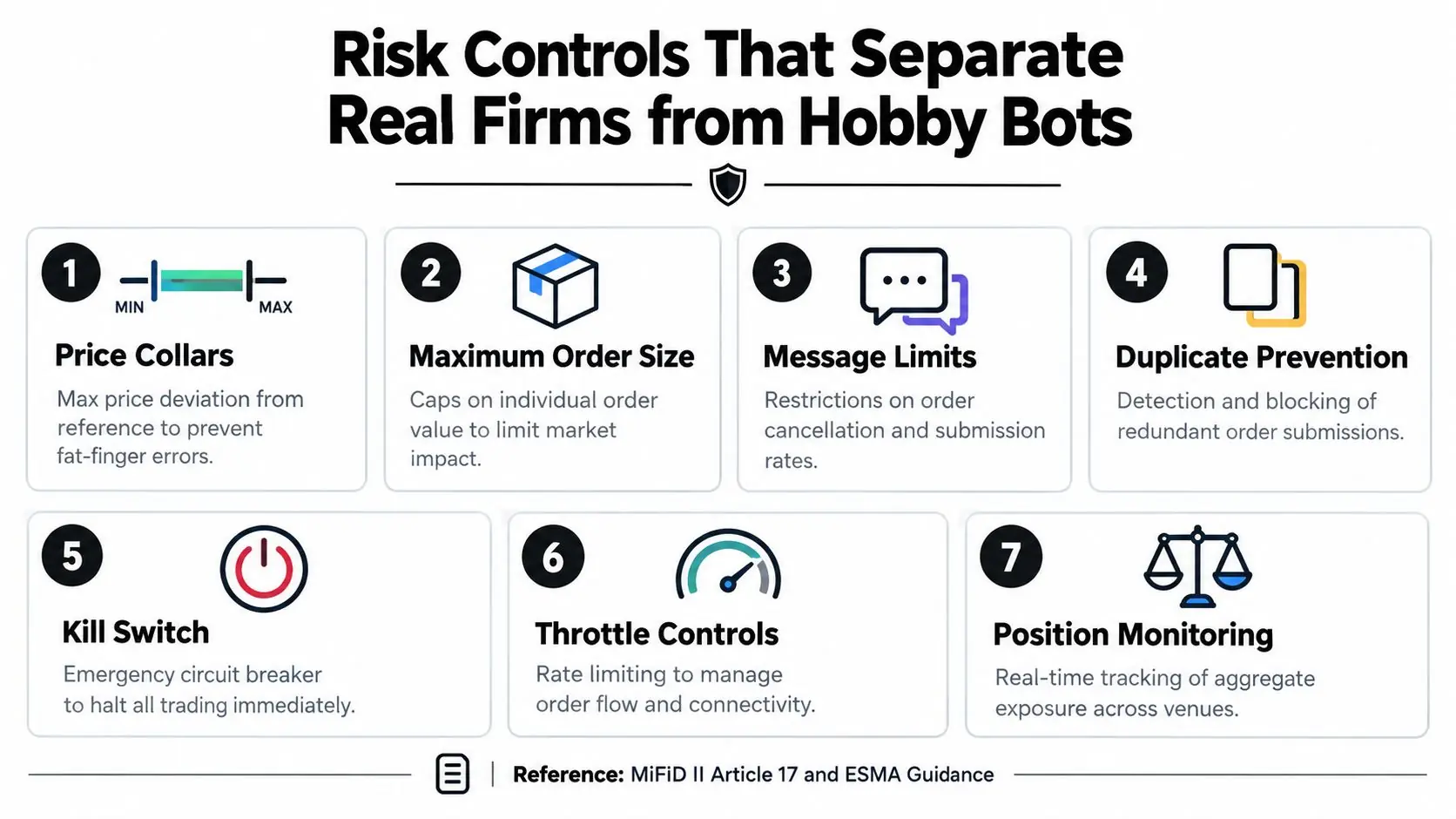
Controls that stop predictable failures
ESMA materials identify controls including price collars, maximum order values, maximum volumes, message limits, and throttles in its supervisory briefing on algorithmic trading. Translate those terms into practical protections:
- Price collars: Reject an order that sits too far from a reference price. This helps contain a decimal error or stale-price submission.
- Maximum order size: Cap the value or volume of an individual order so one faulty calculation can't create oversized exposure.
- Message limits: Restrict repeated submissions and cancellations. A malfunctioning loop shouldn't flood the venue.
- Duplicate prevention: Detect identical orders sent more than once because of a retry, connection issue, or software fault.
- Kill switch: Provide an immediate circuit breaker that cancels working orders and stops new trading.
- Throttle controls: Limit the rate at which the EA can submit, cancel, or replace orders.
- Position monitoring: Track aggregate exposure across symbols, strategies, and venues rather than checking each order in isolation.
These safeguards should sit outside the signal logic where possible. If the model controls its own emergency stop, a software fault inside the model may disable the protection too. A broker, platform, gateway, or separate risk service can provide a more independent control layer.
Deploy in stages
MiFID II-related guidance expects firms to test systems before deployment and after a material change. ESMA describes a testing environment separated from production in its final report on algorithmic trading.
Use a staged process:
- Run the revised EA in a sandbox or demo environment.
- Test abnormal spreads, gaps, delayed acknowledgments, rejected orders, and fast markets.
- Verify size, exposure, message, and shutdown limits independently.
- Release gradually and review logs before increasing risk.
A code change that alters timing, sizing, instruments, or order behavior is a new risk event, even if the strategy name hasn't changed.
Where Algorithmic Trading Quietly Breaks Down
Automation removes hesitation, not risk. The May 6, 2010 Flash Crash showed how quickly automated execution and linked markets can transmit stress when liquidity disappears.
According to the SEC's review, an algorithm sold 75,000 S&P 500 E-mini futures contracts at approximately 2:32 p.m., when major equity indexes were already more than 4% below their previous-day closes. Within minutes, the indexes fell an additional 5% to 6%, then recovered almost as quickly. The event affected nearly 8,000 individual stocks and exchange-traded funds in the SEC's algorithmic trading report.
The lesson wasn't simply “one bad bot”
The joint SEC-CFTC investigation described a sequence involving the exhaustion or withdrawal of liquidity from high-frequency traders, traditional buyers, and cross-market arbitrageurs. Later research generally concluded that high-frequency trading didn't independently cause the crash, but automated liquidity withdrawal and feedback effects amplified the decline under stressed conditions.
The regulatory response included the SEC's final November 2011 provision of Rule 15c3-5, which required stronger controls over sponsored and unfiltered market access. For a trader, the operational lesson is more useful than the historical argument: speed can amplify a mistake when several systems react to the same condition.
The same vulnerability appears in less dramatic settings:
- Weekend crypto gaps The first available price can bypass assumptions built around continuous stop execution.
- Thin Asian-session liquidity A normal order size can consume more of the displayed book than expected.
- News spikes Spreads can widen, fills can be partial, and a stop can execute materially away from its displayed level.
- Correlated signals Several instruments may trigger together, turning separate trades into one concentrated loss.
The Financial Markets Standards Board warns that less liquid markets can experience spread widening, gap pricing, and increased tail risk in its review of algorithmic trading and machine learning. Automation may make decisions more consistent, but it can also make losses faster and more correlated.
Design for regime change. A backtest that contains calm fills cannot prove that an EA can exit during a liquidity vacuum.
A Practical Checklist Before You Run an Algo on a Funded Account
Before connecting an EA or copy system, treat the funded account as a production environment, not as another backtest. Confirm the platform, instruments, permissions, holding rules, execution assumptions, and emergency behavior first.
MyFundedCapital supports manual, algorithmic, and copy trading on DXtrade and cTrader across 350+ instruments, including forex, indices, crypto, and commodities, with simulated accounts using real market quotes through its automated trading programs. That setup can suit different systems, but the strategy still has to fit the account rules and the market conditions it trades.
Your pre-connection checklist
- Confirm permissions Check whether your EA, copy setup, symbol list, news exposure, and weekend holding approach are allowed on the selected account.
- Translate limits into execution prices The flat 5% daily loss limit and up to 10% maximum drawdown must be evaluated using realistic slippage, not only the displayed chart price.
- Test the worst exit Model partial fills, widened spreads, rejected orders, delayed acknowledgments, and gaps. Ask whether the account remains inside its limits after the exit costs.
- Stage the release Run the exact version on demo with real market quotes, then review logs before requesting payouts or increasing size.
- Inspect add-ons If the strategy trades around announcements or holds through weekends, review the relevant news-trading and weekend-holding options before opening the account.
- Check capacity Make sure the position size, order frequency, and expected liquidity match the instrument and the account's risk budget.
For traders testing automated systems on crypto networks, a separate resource on top AI trading tools for Solana can help compare tools and their operating assumptions. Treat third-party performance claims carefully. Ask whether results are live, simulated, or reconstructed, and whether fees and slippage were included.
The practical next step is to compare 1-Step and 2-Step Challenges with Instant Funding, select an account size that fits the strategy's capacity, and review the available add-ons before deployment. Trading involves risk of loss, including when software places every order automatically.
Common Questions From Aspiring Algo Traders
Do algorithmic trading firms allow EAs on funded accounts?
Some do, but permission depends on the firm's platform, prohibited behaviors, risk limits, and account terms. An EA may be allowed while certain practices, such as abusive order traffic, latency exploitation, or unsupported copying, are restricted.
Ask for the rules in writing before connecting the system. You should know whether news trading, weekend holding, external signals, and multiple accounts are permitted, and whether the firm can review execution logs when something goes wrong.
How can a prop firm verify performance without seeing my code?
It can evaluate behavior without owning the source code. Order timestamps, symbol exposure, position size, entry and exit prices, holding duration, cancellation patterns, drawdown, and daily loss provide a detailed operating record.
A credible submission should also include version records, out-of-sample and walk-forward results, maximum adverse excursion, latency assumptions, slippage assumptions, exposure caps, and emergency shutdown procedures. Transparency doesn't require revealing proprietary code. It requires showing that the system is tested, bounded, and auditable.
What supports scaling and payouts for a consistent algo?
Consistency starts with compliance. A system that produces attractive returns but repeatedly approaches the account's loss limits may not be suitable for scaling.
Review the program's payout schedule, scaling rules, profit split, holding permissions, and account-size conditions before selecting a challenge. Payouts and future access depend on the provider's current terms, and past performance doesn't guarantee future results.
Does automation reduce the risk of loss?
No. Automation can reduce discretionary hesitation and enforce rules, but it can also submit errors rapidly, react poorly to gaps, and concentrate exposure across correlated instruments.
Trading involves risk of loss whether a human or an EA clicks the button. This article is educational only, not financial advice. Test the system, cap exposure, monitor execution, and keep a shutdown process available.
MyFundedCapital offers Instant Funding alongside 1-Step and 2-Step Challenges for traders using manual, algorithmic, or copy strategies, with defined loss limits and access to multiple CFD markets. Review the account types and operating rules, then visit MyFundedCapital to choose a program that matches your algorithm's capacity and risk controls.