

Algo trading is the automated conversion of market data and trading rules into order decisions and executions. It's mainstream rather than exotic: in 2025, about 63% of surveyed hedge funds used algorithms to trade more than half of their transaction value.
That figure comes from The TRADE's 2025 Algorithmic Trading Survey, and it measures adoption, not edge. The question worth asking isn't how many firms automate. It's why a rule that prints money across ten years of chart data so often stops working the week it goes live.
Part of the answer sits in the phrase "decision and execution". Most beginners pour their effort into the decision half, the indicator or pattern that says buy, and treat the execution half as plumbing. The plumbing is where the money leaks.
What Algo Trading Means in Plain Terms
Strip away the jargon and algo trading is a rule you hand to a computer, which then decides whether to buy or sell, when, at what price, and in what size. The recipe comparison holds up because it separates two things people blur together: the instructions and the cooking.
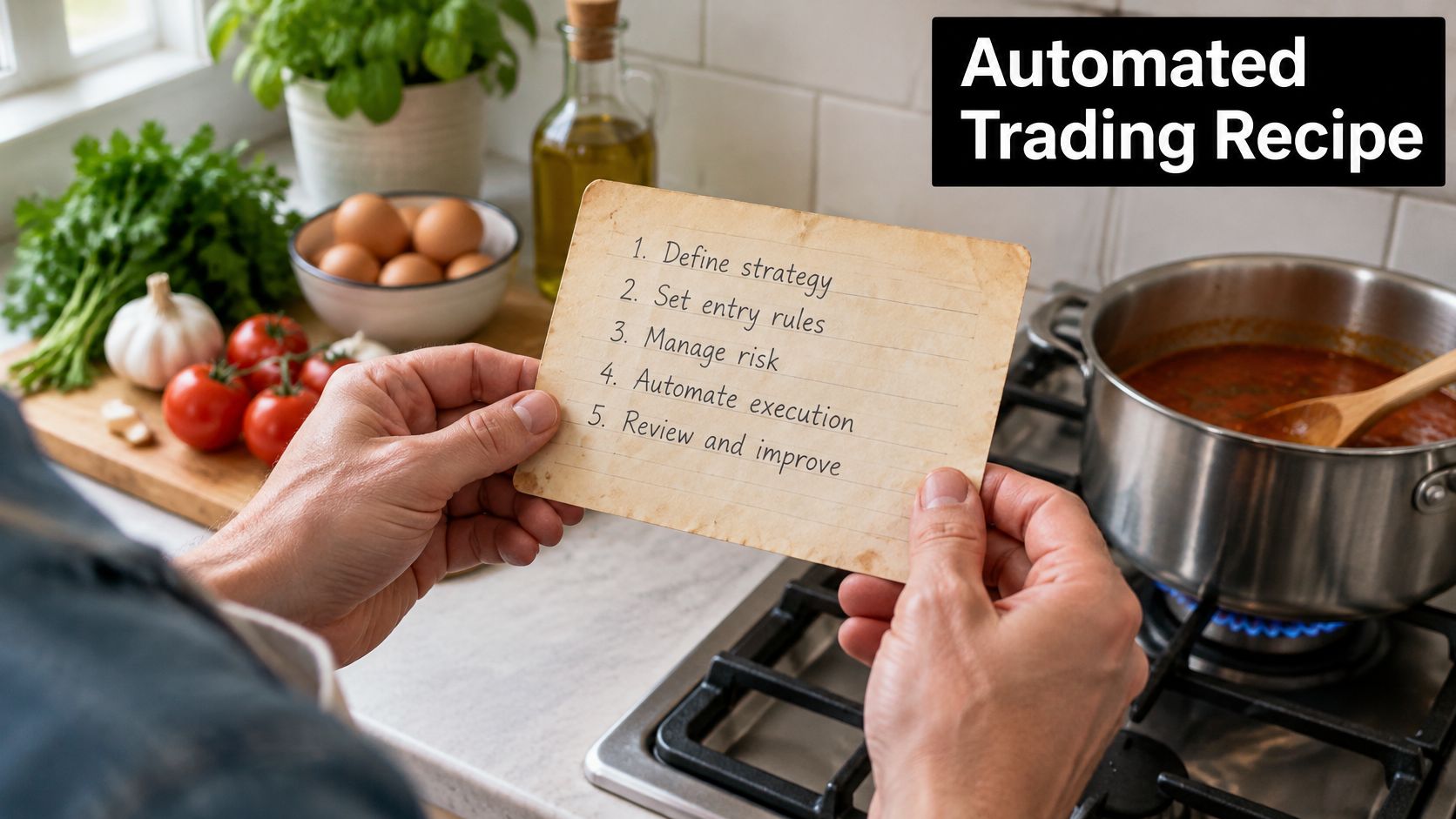
A recipe card produces the same dish every time because the steps don't change and nobody improvises at the stove. A cook working without one makes every plate slightly differently, better on a good day, worse under pressure. Automated trading is the recipe card. It buys you repetition, not judgement.
The legal definition is broader than the trading-floor version. Under MiFID II, ESMA's supervisory briefing on algorithmic trading in the EU describes algorithmic trading as trading in financial instruments where a computer algorithm automatically determines individual order parameters, including whether to submit an order, its timing, price and quantity, or how the order is managed after submission. A slow strategy qualifies if the machine sets the order characteristics. Speed isn't the test.
Take a concrete rule. Buy a currency pair when the 50-period moving average crosses above the 200-period moving average, risk 0.5% of the account, attach a stop 20 pips below entry, exit when the averages cross back. A person can follow that by hand. An algorithm follows it at 3 a.m., on a day you're ill, without skipping the stop because the setup "feels" strong.
Three things it isn't:
- Not only high frequency. HFT is a small, fast, infrastructure-heavy corner of a much larger field.
- Not just a signal generator. An Expert Advisor that prints buy and sell arrows is one component, not the system.
- Not a prediction machine. It executes a decision rule, and a bad rule executed perfectly still loses.
Plain test: if the machine decides the order without you, it's algo trading.
The Four Layers Inside an Algo System
Signals get all the attention. The other three layers decide whether a signal ever becomes money. A production system chains four jobs together, and each one fails differently.
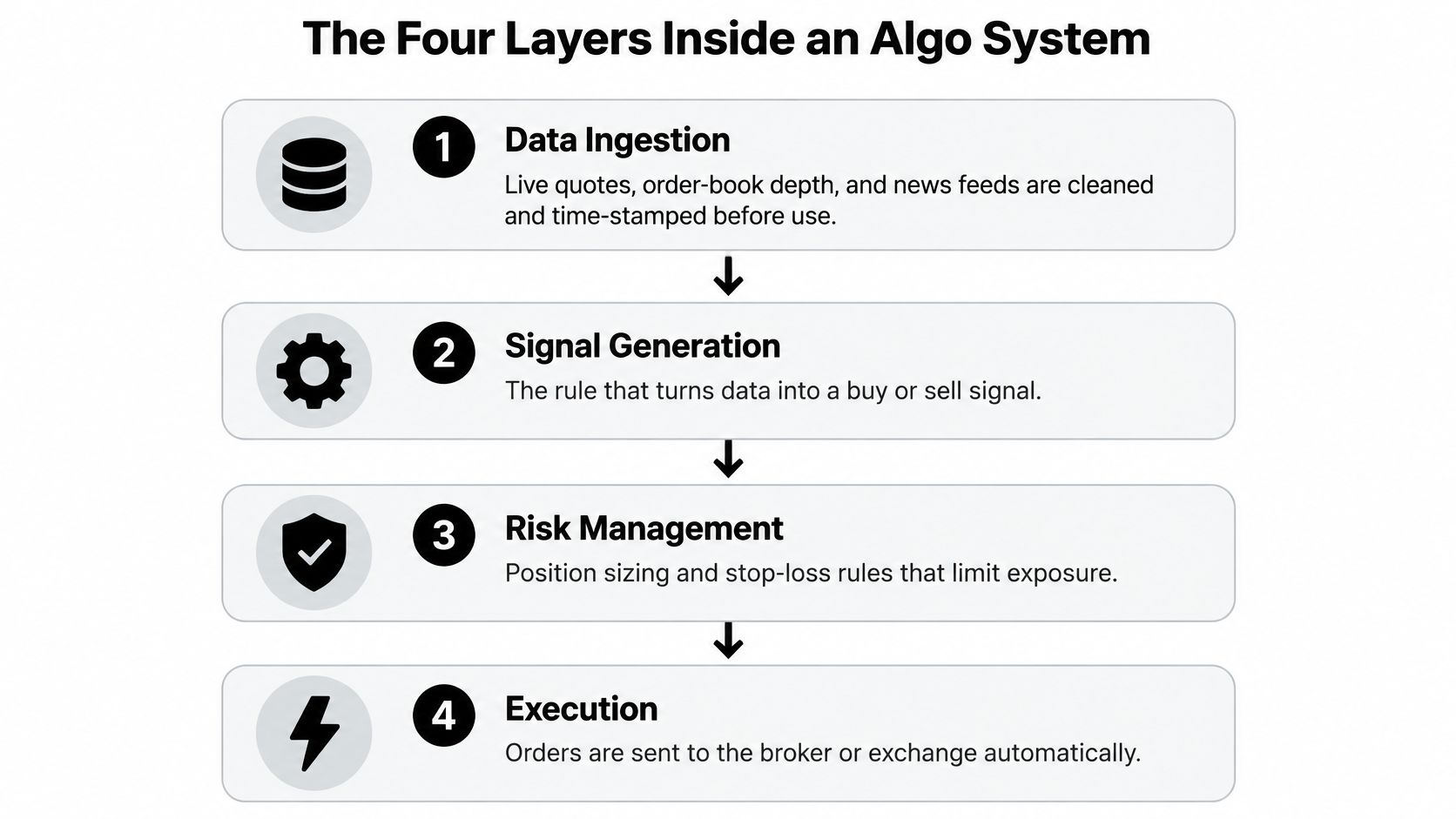
Data ingestion collects live quotes, order-book depth and news feeds, then cleans and time-stamps them before anything else touches them. The classic failure is a stale quote: the feed lags, the algorithm prices off a number that no longer exists, and the order it sends is wrong before it leaves your machine.
Signal generation turns that data into a view, such as a momentum score crossing a threshold or a spread widening past two standard deviations. Here the failure is a rule tuned so tightly to past noise that it fires constantly on randomness and calls it opportunity.
Position-risk logic sizes trades, caps exposure and looks at how open positions correlate. Skip it and four "different" trades in EUR/USD, GBP/USD, AUD/USD and gold become one large bet on the dollar.
Execution chooses order type, route, slicing and cancellations. Its failure is the fill: price moves between decision and arrival, size eats the book, and the trade costs more than the edge was worth.
Why execution decides whether the signal survives
Execution isn't a technical detail bolted on at the end. It determines whether a theoretical signal survives bid-ask spread, slippage, latency, partial fills and market impact, as research on algorithmic trading system design sets out. Execution algorithms are judged against a benchmark, usually arrival price, VWAP or implementation shortfall, and against absolute or risk-adjusted cost.
The cause and effect is mechanical. Larger or more urgent orders consume available liquidity and push price against you, while slicing an order smaller reduces instantaneous impact but leaves you exposed to the market moving while you work.
| Layer | Job | Typical failure |
|---|---|---|
| Data ingestion | Collect and clean market feeds | Stale quote from a delayed feed |
| Signal generation | Turn data into a buy or sell view | Rule fires on random noise |
| Position-risk logic | Size trades and cap exposure | Several correlated trades stack into one bet |
| Execution | Route, time and fill orders | Slippage on a large order in thin liquidity |
When live results diverge from your test, audit each layer in order before you touch the strategy. Most of the gap lives in layer one or layer four.
Common Algo Strategies Compared
Every family below shares the same plumbing and differs in what it's betting on. Read the comparison as a map of failure modes, because that's what separates them in practice.
| Strategy | Core idea | Works best in | Main risk |
|---|---|---|---|
| Trend following | Buy strength and sell weakness on moving averages or breakouts | Sustained trending markets | Whipsaws in sideways markets |
| Mean reversion | Bet that stretched prices return to an average | Range-bound, liquid markets | A trend that keeps running against the position |
| Market making | Quote bid and ask to earn the spread | Liquid, stable markets | Adverse selection when prices jump |
| Execution algorithms (VWAP, TWAP) | Split a large order over time to reduce market impact | Institutional order execution | Timing risk if price moves away |
| Statistical arbitrage | Trade related instruments when their spread diverges | Markets with stable historical relationships | Relationship breaks down permanently |
The two directional families
Trend following is the beginner's entry point for a reason: the logic is easy to state and easy to test. The algorithm buys when price clears a moving average or a prior range high and sells when it breaks below. It pays in long, clean moves and bleeds in chop, where a 50/200 crossover can trigger three losses in a week without the market going anywhere.
Mean reversion takes the opposite bet, that a stretched price snaps back toward an average. Bollinger Bands and RSI are the usual triggers. This family earns steadily in a range and then meets a trend that keeps going, which is where a small, repeated gain turns into a single large loss if the position has no hard stop.
The families that trade the plumbing
Market making quotes both sides of the book and earns the spread on volume. It works while prices are stable and liquidity is thick. The moment a headline hits and price gaps through your resting quotes, you get filled on the losing side every time. That's adverse selection, and it's the whole risk of the business.
Execution algorithms aren't trying to predict anything. VWAP and TWAP slice a large institutional order into smaller pieces over time so the order doesn't move the market against itself. The trade-off is timing risk: the price can drift away from you while the order works.
Statistical arbitrage trades related instruments when their historical spread stretches, buying the laggard and selling the leader. It fails when the relationship breaks for good, which is what happens after a policy change, an index rebalance or a shift in what drives the two assets.
Automation doesn't remove risk. It converts market risk into execution risk, and execution risk is the one retail traders are least prepared to measure.
The market role matters too. Algorithmic trading improves liquidity discovery but introduces operational and market-structure risks, as a study of algorithmic trading and liquidity shows: across 382 trading days, algorithmic traders narrowed bid-ask spreads by 0.28 basis points relative to retail traders, while cancelling orders more often. Narrower spreads help everyone. The same behaviour, badly controlled, amplifies disruptions.
Pick the family that matches the market you trade and the risk you can monitor hour by hour. A mean reversion system with no stop is not a strategy, it's an assumption.
The Tech Stack Behind an Algo System
Build in order, and test each piece alone before connecting the chain. When something breaks later, you'll know which link failed.
- Data. Historical bars or ticks from a source with clear timestamps, plus a live feed of the same instruments, so your test and your live run read the same market.
- Research environment. Python with NumPy and pandas covers most retail work: you write the rule, load the data, and inspect the output. No compiler, no broker dependency, and the same file can run your test and your live loop.
- Backtesting engine. Software that replays history and models spread, commissions, slippage, partial fills and the exact session you trade. A script that fills every order at mid-price isn't a backtester, it's a wish.
- Execution connection. The link that sends orders through a broker or platform API, with order types, size limits and cancellations handled in code rather than by hand.
- Hosting. A machine that stays online through your session, clock-synced so timestamps line up with the venue, and placed close enough to keep latency predictable.
- Logging and monitoring. Every signal, order and fill written down, plus an alert that reaches a human when the system stops behaving.
If you don't want to build the data layer yourself, StalkChain's crypto API shortlist compares feeds on the criteria that matter for automated strategies: coverage, latency and rate limits. For traders comparing ready-made tools instead of writing their own, this overview of algorithmic trading software covers the categories worth evaluating before you commit to one.
Why Backtests Overstate Live Results
A backtest can look profitable and still fail in live trading. Historical prices show what happened, but a strategy must also cope with trading costs, changing liquidity, and uncertainty about whether its rules work beyond the data used to build them. Research on backtest robustness examines why those gaps can undermine historical results.
Start by separating the data. Develop rules on one period, tune them on a second, then judge them on a third that you have not used to make decisions. If you adjust parameters after examining the final period, it no longer provides an independent test.
Next, account for the costs of execution: commissions, spread, slippage, rejected or partial orders, latency, financing, and the session you trade. Mid-price fills and fixed spreads can make a strategy appear more profitable than it would be to trade.
Liquidity matters, too. A large or urgent order can consume available prices, so the fill may differ from the one assumed in a historical replay. Conditions also change: the same order can have different costs in calm and stressed markets.
Judge results by more than headline return. Maximum drawdown, drawdown duration, profit factor, turnover, exposure, tail loss, and sensitivity to spread and slippage show how performance responds to different conditions. Compound annual growth alone can hide dependence on one unusually strong period.
Decision rule: Double the assumed costs. If the edge disappears, the strategy may depend on assumptions that live execution cannot meet.
Robustness is a process, not a check
Vary parameters, instruments, time periods, and execution assumptions. Then check whether performance holds up. In a walk-forward test, each new window uses rules fitted only to earlier data. This better reflects the live sequence: a strategy acts on new prices without knowing what comes next, and its fills depend on available liquidity and execution conditions.
The guide to algorithmic trading backtesting covers the process from data hygiene to walk-forward design. Demo quotes let you compare simulated results with live-style execution; the size and consistency of that gap are useful measures of whether the strategy's assumptions hold.
Risk Controls That Keep Algorithms Contained
A stop-loss is one control. A system needs several, and they fire at different moments. Regulatory architecture for algorithmic trading runs before, during and after execution, and that structure is a sensible template whether or not you're regulated.
Before the order reaches the market, pre-trade checks reject anything outside size or price limits. During trading, real-time monitoring raises alerts for disorderly activity or breaches of pre-set limits. After trading, post-trade reconciliation checks market and credit risk on what happened. EU rules go further and contemplate automatically disabling a trading system after a predetermined number of repeated executions, keeping it off until an authorised staff member re-enables it, as the EU delegated regulation on algorithmic trading controls sets out.
Here's how that plays out in a funded account. A central bank statement lands, spreads triple, and three of your pending orders fill at prices far from where your model expected. The strategy is fine. The conditions aren't. A daily loss stop closes the session before the fourth order compounds the damage.
| Control | What it stops | Typical setting |
|---|---|---|
| Pre-trade order checks | Orders outside size or price limits | Reject any order above a set lot size |
| Position limits | Overexposure to one instrument or to correlated trades | Cap total open risk per instrument |
| Daily loss stop | Losses running through a bad session | Halt trading after a set daily loss |
| Real-time alerts | Disorderly trading or limit breaches | Notify a person when fill rates or spreads move abnormally |
| Automatic disable | Repeated erroneous executions | Stop the system until a staff member re-enables it |
| Kill switch | Abnormal data, pricing or execution behaviour | Flatten positions and halt on one command |
Practical rule: write the exact number for each control on paper before your first live order, then prove the kill switch works in a demo account.
Each safeguard covers a different failure. A position limit won't save you from a broken data feed, and a kill switch won't stop you oversizing one idea across four correlated pairs. Set all of them, and check that the person who can hit the switch is awake when your session opens.
Adapting an Expert Advisor to Prop-Firm Rules
A prop-firm account adds a second rulebook to the market. Your algorithm must follow both, so encode the firm's current requirements as operating limits rather than relying on memory.
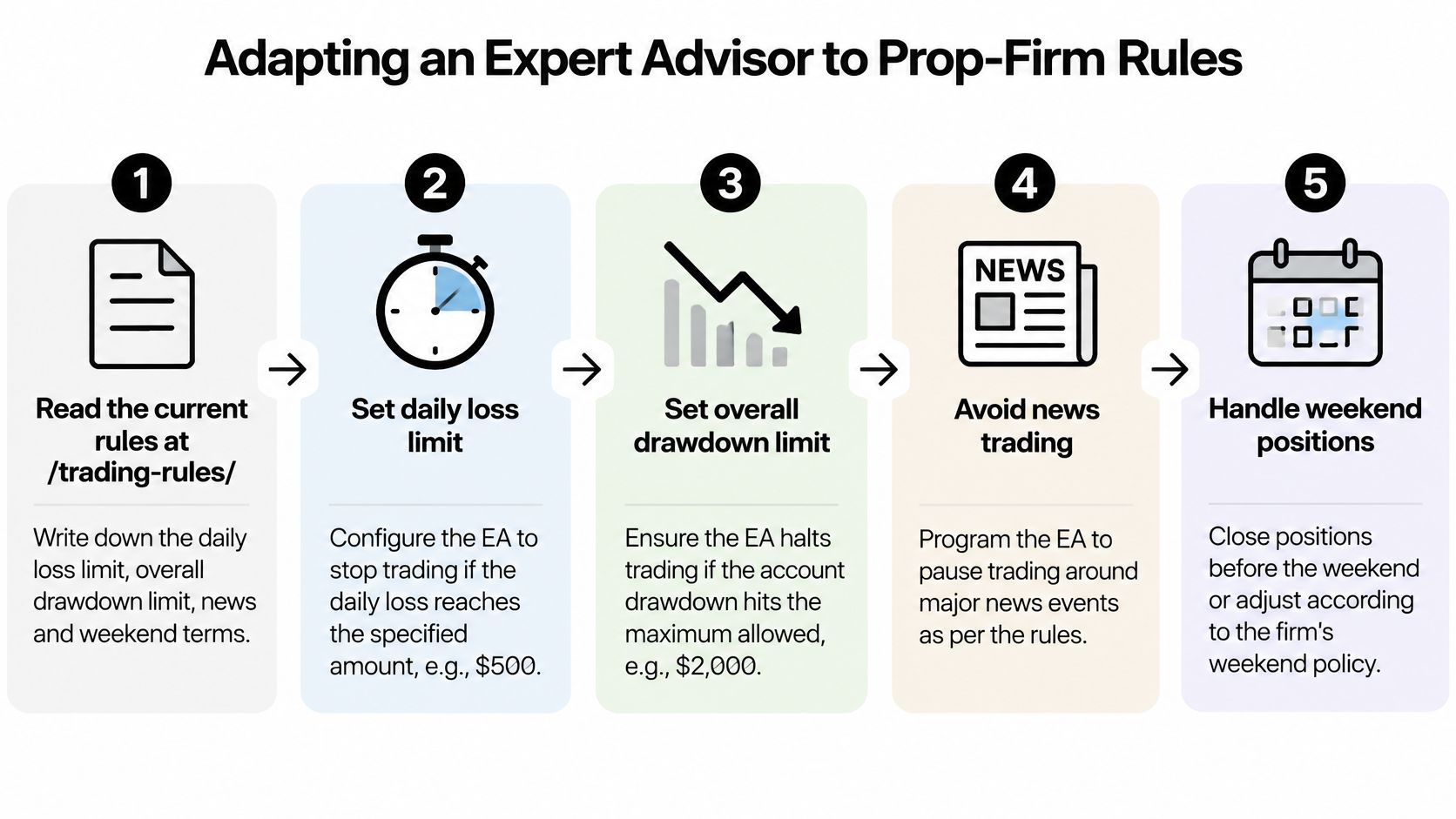
- Read the current trading rules and record them. Note the daily and overall loss limits, news and weekend terms, and permitted instruments. Each limit in your code should match the published rules at /trading-rules/.
- Translate each rule into a code limit. Set your own daily stop below the firm's limit. That buffer gives the strategy room to stop before a sudden price move pushes the account over its threshold.
- Remove prohibited behaviour. Scalping, high-frequency trading, hedging, martingale sizing and all-in bets are not allowed. Check the rules rather than assuming they match those of another firm.
- Contact support before using a bot. Expert advisors and trading bots are allowed by agreement, but traders must contact support before using one. If your setup is unclear, request written confirmation before putting it into use.
- Trade inside the MyFundedCapital Terminal. Before you click Buy, check the daily and overall loss room it displays, then let that figure govern your next order size.
- Test with the limits switched on. Include the rule limits in your backtest, then test the system on demo quotes. If the strategy depends on trades opened or closed during a news window, check whether the news rule and any applicable add-on terms affect it.
- Log each decision. Keep a timestamped record of the system's actions so you can review how it behaved when a rule question comes up.
A position size that ignores remaining loss room can defeat an otherwise sensible stop. If half your daily allowance is already used, reduce the next order size or skip the setup.
For more on the requirements for using an EA in funded trading, read the details before configuring your system.
Decide Whether Algo Trading Fits Your Plan
Four questions decide this faster than any course.
- Can you state the rule in plain words? If it takes a paragraph of conditions to describe, it will take a week to debug.
- Do you have clean data and honest costs? Spread, commission, slippage and the exact session, not just a price series.
- Can you watch the system while it runs? Automation runs around the clock, and so does the risk.
- Can you take one bad day without rewriting the rules mid-run? If a loss makes you switch logic, the problem is the plan, not the market.
Four yeses means you're ready to start small: one rule-based idea, tested with realistic costs, then run on live demo quotes. If you'd rather skip building and follow someone else, copy trading is allowed here between your own accounts or when following another trader or signal service, as long as every trade follows the rules.
For a funded environment, compare current MyFundedCapital plans and read the trading rules in full before you buy. Then do one thing: write your rule, its limits and its kill condition on a single page, and run the backtest using the checklist above. One page is enough. If it doesn't fit, you don't have a strategy yet.
MyFundedCapital gives you a terminal built for rule-based trading, with loss room displayed before every order and clear written risk parameters you can code against, so your algorithm works inside limits you can see. Expert advisors and bots are welcome by agreement, and copy trading is allowed within the rules, which means you can automate or follow without leaving the risk framework. Visit MyFundedCapital to compare plans and read the current rules before your first automated order.
