You're an active trader deciding between a proprietary trading firm and a hedge fund. One route may offer direct profit sharing under defined trading limits, while the other places you inside an external-capital business built around asset management, investor reporting, and performance fees. This guide compares the two models across capital structure, risk controls, regulation, trader responsibilities, payout timing, and career paths. Trading involves risk of loss, and this educational article isn't financial advice. You'll find practical checklists and examples to help determine which structure fits your strategy, cash-flow needs, and professional goals. For a plain-language foundation, start with what a prop trading firm is.
Introduction
A trader who performs well in short sessions may receive two very different offers. A proprietary trading firm might ask the trader to follow fixed drawdown rules and share eligible trading profits. A hedge fund might offer a role on a desk where the trader contributes to a portfolio financed by outside investors, with returns judged alongside liquidity, reporting, and portfolio-level risk.
The choice isn't “more capital versus less capital.” It's a decision about who owns the trading economics, how risk is measured, when money can be paid out, and which constraints shape daily decisions. A prop firm generally focuses on direct trading P&L and trader profit splits, while a hedge fund typically focuses on growing assets under management and earning management and performance fees. The distinction affects strategy deployment, career progression, operational transparency, and the pressure attached to every position.
This comparison also covers a regulatory issue that receives less attention. A firm that trades securities regularly and at scale can face dealer-like obligations, even if it presents itself operationally as a private trading business. That's why a trader should assess the business model, the rules, and the firm's disclosures before treating either path as a simple career upgrade.
Structural and Capital Model Differences
The capital source determines what the firm optimizes. A proprietary trading firm generally trades its own capital and doesn't manage outside investor assets. A hedge fund pools capital from external limited partners and commonly charges management and performance fees. This difference is documented in the structural comparison between hedge funds and prop firms.
The prop model connects the firm's economics to trading activity and risk enforcement. The hedge fund model connects revenue to assets under management, investor retention, and performance above the relevant fee conditions. Neither structure automatically produces better trading results. Each one rewards a different operating behavior.
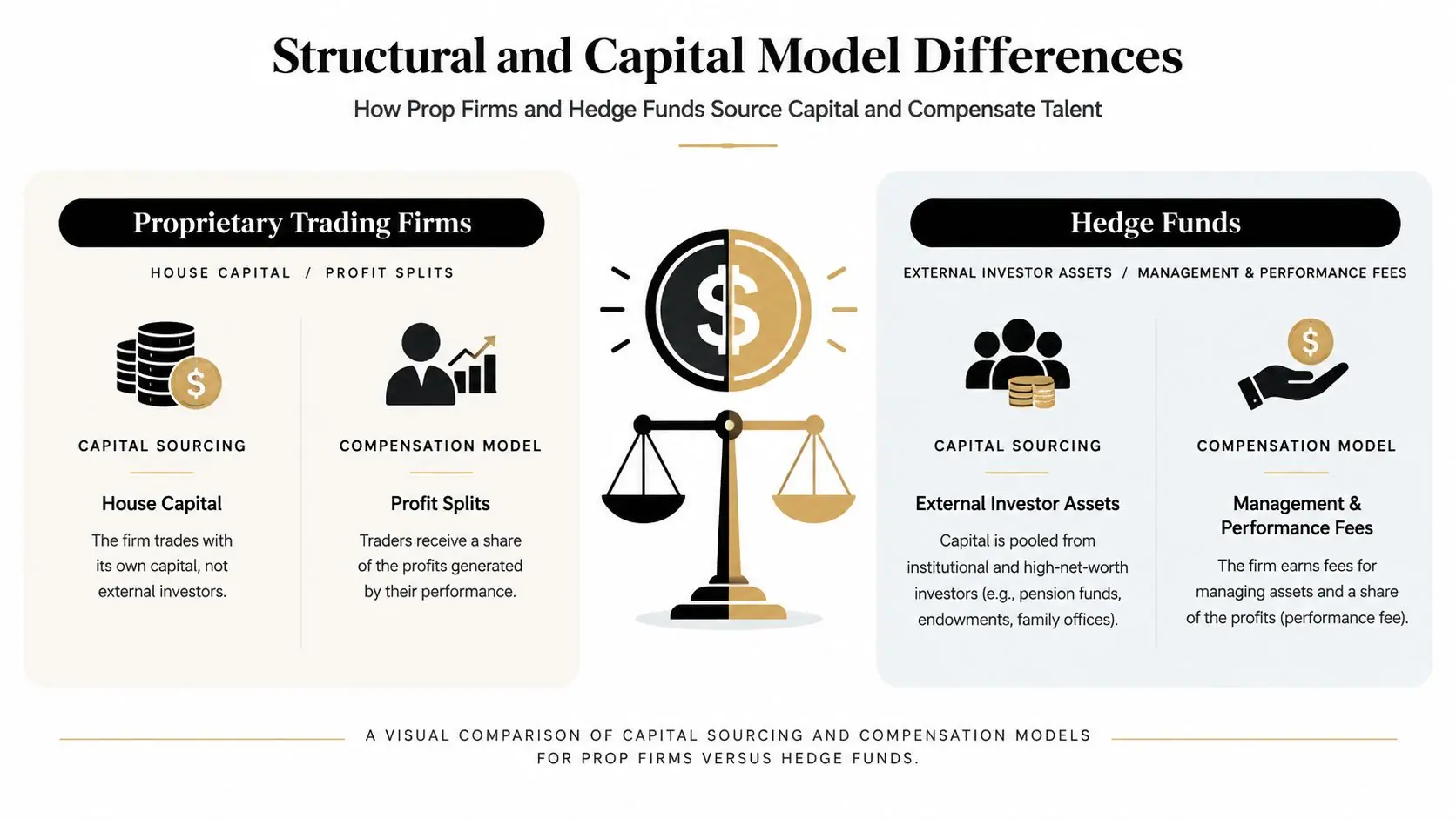
Capital Structure Comparison
| Aspect | Prop Firm | Hedge Fund |
|---|---|---|
| Primary capital | Firm capital, or simulated capital in evaluation-based models | External capital pooled from investors |
| Main economic focus | Direct trading P&L and trader profit splits | AUM growth, management fees, and performance fees |
| Trader's relationship to capital | Allocation under hard loss and drawdown rules | Portfolio or strategy responsibility within an investment vehicle |
| Capital raising | Usually less dependent on investor fundraising | Dependent on attracting and retaining investors |
| Operational speed | Can support faster strategy deployment and rule changes | Strategy changes may require more reporting, controls, and investor communication |
| Scaling path | Larger allocations or defined scaling rules | More capital may follow sustained performance and investor demand |
| External obligations | Usually no investor redemption windows or client lockups | Investor reporting, redemption terms, and fiduciary obligations are central |
For a trader, the practical difference is control. A prop firm can often change an allocation or enforce a risk parameter without waiting for a fund's investors to approve a new strategy. A hedge fund must account for redemption windows, liquidity expectations, valuation procedures, and communications with limited partners. That can slow deployment, but it also creates a more formal institutional framework.
The prop model can suit a trader who wants a clear operating box. The trader knows the maximum permitted loss, the instruments allowed, and the conditions for scaling or payout. The tradeoff is that the firm's risk system may be less transparent than a traditional fund's investor-facing reporting, and the trader's edge must produce results inside firm-level limits rather than through long-horizon capital appreciation.
Practical rule: Don't compare account size alone. Compare who controls the capital, who absorbs losses, who owns the P&L, and what event can stop your strategy.
For a hedge fund employee, the work may involve more than finding entries. Portfolio construction, liquidity planning, exposure aggregation, investor letters, and discussions with risk or operations teams can shape the trading process. A prop trader may spend more time monitoring execution quality, drawdown usage, and rule adherence. Your preferred working environment matters as much as your preferred market.
Risk Rules and Regulation
A trader can reach a hard account limit during an otherwise valid market thesis. That possibility captures a central difference in a proprietary trading firm vs hedge fund comparison. Hedge funds, particularly macro, relative-value, and derivatives-heavy funds, monitor financing risk and liquidity through measures such as gross assets relative to net assets, borrowing, and initial margin compared with gross exposure. The European Central Bank's discussion of hedge-fund leverage and liquidity risk explains why large synthetic exposures can become more sensitive to margin and solvency pressure during market stress.
Prop firms usually translate risk into rules a trader can check immediately. These may include a daily loss limit, maximum drawdown, per-account exposure restrictions, and instrument-specific limits. The key performance question is whether the trader preserves capital under a fixed maximum loss constraint while producing repeatable expectancy, rather than solely reporting a strong annual return.
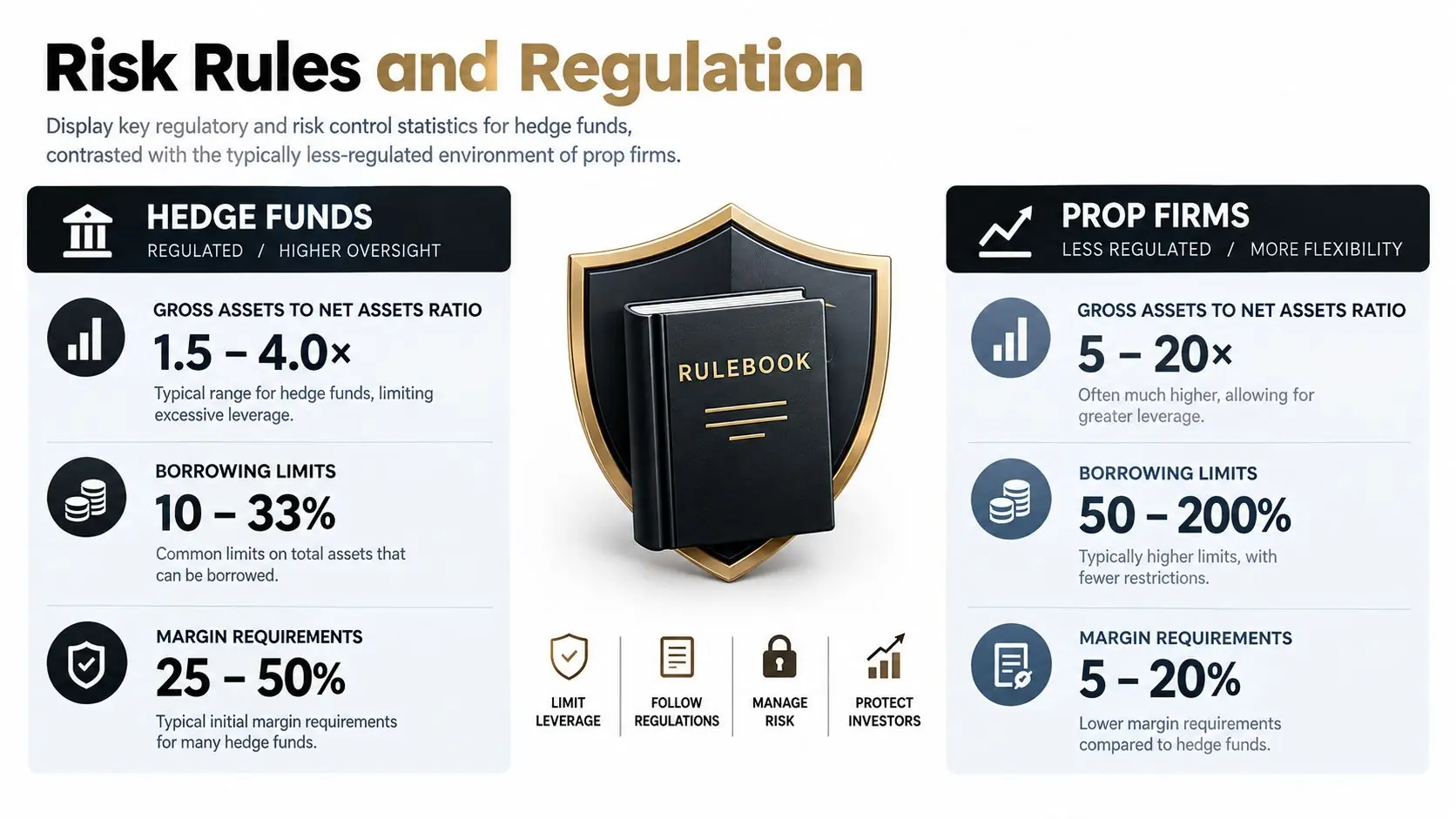
How the risk model changes your routine
A hedge fund risk team may examine portfolio-level debt use, financing, liquidity, collateral, correlations, and stress scenarios. A profitable position can still be reduced if it creates unwanted concentration or liquidity exposure elsewhere in the portfolio. The decision depends on the portfolio's combined risk, not only on that trade's result.
A prop account turns the same concerns into an operating checklist:
- Daily loss limit Confirm whether realized losses, floating losses, commissions, or all of them count.
- Drawdown method Determine whether the limit is static or trailing, then identify the balance or equity reference.
- Reset time Check the exact daily reset hour, especially if you trade across sessions.
- Exposure rules Review position-size, instrument, lot, and correlation restrictions.
- Event restrictions Verify rules for news trading, overnight positions, and weekend holding.
These settings determine how you handle a losing trade. In a fund, a position might remain open because the portfolio thesis survives and the risk budget allows it. In a prop model, crossing a hard account threshold can end the allocation despite the longer-term thesis. Risk discipline therefore includes sizing positions so a normal adverse move does not consume the account's permitted loss.
Before joining, review the firm's prop-firm regulation guidance alongside its rulebook. The written definitions matter more than the headline account size.
Where regulation complicates the comparison
Private-capital status does not settle every regulatory question. Recent SEC rules could require some hedge funds and proprietary trading firms that regularly buy and sell securities for their own accounts, particularly Treasuries at scale, to register as dealers, join FINRA, and meet additional reporting, recordkeeping, and capital requirements. The SEC dealer-rule analysis for hedge funds and trading firms discusses this issue.
The U.S. Volcker Rule separately restricts banking entities from proprietary trading and from owning, sponsoring, or retaining interests in hedge funds or private equity funds, as set out in the relevant U.S. Code provision. Ask what the firm trades, how regularly it trades, whether it provides liquidity, and which legal entity executes the activity. A website description cannot replace a review of the firm's regulatory position.
Check the stated authorization, disclosures, legal entity, complaints process, and treatment of customer or trader funds. Vague answers point to operational and counterparty risk in addition to market risk.
Trader Responsibilities and Career Paths
A trader's daily job changes sharply between the two models. At a prop firm, the central task is often to identify and execute opportunities while staying inside predefined loss and exposure limits. At a hedge fund, the trader may contribute to a broader investment process that includes research, portfolio construction, liquidity planning, attribution, and communication with risk and investor-relations teams.
That doesn't mean every prop desk is fast or every hedge fund is slow. Trading style can overlap. The difference lies in how the firm evaluates the trader's contribution.
The prop firm route
Prop-firm performance is usually read through rule compliance and consistency. A trader may need to demonstrate that the strategy can operate without breaching a daily loss limit or maximum drawdown. A strong single session won't compensate for repeated oversized positions if the account framework treats those positions as unacceptable risk.
Common responsibilities include:
- Execution Enter, manage, and exit trades according to the approved instruments and conditions.
- Risk discipline Track equity, floating loss, exposure, and remaining drawdown before adding risk.
- Process quality Keep the strategy consistent rather than changing rules after a losing trade.
- Scalability Show that larger allocation would not require a significantly different level of risk.
- Technology management Monitor expert advisors, copy systems, connectivity, and platform behavior where those tools are allowed.
This route can fit someone who values measurable boundaries and direct feedback. It may be less suitable for a trader whose edge depends on holding through unrestricted overnight events or accepting extended drawdowns.
The hedge fund route
A hedge fund trader works inside a chain of accountability. Junior staff may support data gathering, research, and execution. More experienced traders can own a strategy or risk bucket, while portfolio managers oversee capital allocation and total portfolio exposure. Senior roles may also involve explaining performance to internal committees and external investors.
Performance can be judged through returns, volatility, drawdown, liquidity, correlation, and the strategy's relationship to a benchmark or mandate. The trader's work can therefore remain valuable even when a single trade loses, provided the broader process produces an acceptable risk-adjusted outcome over the fund's evaluation horizon.
A career decision should account for your preferred feedback loop. Prop environments often provide immediate consequences when a rule is breached. Hedge funds may offer deeper research collaboration and a longer review cycle, but they also place more weight on communication, documentation, and institutional judgment.
The right career path is the one whose review process measures the skill you're actually trying to build.
Before accepting a role, ask whether you'll receive a personal allocation, contribute to a shared book, or support another portfolio manager. Clarify how performance is attributed, who can override trades, and whether promotion depends on returns, risk control, research output, or team leadership.
Payout and Fee Models
The most visible economic contrast is how each business converts trading activity into compensation. Hedge funds commonly use the 2 and 20 model, meaning a 2% annual management fee on assets under management and a 20% performance fee on profits above a benchmark or high-water mark, as described in the two-and-twenty fee structure.
The management fee is linked to AUM rather than a trader's individual winning month. The performance fee depends on the fund's fee terms, including the high-water mark. If the fund must recover prior losses before charging an incentive fee, a profitable period for one strategy may not immediately translate into an individual payout.
Prop firms typically use a different sequence. A trader may pay an evaluation fee, meet performance and risk conditions, and then receive a share of eligible profits under the firm's payout rules. In evaluation-based programs, the funded account can still operate in a simulated environment with real market quotes, so the trader must read the agreement rather than assume the displayed account size represents withdrawable cash.
| Model | Prop Firm | Hedge Fund |
|---|---|---|
| Primary revenue source | Evaluation fees and trading-related profit splits | Management fees and performance fees |
| Trader compensation | Share of eligible profits under firm rules | Salary, bonus, or incentive allocation under employment terms |
| Capital access | Often tied to passing an evaluation or receiving an allocation | Tied to the fund's investment vehicle and internal mandate |
| Payout timing | Defined by the firm's payout schedule and eligibility rules | Usually linked to employment agreements, fund performance, and incentive periods |
| Main cash-flow risk | Rule breach, payout conditions, or counterparty delays | Fund losses, high-water-mark recovery, investor redemptions, or bonus timing |
A useful comparison is cash-flow predictability. A prop trader should ask how often payouts can be requested, what minimum trading history applies, whether open positions affect eligibility, and what happens after a rule breach. A hedge-fund employee should ask when bonuses are calculated, how they're deferred, and whether the payout depends on the entire fund rather than the trader's sleeve.
Don't choose a model based on the headline split. A large percentage of a profit that can't be withdrawn under clear conditions is less useful than a smaller share with transparent eligibility rules. Read the payout policy, risk disclosure, fee schedule, and account agreement before paying or committing capital. The prop-firm payout methods available through MyFundedCapital illustrate why payment rails and timing belong in the comparison, not as an afterthought.
Use Cases for Traders
The best model depends on how your strategy behaves under constraints. A trader who closes positions within a session faces a different problem from someone whose edge depends on multi-day macro analysis. The same firm can look attractive to one profile and unsuitable to another because holding periods, event exposure, and drawdown tolerance change the economics.
Short-holding-period day trader
A day trader who relies on liquid instruments, repeatable setups, and controlled intraday exposure may prefer a prop environment. The appeal isn't guaranteed access to live capital. It's the clarity of a defined loss framework and the possibility of scaling through demonstrated rule adherence.
Before starting, the trader should test the strategy against the firm's exact daily loss calculation. A strategy that performs well in a personal account may fail if several correlated positions count toward the same drawdown threshold or if floating losses trigger a breach before trades close.
Algorithmic or copy-trading practitioner
An algorithmic trader needs operational compatibility before evaluating expected returns. Review the permitted platform, expert-advisor rules, copy-trading restrictions, latency expectations, news policy, and treatment of simultaneous positions. A profitable algorithm can still be unusable if the firm forbids its execution method or applies a drawdown calculation that the backtest didn't model.
This profile may value a prop firm because deployment can be tied to clear account rules rather than an extended investor-raising process. The trader should still forward-test conservatively and monitor slippage, disconnected trades, duplicated orders, and software failures. Technology risk can turn a valid signal into an account violation.
Fundamental swing trader
A swing trader who holds positions through earnings, economic releases, or weekends needs explicit permission for those exposures. If the firm prohibits news trading or weekend holding, the trader's edge may disappear even when the market analysis is sound.
A hedge fund may be a better professional setting when the strategy requires portfolio construction, fundamental research, and a longer investment horizon. The trader can work with a portfolio manager and risk team to define acceptable exposure, liquidity, and exit conditions. That structure brings more institutional oversight, but it also brings investor obligations and less personal control over the capital.
News-focused specialist
A news trader should treat add-ons and permissions as core economics, not optional extras. Confirm whether trading during specified announcements is allowed, how spreads and slippage are handled, and whether positions must be closed before a release. The rule is more important than the marketing label because a strategy built around event volatility can't operate under a blanket event restriction.
An evaluation also has a direct cost. Traders typically pay $99 to $1,800, depending on account size, and after passing may trade under demo conditions with payouts governed by a profit-split agreement, according to this prop-firm evaluation checklist. Treat that payment as a business expense you can afford to lose, not as a deposit that guarantees an allocation.
A practical fit test
Write down your strategy's absolute requirements:
- Holding period Intraday, overnight, or multi-day.
- Event exposure News, weekends, earnings, or scheduled data.
- Risk profile Fixed stop-losses, portfolio hedges, or thesis-based exits.
- Technology Manual execution, algorithmic trading, or copy trading.
- Cash flow Frequent withdrawals or longer-term incentive compensation.
The model that preserves your edge under its rules is more relevant than the model with the largest advertised account.
Choosing the Right Option
A trader may need weekly access to profits, strict drawdown limits, and quick strategy deployment. That combination often points toward a prop structure. A hedge-fund path may fit better when the priority is institutional research, portfolio ownership, and work connected to external investor capital.
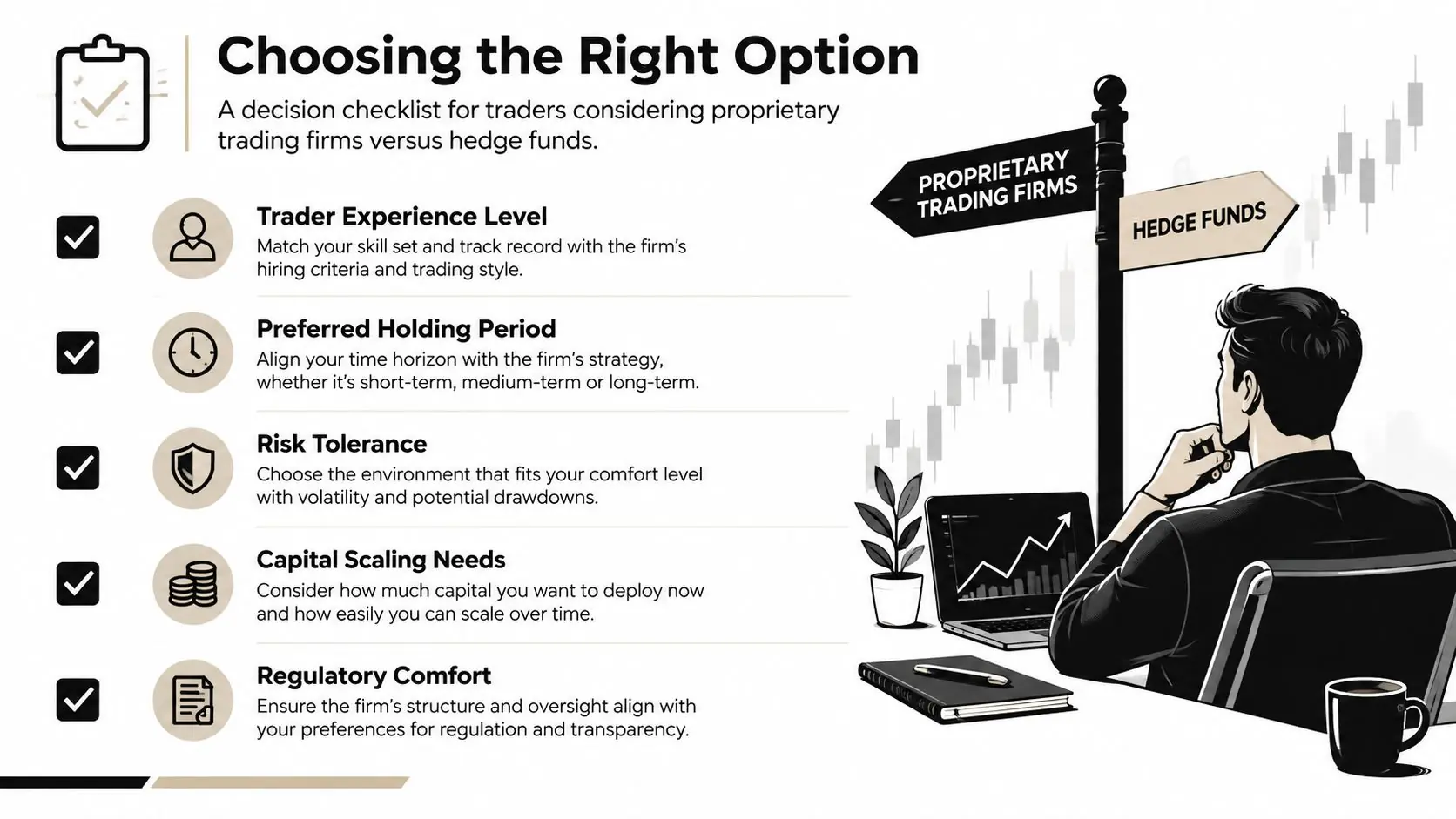
Use this checklist before applying or paying an evaluation fee:
- Experience level Can you follow a written process through losing periods, or are you still changing setups frequently?
- Holding period Does the model permit the time horizon your strategy requires?
- Risk tolerance Can you operate inside a hard account drawdown, or does your method need flexible, thesis-based risk?
- Scaling needs Do you prefer predefined allocation increases, or growth tied to fund AUM and investor demand?
- Payout timing Do you need frequent access to trading income, or can compensation follow a longer fund cycle?
- Regulatory comfort Are you prepared to work within a formal investment business with reporting and compliance obligations?
Questions for a prop firm
Request the rulebook before purchasing. Ask how daily loss and floating loss are calculated, when the daily limit resets, and whether maximum drawdown is static or trailing. Confirm whether news trading, weekend holding, copy trading, and automated systems are permitted.
Also ask what conditions trigger a payout review, which legal entity contracts with the trader, and whether the evaluation and funded accounts are simulated. These details affect both strategy viability and cash flow.
The prop-firm risk-rule checklist emphasizes checking daily loss, floating loss, reset time, maximum drawdown, profit targets, minimum trading days, and news or weekend restrictions. Treat every rule as a possible failure condition. Test the strategy against those conditions before committing money.
Questions for a hedge fund
Review the fund's offering documents, liquidity terms, redemption provisions, valuation policy, risk disclosures, and reporting practices. Employees should clarify how performance is attributed and how bonuses account for losses, high-water marks, and team-level results.
Regulatory status also requires verification. Some prop firms trading Treasuries at scale may face dealer-registration requirements, narrowing the practical distinction between private trading businesses and regulated securities firms. Check the relevant legal entity, registration position, and disclosures rather than relying on the firm's category.
Payout timing can determine whether a model is workable. A prop firm's scheduled withdrawals may support regular trading income, while hedge-fund compensation can follow a longer cycle tied to fund results, liquidity, or employment terms. Compare the timing, conditions, and review process, not only the headline profit split.
Choose the model whose restrictions you can obey on your worst trading day, not the model that sounds most flexible on your best day.
FAQ
Is a prop-firm funded account always a live trading account?
No. Evaluation-based programs can use demo environments with real market quotes, while the firm pays profits under its agreement. Read the account terms, execution disclosures, and payout conditions before assuming that displayed capital is directly deployable in a live market.
How should I assess a drawdown rule?
Recalculate it using both balance and equity. Then test the rule against open-trade loss, correlated positions, spread expansion, and the daily reset time. A strategy that survives only after trades close may not survive an equity-based limit.
Do hedge-fund redemptions affect traders?
They can affect the portfolio's available liquidity and the firm's capital-allocation decisions. Review redemption windows, lockups, gates, and the fund's liquidity terms, then ask how those restrictions influence your strategy's holding period.
What should I verify before joining either model?
Confirm the legal entity, risk disclosures, compensation terms, payout process, permitted instruments, and complaint route. Trading involves risk of loss, and no structure removes market, operational, or counterparty risk.
If you're comparing structured funding with a traditional hedge-fund path, visit MyFundedCapital to review its Instant Funding and 1-Step or 2-Step Challenge options, simulated trading environment, account types, risk parameters, and payout terms. Use those details to test whether the program's instruments, holding permissions, drawdown rules, and payout timing fit your own trading process.