

You've got a rules idea that looks clean on paper. Scan an option chain when implied volatility spikes, sell a defined-risk spread, hedge the delta, exit at a target. Then you read a prop firm rulebook and find hedging's prohibited, scalping's prohibited, and an expert advisor needs agreement before it runs. The strategy didn't fail on its signal. It failed on design assumptions you coded first and questioned last.
That's the trap with algorithmic trading options in a funded environment. The rulebook isn't a compliance check at the end. It's a design constraint on day one, and it decides which textbook techniques you rebuild, which you drop, and which you never write. Build inside those limits from the start and you've got a system you can run. Build outside them and you're rewriting under pressure.
How Algorithmic Options Trading Works
Say you set the rules once on a Sunday night. By Monday, while you're away from the screen, the system scans option chains, prices spreads, routes orders and closes positions that hit your limits. You didn't click anything. The code worked your checklist for you.
An option is a right, not an obligation, to buy or sell an underlying at a strike price before expiry. The premium is the price you pay for that right, and a standard U.S. equity contract usually covers 100 shares. A call gives the right to buy. A put gives the right to sell.
Think autopilot, not auto-pilot-makes-you-rich. The pilot still sets the route, altitude and abort conditions. Instruments and checklists handle the constant monitoring a human can't sustain. Your algorithm does the same. It watches every strike and expiry, but only inside the route you defined.
Why the scale forces automation
No person can watch this market by hand. According to Cboe's state of the options industry review, U.S. listed options volume reached 15.2 billion contracts in 2025, a 26% increase over 2024 and the sixth consecutive annual record, averaging approximately 61 million contracts per trading day.
Growth came from every corner. Single-stock options increased 28%, exchange-traded-fund options rose 32%, and index options grew 21%. Options volume exceeded 70 million contracts on 21 days during 2025, and one session reached 110 million contracts.
That's why automation fits. A system can compare hundreds of strikes, expirations and spreads in the time you'd take to refresh one chain. It'll also apply the same exit rule at 3 p.m. that it applied at the open, without fatigue or second-guessing.
Contract count isn't exposure
Don't confuse volume with risk. One contract generally represents 100 shares, but premium, delta and implied volatility determine the economic risk you bear. Two positions with the same contract count can lose money at completely different speeds.
A signal tells you what looks cheap or expensive. It tells you nothing about whether you can exit, what you'll pay to exit, or how fast the position can hurt you.
So every options algorithm needs four parts, not one. Signal decides when to trade. Sizing decides how much. Execution decides how orders reach the market and at what price. Risk control decides when the system stops, flattens, or hands control back to you. If any one part is missing, the other three won't save you.
Strategy Types and What Each Needs
| Strategy | Core Edge | Key Inputs | Main Risk |
|---|---|---|---|
| Volatility arbitrage | Implied volatility priced above or below expected realized volatility | Full option chains, implied volatility surface, realized volatility history | Vega and gamma exposure, model error |
| Market making | Capturing the bid-ask spread by quoting both sides | Live depth, quote updates, fill data | Adverse selection, inventory build-up |
| Trend-following with options | Directional moves with defined maximum loss | Underlying price history, implied volatility, expiry calendar | Whipsaw, time decay outrunning the move |
| Statistical arbitrage | Mean reversion between related underlyings or spread relationships | Correlated instrument history, spread statistics | Regime break, spread that stops reverting |
| Put-call parity arbitrage | Mispricing between a call, a put and the stock | Synchronized quotes, borrow and financing costs | Thin liquidity, legging risk |
Volatility arbitrage compares implied volatility with the realized volatility you expect. You need full chains and a clean implied volatility surface, because a single mid-price tells you nothing about skew. If you want the practical setup, our guide to volatility trading with options works through the entry logic.
Market making earns the bid-ask spread by quoting both sides all day. That sounds steady until informed flow picks you off. You carry adverse selection and inventory that grows exactly when you least want it, and you need live depth and fill data most retail feeds don't give you well.
Trend-following with options expresses a directional view with defined maximum loss. A debit spread caps the downside, but time decay works against you every hour. If price whipsaws sideways, the move you called correctly can still expire worthless.
Relative value and parity
Statistical arbitrage trades relationships between related underlyings or spreads that normally revert. Your edge lives in the history of that relationship. When the regime breaks, the spread doesn't revert, it trends, and a mean-reversion bot keeps adding to a loser unless you cap it.
Put-call parity arbitrage looks for mispricing between a call, a put and the underlying stock. In theory it's riskless. In practice, borrow costs, financing, thin liquidity and legging risk, where one leg fills and the others don't, usually erase the gap before you collect it.
Where machine learning actually helps
Don't let a neural network replace pricing structure. Research on American options using S&P 100 data trained networks on the difference between market-implied volatility and Black-Scholes and Heston outputs, and sequentially trained networks reduced implied-volatility forecast RMSE relative to the traditional benchmarks.
Use that as a hybrid pipeline. Calibrate a baseline surface first, predict the residual errors with your model, impose no-arbitrage and smoothness constraints, and trade only after bid-ask spread, gamma and vega exposure, and transaction costs. Validate by expiry and moneyness bucket, not just aggregate error, because a small surface miss in short-dated, high-gamma options hits profit and loss hard.
Selection rule: Pick the family that matches the data you can actually obtain and the capital you can risk, not the family with the prettiest backtest.
Execution Platforms and Languages Compared
| Platform | Strategy Language | External API | Backtesting |
|---|---|---|---|
| MetaTrader 5 | MQL5 | Official Python package | Built-in Strategy Tester |
| cTrader | C# through cAlgo | Open API | cTrader Automate backtester |
| DXtrade | Platform-specific scripting or integration, depending on setup | Availability depends on the connected broker | Testing tools depend on the connected broker |
These columns answer different questions. The strategy language determines how you express and change logic. API access determines whether an external program can receive quotes and send orders. Backtesting determines how closely you can model execution before risking capital.
MetaTrader 5 supports native MQL5 strategies and an official Python package for external programs. Its built-in Strategy Tester can test single-instrument logic. For multi-leg options, check how the system models each leg: separate orders create fill assumptions that may differ from live execution.
cTrader supports C# through cAlgo, offers an Open API for external bots, and includes a cTrader Automate backtester. C# can shorten setup if you already use it; otherwise, learning the language adds development time. Compare the trade-off before committing to a stack, and find the fastest language for your workload.
DXtrade can be part of the platform comparison, but its scripting, API access and backtesting depend on the specific setup. Confirm those capabilities with the relevant provider before designing around them. A platform label alone does not establish that an options bot can retrieve the data or submit the order types it needs.
What to check beyond the table
For each platform, get clear answers to four execution questions:
- Native multi-leg orders Can the platform send a spread as one package, or does the bot send each leg separately and carry legging risk?
- Historical bid and ask Are historical options quotes available with bid and ask, rather than only last trade, so the backtest can model executable prices?
- Rejection reporting How does the platform report rejected orders and partial fills, and can the bot respond automatically?
- Quote timestamps Does each quote include a timestamp your logic can use to reject stale prices?
If the answer about multi-leg orders is unclear, model each leg as a separate fill. That makes the backtest less flattering, but more useful.
The position for MyFundedCapital traders
MyFundedCapital traders place trades in the MyFundedCapital Terminal, within their program's risk rules. Supported platforms include DXtrade and cTrader. Treat platform choice as a design constraint from the start: an options technique that depends on unavailable order handling or data must be rebuilt before coding, not patched after testing.
Hosting and Execution Speed for Options Bots
| Hosting Option | Typical Latency | Uptime and Control | Best Fit |
|---|---|---|---|
| Home PC | Tens of milliseconds to over 100 ms | Exposed to power and internet outages | Learning, paper trading, slow strategies |
| VPS in the exchange region | Low tens of milliseconds or less, depending on location | 24/7 hosting, shared resources | Retail EAs and intraday strategies |
| Colocation | Sub-millisecond inside the exchange data centre | Highest uptime, high fixed cost, own hardware | Institutional market making and latency-sensitive systems |
A home PC is cheap and fragile. A power cut or lost connection can leave positions open while the bot is offline. Use it for learning and paper trading, not for unattended production.
A VPS in the exchange region suits many retail and prop-style systems. It provides continuous hosting, with latency depending on its location, without requiring you to buy hardware. Colocation places your own machine inside the exchange data centre, but its fixed cost is difficult to justify unless the strategy depends on very low latency.
Speed is two different problems
Separate decision latency, the time your model takes to decide, from execution latency, the time orders take to reach the market and fill. Stale quotes, slow reconnects and weak order handling can cost more than network distance. Before paying for proximity, improve app response times by trimming unnecessary work from the decision loop.
Sizing hurts more than distance
Order size creates its own cost. A systematic study of high-frequency options metaorders, large parent orders divided into smaller child orders, found that options markets exhibit the same core empirical relationships documented in equities, including the square-root law and market-impact dynamics. A fixed-rate schedule can concentrate trades in thin strikes, worsening price impact far from at-the-money or during volatility shocks.
Slice orders according to available size and quote width, cap participation, and spread execution across strikes where liquidity supports it. Avoid the widest quotes at the open and during news. Impact-aware sizing can preserve a sound signal; ignoring impact can let execution costs erase it.
Multi-leg execution rules
Treat a spread as one unit, with a plan for partial fills:
- Send it native Use a single multi-leg order where supported. If you must send legs separately, send the hardest-to-fill leg first.
- Use one snapshot Price every leg against the same quote snapshot. Reject the package if any leg's quote exceeds your age limit.
- Flatten filled legs promptly Set a time limit for resolving partial fills. Don't leave a naked leg open hoping the rest fills.
- Log every outcome Record rejections and partial fills per leg so you can compare realized slippage with your backtest.
Before choosing a host, ask about its uptime guarantee, the distance between its server and your broker's server, and what happens after a disconnect. Confirm how the bot reconnects and resynchronizes positions.
How to Test an Options Algorithm
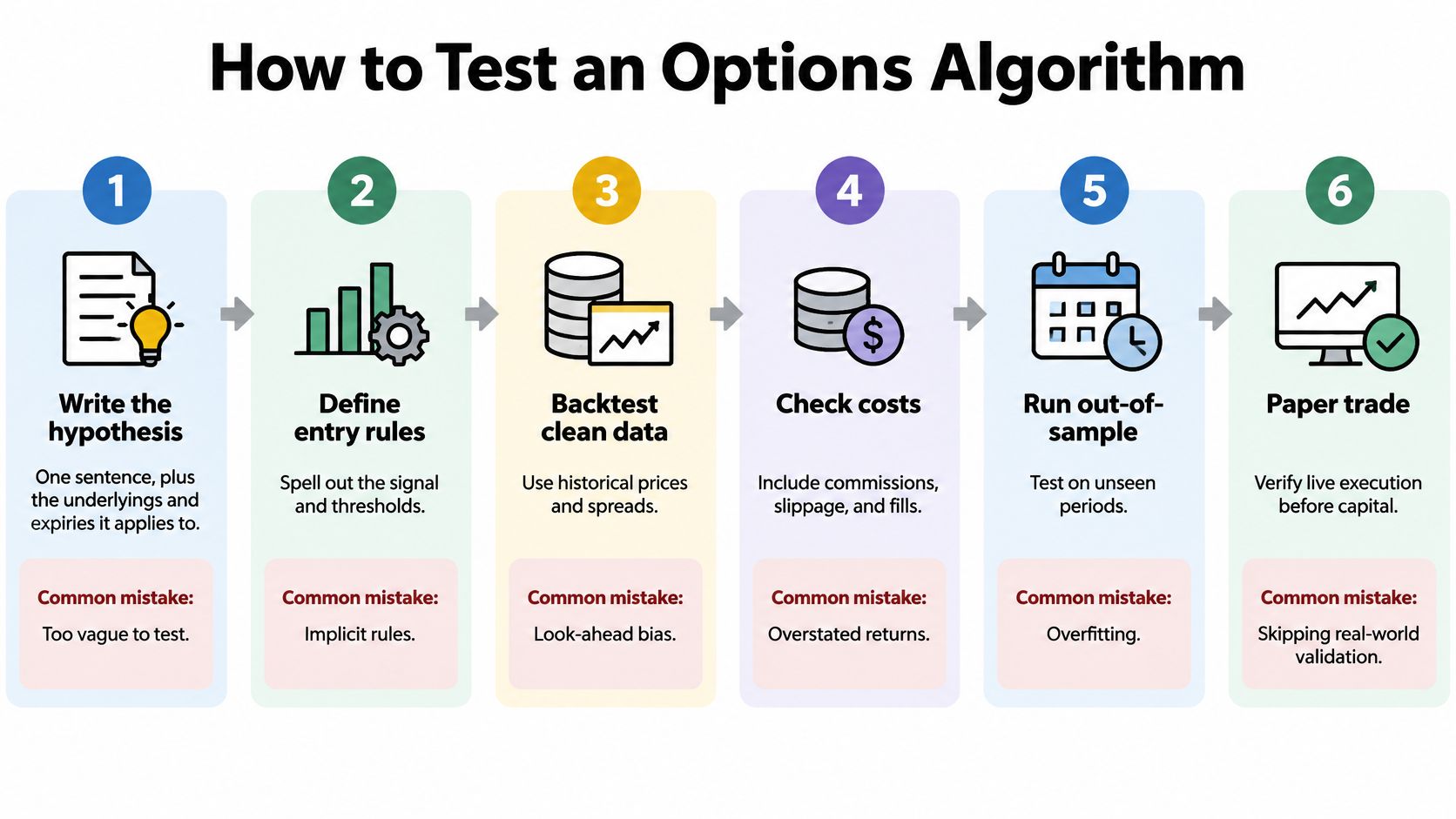
Testing is a sequence, and skipping steps doesn't save time. It moves the failure to live trading, where it's expensive. Our deeper walkthrough of algorithmic trading backtesting covers the mechanics. The order below is what matters.
Write the hypothesis. One sentence, plus the underlyings and expiries it applies to. A rule built for 30-day index options can fail completely on same-day expiring contracts, so scope it before you test it. The usual mistake is a hypothesis too vague to falsify.
Load bid and ask quotes. Use historical option quotes with bid and ask, not only last trade. Filling at mid-price is the most common way traders flatter themselves, because nobody consistently gets mid on every leg.
Charge every leg. Backtest with commissions and slippage per leg. A four-leg spread crosses four spreads, so its true cost is far higher than a single order's. Strategies that look profitable gross routinely die here, and that's the test working.
Validate walk-forward. Split results by expiry and moneyness bucket, not just aggregate return. Keep out-of-sample periods untouched, and purge overlapping observations so future data doesn't leak into training. As your test suite grows, it helps to align automated testing with CI/CD pipelines so every code change reruns the same checks instead of relying on memory.
Stress the ugly cases. Run volatility gaps and vanished liquidity, then measure tail loss, margin usage, turnover and fill quality alongside return. A strategy with a smooth average and one catastrophic week is a bad strategy wearing a disguise.
Shadow, then smallest size. Run on live quotes without order authority first and compare shadow fills with backtest expectations. Then trade the smallest size under hard caps. Paper results that skip live execution prove nothing about your order logic.
When the system must stop itself
Build kill rules before you need them. Disable the system after a fixed loss, after a data outage, or when live behaviour departs from the backtest envelope, and hand control back to a person. A model that keeps trading through a broken feed isn't automated. It's unattended.
A passed test means stable results across volatility regimes, live fills close to shadow expectations, and no dependence on one lucky market period.
If your edge only exists in one regime, you don't have an edge. You've got a fitted story about that regime.
Risk Controls and Prop Firm Rules
Start where most traders finish. Under our rules, martingale, opposite trades across accounts or firms, all-in bets, scalping, high-frequency trading (HFT) and hedging are prohibited. Read the full text in our trading rules before you design anything, because these six patterns shape the system more than your signal does.
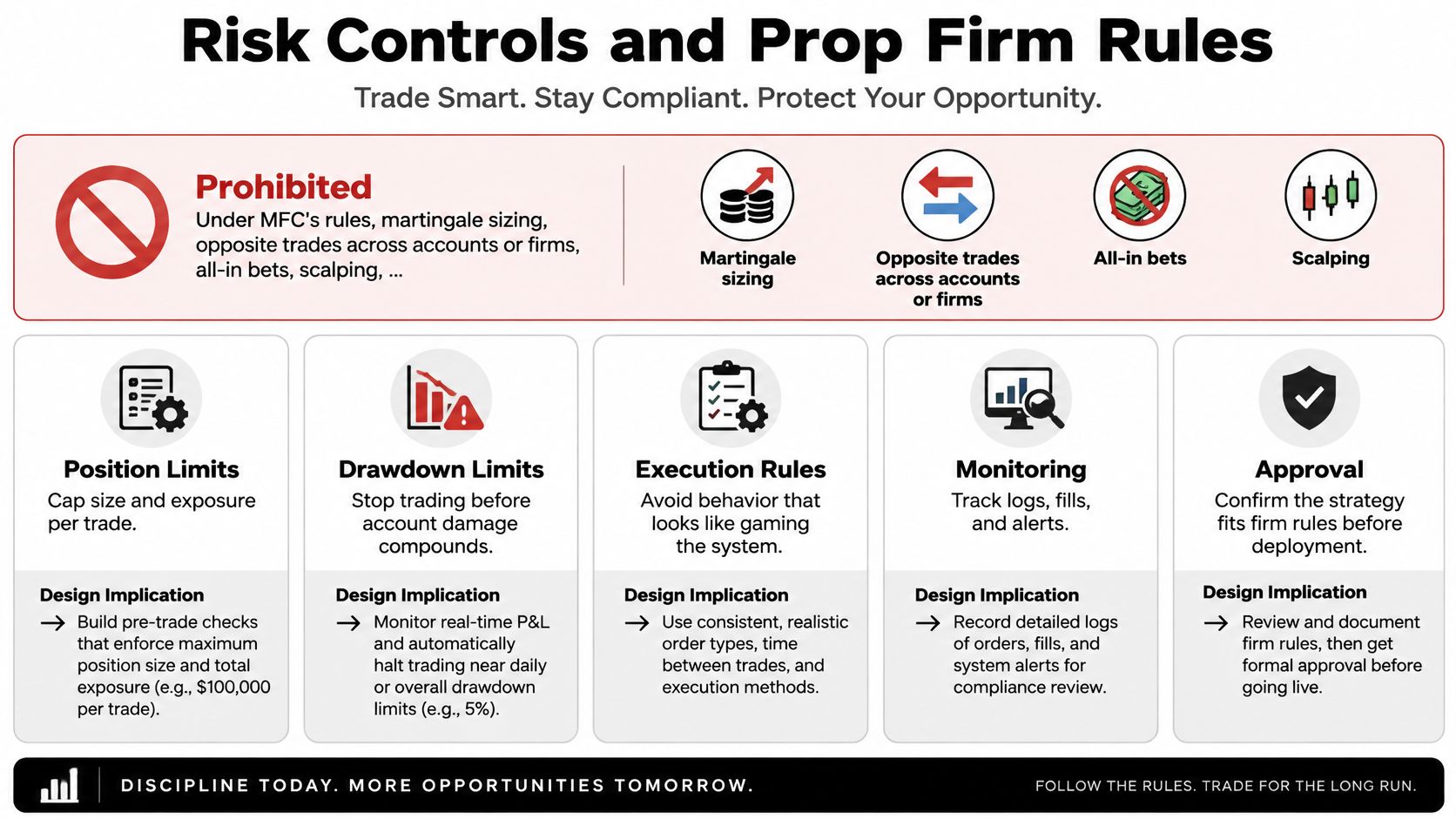
Delta hedging is the hard case. It's a core tool of volatility strategies, and it falls under hedging, so a delta-neutral design doesn't transfer. Rebuild it as a defined-risk directional or spread strategy, where the maximum loss is fixed at entry by the structure itself, not managed later by offsetting trades. That's a different strategy with different maths, and pretending otherwise gets accounts closed.
Expert advisors and trading bots are allowed by agreement, and you must contact support before using one. Copy trading is allowed between your own accounts and from other traders or signal services, as long as no martingale, opposite trades across accounts or firms, or all-in bets are used. The tool isn't the problem. The pattern it produces is.
Pre-trade controls aren't optional
Regulation expects automated screening, not manual hope. U.S. derivatives rules require clearing members to establish risk-based limits using factors such as position size, order size, and margin requirements, and when orders are subject to automated execution, those entities must use automated screening to test orders against the applicable limits.
Copy that structure into your own bot. Set a maximum order size, position caps, margin checks, and automatic rejection of any order beyond approved thresholds. If your code can send an order your rules wouldn't approve, your risk control is decorative.
Assignment and expiry mechanics
Options add risks a stock bot never meets. Selling an American-style equity option creates assignment risk on every business day while the short position remains open, and OCC randomly assigns exercise notices among clearing-member accounts carrying short positions in the same series. At expiration, equity options at least $0.01 in the money are generally exercised unless instructions say otherwise.
Assignment risk rises near expiry, deeper in the money, and around ex-dividend dates. A writer can also remain obligated if the secondary market becomes unavailable, so an exit you assumed might not exist when you need it. Your bot needs explicit expiry handling, not a hope that you'll be watching.
Your controls checklist is short:
- Daily loss kill switch Trading stops automatically at your preset limit, no override in the moment.
- Expiry rules Defined behaviour for the final day and final hour of every short position.
- Quote-age limit Stale quotes rejected before pricing, not after a bad fill.
- Manual override One action that halts the bot and flattens or freezes positions.
Confirm the Rules Before You Build
A strategy can be profitable in a backtest and still be unusable under a prop firm's rules. Check those limits before writing code, especially if the options design depends on delta hedging. MyFundedCapital prohibits hedging, so a delta-hedged strategy needs to be rebuilt as a permitted defined-risk directional or spread strategy before development begins.
Start with the current trading rules. Then write down how the strategy behaves near its daily and overall loss limits. The MyFundedCapital Terminal shows your remaining loss room in dollars before you place a trade, so size each order against that room.
For a beginner, free trading calculators can help with position sizing, drawdown, and payout dates. For an experienced developer, check every strategy rule before implementing it. Copy trading is allowed between your own accounts and from other traders or signal services, provided you do not use martingale, opposite trades across accounts or firms, or all-in bets. EAs and trading bots are allowed by agreement, but contact support before using one.
Work through these checks in order:
- Choose a program and size MyFundedCapital offers 1-Step, 2-Step, Instant Funded, Stocks, and Prediction Markets programs. The 2-Step Challenge has two evaluation stages before funded trading.
- Check the trading environment Trade within the MyFundedCapital Terminal and your program's risk rules. Test your implementation against that environment before relying on it.
- Match the strategy to the loss limits Set order sizes and position caps so the bot cannot exceed the available daily or overall loss room.
- Confirm any add-ons News trading, weekend holding, higher profit splits, and weekly payouts are optional paid add-ons selected at checkout. Choose only what the strategy needs.
- Get approval before running an EA Contact support before deploying an expert advisor or trading bot.
Put the final rules on one page: entry conditions, position limits, loss thresholds, and what the bot does when a limit is reached. If a strategy cannot be described clearly enough to fit there, simplify it before coding.
If your options system fits the rules and you are considering MyFundedCapital, compare programs and account sizes against the strategy's expected risk. Profit splits start at 80/20 and can be upgraded to 90/10 or 100%. The firm offers 24/7 multilingual support. Confirm any bot with support before it runs, then choose a size your testing supports.
