

You've closed your trades, your account shows a profit, and a bill is coming due. The payout date looks close enough, but you still don't know whether that date means you can submit a request, the firm will approve it, or the money will be ready to spend.
A payout schedule helps only when you know which event it controls. Build your budget around usable funds, not just the first date a request button becomes available.
Weekly, Biweekly and On-Demand Payout Cadences Compared
A payout cadence works like a train timetable. It tells you when a request can depart, not when the money arrives at its destination. Approval, transfer settlement and usable funds each run on their own clock, so the timetable is only the first number worth knowing.
Three cadences cover most trading programs:
| Cadence | How often a request can be made | Best for | Main trade-off |
|---|---|---|---|
| Weekly | Every 7 days | Traders who want smaller, steadier withdrawals | Each cycle still carries eligibility conditions, such as minimum trading days |
| Biweekly | Every 14 days | Traders who prefer fewer, larger payouts | A longer gap to bridge before the next request opens |
| On-demand | Whenever the trader is eligible under program rules | Irregular or urgent cash needs | Usually sold as an add-on, so check its price and terms before buying |
Weekly payouts suit traders who prefer several small withdrawals over one large one. At MyFundedCapital, Prediction Markets accounts follow this pattern: the first payout is available on day 7 after the first funded trade, then weekly. The frequency does not remove the conditions attached to each cycle. A payout request still has to sit between $50 and $5,000, positions must be closed before it is submitted, and each cycle requires at least 3 trading days, with a day counting only when the trader risks at least 0.25% of the balance.
Biweekly payouts double the spacing between windows. On 2-Step and MFC Stocks accounts, requests open 14 days after the first funded trade and then every 14 days. This rhythm suits a trader who keeps enough cash outside the account to cover bills during the wait and prefers fewer transfers and less payout administration. The trade-off is concentration: because each request is capped at $5,000, a larger balance may need several cycles to withdraw fully, with any remaining profit carried into later requests.
On-demand means flexibility, not automatic approval
On-demand payouts relax the calendar itself rather than the checks behind it. MyFundedCapital offers Payout On-Demand and a 7-Day Payout Cycle as paid add-ons chosen at checkout, alongside options like news trading and weekend holding. The add-on changes when a request may be made. Eligibility review, request limits and processing still apply.
Reading payout terms outside trading can sharpen the same habit. AmaJova's payout guidance for service sellers is one example of a policy built around the same questions: what makes earnings payable, and what happens after a request goes in.
Budgeting rule: Choose a cadence you can live with even when a request takes longer than expected.
A frequent request window reduces the gap you must bridge between withdrawals, but it cannot turn uncertain trading profit into a guaranteed salary. Pick the timetable first. Then read every condition attached to each departure.
Why a Payout Schedule Is Not the Same as Money in Your Account
Follow the money through these distinct stages:
- Request submitted. You send the payout request.
- Eligibility reviewed. The firm checks account conditions and approves it.
- Payment released. The firm initiates the transfer or releases its payment file.
- Transfer settled. The bank, e-wallet provider or crypto network handles the payment.
- Funds usable. You can spend, transfer or withdraw the proceeds at the destination.
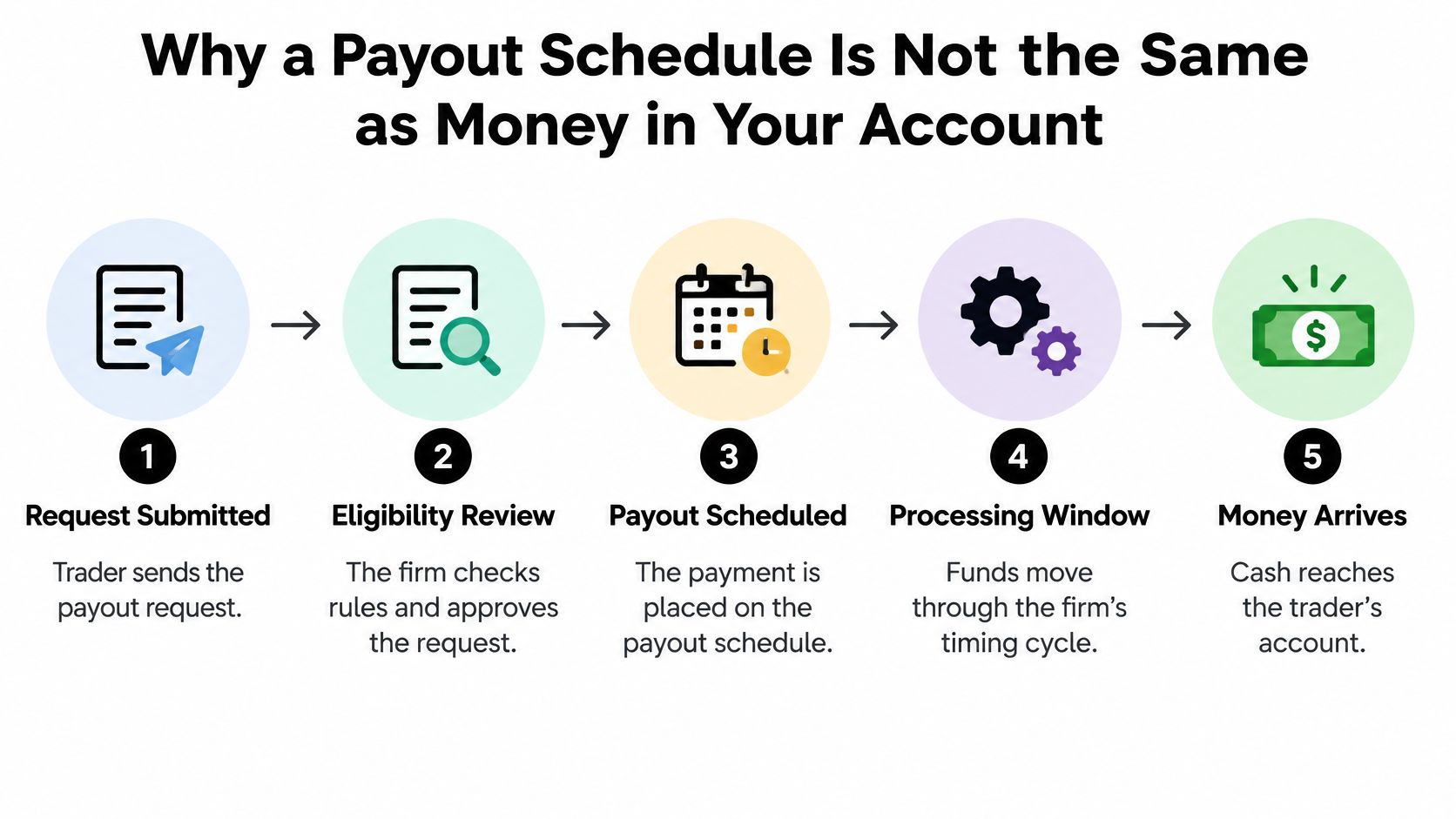
At MyFundedCapital, payouts are processed in an average of 1 hour and 46 minutes, measured from request to approval. That describes our approval clock, not a guarantee that every receiving account has usable money within that period.
Say you submit a request on Friday afternoon and receive approval within a day. If the bank transfer misses its processing cutoff, settlement may wait until the next business day. A public holiday or an intermediary-bank review can push arrival further out.
Where the clock can pause
Incomplete beneficiary details can stop payment initiation. Currency conversion and intermediary banks can add handling stages, while a crypto payout may still require conversion before you can use the proceeds for ordinary expenses.
For eligible U.S. ACH payments, the Federal Reserve's FedACH processing schedule includes same-day settlement windows at 1:00 p.m., 5:00 p.m. and 6:00 p.m. Eastern Time, subject to transmission deadlines. A fast approval doesn't override those deadlines.
Sambapay's explanation of how to manage card payment cash flow offers a useful parallel: payment processing and final access to money are separate operational events.
When comparing payout promises, resolve these questions:
- Starting event Does the advertised clock begin at the first trade, request, approval or payment release?
- Calendar treatment Do weekends and public holidays count toward eligibility, processing or neither?
- Service levels Are review time, approval-to-release time, settlement expectations and exceptions reported separately?
Keep the request time, approval time and arrival time in a simple spreadsheet. If a payment is late, those timestamps help identify whether the delay occurred inside the firm or after the transfer was released.
How Each Cadence Shapes Your Monthly Cash Flow
Suppose you need $1,500 a month for living costs and expect $3,000 of eligible profit over the month. These are hypothetical planning figures, not a return forecast. You decide to withdraw only the amount needed for expenses and leave the remainder outside your spending budget.

With a weekly cadence, your hypothetical expense withdrawals could be four requests of about $375 each. That creates smaller spending allocations, provided enough eligible profit is available whenever you request it.
With a biweekly cadence, the same hypothetical budget could use two requests of about $750 each. You'd need to hold enough cash between requests rather than treating the entire arrival as immediately spendable.
Match withdrawals to the bill calendar
An on-demand option could let you time a request around rent or a tax payment, where the program permits it. Submit early enough to accommodate review and settlement rather than waiting until the bill's due date.
The hidden problem is that your expenses continue even when trading doesn't produce eligible profit. A losing stretch or an unmet trading-day condition can interrupt the withdrawal pattern.
Keep at least one full payout cycle of expenses in a separate account. Don't rely on an unapproved request to cover an essential bill.
The firm needs its own liquidity planning. Treasury must reserve cash for approved payouts while preserving funds for refunds, payment reversals and operating costs, rather than assuming all available cash can be distributed.
The Bank for International Settlements' analysis of foreign-exchange settlement risk provides context for why settlement obligations and cross-border timing deserve careful liquidity management. For payout planning, the practical discipline is to forecast outflows by currency and payment method, then size reserves against the highest expected settlement-day outflow, not just the average.
Match your cadence to your largest fixed bill, and keep the money needed to bridge a full cycle separate from trading funds.
Payout Methods Compared by Speed, Recovery and Risk
The payment route affects what happens after approval. At MyFundedCapital, payouts can be made through bank transfer, e-wallets, crypto or local methods.
Payout methods compared
| Method | Typical speed | Reversibility | Main risk to check |
|---|---|---|---|
| Bank transfer | Slower when cutoffs or non-business days intervene | Recall possible through the bank, not guaranteed | Wrong account details or bank rejection |
| E-wallet | Often quicker, subject to provider processing | Governed by the provider's correction and dispute policy | Account verification and fees |
| Crypto | Can be fast, subject to network conditions | Generally irreversible | Wrong address or wrong network |
| Local methods | Set by the domestic payment rail and its operating hours | Governed by the local scheme's recovery rules | Country availability and recipient eligibility |
Bank transfers offer an identifiable banking route for tracing a payment and requesting recovery. That doesn't mean a bank can always recover money sent to the wrong account, especially after the recipient has received or moved it.
Crypto requires particular care before release. A valid-looking wallet address doesn't establish that you've selected the correct network or that the destination supports the asset.
Treat recovery as part of the price
The European Central Bank and European Banking Authority's payment-fraud report recorded approximately €4.2 billion in payment fraud across the EEA in 2024; users bore 85% of credit-transfer fraud losses. These figures concern payment fraud broadly, not MyFundedCapital payouts, but they underline why recovery and responsibility matter alongside speed.
Before selecting a route, review:
- Verification Which beneficiary or wallet details are checked before release?
- Correction Can the payment be recalled, cancelled or amended?
- Loss responsibility Who bears losses from an incorrect address, bank rejection or compromised account?
- Total cost Are network fees deducted, and is the exchange rate disclosed?
- Compliance Which documents may be requested, and what information must be supplied to resolve a hold?
If you're also arranging business banking across borders, Mazurly's banking guidance for non-U.S. founders provides relevant account-opening context. Keep that separate from confirmation that a particular account can receive your payout.
Use our payout methods and processing-time guide to review the payout route. Prefer bank rails when traceability matters; choose crypto only when you understand address verification, network selection and irreversible transfers.
MyFundedCapital Payout Schedules by Program
Every date in the table below is request eligibility: the day MyFundedCapital lets you ask for the money, not the day it lands in your bank or wallet. The approval clock and the arrival of usable funds are two separate timelines, and the MyFundedCapital Payouts page sets out the core timings.
MyFundedCapital payout schedule by program
| Program | First payout eligible | Then every | Weekly add-on |
|---|---|---|---|
| 1-Step Challenge | 14 days after first funded trade | 14 days | 7-Day Payout Cycle add-on |
| 2-Step Challenge | 14 days after first funded trade | 14 days | 7-Day Payout Cycle add-on |
| MFC Stocks | 14 days after first funded trade | 14 days | 7-Day Payout Cycle add-on |
| Prediction Markets | 7 days after first funded trade | 7 days | Weekly by default |
Don't transfer the schedule from one program to another merely because both accounts appear in your Dashboard. Prediction Markets is the only program here that pays weekly without an upgrade.
Read the starting event carefully
The countdown starts from your first funded trade, not from the purchase date, approval emails or your first winning day. If you buy a challenge account on a Monday but take your first funded trade two weeks later, your eligibility clock only starts then.
Paid add-ons change the cadence, not the starting event. The 7-Day Payout Cycle add-on shortens the recurring interval to weekly, and Payout On-Demand removes the wait between requests on accounts that carry it. Neither rewrites the initial waiting period.
A 35% consistency rule applies, and profit above the per-request limit is paid across later requests, so a larger balance may take several cycles rather than one transfer. Program rules, verification and the selected payout method still affect each request. Follow the cutoff displayed in your Dashboard rather than calculating a date from memory.
Before buying: Match the program's first waiting period and recurring cadence to the cash gap you can comfortably cover.
Read the full trading rules alongside the schedule, and use plan details and prices to compare the complete purchase. A shorter interval is useful only if the account's other conditions fit how you trade.
Choose your program around the cadence you need before you buy. A faster recurring schedule shortens the gap between requests, while the initial waiting period stays fixed.
How to Request and Track a Payout in Your Dashboard
Our profit-sharing eligibility guidance explains that payout access remains subject to program rules, relevant consistency requirements, verification and payment method. A newly closed profitable trade isn't automatically ready for withdrawal.
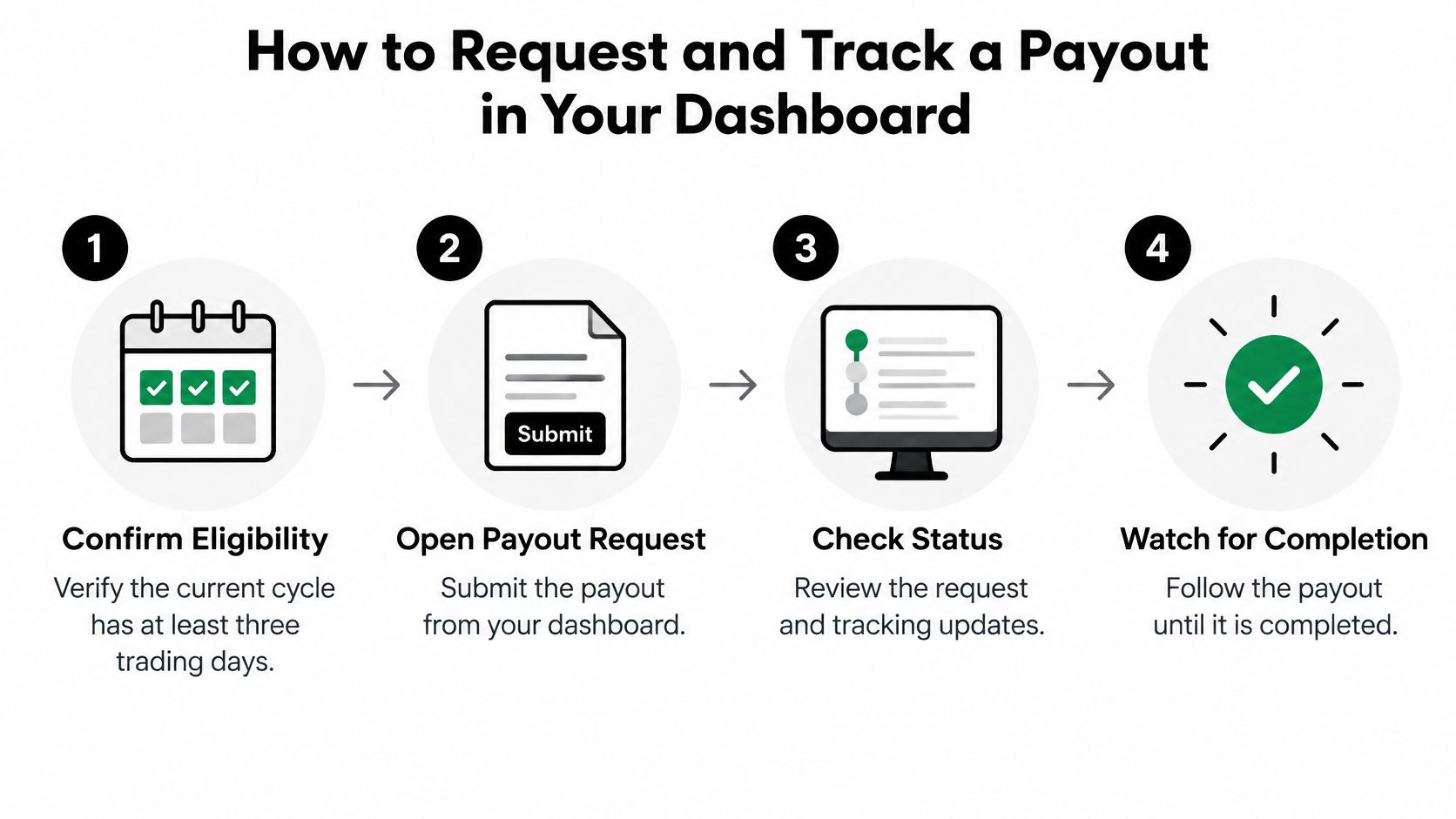
Prepare and submit the request
Confirm your qualifying trading days. For accounts bought from 22 October 2026, each payout cycle requires at least 3 trading days before a request. A day counts when you risk at least 0.25% of your balance, so opening a token position isn't enough to satisfy the requirement.
Close all open positions. Positions must be closed before requesting a payout. An otherwise eligible date doesn't override this condition.
Check the requested amount. Each request must be between $50 and $5,000. If your eligible profit exceeds the request ceiling, plan for the remainder to be paid through later requests.
Submit through the Dashboard. Open the payout area and enter the request there, checking the destination details before submitting. Use our Dashboard payout-request walkthrough for interface guidance rather than guessing which control to select.
Track the request status. We let traders track every payout request in the Dashboard. Once approved, review the payment-method details shown and retain the request reference for follow-up.
Investigate a delay using timestamps. Compare submission, approval and receipt against the payment stages, and check the Dashboard cutoff before contacting support. Include the request reference and relevant timestamps so support can distinguish a pending review from a released transfer.
Keep a usable payout record
Save the amount requested, destination method, status and any transfer reference. If the receiving provider needs to trace a transfer, the payment reference is more useful than a screenshot showing only your trading balance.
By the end, you should have a request record in the Dashboard and a clear expected arrival date or delivery window. Treat that window as an estimate until the receiving account confirms usable funds.
Choose the Payout Schedule That Fits Your Cash Needs
Choose the schedule that fits your fixed costs, not the one with the shortest headline promise. Apply this simple test:
- List your fixed monthly costs. Separate essential bills from spending you can postpone.
- Choose your request pattern. Decide whether smaller regular withdrawals or fewer larger transfers suit your budget.
- Test the delivery window. Allow for eligibility, review and the selected payment method before each bill falls due.
Weekly requests suit steady budgeting. Biweekly requests suit traders who can bridge longer gaps, while on-demand access can help with an irregular bill where the program offers it.
Our faster-payout add-ons are 7-Day Payout Cycle and Payout On-Demand. Where a program offers a weekly-payout add-on, including the 2-Step Challenge, make that decision before buying rather than after discovering the first payout date doesn't suit your needs.
Use the payout-date calculator as a planning aid, then confirm the cadence in your Dashboard. Before purchasing, check the trading rules and compare plan prices against the full set of conditions, not timing alone.
Write down your fixed costs, match them to a cadence, then check the rules.
MyFundedCapital offers defined payout schedules and Dashboard tracking so you can plan requests around your cash needs. Visit MyFundedCapital to review the available programs, confirm their payout conditions and choose a schedule you can budget around.
