

 AR
AR
 NL
NL
 FR
FR
 DE
DE
 ES
ES
 PT
PT
 IT
IT
 PL
PL
 SV
SV

Most traders choose a style first, then discover that their prop-firm account rules make it impractical. That's backwards. This guide compares swing trading vs scalping through the filters that determine viability, including execution costs, screen time, drawdown rules, news restrictions, and overnight exposure.
Why Swing Trading vs Scalping Is Really an Infrastructure Question
A trading style isn't viable just because you understand its entries. It must also fit the account's operating rules. Daily loss limits, maximum drawdown, news restrictions, weekend policies, and execution conditions can eliminate an entire style before skill becomes the deciding factor.
The four rule categories deserve an audit before you choose a strategy:
- Per-trade stop rules: Check whether the firm restricts stop placement, position size, or exposure.
- Daily loss thresholds: Calculate how a losing sequence affects your account before you trade.
- Event blackout windows: Find out whether major economic releases can be traded or require positions to be closed.
- Holding-period minimums: Confirm whether very short trades, tick scalping, or rapid entries are prohibited.
A scalper needs an account that permits frequent entries, supports reliable execution, and doesn't punish the strategy's normal trade duration. A swing trader needs permission to carry positions through rollover, and sometimes through weekends, while accepting financing charges and gap risk. The rules aren't adjustable preferences. They're filters.
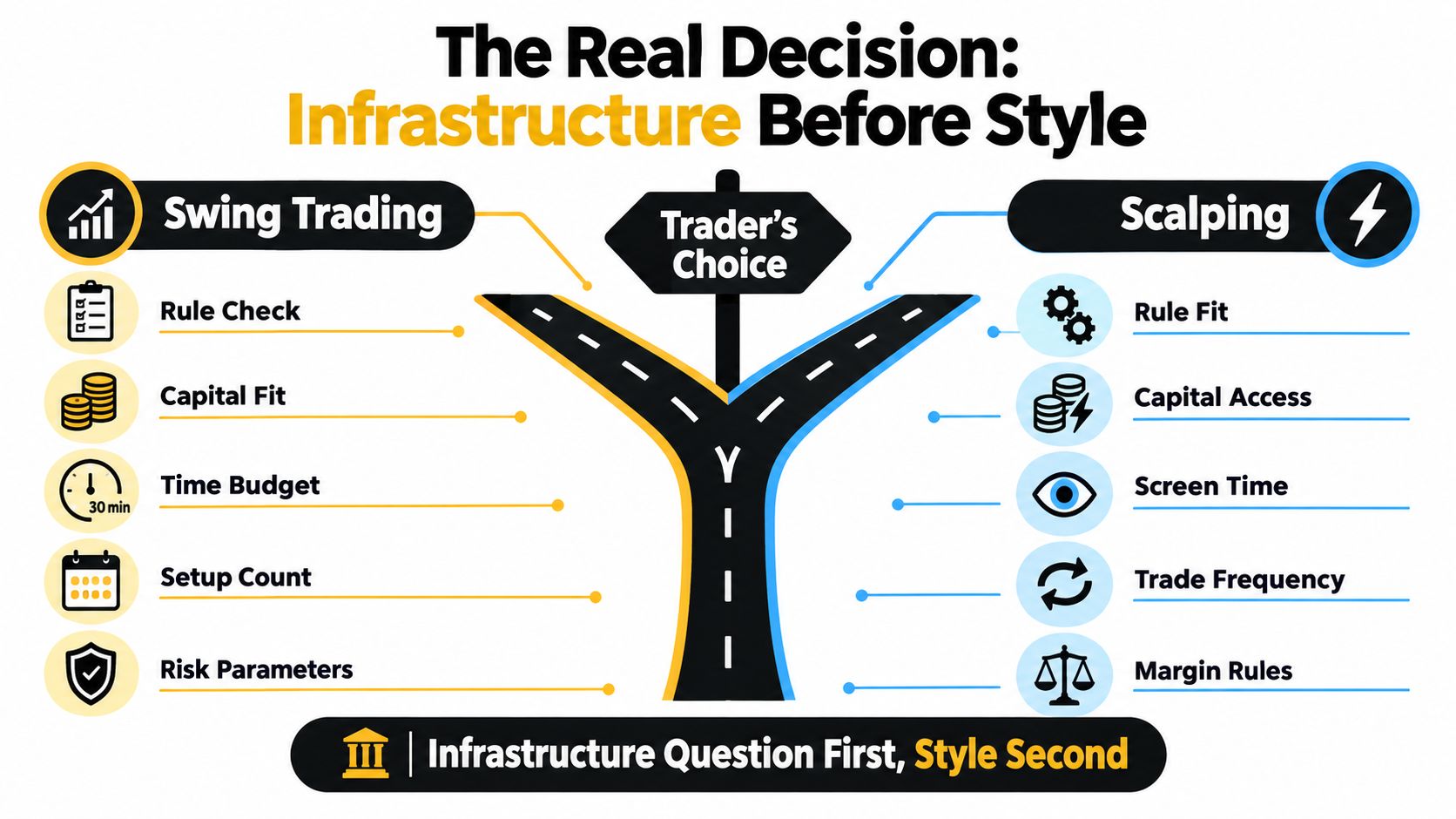
The comparison below uses five tests: holding period, cost structure, execution requirements, prop-firm compliance, and trader fit. A strategy can look profitable on a chart while failing under a trailing drawdown rule or an event-trading restriction.
Risk manager's rule: Don't select the style you enjoy most. Select the style your account can legally and operationally support.
Timeframes, Holding Periods, and Trader Time Commitment
Scalping and swing trading sit on a spectrum rather than in two perfectly sealed categories. Scalping normally targets seconds-to-minutes price movement, while swing trading usually holds positions for several days to a few weeks, according to this guide to scalping and swing trading.
| Dimension | Swing Trading | Scalping |
|---|---|---|
| Primary charts | Daily and 4H | 1-minute to 15-minute |
| Typical holding period | 1 to 15 trading days | Seconds to 30 minutes |
| Screen commitment | Roughly 30 to 90 minutes per session | Roughly 2 to 6 focused hours during active sessions |
| Main objective | Capture a broader directional move | Capture small intraday fluctuations |
| Main operational risk | Overnight gaps, rollover, and weekend exposure | Execution errors, spread, slippage, and decision fatigue |
A swing trader can build a plan around daily structure, 4H pullbacks, and scheduled reviews around market opens and closes. The position may survive a missed session because the setup isn't dependent on a single tick or a split-second fill. That flexibility is useful for traders with employment, family commitments, or limited access to a trading workstation.
A scalper's schedule is more rigid. The trader must watch the market during selected liquid sessions, react quickly, and stop when concentration drops. The chart may offer many signals, but that doesn't mean each signal deserves a trade.
An approach based on 1H charts and multi-hour positions sits in the middle. It may inherit scalping's sensitivity to intraday execution while also carrying swing trading's exposure to broader market moves. Traders often call this “day trading,” but the label matters less than the account rules and actual holding behavior. The Trading the Tick resource is useful for understanding why ultra-short execution deserves separate scrutiny.
Prop firms may also impose minimum holding periods or restrict micro-scalping. That can disqualify sub-minute trading even when the trader has the technical ability to execute it. Check the contract before building a strategy around rapid entries.
Position Sizing, Win-Rate, and the Real Cost of Each Trade
The central mathematical difference is simple. Scalping needs a higher hit rate because fees and execution friction consume a larger share of each small target. Swing trading gives each position more room to absorb fixed costs, but it introduces overnight financing and gap exposure.
A large trading dataset summarized across more than 500,000 accounts reported that swing traders were net profitable 27.5% of the time, compared with 19.3% for scalpers and 17.3% for day traders overall. Those figures come from an independent TradingView case study, and they don't prove that swing trading guarantees better results. They do show why cost structure and execution burden deserve serious attention.
The same case study estimated that, after a 1-pip fee on a 1:1 setup, a scalper needs to win 53.3% of trades to break even, while a swing trader needs 50.25%. A separate trading-cost analysis describes an effective scalping break-even range of roughly 52% to 55% after fees.
| Cost Factor | Swing Trading | Scalping |
|---|---|---|
| Spread | Paid less frequently | Paid on every round trip and often decisive |
| Commission | Distributed across larger targets | Can consume a meaningful share of the target |
| Slippage | Important at entry, exit, and news | Repeated friction can erase a small edge |
| Financing | Overnight swap or financing can apply | Usually less central when trades close quickly |
| Core cost problem | Holding exposure | Trade churn |
Consider the supplied risk examples. A swing trader risking 1% for a 2R target needs a 33% win rate before costs to reach a positive expectancy under the simplified payoff model. A scalper risking 0.2% for a 1R target needs roughly 51% after fees and spread, as described in the trading-cost framework above. These are illustrations, not promises, and actual results depend on execution, exits, losses, and account rules.
The account choice follows the cost profile. Choose swing trading if you can manage swaps and gaps without violating drawdown rules. Choose scalping only when your spread, commission, and slippage are low enough that the target remains meaningful after every round trip.
Execution Needs, Spreads, and Slippage Tolerance
Scalping is an infrastructure purchase. Swing trading is primarily a chart-reading purchase.
A serious scalper needs a stable connection, a responsive trading platform, accurate market data, and an execution environment that doesn't add unpredictable delay. A high-quality workstation and broker connection matter because a small difference between intended and filled price can change the trade's risk-to-reward profile.
The proposed operating thresholds are demanding:
- Latency: Sub-100ms execution is the target for a speed-dependent scalping model.
- Spread: Raw spreads under 0.5 pips on major pairs are needed for tight-target setups.
- Hosting: A co-located VPS can reduce connection instability for automated or highly time-sensitive execution.
- Slippage: More than one tick per round turn can damage a small edge quickly.
- Target structure: A scalping setup should offer at least a 1:1.5 reward window relative to the spread and execution burden.
Those thresholds are strategy requirements, not universal market facts, so test them on the exact venue and instrument you'll trade. A broker's advertised spread also doesn't tell you what happens during volatility, news, or thin liquidity.
| Requirement | Scalping | Swing Trading |
|---|---|---|
| Platform response | Critical | Important, but less time-sensitive |
| Connection | Stable wired or professional setup preferred | Reliable laptop connection is generally sufficient |
| Account type | ECN or raw-spread structure often preferred | Standard account may be workable |
| Slippage tolerance | Very low | More tolerable when targets are larger |
| Monitoring | Continuous during the selected session | Periodic review and planned alerts |
Swing traders still need disciplined execution. A gap, poor fill, or widened spread can increase risk, especially around major releases. The difference is that a single small execution variance usually represents a smaller portion of a multi-day target.
Before selecting a firm, read its execution terms and test fills in a demo environment. The spreads in trading guide can help you evaluate why the quoted spread isn't the same as the full cost of entering and exiting.
Prop Firm Rules That Decide Which Style Actually Works
Prop-firm rules can make a profitable strategy impossible to operate. A daily loss limit of 4% to 5% affects a scalper completing 15 to 20 round turns differently from a swing trader opening 1 to 2 positions per week. Treat these figures as rule-stress examples, not trading-frequency recommendations.
Audit the rule book before choosing a style:
- Daily loss calculation: Confirm whether the limit uses balance, equity, floating loss, or a combination.
- Maximum drawdown: Identify whether the threshold is static or trailing.
- News policy: Check blackout periods and whether positions may remain open through events.
- Weekend policy: Confirm whether positions can stay open through the close.
- Minimum holding period: Look for restrictions on rapid entries, tick scalping, or trades closed almost immediately.
A trailing drawdown based on equity can put a scalper under constant pressure. Rapid gains may lift the equity curve, while a short losing sequence can bring the account close to the moving threshold. Swing traders make fewer decisions, but one overnight gap can create a large loss before an exit is possible.
News rules create a different constraint. A scalper may rely on volatility around NFP or FOMC, yet a blackout window can remove the market condition the strategy requires. A swing trader may avoid the event, but any position held through it still faces gap and spread risk.
The amount of borrowed capital changes the operating profile as well. A 1:30 swing setup may require wider planning around margin and stop distance, while a 1:100 scalping setup can create rapid exposure changes. Borrowed capital does not create an edge. It changes how quickly a trader can breach a risk limit.
Treat mandatory rules as hard constraints. Optional permissions, such as news trading or weekend holding, expand the available playbook only when the firm allows them. They do not fix poor sizing, weak execution, or a strategy that cannot survive the account's loss rules. Choose the style that fits the firm's operating limits first, then refine the trading method.
Which Style Fits Which Trader Profile
Personality matters, but it comes after time, capital access, and infrastructure. A trader can train discipline and reaction speed. A trader can't manufacture free hours or turn an unsuitable connection into a professional execution stack.
The part-time funded trader
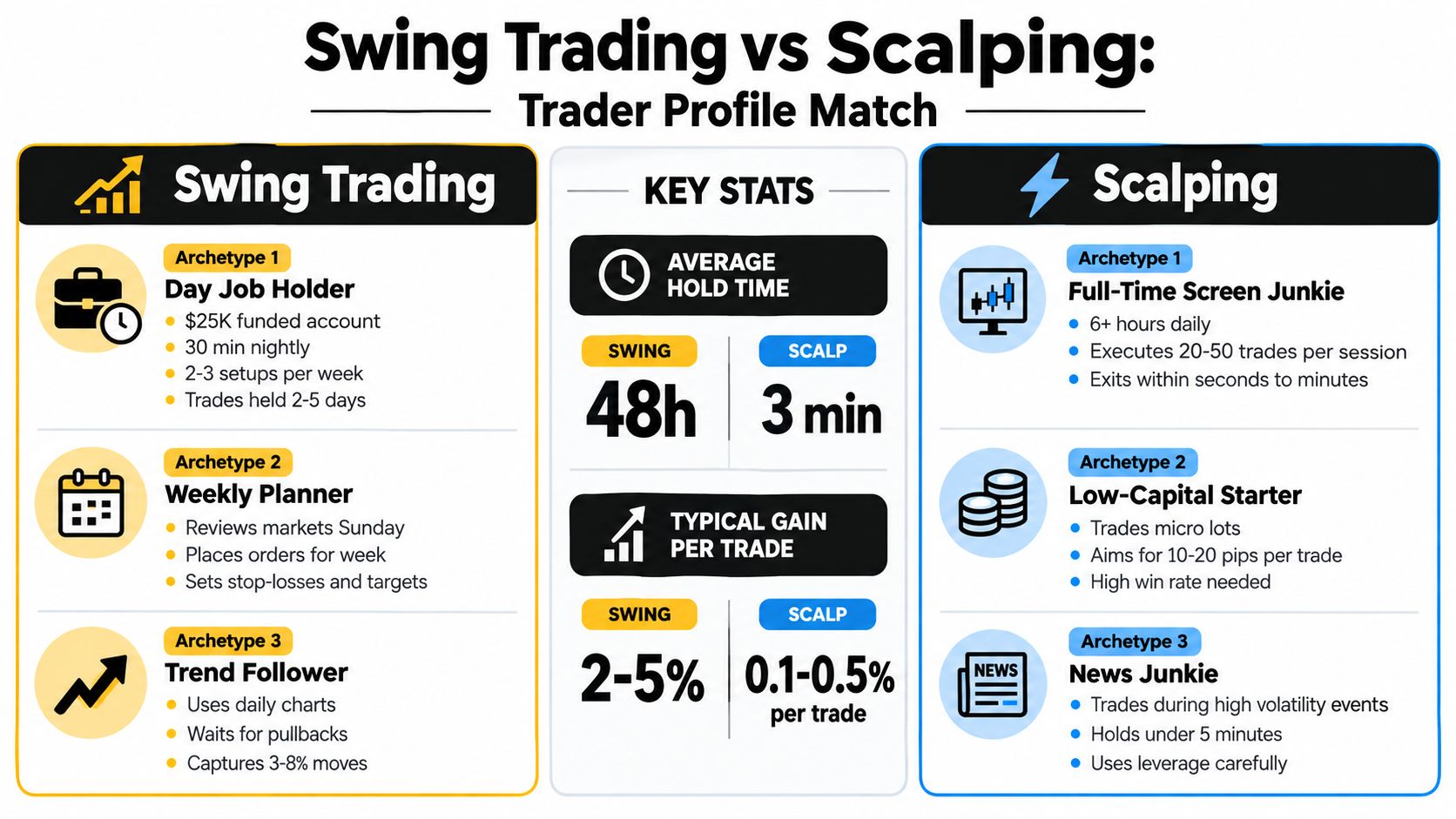
A $25K funded account holder with a day job is usually better suited to swing trading. A short nightly review, planned entries, and 2 to 3 setups per week create a process that doesn't collapse when the trader misses an intraday session. Trades held for 2 to 5 days can be managed with alerts and predefined stops.
The full-time execution specialist
A full-time trader with $5K in capital, a co-located VPS, and access to the London and New York overlap may have the conditions required for scalping. The model still needs strict limits on trade count, a tested spread assumption, and a hard stop for fatigue. More trades don't automatically mean more opportunity.
The higher-timeframe planner
A trader who reviews markets weekly, prefers indices, crypto, commodities, or individual stocks, and waits for structured trends is generally better matched with swing trading. Lower-frequency instruments often require wider targets and more patience, while major FX pairs and heavily traded indices are more natural candidates for short-term execution.
The infographic below shows the practical distinction between trader schedules, hold times, and target sizes. Its example ranges are visual planning aids, not expected returns.
Don't use expected monthly returns as a selection tool. No verified return range can tell you what you'll earn, and trading involves risk of loss. Use drawdown behavior instead:
- Swing profile: Fewer decisions, wider market exposure, and losses that may arrive through gaps.
- Scalping profile: Smaller individual targets, repeated execution costs, and faster accumulation of mistakes.
- Hybrid profile: More complex rule tracking and a higher chance of mixing incompatible risk assumptions.
Use the best indicators for swing trading guide only as a research aid. Indicators don't replace a tested setup, position-sizing model, or contract review.
A Practical Decision Framework and Next Step With a Prop Firm
Use four questions. Don't answer them with your preferred identity. Answer them with your actual operating conditions.
Capital: Can your account support the stop distance, margin use, and position size your setup requires? Smaller capital often pushes traders toward tighter stops, but tighter stops can make execution costs more important.
Screen time: Do you have less than an hour, one to four hours, or more than four focused hours? Limited time favors swing trading. Extended availability makes scalping possible, not automatically suitable.
Instrument liquidity: Are you trading liquid FX majors, large indices, or another market with dependable execution? If spreads are wide or fills are inconsistent, short-term trading becomes harder to justify.
Rule tolerance: Can you comply with news windows, weekend restrictions, drawdown calculations, and holding-period rules without changing your strategy impulsively?
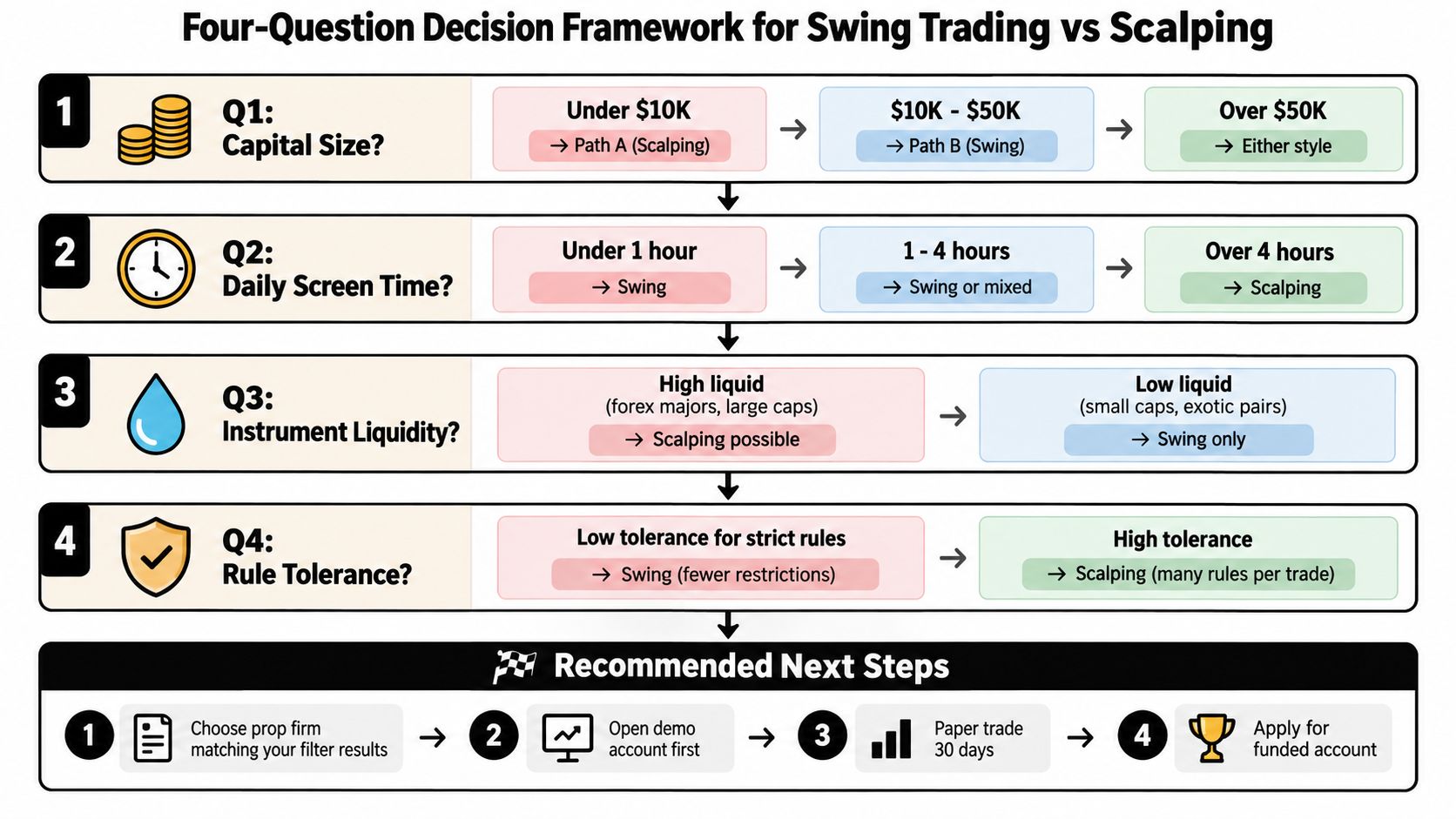
Before allocating real risk, verify the contract's drawdown tier, news-window policy, weekend holding allowance, and payout cadence. For a one-week test, review your chosen instruments, paper trade only one style, record every spread and slippage issue, and then compare the results with the firm's limits. Don't apply for funding until your process survives the same restrictions you'll face after approval.
MyFundedCapital offers Instant Funding and 1-Step or 2-Step Challenges, with account sizes from $5K to $100K and scaling paths up to $500K, according to its publisher information. Its stated conditions include a flat 5% daily loss limit, up to 10% maximum drawdown, optional news and weekend-holding add-ons, and support for manual, algorithmic, and copy trading across 350+ instruments. Verify the current contract directly before choosing an account.
Frequently Asked Questions About Swing Trading vs Scalping
Can swing traders and scalpers use the same funded account?
They can, if the account rules permit both holding behavior and execution style. Splitting one account between strategies is usually a poor first move because each style has different risk, cost, and review requirements.
If you insist on combining them, separate the risk budgets, maintain distinct journals, and prevent a scalping loss from changing a swing position's stop. The cleaner choice is to prove one approach first, then add the second only after you understand how the firm calculates daily loss and drawdown.
Can a hybrid strategy survive prop-firm daily-loss limits?
A hybrid approach can work, but it needs a daily risk ceiling shared by both activities. Day trading the open and swing trading the close creates two exposure windows, so the trader must count floating losses, realized losses, and overnight risk together.
The common failure is treating each style as a separate account inside one account. It isn't. A losing scalp reduces the room available for the swing position, even if the swing thesis remains valid.
Which style uses capital more efficiently under a 1% risk rule?
That depends on target size, stop distance, contract specifications, and execution cost. Swing trading usually uses each entry more efficiently when winners are materially larger than the cost of the trade. Scalping can turn capital quickly, but repeated spreads, commissions, and slippage consume more of the risk budget.
Capital efficiency isn't the same as return potential. A strategy that uses margin efficiently but creates frequent rule breaches is not efficient for a funded account.
Do copy trading, trade copiers, or EAs favor one style?
They can favor neither until the firm approves the method and the execution behavior. A copier or EA may replicate entries, but it can also duplicate slippage, latency, rejected orders, and correlated losses across accounts.
For scalping, small execution differences between the source and follower can materially change results. For swing trading, synchronization is generally less time-sensitive, but the trader still needs to verify position limits, news rules, and whether pass-along trading is permitted. Read the firm's exact policy before deploying automation.
Trading involves risk of loss, and this article is educational content rather than financial advice.
MyFundedCapital offers Instant Funding plus 1-Step and 2-Step Challenges for traders who want to test a swing or scalping process under defined risk parameters, with manual, algorithmic, and copy-trading support. Visit MyFundedCapital to compare account conditions, check the current news and weekend options, and choose a challenge only after your strategy passes the firm's rule audit.
