Bots already drive at least half of Solana DEX volume, reaching as much as 70% on the busiest days, according to market-data summaries on AI trading bot activity. That doesn't mean a retail bot has an automatic advantage. It means you're competing inside an execution environment shaped by code, latency, liquidity, fees, and rules. This playbook shows how algorithmic trading crypto works, where a durable net edge might still exist, how to test one without fooling yourself, and what to check before connecting automation to a funded account. Trading involves a risk of loss, and this article is educational content, not financial advice.
Why Crypto Algorithmic Trading Is Worth Learning the Right Way
The common retail mistake isn't always choosing the wrong indicator. It's deploying a bot without understanding how orders reach a venue, how fills differ from quoted prices, or how account rules can invalidate an otherwise sensible strategy. A backtest can look attractive while ignoring fees, latency, slippage, funding, outages, and the restrictions attached to a prop-firm account.
The market is already heavily automated. One historical benchmark estimated that algorithms handled roughly 70% of global trading volume across markets, while another benchmark found that about 86% of crypto trading volume was algorithmically executed in 2019, even though only 38% of individual crypto users reported using trading bots. The contrast shows why retail traders can underestimate their competition. You may be clicking manually while much of the liquidity and order flow is being managed by systematic participants. See this overview of whether algorithmic trading works for a useful starting point.
Practical rule: Treat the bot as an execution machine, not as a money-making idea.
By the end of this guide, you should be able to:
- Classify the strategy Decide whether market making, arbitrage, or momentum fits your capital, latency, and infrastructure.
- Audit the test Separate genuine robustness from look-ahead bias, unrealistic fills, and overfit parameters.
- Measure live costs Log every fill so you can distinguish signal performance from execution drag.
- Check account compatibility Confirm that automation, instruments, drawdown controls, and order behavior fit the prop firm's current rules.
- Build a failure plan Make the system stop safely during outages, abnormal volatility, or unexpected position growth.
The sensible objective isn't to find a perfect bot. It's to build a process that can identify weak edges early, limit damage when market conditions change, and scale only after live evidence supports the model.
What Algorithmic Trading Crypto Actually Means
Algorithmic trading crypto means using code, an Expert Advisor, or another automated system to execute predefined decisions. The system can determine when to enter, where to place a stop, how much to trade, and when to exit. Once deployed, it follows those rules without asking you to interpret each candle or approve every order.
Discretionary trading keeps a human in the live decision loop. You read price action, form a view, click an order, and may override the plan when fear or excitement appears. An algorithm does the same sequence mechanically. It can react faster, apply identical logic repeatedly, and monitor multiple markets without getting tired. That consistency helps, but it also means a bad rule can fire consistently.
A useful analogy is a vending machine. You put in a condition, such as “if the moving-average relationship and volatility filter meet the rule, submit an order,” and the machine produces an output. It doesn't bargain with the market, hesitate after a loss, or decide that the next trade “feels different.” It also doesn't understand whether the data feed is stale unless you explicitly program that check.
Why crypto makes automation attractive
Crypto markets trade continuously, so manual traders face a monitoring problem that doesn't exist in the same form in markets with a daily close. A bot can watch overnight moves, scheduled events, funding conditions, and several venues at once. Exchange APIs commonly provide REST and WebSocket interfaces, along with order types such as limit, market, stop-limit, stop-market, iceberg, and post-only, as described in this explanation of crypto execution mechanics.
That access doesn't put a retail trader on equal technical footing with a professional firm. It does make systematic execution available without building an entire brokerage stack. You can stream market data, submit an order, receive an execution report, and update a position model through software.
Automation isn't an edge
The code only delivers a decision. It doesn't prove that the decision has positive expected value after costs. A momentum signal with weak exits remains weak when automated. A mean-reversion strategy can accumulate losses faster because it keeps applying the same assumption while the market trends.
Separate the project into two questions:
- Does the strategy have a defensible edge after realistic costs?
- Can the infrastructure deliver that edge reliably and within the account's rules?
A “yes” to only one question isn't enough to trade capital.
The Three Strategy Families That Matter in Crypto
Crypto algorithms generally fall into three broad families. They don't compete on the same terms, so choosing one should begin with infrastructure and failure modes rather than with whichever backtest has the smoothest curve.
| Dimension | Market Making | Arbitrage | Momentum / Trend |
|---|---|---|---|
| Core return source | Capturing bid-ask spread | Capturing price or basis differences | Following persistent directional movement |
| Capital requirement | Inventory and collateral across quoting venues | Capital on multiple venues or instruments | Usually simpler, directional allocation |
| Latency tolerance | Very low | Low for tight opportunities, higher for slower dislocations | Moderate, especially on higher timeframes |
| Infrastructure dependency | Matching-engine access, precise quoting, rapid cancellation | Data synchronization, transfers, routing, hedging | Reliable data, order handling, risk controls |
| Typical break point | Gap events and adverse selection | Spread compression, transfer delay, failed hedge | Whipsaws, regime shifts, crowded signals |
| Solo-trader suitability | Difficult | Possible in slower niches | Most accessible starting point |
Market making
A market maker posts bids and offers and tries to earn the spread while managing inventory. The attractive part is easy to understand. The difficult part is that informed traders often trade against your quote when the market is about to move. A sudden gap can leave you holding inventory at a price your model no longer considers fair.
Professional market making also depends on infrastructure that a solo trader may not possess, including extremely fast cancellation, stable connectivity, and detailed order-book modeling. A retail version can work only with conservative size and a clear inventory limit, but it shouldn't be mistaken for passive income.
Arbitrage
Arbitrage compares related prices across exchanges, spot and derivatives, or centralized and decentralized venues. The theoretical trade may look riskless, yet execution introduces transfer delays, withdrawal restrictions, partial fills, funding changes, and the possibility that one leg fills while the hedge doesn't.
Tighter opportunities are especially difficult because competitors act quickly. Retail traders may still investigate slower cross-venue dislocations or CEX-DEX routes, but the strategy must model settlement and inventory rather than just subtract two displayed prices.
Momentum and trend
Momentum systems enter after a directional condition and exit when that condition weakens, reverses, or reaches a predefined risk limit. They generally tolerate more decision delay than market making and can operate on 15-minute to 4-hour bars, where individual quote updates matter less. That makes them the most realistic starting point for a solo or funded-prop trader.
The practical verdict is straightforward. Start with a simple momentum or trend model, validate it across instruments and regimes, and add arbitrage only after your data, routing, and reconciliation systems are dependable. These algo-trading strategy examples can help you compare the design choices before you write execution code.
Execution Infrastructure From Exchange APIs to Slippage
Execution is the hidden P&L line. A signal can identify the right direction and still lose money if the order arrives late, the book is thin, or the fill consumes several price levels.
A centralized exchange such as Binance, Bybit, OKX, or Coinbase Advanced normally gives you an order book, account API, and matching engine. A decentralized exchange settles through smart contracts and may expose different risks, including gas costs, pool depth, sandwich exposure, and transaction confirmation. An aggregator can route across pools, but routing doesn't remove price impact. It only changes how the system searches for liquidity.
Build the stack in layers
- Market data Use WebSocket streams for timely quotes and trades, with REST for snapshots, historical requests, and recovery after a disconnect.
- Order gateway Submit, amend, cancel, and reconcile orders. Never assume a request succeeded because the HTTP response arrived.
- State manager Track open orders, fills, fees, positions, balances, and pending acknowledgements.
- Risk engine Enforce notional limits, position limits, stop logic, and a trading halt independent of the signal model.
- Monitoring Alert on stale data, missing heartbeats, rejected orders, unexpected fees, and divergence between exchange and internal state.
FIX-style connectivity can suit professional workflows, but many retail systems start with REST and WebSocket APIs. Rate limits matter because an aggressive polling loop can receive throttling exactly when the market becomes unstable. Design for reconnects, duplicate messages, out-of-order events, and partial fills.
Latency changes the strategy
A study of Bybit and Binance found that volatility, exchange or network delay, and weaker limit-order-book liquidity increased the probability of immediate-execution failure. For an order targeting a 2 bps return, the study quantified latency-gap slippage of about 0.1 bps on Bybit Bitcoin, 0.07 bps on Bybit Ethereum, and 0.3 bps on Binance Bitcoin and Ethereum in the examined settings, as reported in the Frontiers execution study.
Those figures aren't a promise of typical cost. They show why venue selection and routing logic can change realized edge. A market order guarantees urgency, not price. A limit order controls price, not execution certainty. Post-only can protect maker intent, while IOC can prevent an unfilled remainder from resting unexpectedly. TWAP and VWAP can distribute a larger order, but they don't eliminate adverse movement or thin liquidity.
| Layer | Options | Trader concern | Typical retail cost |
|---|---|---|---|
| Venue | CEX, DEX, aggregator | Liquidity, settlement, outages | Fees, gas, spread, and market impact |
| Data | REST, WebSocket | Freshness, gaps, reconnection | API limits and engineering time |
| Connectivity | Public internet, hosted server | Ping variability and downtime | Hosting and maintenance |
| Order logic | Market, limit, IOC, post-only, TWAP or VWAP | Fill certainty versus price control | Slippage, rejects, and partial fills |
| Reconciliation | Reports, trade IDs, fee records | Accurate realized P&L | Development and monitoring effort |
For venue research, a broader TradingList platform comparison can help you evaluate platform features before choosing where your workflow will live.
Log each fill with the timestamp, venue, symbol, side, order type, requested size, filled size, expected price, average fill, fee tier, fee amount, liquidity flag, and slippage in basis points. Without that record, you can't tell whether the signal failed or the execution stack consumed the return.
Backtesting Without Fooling Yourself
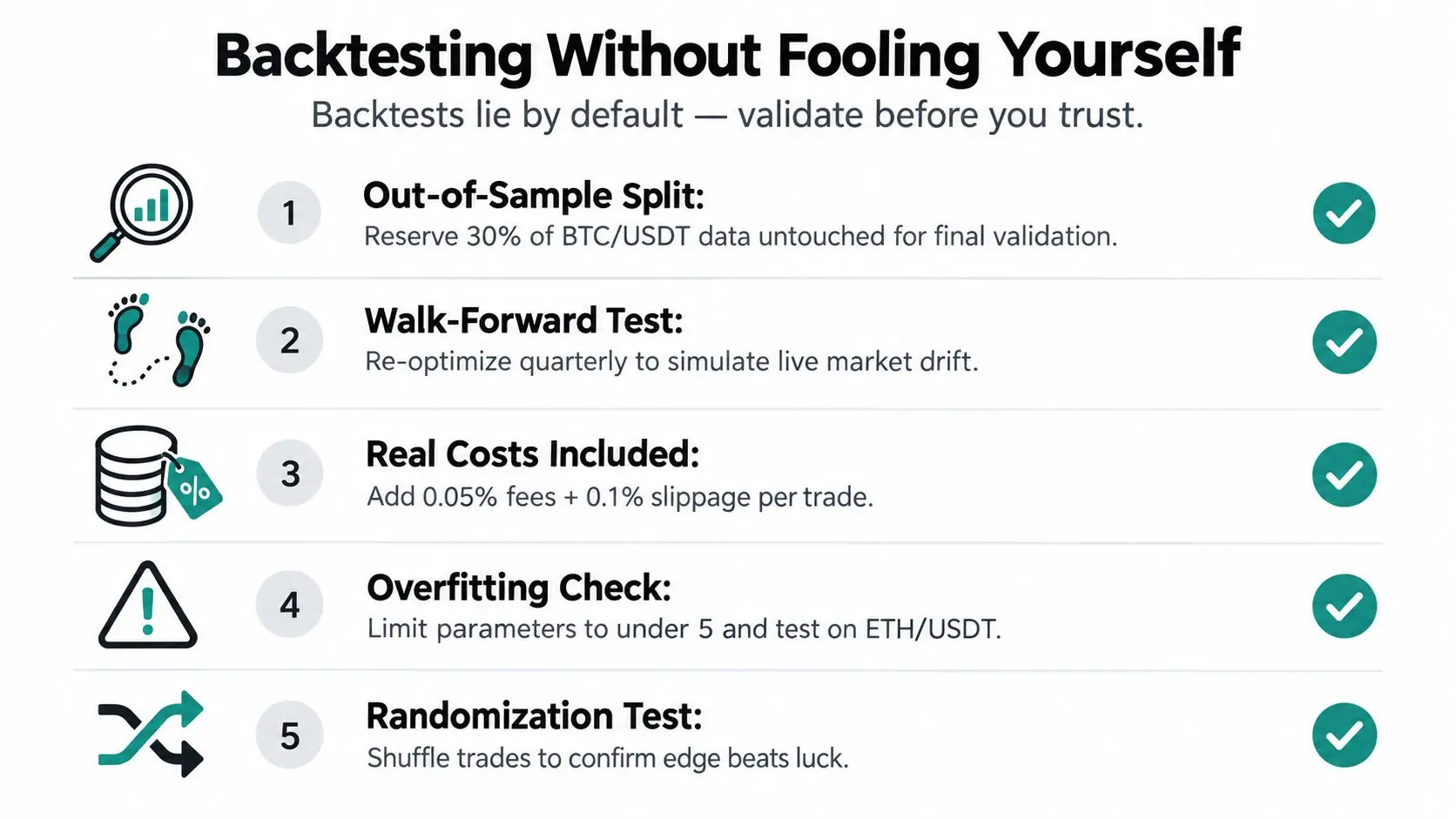
Backtests lie by default. The useful question is how much deception you've allowed into the test.
Running a strategy on a long BTC/USDT history and calling it validated often hides several problems. A symbol list may exclude assets that failed or disappeared. An indicator can accidentally use future information through a shifted value. Fee schedules can change, pairs can be delisted, and historical order books may not resemble the live venue you plan to use.
Market regimes also matter. A model that works during a strong trend may fail during a compressed range, while a mean-reversion model can break when volatility expands. The 2026 review of algorithmic trading evidence highlights the broader problem: evidence for durable net performance remains thinner than the number of attractive backtests suggests, while liquid BTC spatial arbitrage spreads were reported at roughly 1–5 bps in calm markets, widening mainly during stress.
A stricter validation routine
- Separate the data. Keep an untouched out-of-sample period. Don't optimize on it, inspect it repeatedly, or change the model because of what it shows.
- Use walk-forward testing. Train or tune on one window, test on the next, then roll the window forward. This better reflects how a live trader encounters changing conditions.
- Model costs explicitly. Include maker and taker fees, funding, borrow costs where relevant, partial fills, and plausible slippage. The source assumptions in a backtest must match the target venue.
- Stress known shocks. Test fast moves, liquidity gaps, exchange interruptions, and periods in which the strategy's preferred regime disappeared.
- Randomize trade order. Monte Carlo reshuffling can show how much the equity curve depends on lucky sequencing rather than on the distribution of outcomes.
The 2026 Frontiers research on limit-order-book alpha offers an important warning. A simple linear model produced a small improvement over a random-walk benchmark only with strict leakage controls, while a more flexible gradient-boosted model overfit and performed worse than chance. Feature timing, temporal separation, and leakage-safe validation matter as much as model selection.
Use this backtesting guidance as a process reference, then paper trade on the exact target venue. A backtest Sharpe ratio is a ceiling created by historical assumptions, not a forecast of live returns.
Risk Management and Position Sizing for Crypto Bots
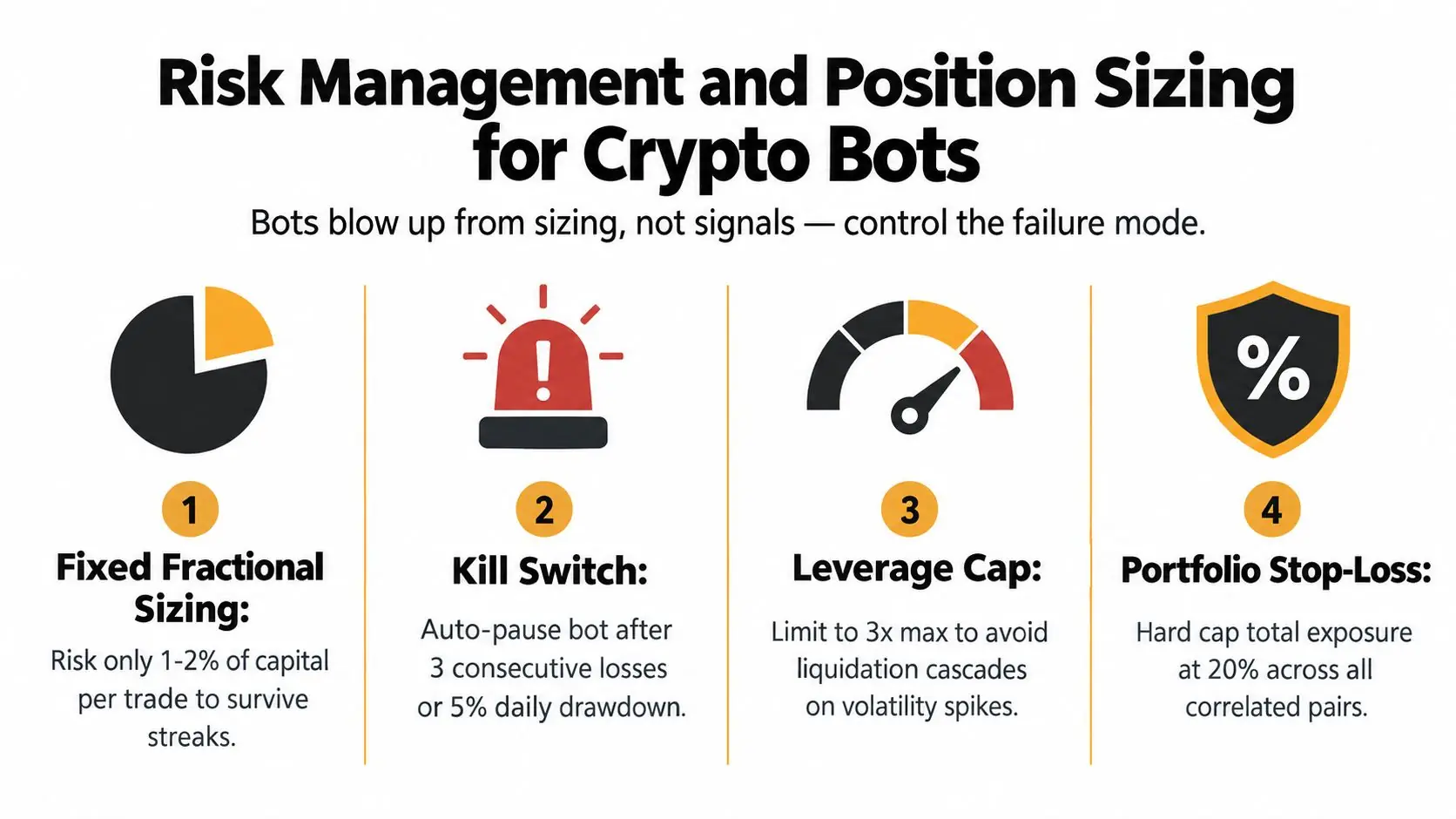
Bots rarely fail because one signal is wrong. They fail because the system turns an ordinary loss into an oversized position, repeats an order after a connection error, or keeps trading after market conditions have changed.
The first control is position sizing. Fixed-fractional sizing keeps each trade tied to account equity. Volatility targeting adjusts size when the market becomes more or less active, often using a measure such as ATR. Kelly-style sizing is especially dangerous when the estimated edge is uncertain, because small errors in win rate or payoff can produce excessive exposure. A conservative fraction is more defensible than trusting a full theoretical output.
Match the control to the failure
- Sizing limits a wrong signal Set a maximum risk budget per trade, then calculate quantity from stop distance and current equity. If the stop widens, the position should shrink rather than preserve the original notional.
- Drawdown rules stop a bad regime Add a daily loss ceiling, a total trailing-drawdown ceiling, and an equity-curve breaker. Once the account reaches the threshold, the bot should stop opening trades and require a deliberate review.
- Kill switches contain technical errors Use exchange-side protective orders where available, an API-level flatten function, and a heartbeat watchdog that disables new orders when the strategy process or data stream stops responding.
- Notional caps contain concentration Limit exposure per symbol and across correlated pairs. A long position in several highly related assets is one risk cluster, not several independent trades.
A fat-finger bug might multiply order size. A venue outage might leave a protective instruction unconfirmed. A regime flip might cause a trend system to add repeatedly while price reverses. Each scenario needs a mechanical response, not a hope that the operator notices quickly.
Protect the account before optimizing returns
Write the risk engine separately from the signal code. It should know the account's equity, open risk, pending orders, realized loss, and connection status. It should be able to reject a valid signal when the account is already too exposed.
For funded accounts, use the firm's stated daily-loss and maximum-drawdown rules as hard engineering constraints, not as figures to approach. Include floating losses, commissions, swaps, and gaps in the calculation if the rules do. Trading involves risk of loss even when every safeguard works, so begin with an amount and margin level you can afford to lose.
Prop Firm Compatibility for Crypto Algorithmic Trading
A profitable bot can still be unusable on a funded account if its order behavior conflicts with the firm's rules. Prop firms differ on automation, copy trading, news exposure, weekend holding, instruments, margin requirements, evaluation structure, payout conditions, and how they calculate drawdown. Don't infer permission from a platform button. Read the current terms and ask support for a written answer when the rule is unclear.
MyFundedCapital states that it supports manual, algorithmic, and copy trading across a broad instrument set on DXtrade and cTrader, with MT5 identified as coming soon in its publisher information. Its published account structure includes Instant Funding and 1-Step or 2-Step Challenges, account sizes from $5K to $100K, scaling paths up to $500K, a flat 5% daily loss limit, and up to 10% maximum drawdown, according to the supplied company information. Profit splits start at 80/20, with upgrade paths to 90/10 or 95/5, and payouts are described as available every 7 or 14 days depending on the program, or on demand with the payout add-on, with average processing around 2 hours. Confirm current availability, symbols, and automation conditions before trading because account terms can change.
| Rule area | What most prop firms enforce | What to check before you connect your bot |
|---|---|---|
| Platform | Specific terminals such as DXtrade, cTrader, or MT5 | Whether your EA, cBot, API adapter, and hosting environment are supported |
| Instruments | Approved symbols and contract specifications | Crypto symbol names, trading hours, spreads, swaps, and position limits |
| Automation | EAs may be allowed, restricted, or banned | Written permission for your exact strategy and execution method |
| Copy trading | Rules often distinguish personal accounts from external signals | Whether signal mirroring, account grouping, and multi-account management are permitted |
| Latency activity | HFT, latency arbitrage, and toxic flow may be restricted | Whether order speed, cancellation frequency, or venue arbitrage triggers a violation |
| Grid and martingale | Often subject to soft or hard restrictions | Maximum entries, increasing size, recovery logic, and exposure caps |
| Drawdown | Daily and trailing limits | Calculation method, reset time, floating loss treatment, and breach behavior |
| Evaluation | One-step and two-step targets can differ | Profit target, consistency requirement, minimum days, and prohibited activity |
| Payout | Timing, split, settlement, and review conditions | Crypto or bank settlement method and eligibility after automated trading |
Run an automation audit
Before a funded connection, export the bot's order rules and answer these questions:
- Can it open multiple positions after a partial fill?
- Can it increase size after a loss?
- Does it trade during news or hold through weekends?
- Does it place orders across several accounts?
- What happens after a disconnect, rejected order, or duplicate execution report?
- Can you prove that every trade came from your own approved logic?
Some firms classify latency arbitrage as exploiting delayed prices rather than ordinary fast execution. A bot that trades a grid or uses martingale recovery may also breach rules even if each individual order looks normal. Never assume that a successful evaluation proves compliance. Payout review can examine behavior that wasn't obvious from the dashboard.
Your Next Steps and Common Questions on Crypto Algo Trading
A practical build sequence keeps technical enthusiasm from outrunning evidence. Start with research in Backtrader or vectorbt, use TradingView to inspect signals visually, and use ccxt when you need a common execution interface across supported exchanges. The order matters. Research the rule, inspect the behavior, then connect execution only after the assumptions are documented.
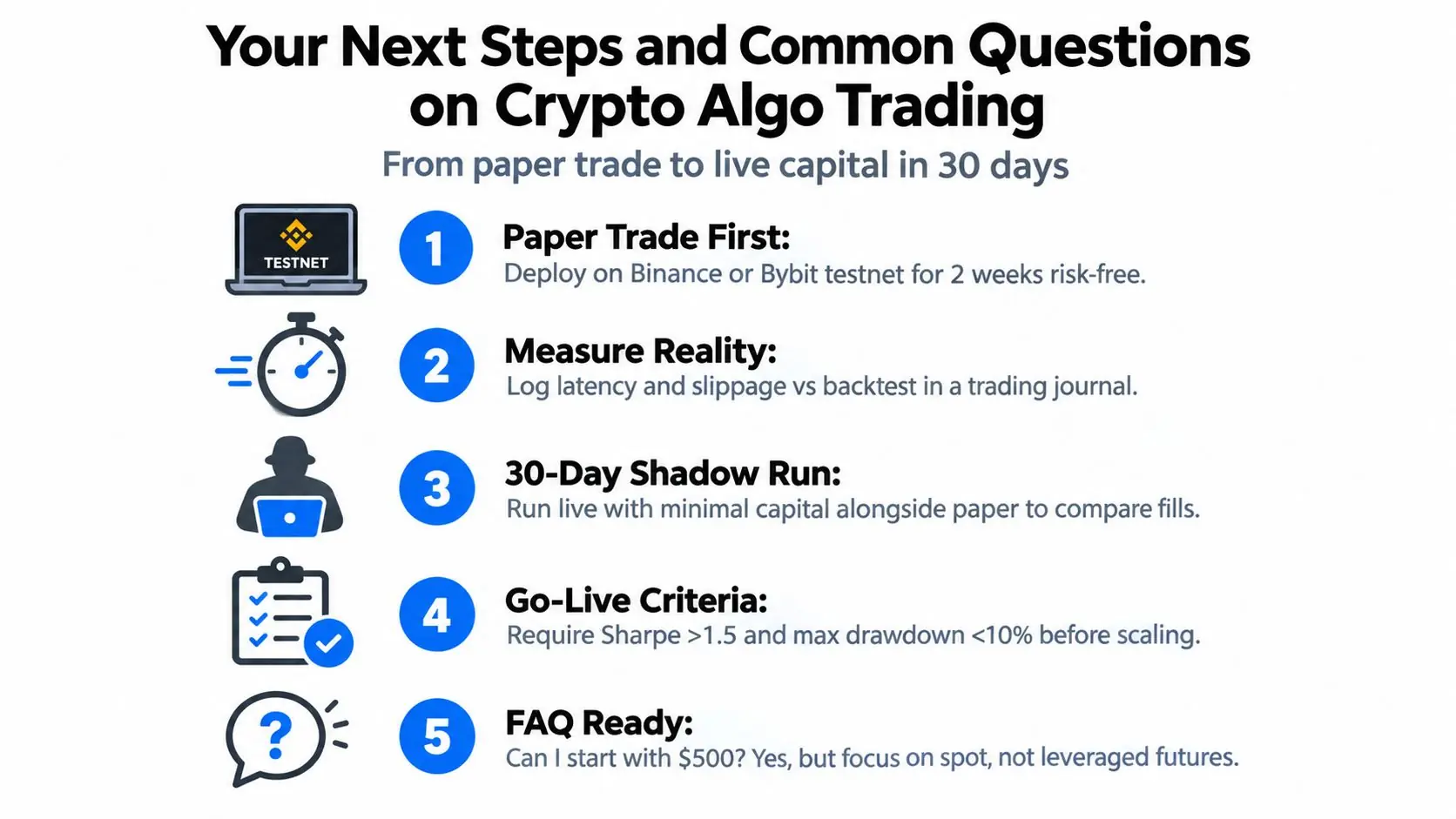
Deploy first on a Binance or Bybit testnet where available, then keep a shadow journal that records intended price, actual price, latency, fees, rejection messages, and position state. Compare those results with the backtest rather than judging the bot by gross profit alone.
A sensible deployment checklist
- Research Define the signal, exit, sizing, and invalidation conditions.
- Test Run out-of-sample and walk-forward tests with venue-specific costs.
- Observe Paper trade and shadow live execution without risking meaningful capital.
- Audit Match every behavior against the prop firm's written rules.
- Scale slowly Increase exposure only when fills, reconciliation, and drawdown controls behave as expected.
FAQ
Are EAs allowed on funded crypto accounts?
Some firms allow them, some restrict them, and some prohibit them. Ask about the exact platform, strategy type, order frequency, and account stage. Permission for a standard EA doesn't automatically cover copy trading, latency arbitrage, or multi-account automation.
Do grid and martingale bots pass evaluations?
They can conflict with position, exposure, or prohibited-strategy rules, especially when the bot increases size to recover losses. Don't connect one until the firm confirms that its recovery logic and maximum exposure are acceptable.
What counts as latency arbitrage?
It generally refers to exploiting a delay or stale quote rather than sending a legitimate order quickly. The classification depends on the firm's terms and its view of your execution pattern, so obtain a written interpretation.
How should weekend or illiquid-symbol losses be handled?
Either disable those conditions or reduce exposure through an explicit market-quality filter. Thin books and fast news can make fills materially worse than the model expected, as explained in this guide to common crypto bot pitfalls.
Durable edge comes less from a clever signal than from disciplined sizing, honest cost measurement, clean state management, and strict rule compliance. A bot that knows when not to trade is often more useful than one that generates more alerts.
MyFundedCapital offers Instant Funding plus 1-Step and 2-Step Challenge paths, with algorithmic and copy-trading support on its stated platforms and risk limits that can be checked before deployment. Review the current account types, crypto conditions, and automation rules at MyFundedCapital, then choose a challenge only after your bot has passed paper testing and a prop-firm compatibility audit.