

 AR
AR
 NL
NL
 FR
FR
 DE
DE
 ES
ES
 IT
IT
 PL
PL
 SV
SV
 PT
PT

You’re probably here because your current day trading feels too slow. You identify a setup, enter, sit through a pullback that tests your nerves, and then either get stopped out early or watch the move finally work without paying you enough for the stress.
Scalp trading futures is a different game. It can suit traders who prefer fast decisions, tight risk, and mechanical execution, but it punishes hesitation and sloppy process fast. Trading involves substantial risk of loss, and this guide is educational only. It is not financial advice.
Why Scalp Trading Futures Requires a Different Mindset
You take a clean long in ES at the open, hesitate for three seconds when the bid stalls, widen the stop by a tick so it can “work,” then watch a manageable loss turn into a prop firm rule problem. That is how futures scalping usually fails. Not from bad intentions. From small lapses in discipline that the pace of the market exposes immediately.
Scalp trading futures is an execution business. The holding time is short, the margin for error is thin, and the feedback is immediate. A setup can be valid and still become a bad trade if the fill is late, the stop is loose, or the exit turns into a negotiation with the tape.
Inside a prop firm, that mindset shift matters even more because strategy quality is only half the job. The other half is staying aligned with firm limits from the first click. A scalp that ignores daily loss caps, consistency rules, or drawdown pressure is not a professional trade. It is a fast way to lose an account.
What stops working fast
Habits that survive in slower intraday trading break down here.
- Waiting for confirmation after entry: If price does not respond quickly, the reason for the trade is weakening.
- Giving the trade extra room: Wide stops and small targets produce poor math and messy decision-making.
- Swinging for a larger move than the setup supports: Scalping pays traders who take what is available, not what they wish the market would offer.
- Trying to win back a loss immediately: In a prop environment, revenge trading does more than damage P and L. It can breach the rules that keep you funded.
One hard truth. A scalp that needs patience usually was not a scalp in the first place.
What the right mindset looks like
A professional scalper works from predefined limits, not impulses. Risk is set before entry. The contract is chosen for liquidity and clean execution. The trade is scratched or stopped without debate if the response is wrong. Small wins are booked without frustration because the goal is repeatability, not ego.
That is why platform quality and market data handling matter early, not after you start going live. If you are setting up a fast execution workflow, use a stable platform such as the NinjaTrader 8 download and setup guide, and understand the infrastructure behind processing financial market data. In scalping, weak tooling shows up as missed fills, delayed decisions, and avoidable mistakes.
The traders who last in futures scalping accept a trade-off that newer traders fight for too long. You give up the chance to catch the full move in exchange for tighter control, faster feedback, and cleaner risk. In a prop firm, that trade-off is often the difference between building a track record and violating rules before your edge has a chance to compound.
Selecting Your Battleground and Tools
The opening bell rings, price jumps, and your setup appears in the first few minutes. You hit buy, get partials on the way in, chase the rest, and your stop fills worse than planned. The idea was fine. The contract and tool stack were not.
That is how futures scalping fails inside a prop firm. Traders blame psychology, but the problem often starts earlier. They pick a market that does not forgive hesitation, then run it on a platform layout that adds friction at the exact moment precision matters.
Your first job is to choose a battleground that matches both the strategy and the firm’s risk rules. In a prop environment, a contract is not just a trading vehicle. It sets your slippage exposure, your stop distance, your daily loss pace, and how easily one bad click can put you near a trailing drawdown limit.
Contracts suited to scalp trading futures
Start with contracts that trade deep, fill cleanly, and stay active during the hours you plan to trade. For many developing scalpers, that usually means index futures first, then faster products later.
ES is often the better training ground. It usually offers heavy participation, cleaner rotation, and less violent short-term movement than NQ. You still need discipline, but small mistakes are less likely to turn into oversized damage.
NQ gives more opportunity and more punishment. It can move fast enough to make a good read pay quickly, but it also blows through weak entries and loose stops without much mercy. Traders who jump to NQ too early often confuse speed with edge.
CL attracts scalpers because it can move hard and react well around active windows. It also punishes late execution, slow reads, and poor size control. In a prop account, that combination can turn one sloppy sequence into a rule breach.
Use a simple filter before adding any contract to your playbook:
- Can you get in and out without spread friction eating the trade?
- Does the ladder stay populated during your trading window?
- Does the contract move cleanly enough to define a tight invalidation point?
- Can your normal stop size fit inside the firm’s daily and trailing risk limits?
If the answer to any of those is no, skip it.
Below is a practical comparison table. Tick values and contract details should always be confirmed on your platform before trading.
| Contract (Symbol) | Exchange | Tick Value | Typical Spread (Ticks) | Best Trading Hours (EST) |
|---|---|---|---|---|
| E-mini S&P 500 (ES) | CME | platform-dependent, verify in contract specs | typically tight in active periods | U.S. session open, key economic releases |
| Nasdaq-100 (NQ) | CME | platform-dependent, verify in contract specs | typically tight in active periods | U.S. session open, tech-driven momentum windows |
| Crude Oil (CL) | ICE/CME references vary by product, verify on your platform | platform-dependent, verify in contract specs | can stay tradable in active periods but reacts fast | U.S. session open, energy news, high-volume overlaps |
What to avoid
Thin contracts trap impatient traders.
A chart can look clean while the order book tells a different story. If depth disappears, the spread jumps, or fills come back inconsistent, the trade is no longer a scalp. It becomes a liquidity gamble.
Avoid markets that regularly show:
- Shallow depth: Stops and targets become estimates instead of planned exits.
- Spread instability: A widening spread can wipe out the entire expected reward.
- Slow or uneven fills: Entry quality changes, stop placement gets distorted, and the trade statistics become useless.
- Dead time behavior: Outside active windows, many markets chop in ways that tempt overtrading without offering clean exits.
This matters even more in funded trading. A mediocre trade in a liquid contract may cost a controlled amount. The same idea in a thin contract can produce enough slippage to break the day’s plan.
Your platform is part of the strategy
Scalping exposes every weakness in your setup. Slow order routing, cluttered charts, poor DOM visibility, and awkward bracket entry all show up in live P and L.
The platform needs to support rapid execution and clear decision-making. That means:
- Depth of Market that is readable under pressure
- Fast order entry with bracket orders ready before the trade
- Tick or very fast intraday charts that match the holding period
- Hotkeys or equally fast flatten controls
- A layout that lets you see price, DOM, and active orders without hunting across the screen
Manual stop placement after entry is a bad habit. In a prop firm, it is also an avoidable risk event.
If you want to understand why speed and consistency matter at the infrastructure level, study how firms approach processing financial market data. You do not need to build that infrastructure yourself. You do need to respect what delayed or messy data does to short-horizon decision-making.
DXtrade versus cTrader for a scalper
Both can work if the workflow is tight. The right choice depends on which platform lets you execute your routine with the fewest moving parts.
DXtrade fits traders who want a direct interface and fast basic order handling. If your process is simple and repeatable, that can be an advantage. Less clutter means fewer opportunities to hesitate.
cTrader appeals to traders who want more charting and interface control. That flexibility helps if your execution depends on a specific visual layout, but too many options can slow newer scalpers down.
Test both with the same routine. Same contract. Same session. Same bracket structure. Then review where the friction shows up.
| Feature | DXtrade | cTrader |
|---|---|---|
| Order entry speed | Built for fast execution workflows | Also fast, with flexible order handling |
| DOM usability | Useful for quick ladder interaction | Strong for traders who rely on visual depth tools |
| Chart customization | Functional and direct | Usually more configurable |
| Best fit | Traders who want simplicity under pressure | Traders who want more interface control |
If NinjaTrader is part of your futures workflow, review the NinjaTrader 8 download and setup guide and compare its execution flow against your current platform before you trade live.
Clean execution is part of the edge. In a prop account, poor platform fit shows up fast in slippage, missed exits, and preventable rule violations.
Developing Precise Entry and Exit Rules
A futures scalp usually looks easy in replay. In real time, it is a knife fight. Price moves two ticks against you, the DOM speeds up, and one sloppy click can turn a valid setup into a rule breach. In a prop account, entries and exits cannot depend on mood or hope. They need to be defined tightly enough that you can execute them the same way on trade one and trade fifty.
You need rules that are specific, repeatable, and strict enough to fit firm risk constraints from the start. Two setups do that well. One uses VWAP reversion. The other uses absorption and failed continuation.

Setup one with VWAP reversion
VWAP matters because it gives intraday traders a shared reference. For a scalper, that only matters if price is moving with enough intent to create a clean extension and a clean snap back. In dead trade, VWAP setups become random noise.
QuantVPS notes in its scalping futures strategy discussion that volume behavior helps confirm these reversions. That lines up with how experienced scalpers read them live. Weakening pressure into a level matters more than the level by itself.
The setup is straightforward. Price stretches too far from VWAP, runs into a nearby intraday reference, stalls, then rotates back.
Long rules
Use this only during active trade, with clear movement and enough liquidity to get in and out without hesitation.
Entry conditions:
- Price is trading below VWAP.
- It flushes into a nearby support area, prior low, or other obvious intraday level.
- Selling pressure starts to weaken. The push lower loses pace, prints repeated holds, or rejects the lows.
- A bullish trigger appears on your execution chart.
- You enter on confirmation of the turn.
Exit framework:
- Primary target: A fixed scalp target that matches the contract and session.
- Stop: Predefined and tight, placed beyond the point that invalidates the setup.
- Scratch rule: Exit quickly if price does not respond. For scalpers, time is part of the stop.
Short rules
Use the same structure in reverse:
- Price extends above VWAP
- Buying pressure fades near a clear intraday reference
- Upside progress stalls
- A bearish trigger confirms
- Entry happens on the failure back toward value
If you need a stronger framework for reading this level, study a dedicated VWAP trading strategy and reduce it to the few conditions you can execute under pressure.
Setup two with absorption and failed break
This setup relies less on indicators and more on order flow behavior. Price tests a level, aggressive traders keep hitting it, and the market still cannot continue. That usually means someone is absorbing the flow. Once the breakout side gets trapped, the reversal can move fast enough for a scalp.
This is one of the cleaner prop-friendly setups because the invalidation is usually obvious. If the break holds, you are wrong. Get out.
Long example logic
Watch a support level during an active session.
- Sellers hit the level more than once.
- Price fails to break cleanly.
- Downside progress slows.
- The next push lower is rejected fast.
- You buy as price rotates away from the level and back into range.
Short example logic
At resistance, the pattern flips:
- Buyers keep lifting into resistance.
- Price cannot hold above the level.
- The break fails or gets rejected immediately.
- You short the move back into the range.
Execution note: The best scalp entries often trigger at the moment trapped traders start exiting. That is why the turn feels late to beginners and obvious to disciplined traders.
Make the rules strict enough to protect your account
Your setup sheet should fit on one page. If you need to interpret it while the market is moving, the rules are too loose for scalping.
Use a pre-entry checklist:
- Contract is liquid enough
- Session is active enough
- Level is clear enough
- Trigger is clean enough
- Stop location is obvious
- Target is realistic
- Trade still fits your daily risk state
That last line matters more in a prop firm than many traders admit. A setup can be valid and still be wrong for your account status. If you are one loss away from your daily limit, the standard for taking the next scalp needs to be higher. The strategy and the funding rules have to work together.
What fails in practice
These mistakes ruin decent setups faster than bad analysis:
- Entering before confirmation because of FOMO
- Moving the stop because the level “should” hold
- Skipping the target because you want a bigger move
- Taking every VWAP touch without context
- Ignoring how price behaves as it reaches the level
- Forcing one more trade after your risk state has changed
Experienced scalpers improve pattern selection, timing, and trade filtering. They do not spend years trying to rescue weak rules with better instincts.
The trade should be clear before you click. If you are negotiating with the chart, pass.
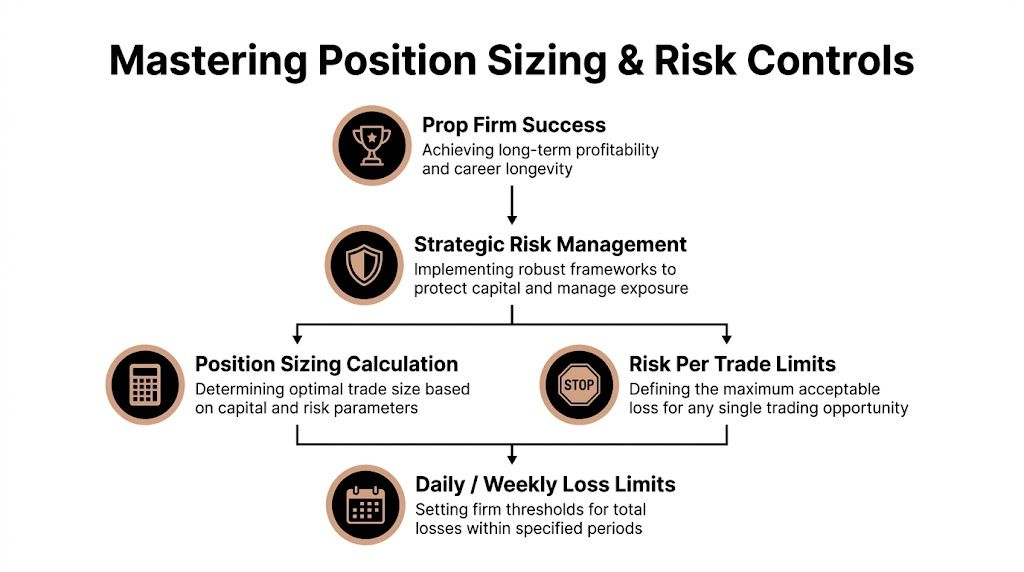
Mastering Position Sizing and Prop Firm Risk Controls
The fastest way to fail a prop evaluation is not a bad read. It is one oversized scalp after two decent winners, followed by a refusal to cut size when the market stops paying cleanly.
A decent setup cannot protect careless sizing. In futures scalping, risk control is part of the strategy, not an add-on after the fact.
Start with the firm rules
In a prop account, the account rules come first. Your opinion on the setup comes second.
The publisher information for MyFundedCapital states a flat 5% daily loss limit and up to 10% maximum drawdown on its programs. Those limits should define your risk plan before the session opens. If your sizing model ignores them, you are not trading a prop strategy. You are freelancing inside someone else’s rules.
Newer traders often size from what they want to make on the trade. Professionals size from what they can lose without damaging the day, the evaluation, or their decision-making.
Use a fixed formula
The sizing math should be boring and automatic:
Position Size = (Max Loss Per Trade) / (Stop-Loss in Ticks × Tick Value)
That formula keeps the trade grounded in acceptable loss.
Using the same example:
- Daily loss limit on a $50K account is $2,500
- Max loss per trade is $100
- Stop-loss is 4 ticks
- ES tick value is $12.50 per tick
- Position size = $100 / (4 × $12.50) = 2 contracts
Nothing about that is exciting. That is the point.
A scalp trader who wants longevity needs to know the contract size before entry, the stop location before entry, and the dollar loss before entry. If one of those is unclear, there is no trade.
Keep per-trade risk small enough to survive clusters of mistakes
Scalping creates repeated exposure. One small loss rarely causes real damage. Five sloppy trades in forty minutes can end the session and put the account in a hole that changes your behavior.
That is why serious scalpers keep risk tight and consistent. Tight stops can work when the setup is clean, liquidity is there, and execution is sharp. Tight stops also create a hard trade-off. They reduce loss per attempt, but they punish hesitation, poor entries, and chasing. A stop that looks disciplined on paper can become random noise exposure if your entry is late by a tick or two.
The goal is not to use the smallest possible stop. The goal is to use the smallest stop that still matches actual market structure.
A practical framework for prop-style sizing
Use these controls before you place the order:
- Per-trade loss cap: Set a fixed dollar amount that stays small relative to the daily loss limit.
- Daily stop: Decide the exact loss amount or number of losing trades that ends the session.
- Size reduction rule: Cut size after a rough start, poor execution, or a short losing streak.
- Platform guardrails: Use hard risk settings and lockouts if your platform supports them.
- Correlation check: Avoid stacking the same idea across highly related contracts if one move can hit all positions at once.
Good prop traders make risk look dull.
That is not a personality trait. It is a process.
Reward targets have to fit scalp conditions
Scalpers lose money by copying swing-trade language without understanding scalp mechanics. The market does not owe you a large multiple on every clean entry. Some sessions barely offer enough movement for modest targets, and forcing a bigger payout usually turns a valid scalp into a scratched trade or a full stop-out.
The trade-off is simple. Smaller targets can support a high-quality scalp if the stop is controlled and the execution is repeatable. Wider targets can improve expectancy if the session has enough expansion and you have proof that your setup reaches them often enough. What fails is mixing a tight stop, a late entry, and an ambitious target, then calling the loss bad luck.
Prop rules should change your behavior
Firm rules expose habits fast. Revenge trading, late-day forcing, and size creep show up quickly because the account has hard boundaries.
Ask these questions before each order:
- Is this setup good enough to spend part of my daily loss limit on it?
- If this trade fails immediately, will I still be within my normal operating state?
- Has my execution today earned the right to keep size the same?
- Am I following my plan, or trying to repair P&L?
If you want to see how those constraints shape trader behavior, study a futures prop trading model built around defined account limits and then build your own worksheet around the same reality.
The job is simple. Keep one trade small, keep one bad stretch survivable, and never let a scalp turn into an account problem.
Refining Your Edge Through Practice and Review
Scalp trading futures rewards repetition, but only if the repetition is clean. Mindless screen time doesn’t build edge. Structured review does.
Most traders practice badly. They take random trades in simulation, remember the winners, ignore the ugly executions, and call it experience. That habit keeps people stuck for months.

Backtest the actual rules, not your memory
If your setup is mechanical, you can test it. You do not need perfect software automation to do this well.
Replay sessions or manually review charts and mark only the setups that meet your exact rules. Then log what happened when traded as written.
Focus on questions like these:
- Was the level clear before the trigger formed
- Did volume support the idea or fight it
- Did price respond immediately or stall
- Was the stop in the correct place
- Did the target fit the market condition
Don’t turn testing into a search for proof that your strategy is brilliant. Use it to find where your rules are too loose, too late, or too difficult to execute under pressure.
Journal execution, not just profit and loss
A scalp journal that tracks only outcome is nearly useless. You also need to track process quality.
A useful trade log includes:
- Instrument traded
- Setup name
- Entry and exit price
- Result in ticks
- Screenshot before entry
- Screenshot after exit
- Market condition notes
- Execution grade
- Mistake tag if applicable
The mistake tag matters. You want to identify patterns such as hesitation, chasing, poor stop placement, early exits, or taking trades outside your allowed window.
Review habit: If the same execution mistake shows up repeatedly, that mistake is now part of your system until you remove it.
Build a short daily review loop
You do not need a huge spreadsheet to improve. You need consistency.
A good end-of-day review can be simple:
- Choose your best trade
- Choose your worst trade
- Mark whether each followed the written plan
- Note one thing to keep
- Note one thing to remove tomorrow
That last step is where real progress comes from. A strong review process trims waste. It removes the little leaks that destroy a high-frequency style.
What experienced scalpers actually improve
As traders mature, the biggest gains usually come from execution quality, not from inventing a brand-new setup every week.
They refine:
- When they trade
- Which contract they trade
- How fast they scratch weak ideas
- How they respond after a loss
- Which setups they now ignore
That’s the professional loop. Test, execute, review, remove error, repeat.
Walkthrough of Real Scalp Trading Setups
Theory is easy to admire and hard to trade. Real setup walkthroughs expose whether your rules are usable.
These examples are not promises. They are models for thinking and execution.

ES long off VWAP bounce
The session opens with active participation and clean movement. ES rotates lower into VWAP after an early push, then starts holding above a nearby intraday support area instead of slicing through it.
What matters is not the touch itself. What matters is the reaction.
You see the selling push weaken, the next test fail to extend, and price start lifting back away from VWAP. That is your cue. The long is valid only when rejection is visible.
Trade sequence
- Market context: Active open and responsive tape
- Location: Price tests VWAP after a pullback
- Trigger: Sellers fail to push decisively through
- Entry: Buy on confirmation of rotation higher
- Stop: Below the invalidation point, tight and absolute
- Target: A fixed scalp objective consistent with your written playbook
If your risk template allows only a small predefined loss on the trade, your contract count comes from the position sizing formula covered earlier. You don’t decide size based on confidence. You decide it based on the stop.
The execution tool matters here. A DOM on DXtrade or cTrader helps you watch how price behaves around VWAP and nearby resting liquidity. One-click order entry matters because the opportunity is brief. If you need extra time to think, the trade is already stale.
NQ short on failed breakout
NQ is fast, and that makes failed breakout setups attractive and dangerous at the same time.
In this example, price pushes into a known intraday resistance area and briefly trades above it. Breakout traders step in, but there is no meaningful continuation. The breakout stalls, then slips back below the level.
That failed hold is the signal. The short is not based on guessing that resistance will hold. It is based on watching the breakout fail.
Trade sequence
- Market context: Momentum contract, active session
- Location: Price tests a clear resistance area
- Trigger: Brief push through the level without follow-through
- Entry: Short as price re-enters the prior range
- Stop: Just beyond the failed break zone
- Target: Quick rotation back into nearby intraday structure
At this point, many newer traders hesitate. They want confirmation, then more confirmation, then a cleaner candle. By then, the risk has worsened and the reward has shrunk.
The best failed-break scalp usually gives you one clean chance. Miss it, and the setup often turns into noise.
What both examples teach
The setup names are different, but the lessons are the same:
- Location first
- Reaction second
- Entry only after confirmation
- Stop where the idea is invalid
- Target taken without greed
The common failure mode is also the same. Traders see the level, enter before the reaction, and then call it bad luck when the level doesn’t hold. That is not bad luck. That is poor sequencing.
A professional scalp is not just a short trade. It is a well-timed short trade in the right place, with the right size, under the right conditions.
Common Questions About Scalp Trading Futures
Is scalp trading futures good for beginners
It can be, but only for beginners who are willing to be highly structured. The pace is fast, and mistakes show up quickly. If you still struggle to follow basic rules, scalping will expose that weakness hard.
How long should a scalp trade last
There’s no fixed clock, but scalp trading futures is built around very short holding periods. If the trade does not respond quickly, many scalpers either scratch it or exit at the stop. Slow confirmation usually means the edge is fading.
Do I need Level 2 or DOM to scalp futures
You don’t need every advanced tool on day one, but DOM and fast order entry help a lot. They become more important as your strategy depends more on immediate reaction around levels and less on waiting for larger chart patterns.
Can I scalp futures during quiet market hours
You can, but quiet hours often produce compressed movement, weaker follow-through, and less forgiving execution. For most traders, active windows are far more practical for building consistency.
Scalp trading futures is not about adrenaline. It is about discipline under speed. The traders who last are not the ones who predict the most. They are the ones who control risk, execute the same small edge repeatedly, and stop acting like every trade needs to change their life.
If you’re ready to apply this with real structure, review the funding options at MyFundedCapital. Compare account types, study the risk parameters carefully, and start a challenge only when your scalp process is tight enough to survive under firm rules.
