The popular answer to “does algorithmic trading work?” is usually too simple to be useful. Algorithms can produce profits, but live results depend on the strategy, market, participant, execution costs, infrastructure, and how quickly other traders copy the same idea. This guide separates genuine edge from backtest illusion and gives you a practical way to judge whether an algorithm belongs in live or prop-firm trading.
What Really Determines Algorithmic Trading Success
Algorithmic trading does not succeed or fail as a single category. A high-frequency market maker, an institutional VWAP engine, a futures trend-following system, and a retail mean-reversion bot face different economics. The useful test is whether a specific strategy can retain an edge in a defined market, timeframe, risk profile, and execution setup.
The sharper question is: which algorithmic strategies work, in which markets, for which traders, and after which costs?
A sound signal can still lose money. A pricing relationship may vanish before the order reaches the market. A strategy that performs in calm, liquid conditions can fail when spreads widen or liquidity withdraws. Backtests can also overstate returns by excluding market impact, rejected orders, stale data, crowding, and account restrictions. Live performance is where those assumptions meet actual fills.
Practical rule: Treat a trading algorithm as a complete operating system, not just a buy and sell formula.
Institutional participants often have an advantage because they can pay for clean market data, research, execution technology, monitoring, risk controls, and reliable liquidity access. Their edge is not always superior prediction. Lower friction, better order handling, and consistent operational control can matter more than a marginally stronger forecast.
Retail participation still has a defensible place. Slower strategies, liquid instruments, disciplined position sizing, and repeatable execution reduce the disadvantages of limited infrastructure. Trying to compete with a co-located high-frequency firm in latency-sensitive market making, using a home connection and a generic expert advisor, is a different proposition.
The operating model matters as well. Firms building trading businesses may evaluate PEO savings for investment firms while budgeting for technology, compliance, and specialist staff. These overhead choices do not create a trading edge, but weak administration can consume one through delays, errors, and uncontrolled risk.
Algorithmic trading can work when the expected edge survives competition, execution costs, changing market conditions, and the trader's risk limits. A backtest is evidence to investigate, not proof that the strategy will survive live markets.
How Dominant Algorithmic Trading Has Become in Global Markets
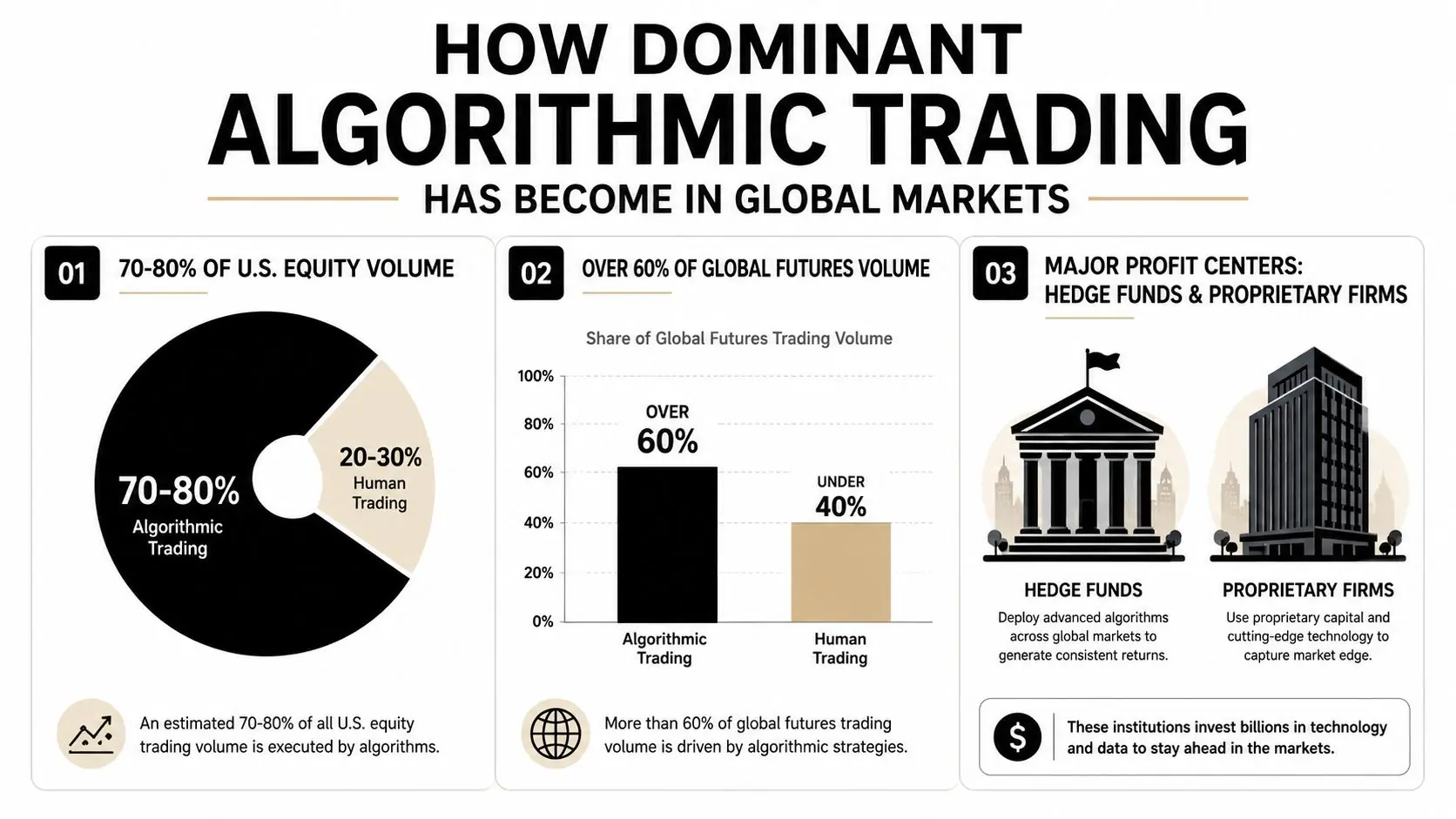
Algorithmic trading is no longer a specialist tool confined to quantitative funds. Algorithms now account for roughly 60% to 75% of trading volume in major global equity markets, while about 70% of U.S. stock trading volume is executed by algorithms, according to Mordor Intelligence's algorithmic trading market analysis.
That dominance developed over time. Electronic communication networks expanded during the 1990s, decimalization changed U.S. equity pricing in 2001, and high-frequency trading grew through the 2000s. Together, these shifts reduced manual order handling and made automated routing, pricing, and execution part of the market's basic infrastructure.
The industry's growth reflects that infrastructure. One estimate places the global algorithmic trading market at USD 20.23 billion in 2026, rising to USD 29.54 billion by 2031, with a 7.87% compound annual growth rate, according to TradeAlgo's 2026 report. That forecast concerns trading technology and services, not the profits available to individual traders. A larger market can still contain crowded signals, expensive execution, and losing systems.
Institutional ownership remains concentrated, with institutional investors holding 61.16% of algorithmic trading market share in 2025. Access to capital, market data, infrastructure, and low-latency execution helps explain that concentration. It does not show that every institutional algorithm is profitable.
Why scale changes the retail problem
Institutional algorithms often handle large orders, manage liquidity, or capture small and temporary inefficiencies. Retail traders generally have less control over routing, fewer data resources, and less infrastructure. Their smaller order size can reduce market impact in slower strategies, but it does not compensate for weak research, poor sizing, or unreliable execution.
The practical distinction is important. A retail trader is not competing on equal terms with a firm whose strategy depends on queue position and latency. A slower approach may still work, but its edge must come from a different source and remain viable after costs and crowding.
By 2024 to 2026, market reports described algorithmic trading as established across equities, futures, foreign exchange, and crypto markets, with forecasts above USD 30 billion globally. The implication is straightforward: algorithmic execution is now a standard market method, so a new strategy enters a competitive environment rather than an unexplored one.
Which Algorithmic Strategies Actually Perform in Live Markets
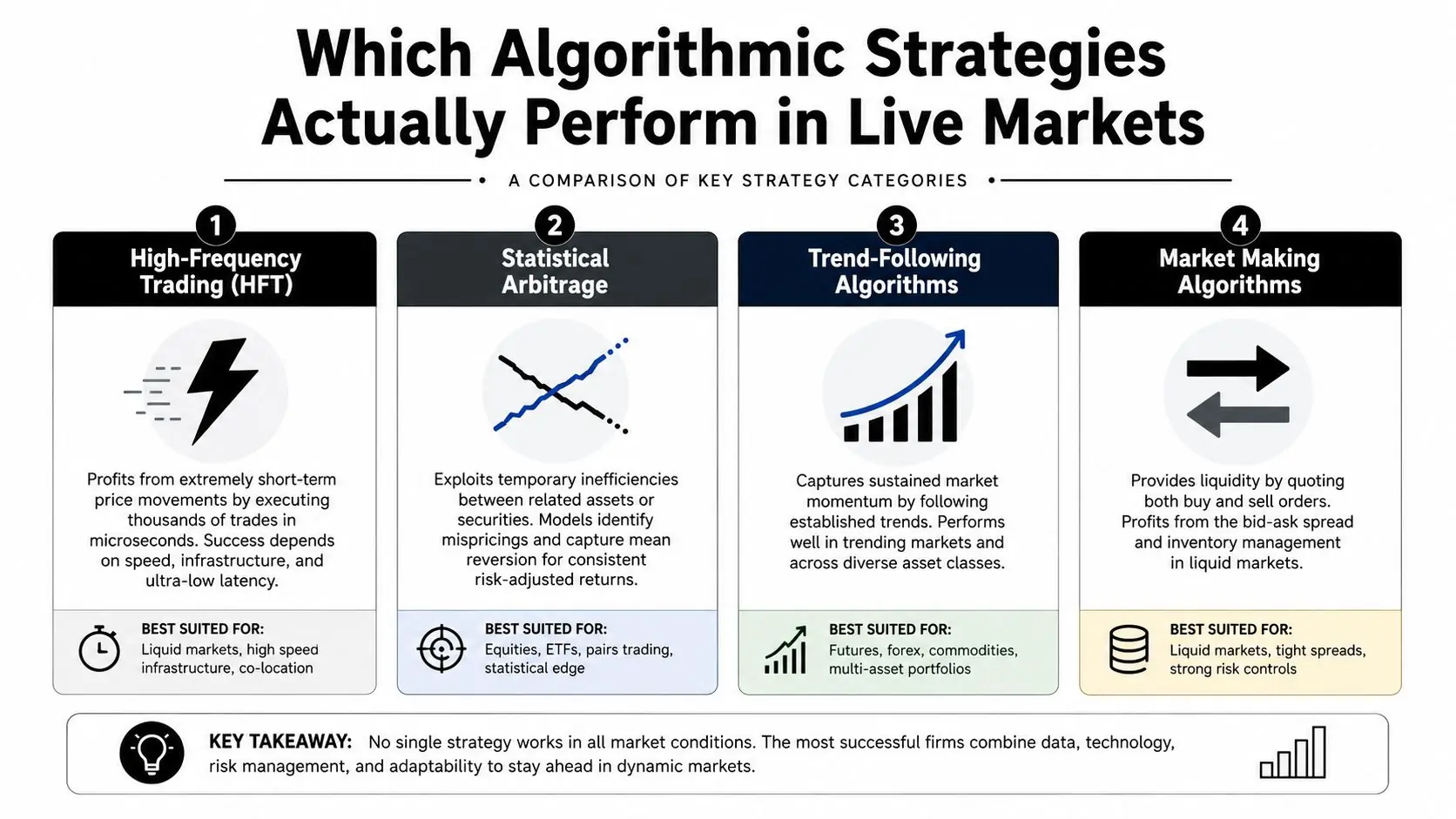
Different strategy families make money in different ways. Comparing them by backtest return alone hides the central issue, which is where the edge comes from and what can erase it.
High-frequency trading
High-frequency trading can be profitable in very liquid markets, but the economics are heavily dependent on speed, queue position, and execution quality. An NBER study of E-mini S&P 500 futures found that HFT firms earned more than USD 23.6 million in gross profits during August 2010, with a median Sharpe ratio of 4.5 across firms. The study found that profits came largely from opportunistic, fundamental, and retail counterparties, while the fastest firms earned the highest profits, as documented in the NBER study of high-frequency trading.
That result doesn't mean a retail trader can copy institutional HFT. The relevant infrastructure, fee schedule, connectivity, and order-book access are different. A strategy that depends on capturing a few price increments may be destroyed by slower routing or worse queue priority.
Statistical arbitrage
Statistical arbitrage searches for relationships that historically revert or converge. It can work when the relationship has an economic explanation, the instruments remain liquid, and the model adapts to structural change. It can fail when too many traders discover the same signal or when correlations that looked stable become unreliable.
For practical development ideas, traders can review strategies for algo trading before deciding whether a signal should be directional, relative-value, or execution-focused.
Trend-following algorithms
Trend-following systems usually operate on slower horizons than HFT. They seek persistent directional movement rather than tiny pricing discrepancies. Their weakness is that sideways markets can produce repeated false signals, while strong trends can create the appearance of effortless profitability in a historical sample.
A trend model needs explicit rules for entry, exit, position sizing, volatility changes, and gaps. It also needs the patience to accept losing periods without constant parameter changes.
Market making and execution algorithms
Market-making algorithms quote both sides and attempt to capture spreads, but inventory risk and adverse selection can overwhelm spread income when informed traders trade against the quotes. Execution algorithms have a different objective. VWAP, TWAP, and implementation-shortfall systems often create value by reducing market impact and improving fills rather than predicting direction.
The SEC synthesis of algorithmic trading evidence reports that algorithmic trading and HFT generally improve price efficiency and reduce short-term volatility in most studies. It also discusses evidence that algorithms can reduce execution shortfalls for institutional buy-side investors, particularly in large stocks. Better market quality is not the same as positive trader PnL, but execution improvement can be a genuine source of value.
Hidden Costs and Execution Realities That Destroy Algo Profits
A backtest can be right about the signal and wrong about the money. The difference usually appears between the intended order and the actual fill.
Slippage is the first practical test. Your model may generate an entry at one price, but the live order can fill at a less favorable level. The effect becomes more severe during fast markets, thin liquidity, news events, and aggressive order placement. Traders should understand what slippage means in trading and include realistic assumptions in both research and monitoring.
The cost stack behind a live trade
A strategy's gross return can be reduced by several layers:
- Spread Every market entry crosses the bid and ask unless the order provides liquidity and gets filled.
- Commission and financing Trading fees, swaps, funding costs, and borrow charges can change the outcome of short-horizon systems.
- Market impact Large or urgent orders can move the market, causing the trader to pay more than the visible quote suggests.
- Latency A delayed signal may enter after the price has already adjusted.
- Data errors Missing candles, bad timestamps, duplicated ticks, and inconsistent contract specifications can create false signals.
- Operational failure Disconnections, rejected orders, platform outages, and unhandled exceptions can turn a normal loss into uncontrolled exposure.
A retail trader doesn't need institutional infrastructure for every strategy. A slower system may tolerate ordinary internet latency, while a short-horizon strategy may not. The mistake is assuming that one infrastructure setup suits every holding period.
Market improvement versus personal profitability
Algorithms often improve market quality on average. A U.S. SEC report explains that electronification can lower trading costs by reducing the need for intermediation and cites evidence that tighter algorithmic quotes can improve effective spreads and reduce retail trading costs. A separate peer-reviewed study links greater algorithmic activity with lower effective spreads, higher realized spreads, and lower adverse-selection risk, as shown in this study on algorithmic trading and liquidity.
Those findings describe aggregate execution conditions. They don't guarantee that your particular bot will profit. A market can become more liquid while your signal decays, your fills worsen during volatility, or your risk rules force an exit at the wrong time.
Execution test: Compare the model's decision price, submitted price, fill price, spread, and delay for every trade. If you can't explain the gap, you don't yet know whether the strategy works.
Testing Fallacies That Make Losing Strategies Look Profitable
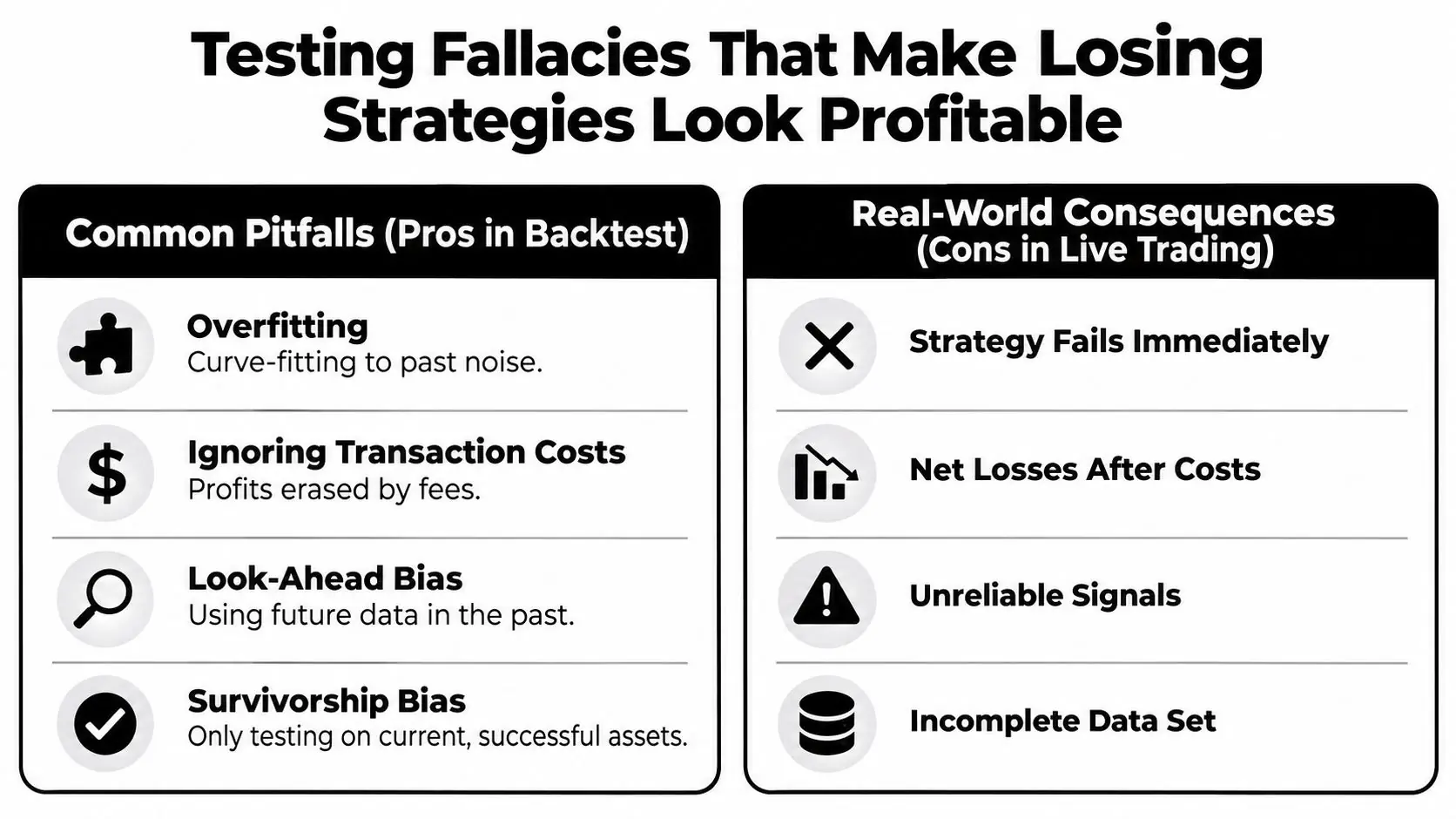
A polished backtest can hide a fragile strategy. The most dangerous errors aren't always mathematical. They often come from using information or assumptions that wouldn't have been available in live trading.
The common traps
- Overfitting A model with too many parameters can memorize historical noise. Its impressive equity curve may reflect curve-fitting rather than a durable relationship.
- Look-ahead bias Using a later close, revised data, or a future constituent list in an earlier decision gives the algorithm information it couldn't have possessed.
- Survivorship bias Testing only assets that still trade or remain successful removes failed instruments from the sample and makes the historical opportunity look cleaner.
- Unrealistic fills Assuming every limit order fills at the desired price, without modeling queue position or partial execution, overstates performance.
- Regime blindness A model trained in one volatility, liquidity, or correlation environment may not behave similarly after market structure changes.
- Crowding A signal can lose power when many agents pursue similar positions at the same time.
The last issue deserves more attention than it receives. A 2026 experimental study found that AI traders could qualitatively match an optimal benchmark in simulation, but fell short when many agents interacted. Their exploration added noise, weakened the learning signal, and reduced profits, market efficiency, and liquidity, according to the experimental study on deep learning traders.
A more honest testing sequence
Use separate development, validation, and out-of-sample periods. Keep the final sample untouched until the rules are frozen. Then run walk-forward tests, vary the parameters slightly, test different instruments where the thesis applies, and model pessimistic execution.
Backtesting in algorithmic trading should be treated as a filtering process, not a certification of future profits. A strategy that survives only one precise parameter setting deserves suspicion. A strategy that survives modest changes, different market periods, realistic costs, and forward observation has earned the right to be tested with limited risk.
A Rigorous Framework for Evaluating Algorithmic Strategy Performance
Total return is a poor first filter. A strategy can produce a high return by taking unacceptable drawdown, relying on rare wins, or using borrowed capital that won't fit your account rules.
Start with risk-adjusted performance
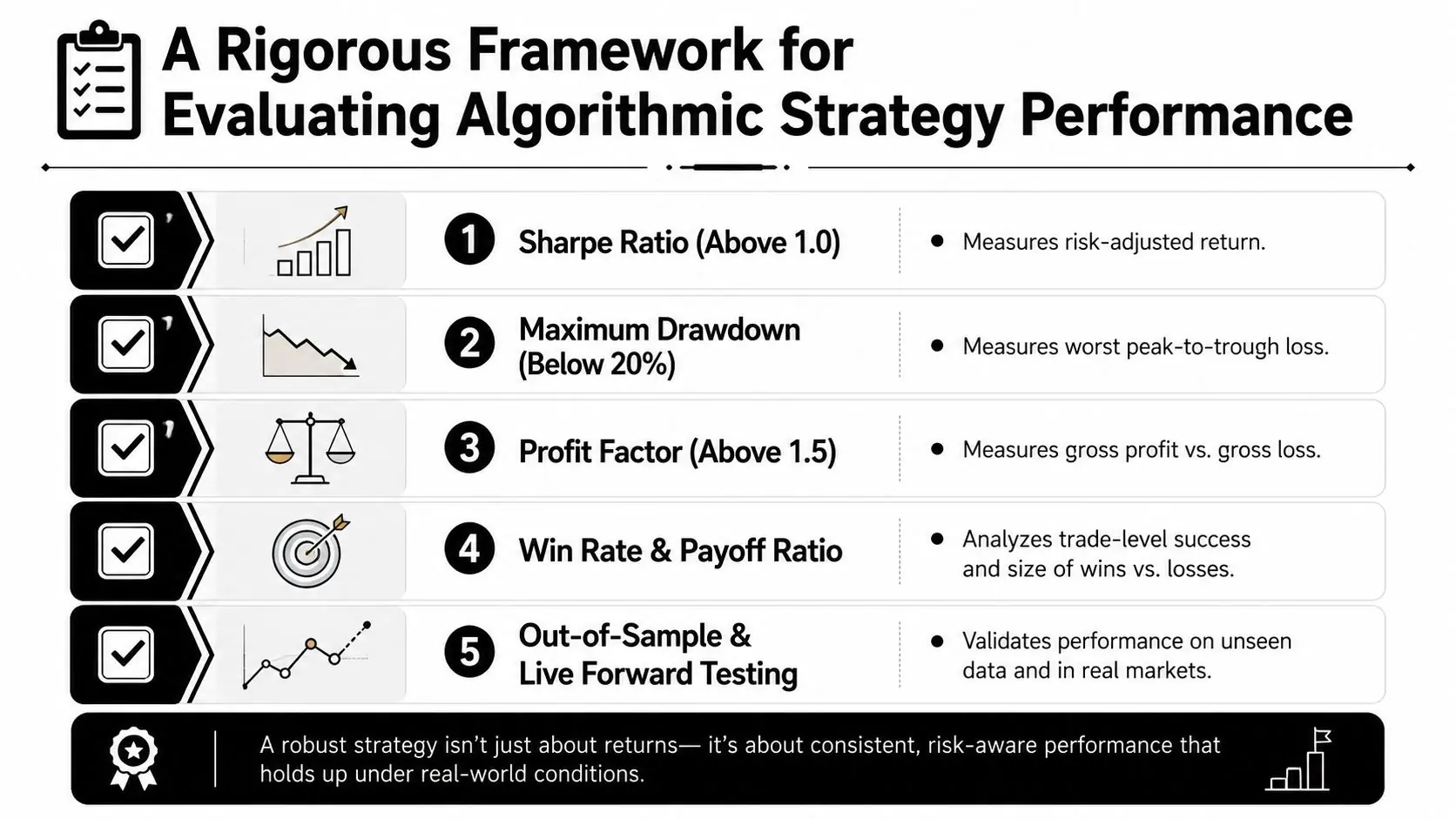
Sharpe ratio helps compare return with variability, but it isn't sufficient by itself. Examine the return path, losing streaks, tail events, and whether a small number of trades produced most of the gains. The NBER evidence on HFT shows why context matters. A reported median Sharpe ratio of 4.5 belonged to a specific group of firms, market, period, and execution environment, not to algorithmic trading as a whole.
Maximum drawdown deserves equal attention. Ask how long the system took to recover, whether the drawdown occurred in one cluster, and whether the account could remain within its loss limits while the strategy recovered.
Use this pre-deployment checklist
- Rebuild the data pipeline. Confirm timestamps, session boundaries, corporate actions where relevant, contract rolls, missing observations, and bid-ask information.
- Apply realistic execution. Model spread, commission, financing, slippage, partial fills, and rejected orders. Test a worse-cost scenario rather than relying on one optimistic assumption.
- Separate the samples. Use walk-forward analysis and unseen out-of-sample data. Never tune the model on the final validation period.
- Stress the strategy. Run Monte Carlo analysis by reshuffling trade order, varying execution costs, and testing losing sequences. Use sensitivity analysis to see whether small parameter changes cause collapse.
- Measure implementation. Track implementation shortfall, VWAP deviation, fill ratios, latency, and realized spread. These metrics tell you whether the live engine executes the research idea.
Red flags that stop deployment
Pause the strategy if profits disappear after modest costs, performance depends on one market event, or a tiny parameter change eliminates the edge. Also stop if the model cannot explain why it should work economically.
There isn't a universal threshold that makes a strategy safe. The infographic's reference points, such as a Sharpe ratio above 1.0, maximum drawdown below 20%, and profit factor above 1.5, can serve as screening markers, but they aren't guarantees and shouldn't override account-specific risk limits.
Implementation Checklist for Prop Trading Environments
A prop-firm environment adds a second objective to strategy design. The algorithm must seek opportunity while staying inside fixed daily loss, maximum drawdown, news, holding, and platform rules.
Configure the account before the bot
Read the firm's rules as if they were part of the strategy specification. Confirm whether automated execution, expert advisors, copy trading, overnight positions, weekend holding, and news trading are permitted. Then map those rules into code rather than relying on memory.
A practical deployment sequence looks like this:
- Verify the platform and connection. Confirm that your EA or API works on the selected platform, including order types, symbol names, contract specifications, and reconnection behavior.
- Set hard risk limits. Use per-trade risk, total exposure, daily loss protection, and an account-level equity stop. The bot should stop opening positions before the firm's limit becomes the emergency exit.
- Add a kill switch. Create a manual and automated shutdown that cancels orders and closes positions when data becomes stale, spreads behave abnormally, or execution diverges from expectations.
- Log every decision. Store signal time, market data, intended order, submitted order, fill, rejection, error, and account equity. Logs make post-trade review possible.
- Start small. Deploy in a controlled phase, observe real fills, and compare live execution with the research assumptions before increasing size.
- Monitor degradation. Alert on drawdown, missed fills, rising slippage, repeated errors, unusual trade frequency, and exposure concentration.
DXtrade and cTrader users should test platform-specific behavior rather than assuming that a strategy written for another environment will behave identically. Differences in symbol mapping, execution, spreads, and automation permissions can change results.
MyFundedCapital offers simulated-capital trading programs that support manual, algorithmic (by agreement with support), and copy trading across forex, crypto, and commodities on DXtrade and cTrader. Its published risk parameters include a 5% daily loss limit and up to 10% maximum drawdown, so an algo trader would need to design controls around those constraints rather than treating them as after-the-fact rules. Trading involves risk of loss, and simulated funding doesn't turn an unvalidated strategy into a reliable one.
Common Questions About Algorithmic Trading Answered
Can retail traders compete with institutional algorithms?
They generally shouldn't compete on the same battlefield. Retail traders are unlikely to win a latency contest against firms with specialized infrastructure, but they can work on slower signals, less crowded instruments, disciplined execution, and strategies whose edge doesn't require exceptional speed.
How much capital do you need?
There isn't a universal capital amount that makes an algorithm profitable. Capital affects position sizing, diversification, minimum order constraints, fees, and the ability to tolerate drawdown. A small account can validate execution and discipline, but it can't make a weak strategy viable.
Does algorithmic trading work in forex and crypto?
It can, but the conditions differ by venue, instrument, liquidity, spread, funding cost, and trading hours. Foreign exchange strategies must account for rollover and fragmented liquidity. Crypto systems need controls for rapid market changes, exchange-specific execution, outages, and weekend exposure. Test the exact market and venue you intend to trade.
Should you build an algorithm or use an existing EA?
Build when you can define the hypothesis, data, execution model, and risk controls. An existing EA may save development time, but you still need to understand its logic, inspect its backtest assumptions, and forward-test it under your account's rules. Copy trading can reduce coding work, but it transfers dependence to another trader's execution and risk decisions.
The development timeline depends on data quality, strategy complexity, and testing discipline. A simple rule set can be coded quickly, while reliable validation, monitoring, and controlled deployment take longer. Don't measure readiness by how fast the bot opens its first trade. Measure it by whether you can explain every trade and contain every foreseeable failure.
MyFundedCapital offers Instant Funding and 1-Step or 2-Step Challenge routes, with account sizes from $5K to $100K and scaling paths up to $500K, while allowing eligible algorithmic strategies under its platform and risk rules. Review the available account types and start testing your process through MyFundedCapital only after your strategy has survived realistic costs, forward testing, and strict drawdown controls.