Struggling to grow a small trading account? Futures prop trading offers a direct path for skilled traders to manage significant capital without risking their own savings. This guide will give you a practical, no-hype look at how it works, why futures are gaining traction, and the concrete steps you need to take to get funded.
Trading futures involves a substantial risk of loss and is not suitable for all investors. The content provided is for educational purposes only and should not be considered financial advice. All trading within prop firm programs is conducted on simulated accounts.
What Is Futures Prop Trading?
Proprietary (or "prop") trading allows you to trade a firm's capital instead of your own. If you have a proven strategy but lack the funds to make a meaningful income, a futures prop firm provides the account size you need. In return for a small evaluation fee, you get the chance to trade a large account and keep a majority of the profits.
This model removes the biggest barrier for most traders: undercapitalization. Your job is to prove you can trade profitably and manage risk according to the firm's rules. If you can, you get to trade with their money and share in the success.
The Firm's Perspective: A Business Model Based on Skill
Prop firms are not charities; they are talent-scouting agencies for traders. Their business model relies on finding disciplined individuals who can generate consistent returns. They use evaluation challenges to filter thousands of applicants for the few who have what it takes.
The evaluation isn't just about hitting a profit target. It’s a test of your discipline. Firms need to see that you can follow rules, respect drawdown limits, and perform under pressure before they risk real capital on you.
Your Role as the Trader: Prove Your Discipline
Your job is to execute your trading strategy within the firm's specific risk parameters. This partnership works because when you make money, the firm makes money. The process is straightforward:
- Evaluation You pay a one-time fee to enter a challenge on a simulated account. You must hit a profit target without breaking any rules.
- Funding Once you pass, you're given a funded account. The firm now assumes the financial risk on your trades.
- Profit Split You keep a large portion of any profits you generate—typically between 80% to 90%.
Using innovative trading tools can help you analyze the market, but remember that no tool can replace solid risk management.
Why Traders Are Moving to Futures
There is a major shift happening in the prop trading world. A growing number of traders are leaving the forex and CFD space for the structured, transparent environment of futures. This isn't just a small trend; it's a fundamental change driven by the search for a more professional trading environment.
Data backs this up. According to recent analysis, search interest in futures prop firms decisively overtook forex prop firms, hitting 19,100 global monthly searches by late 2025. You can explore the data in more detail through reports on prop trading statistics on Tradeify.co. So, what's behind this migration?
The Power of Regulated Exchanges
Futures contracts trade on highly regulated, centralized exchanges like the CME Group. This creates a professional and trustworthy trading environment, which is a night-and-day difference from the over-the-counter (OTC) markets where many FX and CFD prop firms operate.
On a regulated exchange, everyone sees the same price feed from the same source. This eliminates the "B-book" model where a broker might profit from your losses, creating a conflict of interest. For a prop trader, this transparency is critical. It means your success is a direct result of your skill, not the business model of your firm.
Centralized Order Book: A Level Playing Field
The central limit order book (CLOB) is a massive advantage in futures trading. It's a single, transparent ledger where every buy and sell order across the entire market is visible. This offers huge benefits:
- No Price Manipulation The price you see is the real market price. There’s no room for firms to artificially widen spreads or create slippage against you.
- Real Market Depth You can use powerful tools like order flow and volume profile analysis with confidence, knowing the data is accurate and complete.
- Fair Execution Your orders are filled based on a simple "first-come, first-served" rule. There are no opaque dealer desks deciding when or if your order gets filled.
This structure provides the solid foundation required to build a sustainable trading career. While all trading involves risk, the futures market offers a framework where discipline and skill are rewarded.
How to Pass a Futures Prop Trading Evaluation
Let's be direct: most traders fail their evaluation. Success isn’t about finding a secret strategy; it's a test of your discipline, risk management, and your ability to follow rules to the letter. Think of it as your professional audition—and you need to treat it that way.
Pass rates for futures evaluations often sit between a sobering 5% and 10%. It’s not the flashy, high-risk traders who get funded. It’s the disciplined ones who prove they can be trusted to manage risk.
Understand the Evaluation Structure
Before placing a trade, you must know the test you're taking. Most firms offer two main paths:
- 1-Step Challenge A single-phase test where you must hit one profit target (e.g., 10%) without breaking any rules. These often have no time limit, rewarding patience.
- 2-Step Challenge A two-phase test. Phase 1 has a higher profit target (e.g., 8%), and Phase 2 has a lower one (e.g., 5%). This is designed to test for consistency.
A 1-step challenge may suit a patient, methodical trader, while a 2-step could be better for traders skilled at generating consistent, smaller wins.
Deconstruct the Rules and Your Risk
Rules are not suggestions. Break one—even by a single tick—and your evaluation is over. The most important rule to master is drawdown.
You must know your maximum allowable loss at all times. Let's make this concrete.
Example: You have a $100,000 account with a $5,000 daily loss limit. This means your account equity, including open positions, cannot fall below $95,000 during the trading day. If your equity dips to $94,999.99, you have failed. It is that black and white.
This hard limit must be the foundation of your risk plan. Before entering any trade, calculate your maximum position size based on this rule. If your strategy on the E-mini S&P 500 (ES) has a 4-point stop loss ($200 per contract), you can’t simply load up on contracts. A professional approach would be to risk no more than 1% of the account ($1,000) per trade. This gives you a buffer to take five full-loss trades before you even approach your daily limit. This is the calculated risk management that firms want to see.
A Practical Checklist for Passing Your Challenge
Success comes from a plan. To see a detailed breakdown, check out this guide on how prop firm challenges work.
- Read the Rules (Twice) Know the daily loss limit, the max drawdown (is it static or trailing?), and rules on news trading or holding overnight.
- Define Your Risk Per Trade Set a fixed dollar amount or percentage to risk on every trade. A professional standard is 0.5% to 1%. No exceptions.
- Calculate Your Max Position Size Based on your risk-per-trade rule and your strategy's stop-loss, determine the maximum number of contracts you can trade. Never exceed it.
- Trade Your "A+" Setup Only An evaluation is not the time for experiments. Stick to the one or two high-probability setups that you have backtested and know you have an edge with.
- Focus on Consistency, Not Speed There is no prize for finishing fast. Your job is to hit the profit target with small, consistent gains. Prove you can be a steady hand.
Understanding Prop Firm Rules and Drawdowns
Here’s a hard truth: it’s not a bad strategy that disqualifies most traders. It’s breaking a rule they didn’t fully understand. To succeed in futures prop trading, you must know the firm’s rulebook better than your own strategy.
The single most important concept to master is drawdown. This is the firm’s absolute limit—the maximum your account can lose before they pull the plug. Violating the drawdown rule is the #1 reason traders fail.
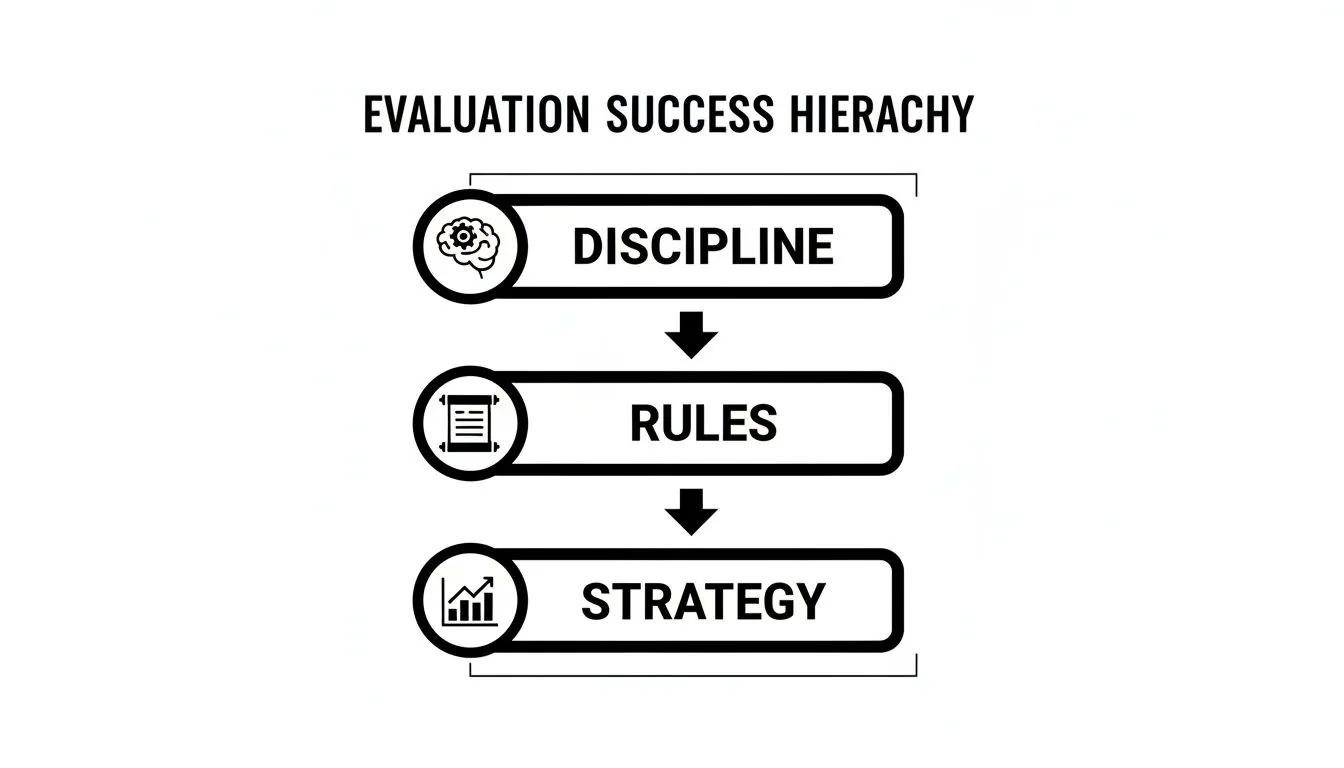
Discipline and rules form the bedrock of your trading. Only once you’ve mastered them can your strategy truly perform.
Comparing Common Prop Firm Drawdown Rules
Not all drawdown rules are the same. The type a firm uses will dramatically impact how you manage your risk from one trade to the next.
| Rule Type | How It Works | Example on a $100k Account (10% Max Drawdown) | Key Consideration |
|---|---|---|---|
| Static Drawdown | A fixed loss limit based on your initial balance. It never moves, regardless of your profits. | Your account balance can never drop below $90,000. If you make $5k, your buffer increases to $15k. | The most trader-friendly. Gives you more breathing room as you build profits. |
| End-of-Day (EOD) Trailing | Your drawdown limit "trails" your profits, but it only adjusts once per day based on your account's closing balance. | If your account closes at $102,000, your new drawdown limit becomes $92,000. It won't rise further until the next day's close. | A good balance, as intra-day profit swings won't immediately tighten your limit. |
| Intra-day (Real-Time) Trailing | The strictest type. The limit trails your highest account balance (your "high-water mark") in real-time, including open profits. | If a trade's open profit takes your equity to $101,500, your drawdown floor instantly moves up to $91,500 and stays there, even if the trade reverses. | Most common in futures. Requires constant awareness of your peak equity. |
The intra-day trailing drawdown catches many traders by surprise and is critical to understand.
How Trailing Drawdown Works in the Real World
Let's walk through a common scenario to see how a real-time trailing drawdown can end your evaluation. Imagine you're on a $100,000 account with a $3,000 trailing drawdown.
- Day One You start at $100,000. Your violation level is $97,000.
- A Winning Trade You enter a trade that goes in your favor. At its peak, your unrealized profit takes your account equity to $101,500. This is your new "high-water mark." The system immediately raises your violation level to $98,500 ($101,500 – $3,000).
- The Reversal The trade pulls back, and you close it for a $500 profit. Your account balance is now $100,500.
- The New Reality This is the critical part. Even though your balance is $100,500, your violation level does not go back down. It's locked at $98,500. You now only have $2,000 of room to trade ($100,500 balance – $98,500 violation level), not the original $3,000.
Your risk is measured from your peak equity, not your current balance. To master this concept, you can learn more about how trailing drawdown works in our guide.
Your Pre-Flight Checklist for Firm Rules
Before paying for an evaluation, get clear answers to these questions from the firm's website or support team.
- Max Drawdown What is the exact dollar amount or percentage?
- Drawdown Type Is it Static, EOD Trailing, or Intra-day Trailing? This is non-negotiable.
- Daily Loss Limit Is there a separate daily limit? Does it include commissions and fees?
- Prohibited Activities Is news trading allowed? Can you hold trades overnight or over the weekend?
- Consistency Rules Are there rules limiting how much one day can contribute to your overall profit target?
Treat this like a detective investigating a case. Knowing these details is essential for any serious futures prop trader.
Choosing the Right Futures Prop Firm
With dozens of firms competing for your attention, picking the right partner is one of the most important decisions you'll make. A good firm provides the support and structure to succeed, while a bad one can be a roadblock to your goals.
Don't be swayed by marketing hype or promises of huge accounts. The goal is to find a firm whose rules and funding model fit your specific trading style.
Key Factors in Your Evaluation
Use this as your due diligence checklist. Any reputable firm will provide this information clearly.
- Funding Model Do they offer a 1-Step Challenge, a 2-Step Challenge, or Instant Funding? Each model tests different skills. Instant Funding lets you earn right away but often comes with tighter risk rules.
- Profit Split and Scaling An 80% or 90% profit split is the industry standard. Look beyond that to the scaling plan. A good firm offers clear, achievable milestones for increasing your account size as you demonstrate profitability.
- Payout Schedule How quickly do you get paid? Weekly, bi-weekly, or on-demand payouts are common. A firm with a fast, reliable payout system is a strong sign of financial health.
- Supported Platforms Ensure the firm works with a platform you trust, like cTrader or DXtrade. Being forced onto an unfamiliar platform puts you at an immediate disadvantage.
Vetting a Firm’s Reputation
A prop firm’s reputation comes down to one thing: paying its traders on time and without hassle. A fancy website means nothing if a company has a history of denying payouts.
Look for a firm’s Discord or Telegram community. Are traders actively sharing proof of payouts? Is the community engaged and transparent? A thriving, open community is one of the best signs of a trustworthy operation. Your trading style must align with the firm's rules. If you are a scalper, a firm with tight drawdowns might not be a fit. If you are a swing trader, you must find a firm that allows overnight positions.
Choosing the right firm is about alignment. You are entering a business partnership. To get a head start, our guide on the best futures prop firms can help you compare the top players and make an informed choice.
Frequently Asked Questions (FAQ)
What's the main difference between futures and forex prop trading?
The biggest difference is the market structure. Futures trade on centralized, regulated exchanges (like the CME), meaning everyone sees the same price and data from a single source. This creates a transparent environment with no conflict of interest between you and the firm. Forex prop trading often happens in over-the-counter (OTC) markets, which can be less transparent.
Can I hold trades overnight or over the weekend?
It depends entirely on the firm and the specific account you choose. Most standard evaluation accounts require you to be flat at the end of the trading day to manage risk. However, many firms offer dedicated "swing" accounts or an add-on that explicitly allows you to hold positions overnight and through the weekend, usually for a higher one-time fee. Always check the rules for your program.
What is a realistic profit target for a funded trader?
Once funded, the goal shifts from hitting a big target to achieving consistency. A realistic and sustainable goal for a professional prop trader is often in the range of 2% to 5% per month. Trying to make 20% a month is a recipe for violating drawdown rules. Slow, steady, and disciplined gains are what build a long-term career.
Are my earnings from prop trading taxed?
Yes, absolutely. As a funded trader, you are classified as an independent contractor, not an employee. This means the firm pays you your full profit share, and you are solely responsible for reporting that income and paying taxes according to your country's laws. It is crucial to consult with a local tax professional to understand your obligations and plan accordingly.
Take Your Shot at Futures Prop Trading
The path to becoming a funded futures trader is clear: it’s for disciplined individuals who can prove they can manage risk. Success isn't about finding a magic strategy; it's about demonstrating that you can operate like a professional within a defined set of rules.
Your first step is to choose a funding model that aligns with your trading style. Are you patient enough for a 1-Step Challenge? Does your consistent approach make a 2-Step process a better fit? Or are you confident enough to jump straight into Instant Funding and start earning from day one?
Choosing a path that plays to your strengths is the first step toward building a sustainable trading career.
Ready to prove your skills? Compare our Instant Funding and Challenge accounts and find the right path to start trading with professional capital.