You've probably seen it happen: a cTrader cBot opens three EURUSD positions during the New York session while you're still drinking coffee. The hard part isn't making software click Buy or Sell. It's proving that every order obeys your funded account's drawdown rules, survives real execution conditions, and leaves an audit trail you can trust.
What Algorithmic Trading Software Actually Does
Algorithmic trading software is a program that receives market data, applies coded decision rules, and sends orders to a broker or prop firm server without a person pressing the button. A manual trader interprets a chart, decides on size and timing, and clicks. An algorithm follows its instructions consistently, whether those instructions are sensible or badly designed.
That distinction matters in a funded evaluation. Maximum daily drawdown, overall drawdown, profit targets, and consistency requirements are easier to monitor when every trade has a timestamp, entry reason, volume record, stop-loss instruction, and exit event. A mental notebook can't explain why an order appeared during a volatile minute. A properly logged system can.
A useful overview of the basic concept is available in this guide to what algorithmic trading is, but the practical distinction starts with the type of automation you're using.
Execution automation versus strategy automation
Execution algorithms handle an order you've already decided to place. VWAP, or volume-weighted average price, stages a parent order according to expected market volume. TWAP, or time-weighted average price, spreads that order across a chosen period. Implementation shortfall algorithms focus on balancing execution urgency against market impact. These tools automate how an order is filled, not necessarily why the trade exists. Execution algorithm references describe VWAP and TWAP as ways to stage orders while limiting market impact.
Full strategy automation goes further. The software can evaluate indicators, session times, volatility filters, spread conditions, and account exposure, then create and manage the trade from signal to exit.
Practical rule: If you can't reconstruct the reason, risk check, and execution path for every order, the system isn't ready for a funded account.
The industry has moved well beyond simple order splitting. One market estimate values algorithmic trading software at USD 21.06 billion in 2024, with a projection of USD 42.99 billion by 2030 and a 12.9% CAGR from 2025 to 2030. A separate estimate uses a much narrower market definition, placing the market at USD 2.53 billion in 2025 and projecting USD 4.33 billion by 2034, at a 6.0% CAGR. The difference reflects scope and methodology, but both estimates point to sustained demand for automated execution and strategy infrastructure. Grand View Research's algorithmic trading market analysis provides the broader market estimate.
The Building Blocks of Modern Trading Software
Think of a trading system as a commercial kitchen. The market data feed is grocery delivery, bringing prices and depth to the door. The strategy engine is the chef applying a recipe. The order router is the waiter carrying the completed order to the broker. Risk controls are the health inspector who can reject the dish before it reaches the customer.
That analogy helps because most failures occur between the signal and the fill, not inside the entry condition.
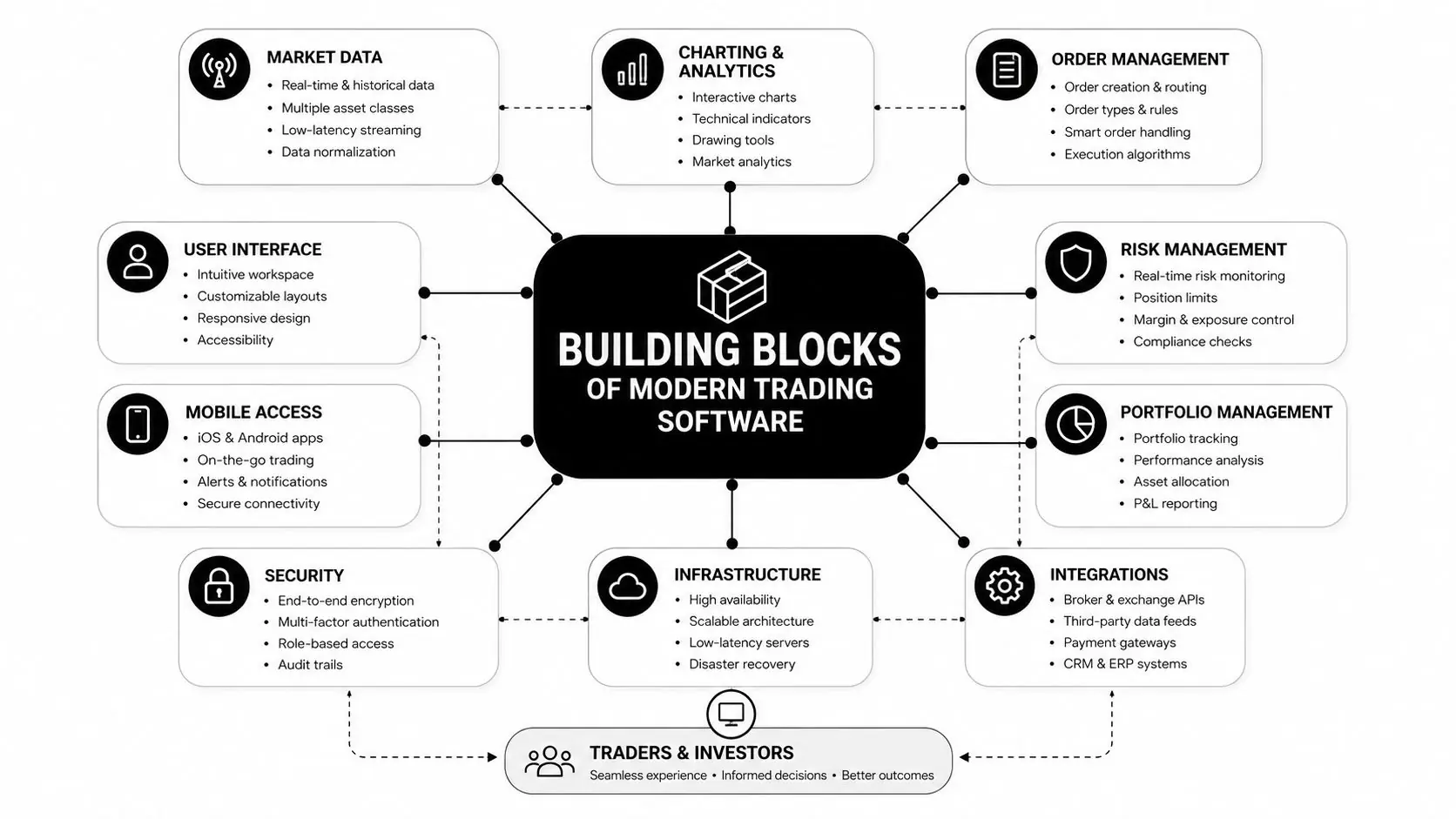
Five layers to inspect
- Data ingestion receives bid, ask, candle, tick, news, and account information. Bad timestamps or stale quotes can generate a perfectly coded but invalid signal.
- Signal generation applies the rules. That might be a moving-average condition, a breakout, a mean-reversion trigger, or a portfolio allocation decision.
- Risk and order management checks position size, open exposure, price distance, duplicate orders, and account drawdown before submission.
- Broker connectivity sends, modifies, rejects, or cancels orders through the platform or an API. This layer also returns fill prices and rejection messages.
- Post-trade reporting records decisions, fills, slippage, cancellations, and errors. Without it, debugging becomes guesswork.
Latency can enter at every hop. The data feed may arrive late, the strategy may process slowly, the API may queue a request, or the broker server may acknowledge the order after price movement. For sub-second systems, hosting near matching infrastructure in locations such as NY4 or LD4 can reduce network distance. That won't rescue a weak strategy, and it won't remove spread or market impact.
Middleware adds another dependency. A FIX bridge can connect institutional-style order flow, while REST and WebSocket APIs support application-based integrations. Copy-trading rails add a master-to-slave transmission step, which can create another source of delay, rejected symbols, or mismatched volume. Treat each connection as a component that needs failure testing, not as invisible plumbing.
Core Features Every Algo Platform Should Have
A funded account can reject a technically impressive system for operational reasons. Evaluate algorithmic trading software by whether it preserves an audit trail, enforces drawdown rules, and supports the account's platform natively. Speed matters, but unexplained fills and missing records create larger problems.
Start with the order record. The platform should support market, limit, and stop orders, then show each modification, rejection, cancellation, partial fill, and retry with timestamps. Slippage reporting should compare requested and filled prices. If the system conceals rejected orders or repeatedly resubmits them, you cannot reliably review exposure or explain a breach.
Backtests need disciplined assumptions. Use credible tick data when intrabar movement affects entries or exits, then test walk-forward and out-of-sample periods rather than optimizing every parameter on one historical sample. Perfect fills make results look cleaner than live trading. Research on backtesting technical factors and live slippage explains how signal-to-order latency can add slippage and change performance.
A practical review should answer four questions:
- Execution Can you inspect order-state changes, partial fills, rejected orders, slippage, and timestamped audit logs?
- Backtesting Are data sources, spread assumptions, walk-forward tests, and out-of-sample results visible? A single currency pair should not be optimized until it looks flawless.
- Strategy development cTrader commonly uses C# for cBots, MT5 uses MQL5 for Expert Advisors, and DXtrade integrations may use Lua or an adapter. Debugging and version control make changes traceable and reversible.
- APIs and connectivity REST and WebSocket endpoints, FIX where available, and stable webhook handlers support external analytics or copy-trading workflows. Each connection needs failure tests.
The useful test comes after a losing trade. Can the software show the signal, the risk check, the order request, the broker response, the fill, and the resulting drawdown? A strong backtesting platform supports research, but it cannot correct fragile routing, wrong symbol specifications, or a risk layer running only on a home computer.
| Feature Pillar | What to Look For | Why It Matters in Prop Trading |
|---|---|---|
| Execution | Native order types, partial fills, slippage logs | Helps verify fills and protect drawdown limits |
| Backtesting | Tick data, walk-forward tests, out-of-sample validation | Reduces false confidence from curve fitting |
| Strategy development | C#, MQL5, adapters, debugging, version control | Makes changes traceable and reversible |
| APIs and connectivity | REST, WebSocket, FIX, reliable webhooks | Supports stable integrations and copy-trading workflows |
cTrader, DXtrade, and MT5 for Algo Traders
Platform choice should follow the strategy and the funded account rules, not the size of a marketplace. cTrader is attractive for traders who want C# development through cTrader Automate, cBots, and platform-native execution tools. MT5 uses MQL5 Expert Advisors and has a deep ecosystem of indicators and third-party tools. DXtrade is more browser-oriented, so automation often depends on its API, Open API integrations, or a bridge.
News conditions expose the differences. A cBot or EA running directly inside a supported platform may have fewer translation steps than a copier that moves signals through an external service. DXtrade can be convenient for browser-based access and copy trading, but you need to verify whether the strategy runs natively or relies on an adapter. Traders who analyze TradingView data can also review resources for scraping TradingView charts, though data collection and execution are separate problems.
| Platform | Algo Language | Native Bot Support | Copy Trading | Typical Latency | Prop Firm Availability |
|---|---|---|---|---|---|
| cTrader | C# | cBots through cTrader Automate | Native tools and third-party options | Direct platform execution can reduce bridge steps | Depends on the firm and account setup |
| MT5 | MQL5 | Expert Advisors | MetaQuotes and third-party copiers | Direct EA execution, with venue and VPS conditions affecting results | Widely offered, subject to firm rules |
| DXtrade | API integrations, Lua or bridge scripts | Often API or adapter-based rather than server-side cBots | Copy-trading bridges and supported integrations | Depends heavily on API and bridge path | Increasingly available through supported firms |
Match the platform to your operating model
A C# developer who wants custom order management may prefer cTrader. A trader with existing EAs and marketplace tools may find MT5 more practical. A browser-first trader or copier may prefer DXtrade, provided the API behavior, symbol mapping, and risk controls are documented.
Before choosing, read the firm's current platform terms and confirm whether the account supports your exact automation method. This comparison of FX trading platforms can help frame that decision, but platform availability isn't the same as permission to run every type of bot.
How to Choose the Right Software for Your Style
Software choice starts with the strategy's holding period, then moves to the rules around the account. A scalper depends on spread, quote freshness, order acknowledgement, and VPS location. A swing system usually needs dependable historical data, multi-asset support, restart behavior, and portfolio APIs that preserve state after an interruption.
A platform can pass a backtest and still fail in production. Before connecting a funded account, run a small operational test that records how the system handles rejected orders, reconnects, market closures, and partial fills.
Evaluate the operating details
Hosting location affects execution more than computer specifications alone. Identify the broker or prop firm server location and measure the route from the VPS. A powerful machine on the wrong network can be slower than a modest nearby server.
API limits and recovery behavior deserve a direct test. Confirm request limits, authentication, reconnect handling, and the platform's response to a burst of orders. The system must also distinguish a rejected request from an accepted order whose confirmation arrived late.
Drawdown enforcement should work across positions, strategies, symbols, and the account. Account-level daily loss protection matters when separate bots trade correlated instruments, even when each bot appears safe on its own.
Execution records should show requested price, fill price, spread, delay, and rejection reason. A generic “trade completed” message cannot explain whether a backtest illusion came from ideal fills or whether a live loss came from slippage.
Check paper trading with changing spreads, partial fills, disconnects, and market closures. Record signal time, rule state, risk decision, order payload, broker response, and exit reason so the audit trail can support both debugging and funded-account compliance.
A fast strategy with poor observability is harder to trust than a slower strategy with clean records.
Portability also affects long-term cost. Proprietary formats can trap logic inside one vendor, while bridges between MT5 and cTrader may add latency, change volume conventions, or duplicate orders after a reconnect. Test symbol renames, rejected orders, platform updates, and session changes before exposing capital.
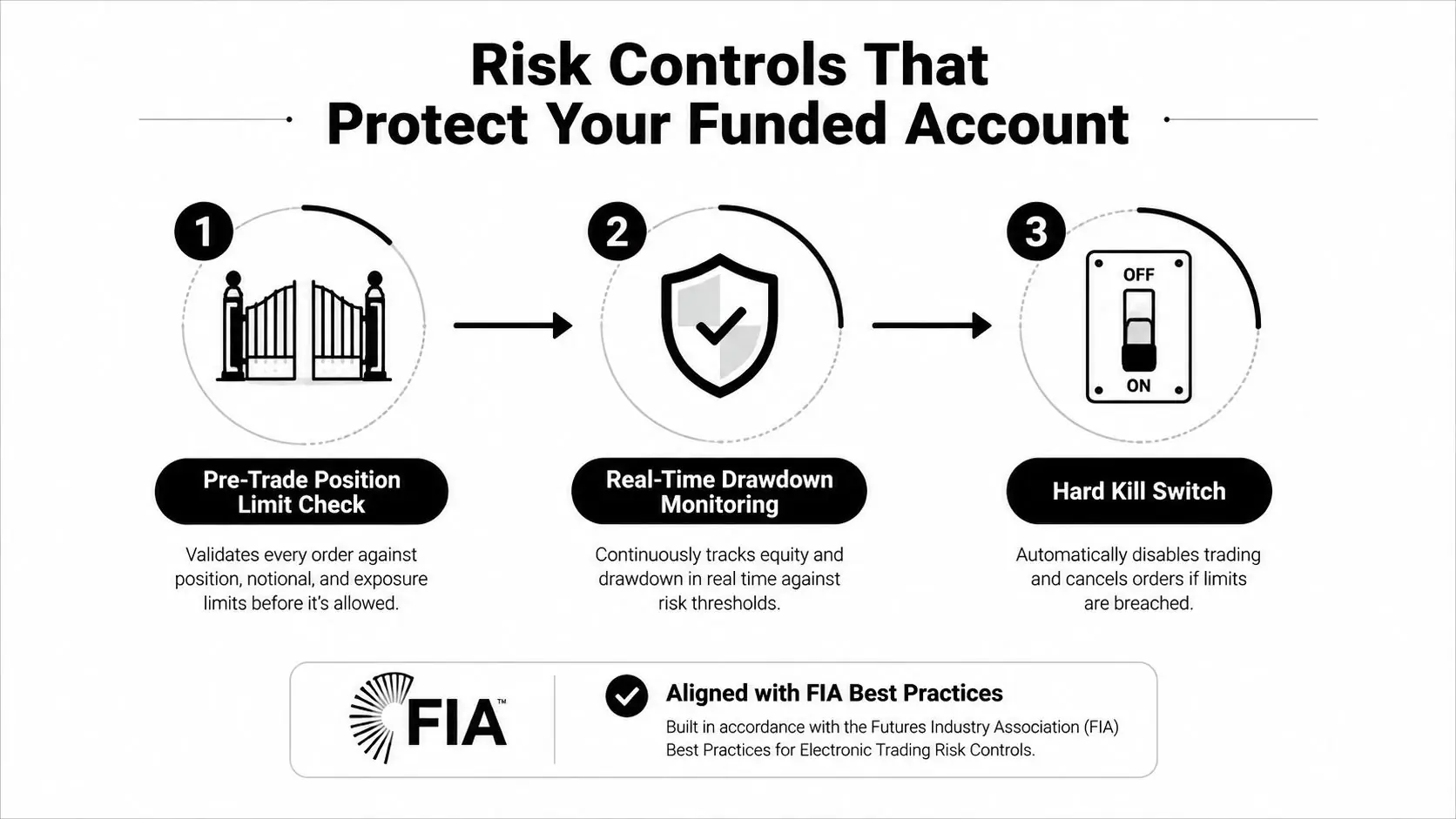
Risk Controls That Protect Your Funded Account
A funded trader has less room for technical improvisation because the account operates under a defined loss boundary. The strategy should never be the only place where risk is checked. The FIA's guidance on automated trading risk controls identifies localized pre-trade controls as a primary safety layer, including mechanisms such as price collars, order throttles, position limits, and kill switches. FIA guidance on automated trading controls is directly relevant when a bot can submit orders without manual review.
A practical funded-account stack can include:
- Account-level loss control Stop new orders when the daily loss threshold is reached.
- Position cap Limit volume per symbol and total open exposure.
- Symbol whitelist Prevent a strategy from trading an untested instrument.
- Session lock Block new positions during prohibited sessions or before a planned shutdown.
- Kill switch Cancel working orders and disable new submissions from a dashboard or server-side control.
Server-side controls are safer than relying only on an EA running on a VPS. A power outage, platform crash, internet interruption, or software exception can stop a client-side script while open exposure remains. A server-side stop or account rule can continue operating even when your local process cannot.
A day-one configuration
Set the account and strategy limits before attaching the bot. Use a smaller position cap than the platform maximum, restrict symbols, define a daily shutdown threshold below the firm's hard limit, and test the kill switch with no meaningful exposure. Disable one-click trading where possible and use confirmation dialogs for manual orders, so a hurried intervention doesn't add risk while the algorithm is active.
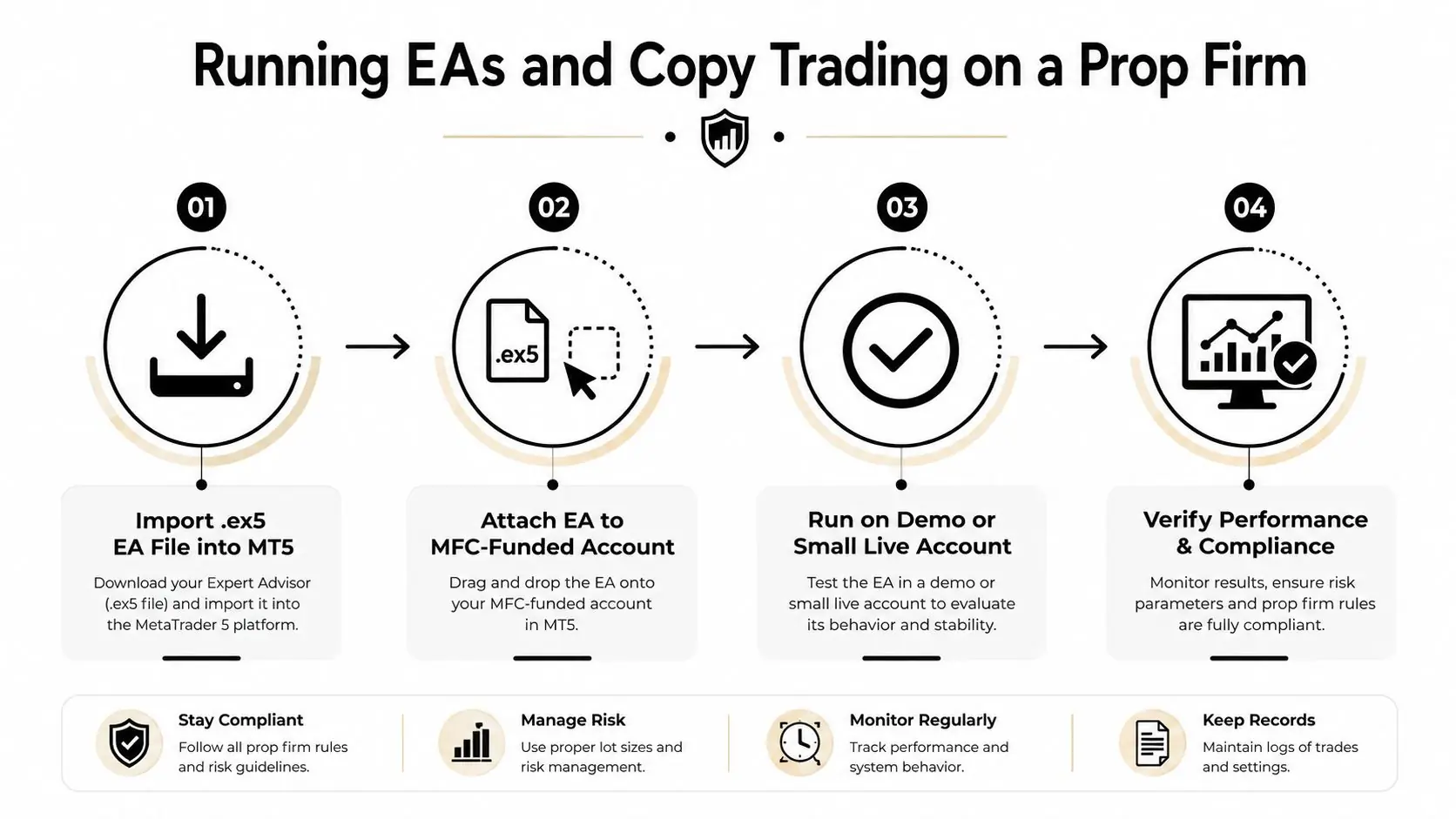
The control layer should also record every blocked order. A rejected trade may indicate normal protection, but repeated rejections can reveal a sizing bug, incorrect contract specification, or a strategy that doesn't fit the account's rules.
Running EAs and Copy Trading on a Prop Firm
A funded deployment can fail before the first trade if the platform maps the instrument incorrectly. On MT5, import the compiled Expert Advisor into the supported build, attach it to the intended chart, then verify the symbol name, contract size, tick value, trading session, and volume step. EURUSD on one broker may use different specifications from the same symbol elsewhere.
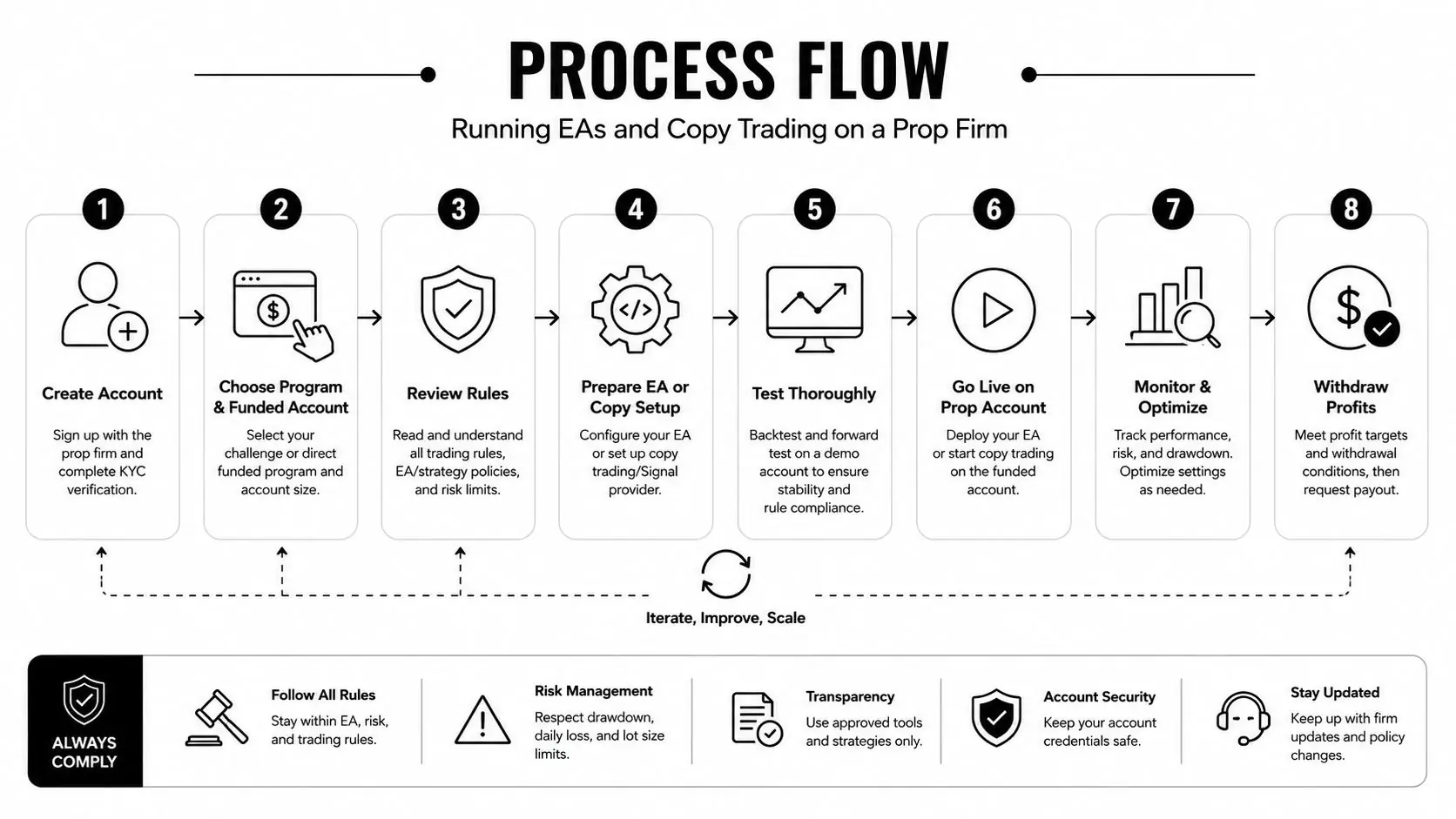
Before risking evaluation capital, reconcile the EA's expected orders with the platform's records. Run it in a demo or paper environment, test stops, position caps, and shutdown behavior, then compare order timestamps, fills, and rejection messages in the logs. After that, use reduced exposure and review drawdown, slippage, and execution consistency. Scale only when the operating process remains stable.
The account's daily-loss and trailing-drawdown rules must be enforced by the strategy. Add a separate position-size cap even if the EA already calculates volume. Independent protections limit the damage from a sizing bug or a failed risk check. Keep an external decision log so a reviewer can trace configuration changes, manual interventions, blocked orders, and shutdowns.
Copy trading introduces another failure point between signal and fill. A MetaQuotes ID or cTrader ID may receive trades from a master using another broker or platform. Signal delay, different spreads, volume rounding, rejected symbols, and weekend gaps can change the result. Test the copier during fast markets, not only in quiet conditions, and confirm that the receiving account's drawdown rules still apply after every conversion.
cTrader Automate fits accounts that support native cBots. On DXtrade, where server-side cBots may not be available, an Open API integration or approved bridge might be required. Confirm the firm permits that connection and records enough information to reconcile master signals, copied orders, and account-level risk events.
A 2025 summary of SEBI's framework describes controls for API-based retail algo orders, including unique algo IDs and exchange approval for each algorithm, with rollout deadlines tied to specific dates. Traders using API automation should check the current requirements in their jurisdiction instead of treating a working connection as proof of compliance. The SEBI framework summary provides that regulatory context.
Next Steps and Common Algo Trading Questions
Use a staged process instead of jumping from a promising chart to a funded challenge.
- Define the market condition and edge in plain language.
- Backtest with realistic spreads, latency assumptions, and walk-forward validation.
- Test the exact platform, symbol specifications, and order types.
- Paper-trade the deployment and compare expected versus actual behavior.
- Run a small live-style test before pursuing a funded evaluation.
- Track stable metrics for 30+ days before scaling into a challenge.
That final period isn't a guarantee. It gives you time to observe restarts, losing streaks, spread changes, news conditions, and rule conflicts. Trading involves risk of loss, and a backtest cannot establish future results. Independent research across 42 equity markets found that algorithmic trading can improve liquidity and informational efficiency while lowering execution shortfalls for institutional buyers, but it can also increase short-term volatility and tends to work better in large, liquid stocks than in small-cap names. The cross-market equity research reinforces why instrument selection and liquidity filters matter.
Common questions
Are algorithms allowed on prop firm accounts?
Some firms permit EAs, cBots, and copy trading, while others restrict certain strategies, execution methods, or automation patterns. Read the current rules and confirm whether your exact platform and copier are permitted before connecting an account.
What's the difference between an EA and a cBot?
An EA is an Expert Advisor designed for MetaTrader, commonly written in MQL5 on MT5. A cBot is an automated strategy for cTrader Automate, commonly written in C#. Both can generate and manage trades, but their APIs, order models, and deployment processes differ.
How long should backtesting take?
The software runtime matters less than validation quality. Test multiple market conditions, use out-of-sample data, and investigate every difference between simulated and live-style fills. A short, clean test isn't stronger than a longer test with poor assumptions.
Can free algorithmic trading software work?
It can be useful for learning and prototyping. Free software doesn't remove data-quality problems, VPS costs, maintenance, bridge failures, or execution risk. Judge the complete operating stack, not the subscription price.
How much capital do I need?
There isn't one universal minimum. Your required capital depends on instrument size, margin, risk per trade, broker conditions, and the prop firm's rules. Never size a strategy from the backtest alone.
How does latency affect funded traders?
Latency can change entry price, stop distance, fill probability, and slippage, especially for short-term systems. Institutional traders retain advantages in data latency, alternative data, retraining frequency, and compute resources, although recent market coverage says the win-rate gap has narrowed to roughly 4 to 6 percentage points from 8 to 10 percentage points two years earlier. The AI trading performance report makes the broader point that infrastructure and monitoring deserve as much attention as signal design.
Before you start, screenshot this checklist:
- Rules: Confirm EA, cBot, API, and copy-trading permissions.
- Risk: Set daily loss, position size, symbol, and kill-switch limits.
- Execution: Record spread, slippage, latency, rejects, and partial fills.
- Testing: Use walk-forward and out-of-sample validation.
- Operations: Test VPS restarts, disconnections, and platform updates.
- Audit: Preserve the decision and order log for every trade.
- Expectations: Treat results as uncertain, and risk only what you can afford to lose.
MyFundedCapital offers simulated trading accounts with support for manual, algorithmic, and copy trading across supported instruments on DXtrade and cTrader, with MT5 coming soon, subject to its risk rules. Visit MyFundedCapital to review the funding programs and choose an account structure that matches your automation, drawdown controls, and execution workflow.