You can lose a trade to slippage, a rule breach, or a frozen platform. The part most traders underestimate is what happens next, when payout questions, server glitches, or disputes need a human answer and nobody picks up. Customer service availability is the difference between a firm that covers its traders and a firm that only looks reachable on a landing page.
Why This Matters Right Now
The worst support failure doesn’t happen on a calm Tuesday. It happens when a news spike hits, your platform lags, your drawdown edge is thin, and the firm’s chat box might as well be a wall. If you trade FX, CFDs, crypto, or prop accounts, customer service availability is a risk-control issue, not a polite extra.
The market has already moved past business-hours support. Zendesk’s summary says 74% of customers now require 24/7 service availability, eDesk reports 52% of global shoppers expect 24/7 support and 57% expect the same response time at night and on weekends as during business hours, and LiveChat says businesses were available through live chat for an average of 17 hours and 58 minutes per day. That tells you the baseline has changed, but it does not tell you whether a firm can help when your account is on the line. Zendesk’s 24/7 service summary
For traders, the practical question is simple. Is support staffed by real people when you need a payout clarification, a rule explanation, or an escalation during a platform problem, or are you just staring at an automated promise?
Practical rule: if a firm’s support claim sounds broad but its hours are vague, assume you’ll be the one paying for the gap.
That’s why traders should judge support the same way they judge execution quality, with evidence. Don’t buy the slogan. Verify the coverage.
What Customer Service Availability Really Means
Customer service availability is not just whether a firm has a contact page. It’s the combination of which channels are open, when real humans staff them, and what happens after hours when the first line can’t solve the issue.
The three parts traders should care about
Start with the channels. A firm can say it offers live chat, email, phone, Discord, or in-platform tickets, but that only matters if those channels are staffed by people who can act, not just acknowledge. A chat widget that replies instantly with canned text is not the same thing as a support desk that can escalate a payout hold or a rule dispute.
Then look at the hours. A gym can be “open 24/7,” but if nobody is on the floor overnight, you’re on your own when the equipment jams. Trading support works the same way. Channel availability and real accessibility are different things, and the FDIC’s qualitative research on banking customers shows people judge service quality by whether agents are available through channels and at times that are convenient, with reasonable wait times also mattering. The same report also shows uneven coverage across firms, with only about 34% of support teams offering 24×7 service, 14% offering 12×7, 12% offering 12×5, and 18% still offering only 8×5 support. FDIC qualitative research on service accessibility
Availability is not the same as speed
Don’t confuse coverage with response time. A firm can be technically available and still leave you waiting too long for the one answer that matters. For traders, the useful question is not, “Are you open?” It’s, “Can a human solve the problem before it turns into a loss or a blocked payout?”
That’s why availability belongs inside your due-diligence checklist. A missed support window can create a rule breach, stale fills, or a payout delay that should have been preventable. If you want to see how disputes should be handled when support gets messy, keep the firm’s escalation process in mind as you read the dispute resolution process.
Support is only real when the person answering can move your case forward.
The Metrics and SLAs Traders Should Measure
Support marketing is cheap. Service-level agreement language is what you want. Ask for metrics you can compare across firms, then write the answers down before you deposit a dollar.
The trader-facing benchmarks that matter
Start with the response windows traders already understand from other channels. A 2026 roundup says 90% of customers rate an “immediate” response as essential or very important, and it defines immediate as 10 minutes or less. The same source notes that customers often expect email replies within 4 hours, which gives you a practical way to judge whether written support is serious or just decorative. Help Scout’s 2026 customer service facts and statistics A separate 2026 report says 64% of customers expect 24/7 support availability through at least one channel and that the median first-response time for email tickets across B2B SaaS is about 12 hours, which is too slow if the issue is payout-related or time-sensitive. AMW World Group’s customer support statistics
Use those benchmarks to pressure-test a firm’s promises. If they say “24/7 support” but cannot tell you live-chat wait times, ticket response targets, or escalation rules, they are selling a label, not a service.
| Metric | What to ask for | Why it matters for traders |
|---|---|---|
| Live chat wait time | Median and worst-case wait during active market hours | News spikes do not wait for a queue |
| Email first response | Target time for support and payout tickets | Slow written replies create avoidable dead time |
| After-hours escalation | Named path for urgent account issues | You need a human route when a first reply fails |
| Rule dispute handling | Who reviews it and how fast | Trading rules have to be interpreted, not guessed |
| Payout inquiry window | Published response target for payout questions | Cash flow delays become strategy delays |
Use a clear measurement framework, not vague promises. The AI-powered support metrics framework is useful because it pushes teams to measure access, speed, and resolution instead of hiding behind generic “we're responsive” language.
Do not let the SLA wording fool you
A strong answer sounds specific. “Live chat is staffed by humans during market hours, payout tickets get a same-day reply, and urgent account disputes escalate to a senior agent” is workable. A weak answer sounds slippery. “We try our best to respond quickly” is not a service standard.
For traders, the same standard should apply to disputes. A firm's support promise usually shows how it handles customer support operations and trader-facing service, so vague SLA language is a warning sign, not a minor detail. If the answer changes depending on who you ask, expect the same confusion when you need help with a payout delay or a rule dispute. Keep the dispute resolution process in view before you fund an account.
How Different Trader Types Need Different Coverage
Not every trader needs the same support shape. The right coverage for a London session scalper is not the same as the right coverage for a weekend crypto holder or an EA user running automation overnight.
Manual traders need fast live coverage
If you're a manual FX or CFD trader, your pain point is timing. You need live chat or phone support during the sessions you trade, especially when volatility is high and rules can be easy to misread under pressure. A fast human answer beats a polished FAQ when you're trying to find out whether a trade counts toward a rule limit.
Automated and copy-trading users need escalation depth
If you run an EA, a bot, or copy trades, support quality depends on what happens when the system misbehaves. A simple chat agent isn't enough if the issue sits in platform logs, server behavior, or execution quirks. You need a ticket trail, someone who can escalate, and a support team that understands the difference between a user error and a platform-side problem.
Crypto and weekend traders need after-hours reach
If you hold through weekends, trade crypto, or keep positions open around news, after-hours support matters more than a polished business-hours promise. A payout question on a Saturday is still a payout question on a Saturday. If your trading style crosses time zones, read the firm's coverage the same way you'd read a risk policy, with no assumption that business hours match your risk window.
The same logic applies to language access. If you trade from a non-English-speaking region, you should check whether support can communicate in the language you use when money is stuck or a rule is disputed. That's where multilingual customer service for traders becomes more than a convenience.
Self-check: trade the hours you sleep, or only the hours you're awake? Your support requirements change immediately based on that answer.
More Hours Does Not Always Mean Better Support
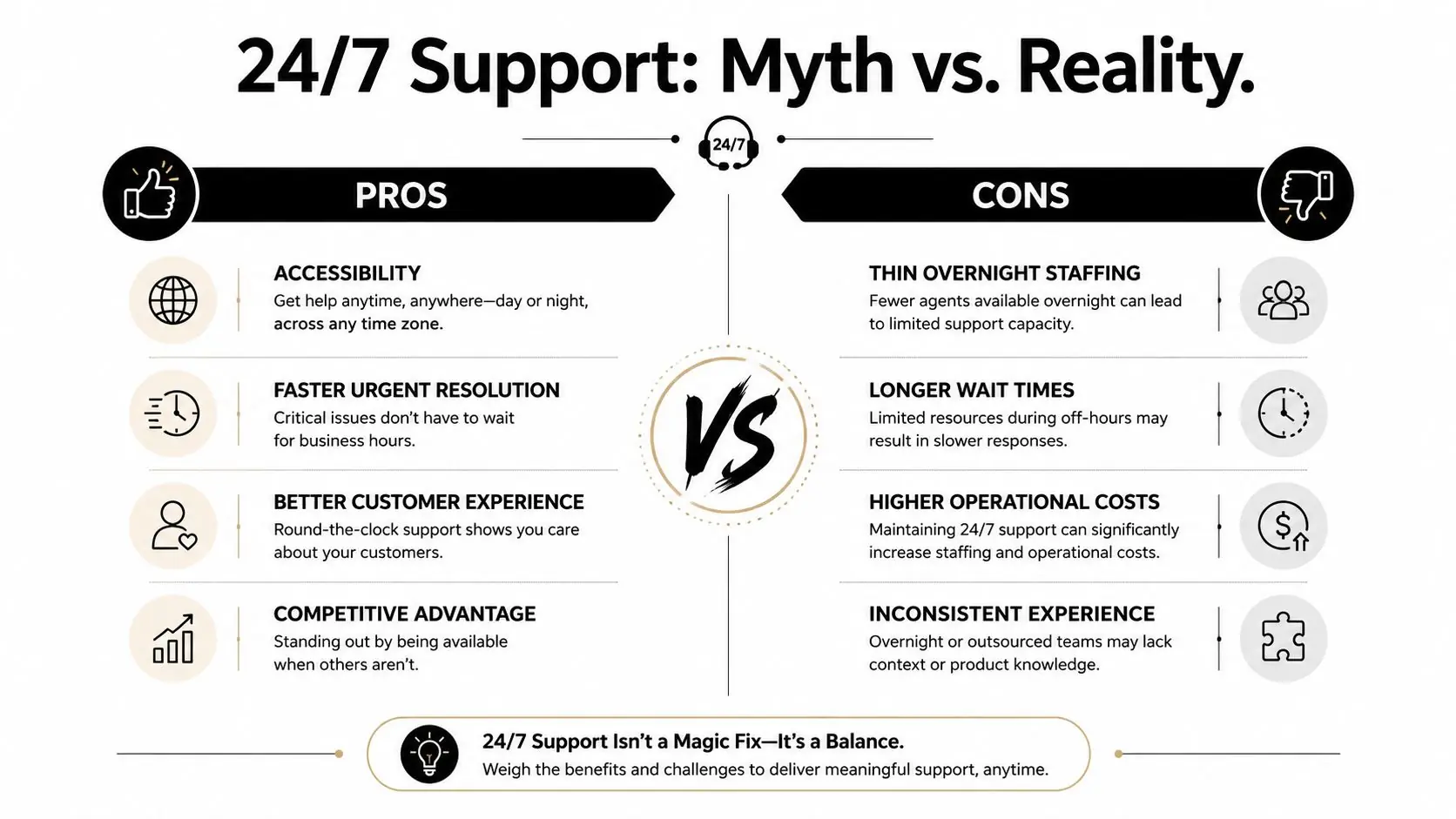
A firm can run a 24/7 chat box and still deliver lousy service. Thin overnight staffing, shallow triage, and slow escalation can make “always open” worse than a narrower schedule with real ownership.
The cleanest proof is in wait-time behavior. The RingCentral report says consumers are generally tolerant of hold times up to roughly three minutes, yet 46.4% still found hold times unacceptable. That's the point traders miss. People don't just want access. They want the issue handled without endless queue pain. RingCentral's wait-time and customer service report
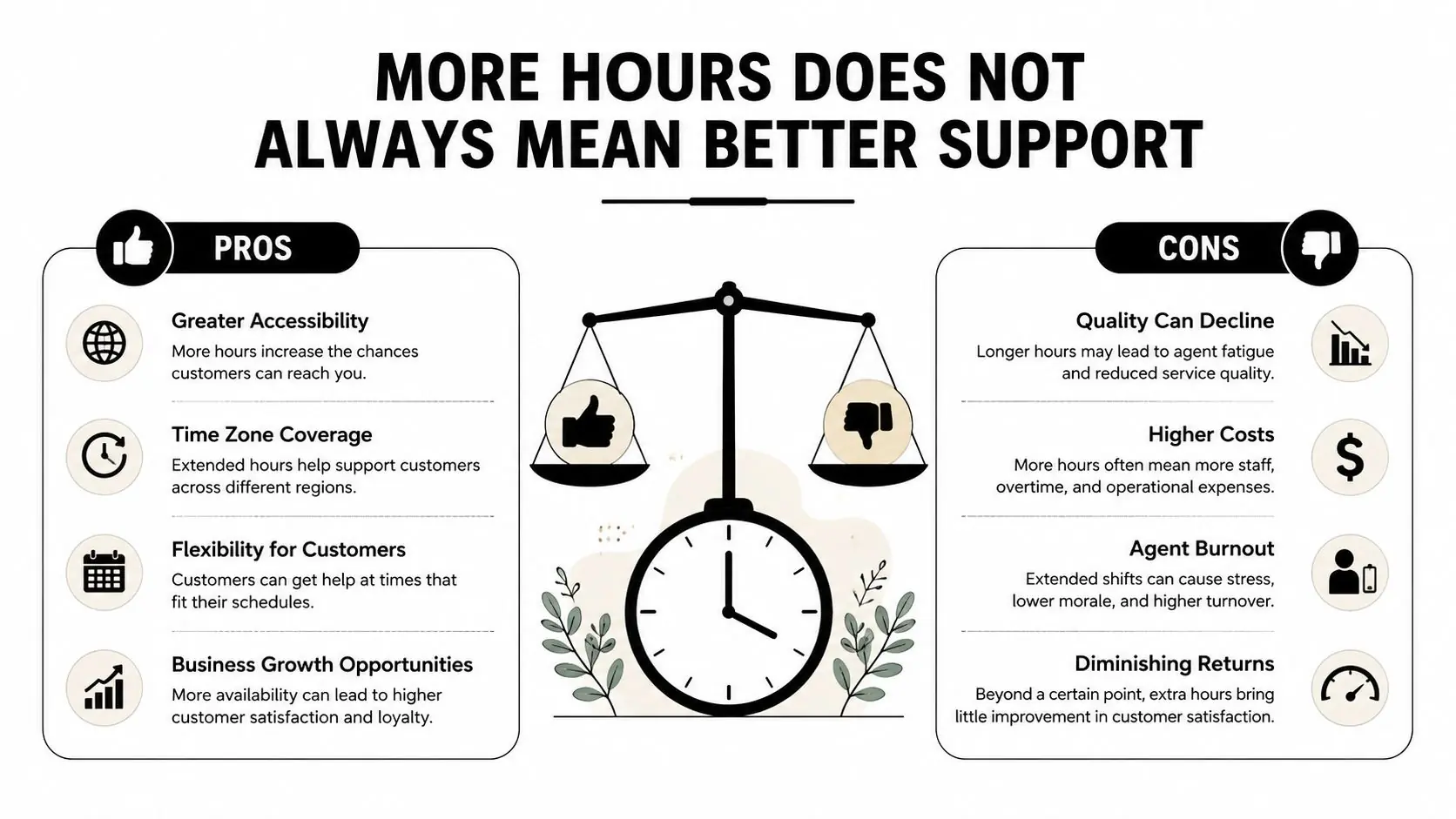
What cosmetic 24/7 support looks like
Look for these signs:
- Canned replies at odd hours. If midnight chat only sends scripted filler and no one can answer account-specific questions, the coverage is cosmetic.
- No phone number anywhere. Some firms hide behind chat forms because they don't want direct escalation pressure.
- No documented handoff path. If the first agent can't solve a payout or rule issue and there's nowhere to send it, your case will stall.
For traders, the smarter setup is often business-hours support plus strong self-service plus a real escalation path. That structure can outperform thin overnight coverage because it focuses on effective access, not just visible hours. Industry guidance on customer service challenges points toward automation, unified platforms, and self-service to reduce response times and handle high inquiry volumes, which supports that same conclusion.
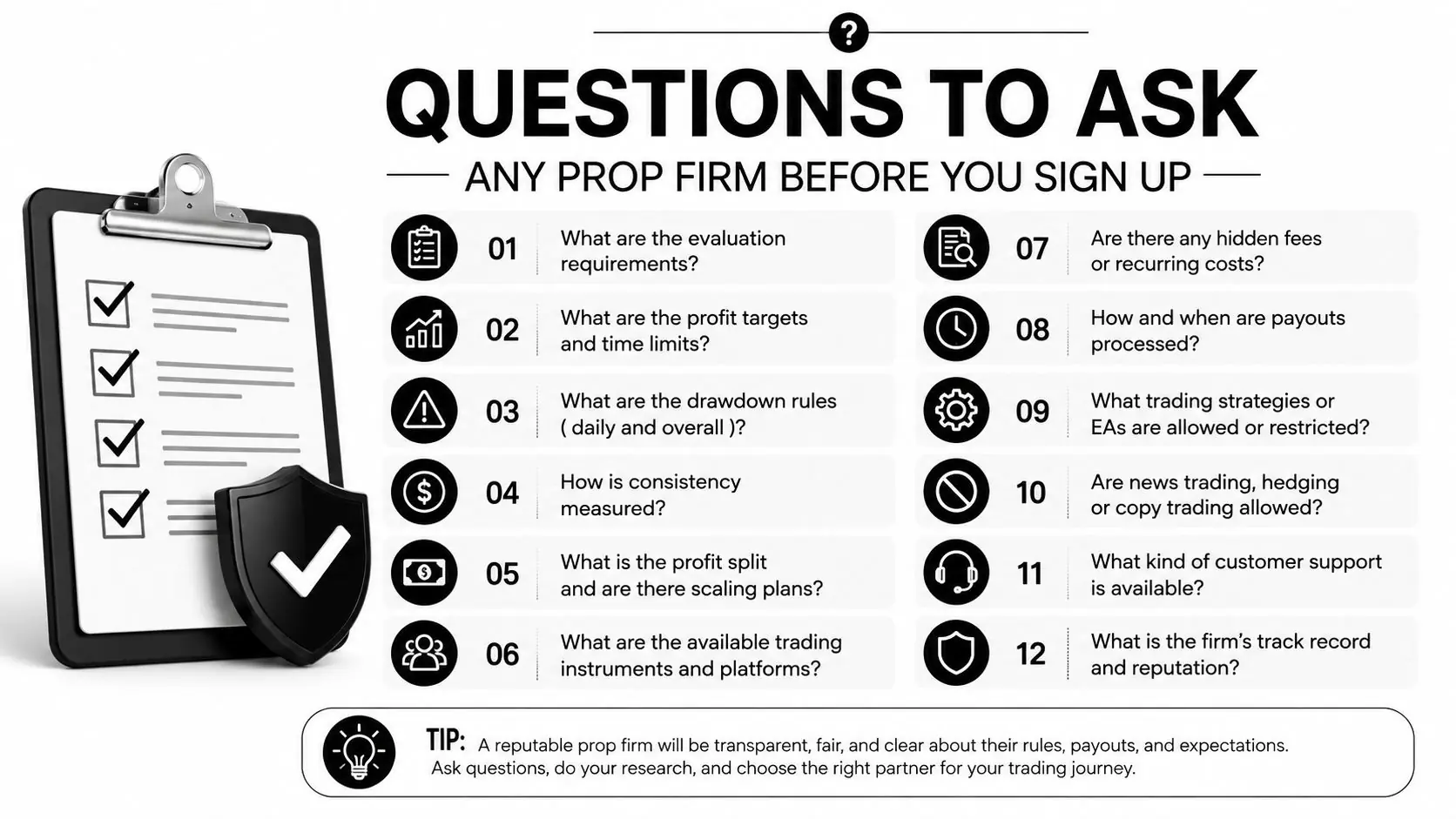
Questions to Ask Any Prop Firm Before You Sign Up
Use these questions before you fund an account. You're not being difficult, you're checking whether the firm can deal with the exact situations that break traders.
Ask them this, and watch the answer
-
Which channels are staffed by humans?
Strong answer: “Live chat and email are monitored by agents, and urgent issues can move to a senior team.”
Red flag: “We're always available through our contact form.” -
What's your live-chat wait-time target?
Strong answer: “During market hours, chat is usually answered within a few minutes.”
Red flag: “We respond as quickly as possible.” -
What's the first-response time for payout tickets?
Strong answer: “Payout-related tickets get an initial response within a stated window.”
Red flag: “Payouts are processed when they're processed.” -
Who handles rule disputes?
Strong answer: “A separate review path exists for disputes, and agents can escalate if needed.”
Red flag: “Please review the FAQ again.” -
What happens if support gives the wrong answer?
Strong answer: “There's a formal escalation route and a second review.”
Red flag: “Each agent handles cases individually.” -
Do you cover weekends and holidays?
Strong answer: “Yes, for the channels traders use.”
Red flag: “Our team checks messages when possible.” -
Do you support traders in more than one language?
Strong answer: “Yes, here's the list of supported languages.”
Red flag: “Use English only.” -
Can you point to your written coverage policy?
Strong answer: “Yes, it's public and specific.”
Red flag: “We don't publish that.”
If you want to compare how a support stack is operationalized with automation, the AI agent platform for support teams is useful background because it shows how teams can blend self-service and escalation without pretending a bot is a human.
How MyFundedCapital Handles Trader Support
MyFundedCapital is worth checking because its support setup lines up with the failures traders face. It offers 24/7 multilingual support and an active Discord community, which covers traders across time zones and gives you more than one place to get help when a position, payout, or platform issue turns urgent. It also supports manual, algorithmic, and copy trading across 350+ instruments on DXtrade and cTrader, with MT5 coming soon, so the support model is tied to real platform use instead of a generic contact form.
That matters more than marketing language. If a firm supports several trading styles and platforms, support has to understand the difference between a charting problem, a copy-trade sync issue, and a rule dispute. A trader should judge the support desk by whether it can handle those cases without sending everything into a slow ticket queue.
The payout side matters too. MyFundedCapital lists payouts every 7 or 14 days depending on the program, or on demand with the payout add-on, with average processing around 2 hours. That gives traders a concrete reference point for payout-related expectations, which is better than a vague “fast withdrawals” claim. If you are comparing firms, this is the kind of detail worth asking for before you fund an account.
Match the support setup to the trader pain point
If your biggest fear is a server issue during news, you need a support team that can answer across channels and time zones. If your biggest fear is a rule dispute, you need a firm with a clear escalation path that does not hide the answer behind layers of tickets. If your biggest fear is a weekend payout question, you need after-hours coverage that exists, not a promise that someone may look at it later.
MyFundedCapital also offers optional add-ons such as news trading and weekend holding, which is exactly the kind of setup that puts pressure on support coverage. For a broader view of how the firm organizes help around those needs, see trader support services.
If you want to see how teams blend self-service with escalation without pretending a bot is a human, the AI agent platform for support teams is useful background.
Trading still involves risk of loss. Evaluations and funded accounts run on demo environments with real market quotes, and past performance does not guarantee future results. Keep that in mind no matter how responsive the support desk looks.
Your Trader Support Checklist and Next Steps
Treat this like a pre-funding checklist, not a wish list.
- Confirm human coverage. Make sure the channels you'll use are staffed by real people, not just bots and generic forms.
- Check response targets. Compare live chat against the 10-minute “immediate” benchmark and email against the 4-hour expectation noted earlier.
- Verify payout handling. Ask how quickly payout questions get a first reply and who owns the escalation.
- Test weekend and holiday coverage. If you hold crypto or trade through news, don't assume weekday support is enough.
- Ask about language support. If English isn't your first language, support has to work in the language you'll use when money is stuck.
- Read the dispute path. If a firm can't explain who reviews rule disputes, that's a problem.
If you still want a broader benchmark for how customers talk about service quality, the idea to analyze customer feedback for growth is useful because it shows whether a support team learns from repeated complaints or just collects them. That matters for traders, because repeat problems around payouts, rules, or access usually show up long before a firm admits them publicly.
When deciding whether 24/7 support is worth paying for, ask one blunt question. Will that overnight coverage solve the kind of issue you're likely to have, or would a strong business-hours desk with self-service and escalation be enough? The answer depends on your strategy, your time zone, and how often you trade outside normal hours.
If you're comparing firms, look at MyFundedCapital's Instant Funding, 1-Step Challenge, and 2-Step Challenge options, then decide whether your priority is speed, scaling, or a more structured evaluation path. Trading involves real risk, this article is educational only, and nothing here is financial advice.
If you want a prop firm that pairs funding programs with 24/7 multilingual support, payout timing that's spelled out, and account types built for different trading styles, visit MyFundedCapital and compare the setup against the checklist above. Use the support questions in this guide before you deposit, especially if you trade weekends, news, or automated systems.