You're calm one minute, then an email lands saying your account breached a rule you're sure you respected. That's when most traders make their first mistake. They argue before they document.
A good dispute resolution process protects you from that spiral. If a prop firm dispute ever lands on your desk, you need a clean record, a clear request, and a professional escalation path.
Why Every Trader Needs a Dispute Resolution Plan
A trader gets flagged for a consistency rule, max loss breach, prohibited trading style, or payout denial. He opens support chat immediately and starts firing off messages. He's frustrated, he's certain he's right, and he wants a fast reversal.
Then support asks for proof.
He has partial screenshots, no export of trade history, no saved platform logs, and no written timeline. What felt obvious in his head now looks messy on paper. That's the true risk. Not just the underlying dispute, but being unprepared when the dispute starts.
In prop trading, the process gap is real. A 2024 UCR Ombuds study highlighted that 68% of informal dispute mechanisms in regulated sectors lack clear escalation paths, and that problem is worse in spaces where public process maps are thin or missing. That's one reason traders often don't know whether an “internal review” is structured or discretionary.
Why preparation matters before anything goes wrong
A dispute plan does three things:
- It slows you down Panic produces bad communication.
- It preserves evidence Screenshots taken later often miss key details.
- It improves credibility A trader with records is easier to take seriously.
Most trading disputes aren't won by passion. They're clarified by records.
Practical rule: If you can't reconstruct the event in order, you're not ready to challenge the decision.
The issues traders usually underestimate
Traders often assume a fair outcome will come automatically if they “did nothing wrong.” That's not how any dispute resolution process works. The side that presents the cleaner timeline usually has the stronger position.
In practical terms, your plan should already cover:
- What to save first Platform screenshots, trade IDs, server timestamps, emails, chats.
- Who to contact first Standard support before escalation.
- What outcome to ask for Reinstatement, recalculation, manual review, payout reconsideration, written explanation.
- When to escalate After a clear denial, missing response, or a decision that conflicts with the written rules.
A dispute doesn't mean the firm is acting in bad faith. It can mean a rule was applied automatically, evidence was incomplete, or your case needs a better review. But if you don't have a process, you'll turn a fixable issue into a messy confrontation.
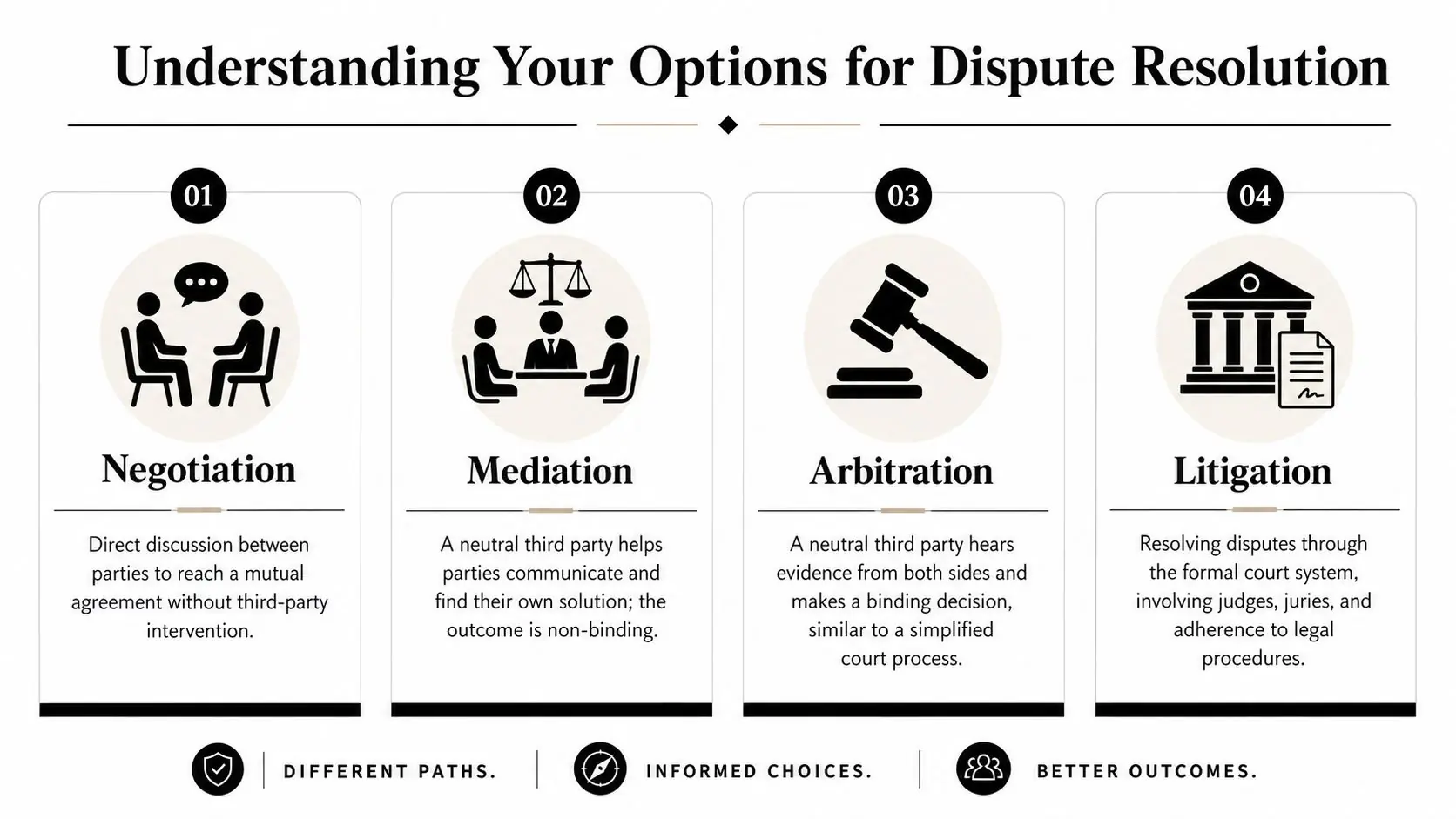
Understanding Your Options Negotiation Mediation Arbitration and Litigation
Most traders use the words interchangeably. They shouldn't. Each option gives you a different level of control, cost exposure, and speed.
Negotiation
This is the starting point in nearly every prop firm dispute. You and the firm communicate directly and try to resolve the issue without a third party.
In trader terms, that usually means support tickets, compliance email, or a manager review. You still control your message, your evidence, and whether to accept the proposed solution.
Negotiation works best when the issue is narrow, such as:
- A bad data point One trade appears misclassified.
- A timing issue The server log and your local chart need reconciliation.
- A payout discrepancy The amount or eligibility needs review under the written rules.
It works badly when your complaint is emotional, vague, or mixed with unrelated grievances.
Mediation
Mediation adds a neutral person who helps both sides talk and try to find a solution. The mediator doesn't usually impose the final result. The process is about helping the parties settle.
In prop trading, mediation is less common than direct negotiation or contract-based arbitration, but the concept matters. It's useful when both sides want closure but disagree on facts, interpretation, or remedy.
Large organizations have moved heavily toward mediated and informal resolution. A Fortune 1000 survey discussed by Wolters Kluwer described a shift away from relying on binding arbitration alone and toward mediated negotiation and informal methods, with most disputes resolving before merits hearings. The same discussion noted an estimated average cost of defense and settlement of $160,000 per company matter in formal workplace conflict contexts, which helps explain why early resolution matters so much in business settings (Wolters Kluwer on mediation and arbitration trends).
Arbitration
Arbitration is more formal. A neutral decision-maker reviews evidence and issues a decision. Depending on the contract, that decision can be binding.
This matters because many firms build dispute terms into their agreements. If you've never read an overview of how these clauses work in commercial contracts, this plain-English guide on arbitration for startups is useful because the mechanics often look familiar across industries.
The clause you skipped during signup may decide where and how your dispute gets heard.
Litigation
Litigation means court. It's the most formal route and usually the least practical for trader disputes governed by platform terms, arbitration clauses, jurisdiction clauses, and simulated-account contract language.
That doesn't mean litigation is impossible in every situation. It means you should assume it's the exception, not your default path.
Dispute resolution methods compared
| Method | Cost | Time | Formality | Outcome Control |
|---|---|---|---|---|
| Negotiation | Usually lowest | Often fastest | Low | Highest shared control |
| Mediation | Moderate | Often faster than formal adjudication | Medium | Shared control |
| Arbitration | Higher than negotiation or mediation | Slower and more structured | High | Neutral decides |
| Litigation | Often highest | Usually longest | Very high | Judge or court system decides |
For most prop firm disputes, negotiation first is the smart move. Arbitration may exist in the background. Mediation can help in edge cases. Litigation is usually the last and least efficient option.
A Traders Step by Step Dispute Resolution Process
The first hour matters. Not because you need to attack the issue immediately, but because evidence disappears, chat windows move, and memory gets worse fast.
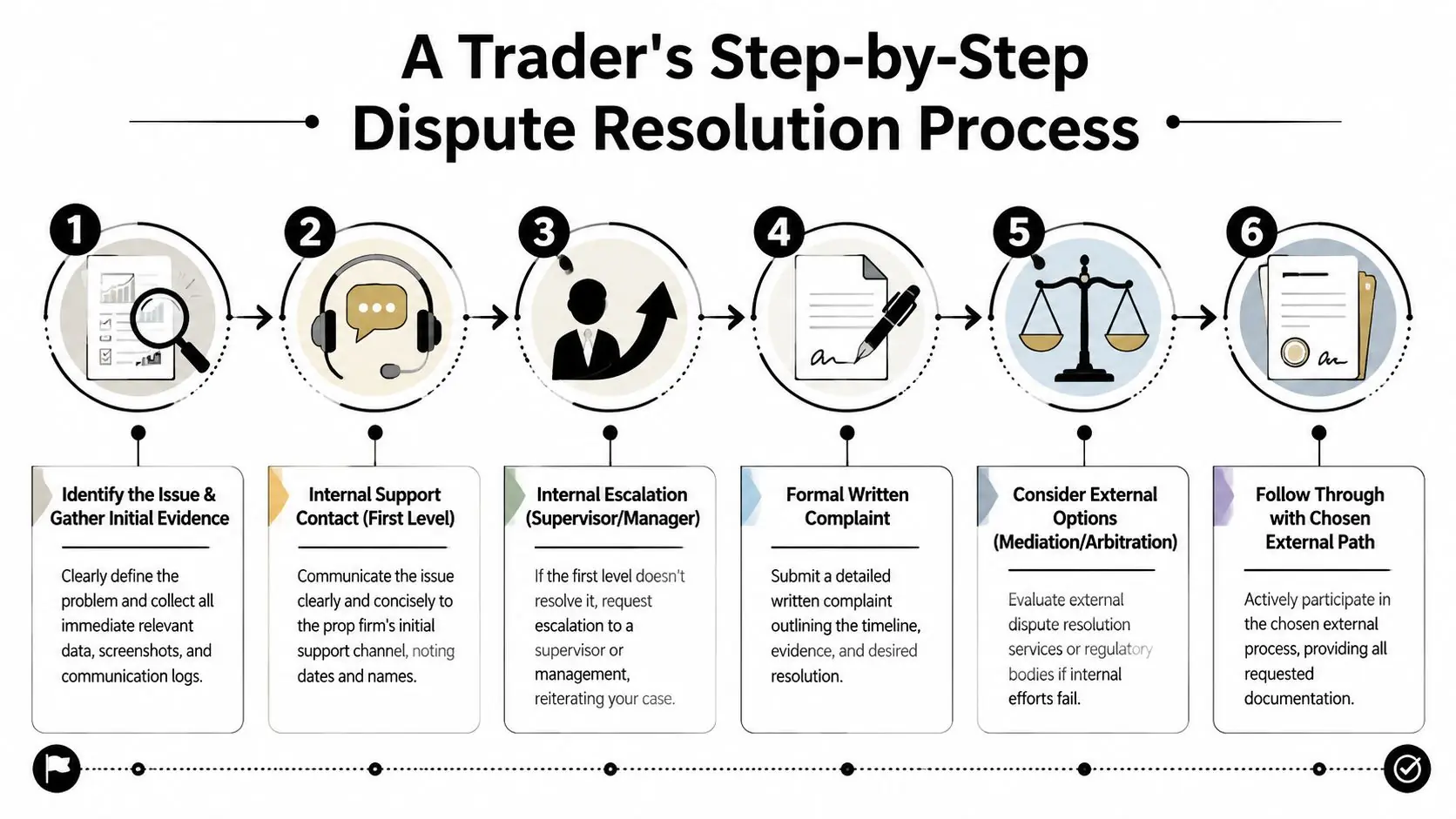
Step 1 Identify the issue precisely
Write one sentence that defines the dispute.
Examples:
- “My account was marked breached due to daily loss, but the reported figure doesn't match my platform history.”
- “My payout was denied for prohibited strategy use, and I need the specific trades and rule basis reviewed.”
- “My account was closed after an EA-related flag, and I'm disputing whether the log data supports that conclusion.”
If you can't define the problem in one sentence, support can't either.
Step 2 Freeze the record
Before you contact anyone, save what you can.
Capture:
- Platform screenshots Open positions, closed positions, balance, equity, drawdown, order history.
- Trade identifiers Ticket numbers, instrument, lot size, entry and exit times.
- Rule references The exact clause you believe applies.
- Communications Emails, Discord messages if relevant, support chat transcripts, ticket IDs.
- Environment details Platform name, server time, local time, account number, any EA or copier activity.
If your issue involves a technical workflow, act like you're building an audit trail. That mindset also shows up in other administrative disputes. Even in unrelated formal ADR systems, the process is often staged by agreeing on the mechanism, selecting a neutral, and exchanging information before the hearing because narrowing the record early improves efficiency (GSA guidance on using ADR techniques).
Step 3 Read the agreement before you write the complaint
Most traders do this backward.
Check the terms for:
- Definitions of breach events
- Daily loss and max drawdown calculations
- Restricted trading behavior
- Payout eligibility rules
- Complaint or escalation procedures
- Arbitration or governing law clauses
Don't rely on memory, Discord summaries, or what another trader posted. Read the actual document tied to your account.
Step 4 Send a first-level support request
Your first message should be short and usable.
Include:
- What happened
- When it happened
- What evidence you have
- What you want reviewed
A useful model is the same disciplined approach people take in other administrative disputes, where a documented sequence matters more than outrage. Even outside trading, clear procedural thinking improves outcomes. For example, consumer-facing guides like these steps to remove debt collections work because they focus on records, sequence, and written follow-up.
You should also understand the firm's operating flow before raising the issue. Reviewing how the process works for funded accounts and evaluations can help you frame your complaint around the actual account structure instead of assumptions.
Step 5 Escalate internally if needed
If first-level support gives a generic answer, asks no real questions, or closes the issue without addressing your evidence, request escalation.
Ask for:
- A supervisor review
- A risk or compliance review
- A written explanation tied to the relevant rule
- A recalculation if numbers are disputed
Keep your tone steady. You're not trying to win an argument. You're trying to move the file to someone who can assess it properly.
State the disputed fact, the rule involved, and the remedy requested. Leave the sarcasm out.
Step 6 Decide whether external action is worth it
Not every dispute should go further. Some are too small, too unclear, or too expensive to push beyond the firm.
Before moving outside internal channels, ask:
- Is the contract clear?
- Is my evidence complete?
- Is the amount or account status worth the time and cost?
- Am I disputing facts, or just disliking the rule?
That last question matters. If the rule is clear and you broke it, this isn't a dispute resolution process problem. It's an acceptance problem.
Building Your Case Evidence and Communication Tips
A weak case can still have a real issue behind it. But if your evidence is disorganized and your emails are aggressive, you'll make that issue harder to see.
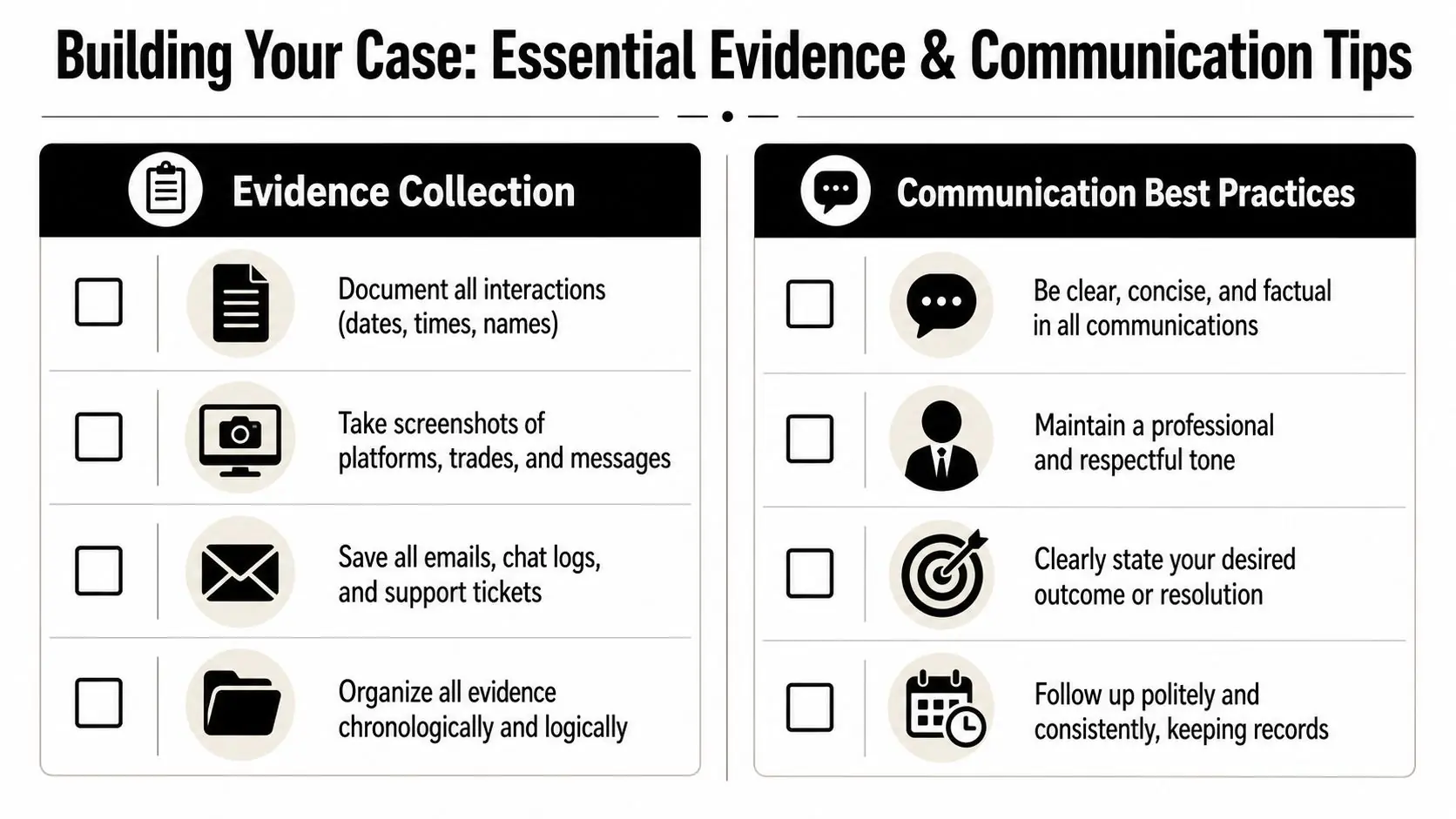
Evidence checklist for a trading dispute
Build one folder for the case and organize it in time order.
Include:
- Account records Account ID, program type, status notices, breach email, payout email.
- Trading records Trade history export, order IDs, symbols, lot sizes, entry and exit times.
- Visual proof Screenshots of the platform, dashboard, and any rule metrics shown at the time.
- System context EA logs, copier settings, VPS notes, server-time references where relevant.
- Communication log Support tickets, email threads, chat screenshots, dates, names, and responses.
- Rule documents Terms in force at the time of the event, not just the current website page.
If you already keep a trading journal, your case gets much easier to build. A detailed log of intent, execution, and result can help distinguish a valid strategy from a rule misunderstanding. This is one reason traders should maintain a proper trading journal workflow, not just a P&L screenshot album.
Why written records matter more than explanations
In technical disputes, the record usually beats the story. That principle shows up across formal review systems. In the NPDB dispute process, for example, review is limited to whether the report complied with reporting requirements, whether it is accurate against the written record, and whether the reporting basis is reflected in that record. The subject must also wait 60 days after entering dispute status while attempting direct resolution first (NPDB dispute process guide).
That's a different field, but the lesson carries over. If your evidence doesn't exist in a reviewable form, your confidence won't substitute for it.
Keep evidence in the form another person can verify quickly. A claim that takes twenty messages to explain is already in trouble.
A complaint template you can adapt
Use this structure:
Subject: Request for formal review of account action
Hello [Team/Name],
I'm requesting a formal review of the action taken on account [ID].
Issue: [One-sentence description]
Date and time: [Include platform/server time if possible]
Relevant rule: [Quote or reference the clause]
My position: [State why you believe the action is incorrect]
Evidence attached: [List screenshots, trade history, logs, prior ticket numbers]
Requested resolution: [Reinstatement, recalculation, written explanation, payout review]Please confirm receipt and advise the next escalation step if this can't be resolved at the current support level.
Regards,
[Name]
Communication rules that help
- Stay factual Describe events, don't speculate about motives.
- Ask for specifics Request the exact trade, timestamp, rule, or calculation behind the decision.
- Keep one thread Don't split the case across five channels unless the firm requires it.
- Avoid threats early Once you jump to legal threats, productive review often stops.
When to Escalate Your Dispute Beyond Internal Support
Escalation should be deliberate. If you escalate too early, you look impatient. If you wait too long, the record goes stale and the process drifts.
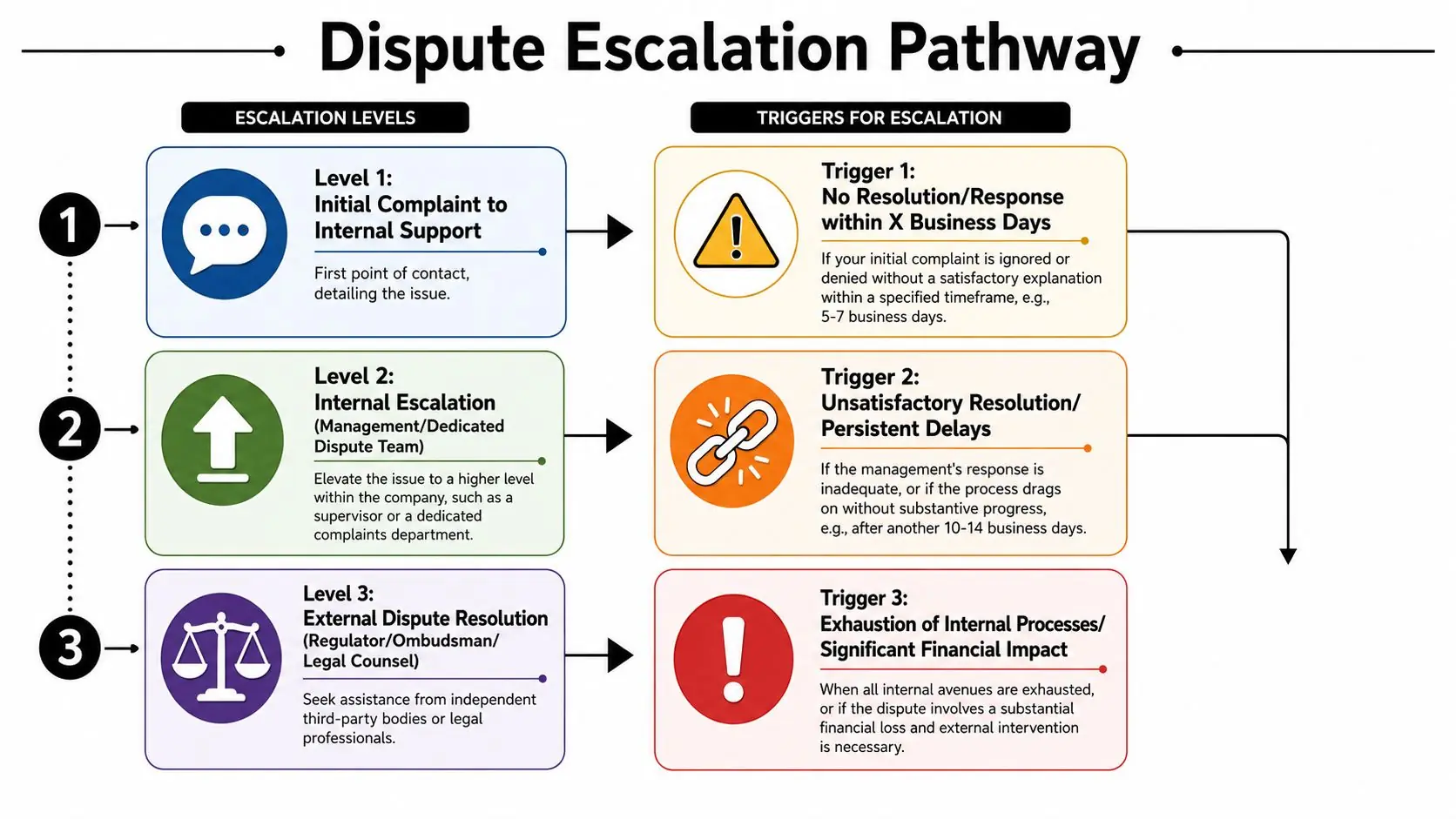
The triggers that justify escalation
Move beyond initial support when one of these happens:
- You receive a generic denial No engagement with your evidence, no citation to the rule, no explanation of the calculation.
- The response misses the core issue They answer a different question than the one you raised.
- The process stalls Repeated promises of review with no substantive update.
- The decision conflicts with the written terms You can point to the language and explain the mismatch.
- The issue is technical and first-line support can't assess it EA behavior, latency questions, log mismatches, or copier-related flags often need specialist review.
The point of escalation is not punishment. It's routing.
What the escalation path usually looks like
In most firms, the practical hierarchy is:
- Initial support
- Supervisor or manager
- Risk, compliance, or dedicated dispute review
- External path defined by contract
Ask for each stage in writing. If the firm has no visible process, ask directly: “What is the next formal review level for this complaint?”
That question matters because many sectors have weak informal pathways. Publicly available prop-firm process maps are especially thin, which leaves traders guessing at whether they're in a real review or a customer-service loop.
Be realistic about external options
A lot of traders assume there's a market regulator waiting to hear prop firm account complaints. Usually, that's not the right model. Your path is often contractual, not regulatory.
Formal resolution also takes time. In U.S. financial-market dispute resolution, FINRA reported 2,926 total arbitration and mediation matters in its services statistics, with an overall average time to decision of 13.6 months. Regular hearing decisions averaged 17.0 months, while special proceeding decisions averaged 7.5 months (FINRA dispute resolution services statistics).
That data isn't about prop firms specifically, and FINRA often won't be the venue for these disputes. But it does show something important. Once a dispute leaves informal resolution and enters a formal track, speed usually disappears.
Escalate because the record supports it, not because you're angry enough.
A simple decision test
Escalation makes sense when all three are true:
- You can state the exact disputed action
- You have evidence that another reviewer can verify
- The remedy matters enough to justify the time and friction
If one of those is missing, strengthen the file before you push further.
Frequently Asked Questions About Trading Disputes
FAQ on Prop Firm Disputes
| Question | Answer |
|---|---|
| Should I post my dispute publicly right away? | Usually no. Public pressure can feel satisfying, but it can also harden positions before the internal dispute resolution process has run. Build the record first, use the formal channels, and keep your public comments factual if you choose to post later. |
| What if support keeps repeating the same answer? | Ask for the specific rule, trade, timestamp, or calculation behind the decision. If they still don't address your evidence, request escalation to a supervisor, risk team, or formal complaints channel. |
| Can I dispute a payout denial in a simulated prop environment? | You can dispute the firm's application of its rules and contract terms. Your remedy usually depends on the agreement, the account structure, and the evidence available. Don't assume the remedy will look like a court-style damages claim. |
| What if my EA or copier triggered the issue? | Treat it as a technical evidence case. Gather platform logs, settings, timestamps, and any relevant execution records. Keep your explanation narrow and tied to verifiable data. |
| Where should I check the firm's official answers first? | Start with the written agreement and the firm's official policies, then review the published prop firm FAQ and support information. That helps you separate actual rules from community rumors. |
A disciplined trader doesn't just manage entry, exit, and risk. He also manages process. That includes knowing how to respond when a rule decision, payout review, or account action doesn't look right.
Trading always involves risk of loss. This article is educational only and isn't financial advice.
If you want to trade with a firm that emphasizes clear rules and transparent evaluation structure, explore MyFundedCapital and compare its funding programs, account types, and challenge paths before you start.