If you search for trader support services, you'll usually land in a completely different world than prop trading. That's a problem, because in a funded account, support isn't just for password resets. It can help you protect your account, avoid preventable rule breaches, and handle platform or payout issues before they turn expensive.
What Trader Support Services Mean for Prop Traders
The term means two very different things
It is often overlooked that the phrase trader support services is already heavily tied to HMRC logistics support for goods moving between Great Britain and Northern Ireland, which creates a semantic gap for prop traders looking for funded-account help. Industry data also shows 78% of failed prop firm traders cite a lack of responsive support during critical drawdown events as a primary pain point (Grant Thornton NI on the Trader Support Service).
That gap matters because a new funded trader might think support is a side issue. It isn't. In prop trading, support sits much closer to a co-pilot, operations desk, and risk interpreter than a generic customer service queue.
When a trader says, “I need support,” they usually don't mean they forgot a login. They mean one of these:
- A risk-rule question They need to know whether floating loss counts right now.
- A platform problem DXtrade or cTrader isn't behaving as expected during active market hours.
- A payout concern They need clarity on process, timing, or required documentation.
- An account-status issue A breach, reset, migration, or add-on rule needs explanation.
- An algo question Their EA, copier, or API setup is producing behavior they need reviewed.
Good support protects traders before things go wrong
Weak support is reactive. It waits for a complaint.
Strong support is proactive. It helps traders understand the rules before they get close to a breach, spot setup mistakes early, and communicate clearly when execution or slippage creates confusion.
Support matters most when you're under pressure, not when the market is closed and everything is calm.
A lot of beginners make the same mistake. They evaluate a prop firm based on account size, platform, and profit split, then treat support like an afterthought. That's backwards. If a firm can't answer basic rule questions clearly, or if it takes too long to resolve account issues, the advertised terms don't help much.
A serious trader should expect support to cover more than troubleshooting:
- Rule interpretation Clear answers on daily loss, max drawdown, news trading, weekend holds, and prohibited behavior.
- Operational clarity Fast help on documents, KYC, payout requests, and account transitions.
- Human communication Accessible help in the trader's preferred language when timing matters. Firms offering multilingual customer service for global traders remove a lot of friction that otherwise causes mistakes.
- Escalation A path from front-line support to someone who can review logs, trades, or platform-side issues.
What support is not
Support should not replace your trading plan. It's not there to tell you where to buy or sell, rescue bad discipline, or turn a weak strategy into a funded career.
It should do something simpler and more important. It should make the rules clear, the systems usable, and the process fair enough that your results come down to execution rather than confusion.
The Pillars of Effective Prop Firm Support
What keeps a trader funded when pressure rises. Fast fills and a nice dashboard, or support that can answer the exact rule, log, and payout question before a small issue turns into a breach?
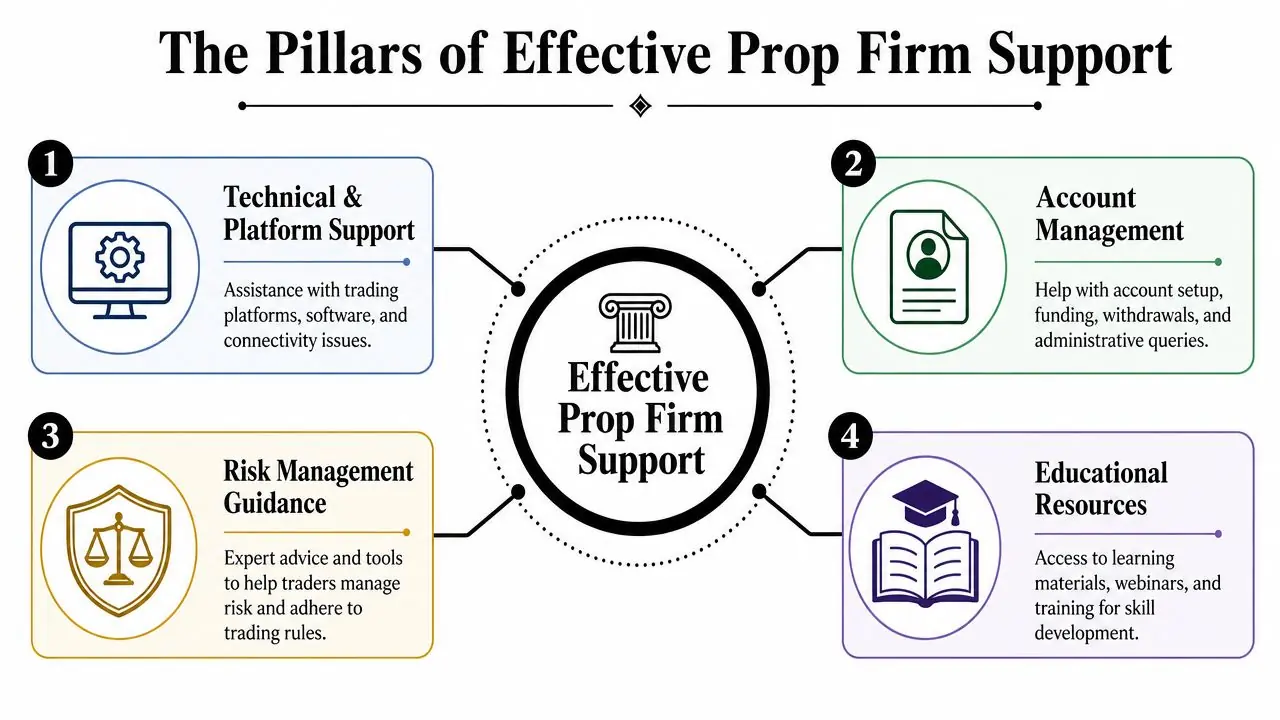
For prop traders, support has one job. Protect account continuity. If a firm cannot clarify a loss-limit calculation, review an execution record, or explain why a payout is delayed, that weakness shows up at the worst possible moment.
Technical and Platform Support
Platform support matters most when the market is open and your position is live.
Manual traders need quick help with login failures, chart freezes, rejected orders, missing trades, and execution records. Algo traders need more than that. They need agents who understand copier setup, API permissions, EA behavior, VPS issues, symbol mapping, and platform-specific quirks on DXtrade or cTrader.
The practical test is simple. Can support explain what happened on the account, using platform logs and timestamps, instead of pasting generic FAQ text?
If your system enters during a volatile release and the trade sequence looks wrong, support should be able to confirm:
- what the server recorded
- whether the rule engine checked equity or closed balance at the breach point
- whether the problem came from market conditions or a platform-side issue
- what review path applies if you contest the result
That is real platform support. Everything else is chat coverage.
Account and Payout Support
A trader who passes an evaluation should not have to chase basic status updates.
This pillar covers account creation, KYC, challenge activation, funded-account setup, add-ons, payout requests, and account changes. Weak firms treat these as back-office tasks. Good firms treat them as risk points, because uncertainty here often leads traders to make bad assumptions, open duplicate tickets, or miss deadlines.
Useful account support does a few things well:
- Sets the process clearly what documents are needed, what step comes next, and what commonly causes delays
- Explains exceptions directly duplicate profiles, verification mismatches, payout holds, or compliance checks
- Keeps case history visible prior chats, emails, and tickets should help the next agent solve the issue faster
- Gives realistic timing traders need an honest window, not a vague promise
Fast answers matter. Accurate answers matter more.
Real-Time Risk Management Support
This pillar protects accounts from preventable rule breaches.
Many traders understand their strategy better than their firm's risk engine. That gap is expensive. Daily loss limits, trailing drawdown rules, reset times, commissions, swaps, and slippage treatment can all change whether an account survives the session. Support needs to explain these details clearly enough that a trader can act before the breach, not argue after it.
Practical rule: If you cannot explain your daily loss calculation in one sentence, you are trading with avoidable account risk.
Strong risk support should answer questions like these without delay:
| Question | Why it matters |
|---|---|
| Does floating loss count toward the limit? | A live drawdown can breach before you close anything |
| What time does the daily limit reset? | Session timing changes position management |
| Are commissions and swaps included? | Small costs matter near the threshold |
| How are slippage spikes handled? | Traders need clear grounds for review |
| Who reviews a contested breach? | Escalation quality decides whether a case is examined properly |
A firm that takes risk questions seriously should also have a clear dispute resolution process for trading issues. If that process is vague, support quality is weaker than it looks on the homepage.
Onboarding and Education
Good onboarding reduces avoidable mistakes before the first order goes live.
That includes plain-English rule summaries, platform walkthroughs, examples of allowed and prohibited behavior, and clear instructions on what to document if something goes wrong. The benefit is practical. Traders spend less attention on rule uncertainty and more on execution.
This is also where support can prevent bad habits from day one. A new funded trader does better with a short rule briefing and a clean checklist than with a pile of marketing copy.
High-pressure performance works the same way in other fields. Resources like expert care for Penticton athletes show the value of structured support under stress. The useful part is not motivation. It is decision quality under pressure.
Algorithmic and API Support
Algo support deserves its own category because generic support usually fails here.
A firm may say it allows EAs, copy trading, or API-based execution. That statement means very little unless support can read order logs, check timestamps, identify symbol mismatches, and review whether the issue came from your setup, the platform, or the firm's rule engine.
Ask direct questions:
- Can support review execution timestamps and order IDs?
- Do agents understand the behavior differences between DXtrade and cTrader?
- What evidence should be submitted for a disputed trade sequence?
- Can they identify copier lag, mapping errors, or VPS-related failures?
If support cannot go beyond scripted responses, algo traders are operating without real coverage.
Community and Mentorship
Community support helps when it stays practical and disciplined.
A useful trader community shortens the gap between spotting a problem and checking the right thing. Traders share pre-session routines, payout prep, journaling methods, and examples of mistakes that cause avoidable violations. That can save time, especially for newer funded traders.
But community support has limits. Peer input does not override official rules, and chatroom confidence is not evidence. The best communities reinforce discipline and point traders back to verified answers. The worst ones spread rumors, encourage revenge trading, and make rule confusion worse.
Use community for pattern recognition and workflow ideas. Use official support for anything that can affect account status, payout eligibility, or a breach review.
How to Evaluate a Firm's Trader Support Before You Commit
How do you tell whether a prop firm's "trader support services" will protect your account when something goes wrong, instead of just answering billing questions?
Before you buy a challenge, treat support as part of execution risk. In prop trading, support is not a side feature. It affects whether a rule gets clarified in time, whether a platform issue gets reviewed properly, and whether a preventable mistake turns into a breach.
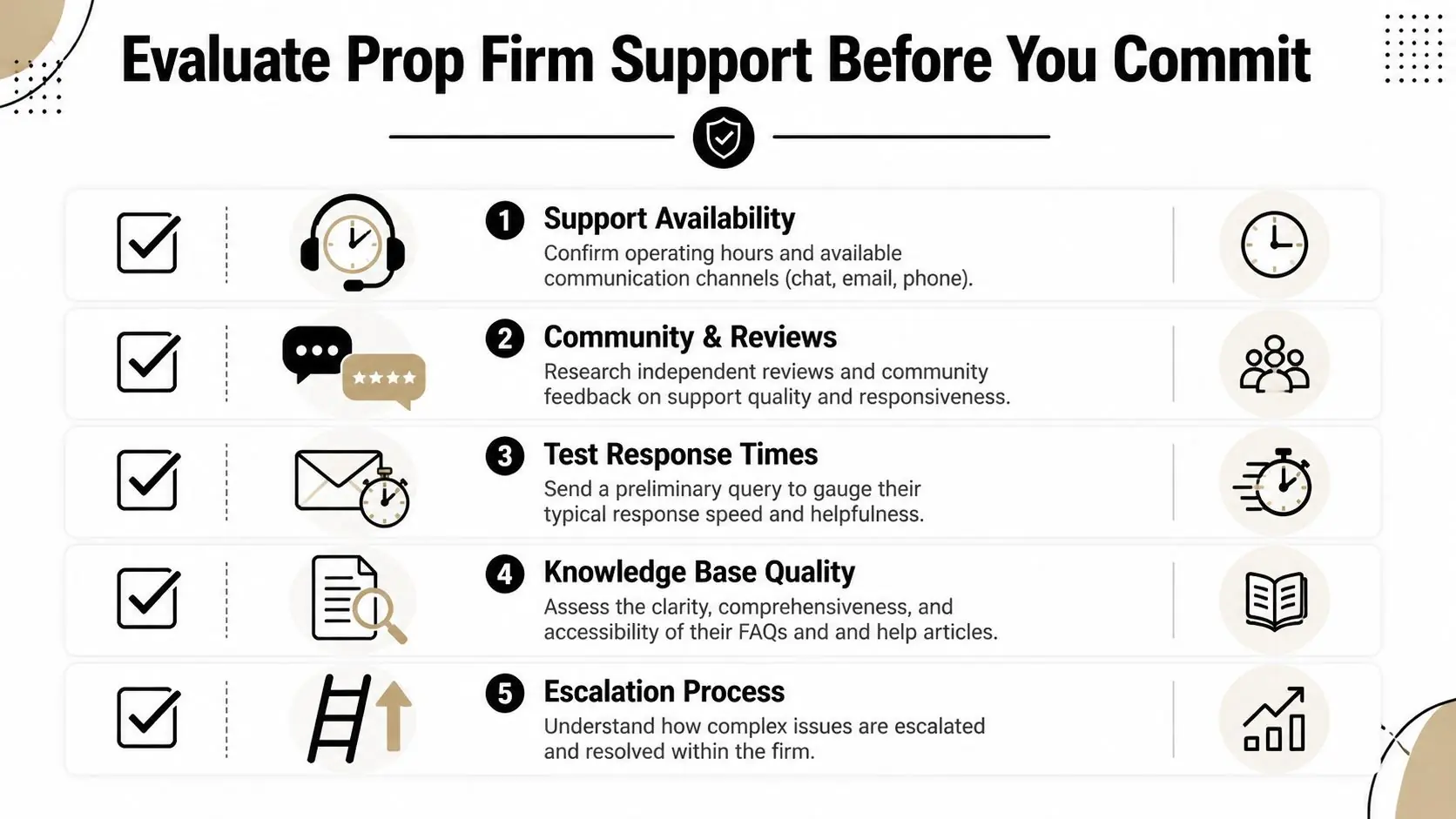
Test support before you need it. Traders usually discover a firm's true quality at the moment delays become expensive.
Run a pre-commitment test
A sales page will always say support is fast, helpful, and available. Verify it yourself.
Send one or two messages before you pay. Ask a rule question that affects live decisions, not a basic question they can answer with a canned script. Good examples include weekend holding, how daily loss is measured, what happens if equity drops below a threshold intraday, or how a disputed breach is reviewed.
Then judge the response on four points:
- Speed Did they answer within a time frame that would matter during your trading session?
- Accuracy Did they answer the exact question, with rule language you can act on?
- Process Did they explain what happens if the issue needs review or escalation?
- Continuity If you follow up, does the next agent understand the context?
Public feedback helps here, but read it with some skepticism. Look for patterns across independent prop firm reviews and trader feedback, especially around rule disputes, payout handling, and platform incidents.
Ask questions that expose operational weakness
Easy questions produce easy answers. Pressure-test the team with questions tied to account survival.
Ask things like:
- How do you calculate daily loss if open positions are fluctuating near the limit?
- What happens if an EA or copier creates exposure I did not intend?
- What is your review process for slippage or execution complaints?
- What evidence do you want for a platform-related issue?
- If I believe a breach was applied incorrectly, who reviews it and how long does that review usually take?
Strong support gives a clear rule, a clear process, and a clear list of evidence. Weak support stays vague, avoids ownership, or keeps repeating FAQ text.
Judge support by how it handles risk, not personality
Friendly agents are fine. Competent agents keep traders out of avoidable trouble.
Daily drawdown rules, floating loss treatment, news restrictions, and payout reviews are the areas where confusion gets expensive fast. If support cannot explain those points in plain language before you join, assume the same confusion will show up when your account is under pressure.
Use a simple standard:
| Scenario | What good support does | Red flag |
|---|---|---|
| You are close to the daily loss limit | Explains the rule clearly and tells you how the firm measures it | Sends a generic article with no direct answer |
| Your platform shows unusual fills | Asks for screenshots, timestamps, and ticket IDs | Tells you to wait without documenting the issue |
| You want to hold through a restricted event | Gives a direct yes or no with rule wording | Replies with vague language you have to interpret yourself |
| A payout is delayed | Confirms status, next step, and who owns the case | Gives no timeline and no accountable contact |
Watch how the firm operates before you fund
Support quality shows up in small details.
Check whether the FAQ, dashboard language, and chat replies match each other. Check whether agents ask for usable evidence such as order IDs, timestamps, screenshots, account numbers, and platform details. Check whether you can tell who owns a case once it moves past first-line chat.
I also pay attention to whether a firm writes like an operations team or a marketing team. Operations teams define rules, document issues, and follow a review process. Marketing teams reassure you without saying much.
If support feels improvised before you join, treat that as a warning about how the firm may handle breaches, disputes, and payouts later.
Trader Support in Action at MyFundedCapital
A trader's path through a prop firm usually exposes support quality in stages. Early on, the issue is clarity. Later, it becomes speed and precision.
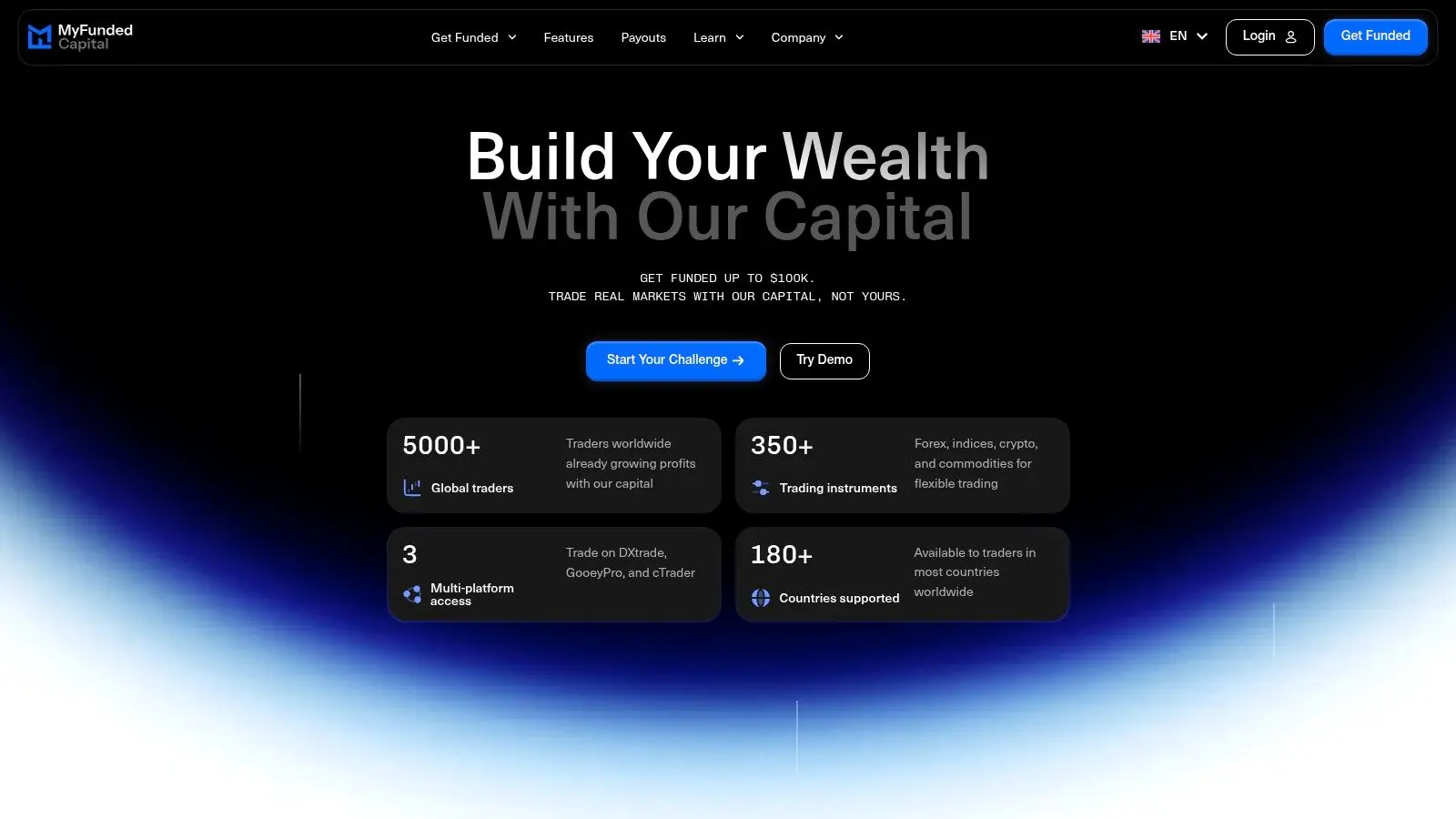
From challenge setup to first live-style decisions
Start with a trader moving from another firm onto DXtrade or cTrader. The first questions are rarely about strategy. They're operational.
They want to know how the account is configured, what the risk parameters mean in practice, whether manual and algorithmic trading are both supported, and how to avoid misunderstanding a rule on day one. That's where around-the-clock chat and a clear help flow matter. A trader in one time zone shouldn't have to wait until the next session to get a rule clarified.
An active Discord community also helps at this stage. Not because community opinions replace official guidance, but because traders learn platform habits, workflow tips, and common mistakes faster when other funded traders are already using the same environment.
During pressure, support becomes part of risk control
The ultimate test comes during trading.
A trader gets close to a loss threshold, sees unexpected slippage, or has questions around execution behavior on DXtrade or cTrader. At that point, slow support creates more than annoyance. It creates hesitation, second-guessing, and sometimes a breach.
Good prop support in that moment should help the trader do three things:
- Confirm the rule application
- Document the issue correctly
- Know whether the case needs escalation
For algorithmic and copy traders, this matters even more. If a system behaves unexpectedly, the trader needs a support team that understands platform logs, account behavior, and how to frame a dispute clearly.
A useful support team reduces uncertainty. That alone can stop a trader from making a bad decision while stressed.
Payouts and ongoing account management
Once a trader passes and starts requesting payouts, support quality shifts from risk clarification to reliability.
A firm's operating culture is revealed in scenarios such as these: Are payout steps clear? Does support explain status changes? Can traders get direct answers on account transitions, add-ons, or verification? If the answer is yes, the trader spends less time chasing admin and more time protecting performance.
That's what good trader support services should look like in practice. Not flashy. Not theatrical. Just dependable when timing and account status matter.
Templates for Contacting Support and Escalating Issues
Most support delays start with bad communication from the trader. If your message is vague, the agent has to pull basic facts out of you first. That costs time you may not have.
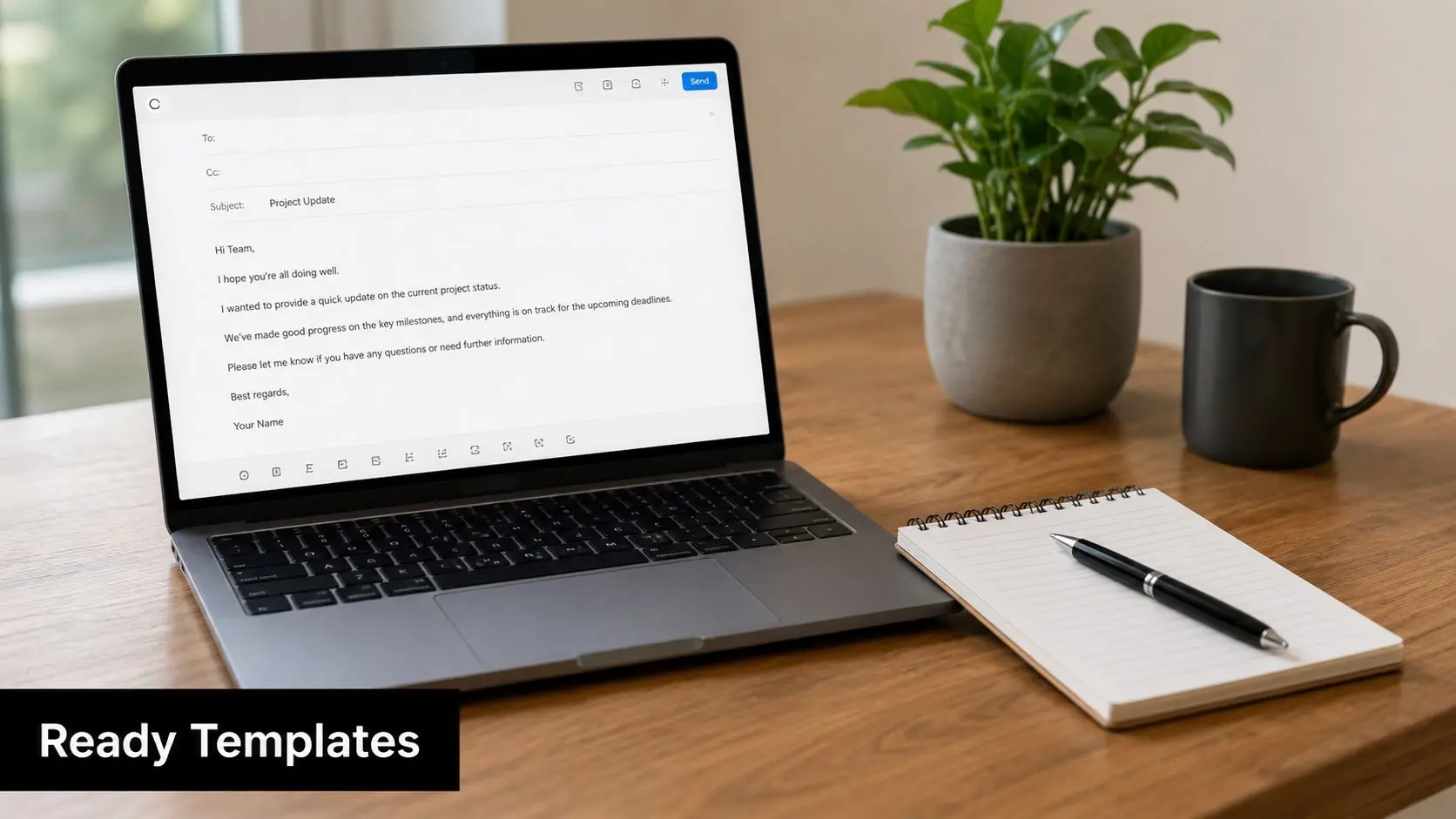
Platform issue template
Use this when fills, charts, connectivity, or platform behavior look wrong.
Subject: Platform issue on [platform name] for account [account ID]
Hi support,
I'm reporting a platform issue on my account [account ID].Time of issue: [include timezone]
Platform: [DXtrade / cTrader]
Symbol: [instrument]
Order or trade ID: [ID if available]
What happened: [short factual summary]
What I expected: [short comparison]
Attached: screenshots / screen recording / error messagePlease confirm receipt and advise whether this needs technical review. Thank you.
Include: account ID, timezone, symbol, order ID, and screenshots. If you leave out the timezone, platform teams often can't match your complaint to the log quickly.
Payout status template
Keep this short. You're asking for status, not writing a complaint.
Subject: Payout status request for account [account ID]
Hi support,
I'd like an update on my payout request for account [account ID].Request date: [date]
Method selected: [bank / crypto]
Any reference number: [if available]Please let me know the current status and whether you need anything else from me. Thanks.
Include: request date and payment method. Don't force support to search without anchors.
Rule clarification template
Use this before placing the trade, not after.
Subject: Rule clarification request for account [account ID]
Hi support,
I want to confirm a rule before trading on account [account ID].My question: [example: Am I allowed to hold this position over the weekend?]
Current setup: [instrument, trade style, add-on if relevant]Please reply with the specific rule that applies so I can stay compliant. Thank you.
Include: the exact scenario. “Can I do this?” is too vague. “Can I hold XAUUSD swing exposure through the weekend on this account type?” is much better.
Escalation template
If the first reply doesn't resolve the issue, stay professional.
Subject: Escalation request for unresolved account issue [ticket number]
Hi support,
I'm requesting escalation for ticket [number] regarding account [account ID].Original issue: [one-sentence summary]
First contact date: [date]
What remains unresolved: [specific point]
Evidence attached: [screenshots, order IDs, prior replies]Please escalate this to the appropriate team and confirm the next review step. Thank you.
Include: the previous ticket number and prior correspondence. Escalation works best when you show a clean record, not emotion.
Frequently Asked Questions About Trader Support
Should a support agent give me trading advice
No. A support agent should explain rules, platform behavior, account status, and process. They shouldn't tell you what to buy, where to place a stop, or whether your setup is good. If support starts acting like a signal service, that's a bad sign.
What's a reasonable response for a critical issue
For a critical issue, the right standard is fast acknowledgment and a clear next step. If you're near a rule breach or dealing with an active platform problem, you need confirmation that the issue has been logged and whether you should keep trading, reduce exposure, or wait for review. Silence is the worst response.
If support can't tell you what information they need, they probably can't solve the issue efficiently either.
What should I send when reporting a dispute
Send facts, not frustration.
Include:
- Account identifier
- Timezone
- Platform name
- Symbol
- Order or trade IDs
- Screenshots or recordings
- A short timeline of what happened
Think like an operations desk. Your job is to make the case easy to review.
How do I give useful feedback after a bad support experience
Be specific. Name the issue, the channel, the time, and the outcome you expected. “Support was terrible” doesn't help. “I asked whether floating loss counted toward daily loss, got a generic reply, and still had no rule clarification during an active session” does.
Also separate the actual problem from your emotional reaction. That gives the firm something concrete to fix.
Trading involves risk of loss, and even the best support can't remove market risk or undo poor execution. Use support to understand rules, document issues, and protect your account. This article is educational only and not financial advice.
If you want a prop firm that treats support as part of trader performance, not just account admin, take a closer look at MyFundedCapital. Compare its funding programs, account types, and platform options, then choose the path that fits your trading style and risk discipline.