

The popular advice in Copy Trading vs Bot Trading is backwards. You're usually told copy trading is the easy, safe route for beginners and bots are the advanced, risky route for coders. That framing hides the choice. Copy trading automates trust in a person you can't control, while a bot automates trust in rules and infrastructure you must test. Neither is hands-off, and neither removes risk. They fail in different places, at different speeds, and for different reasons, so picking by ease alone puts a funded account at risk for the wrong reason.
Copy Trading and Bot Trading Side by Side
Copy trading repeats another trader's decisions in your account, while bot trading executes rules you or a developer set in advance. That one sentence explains most of what follows. You're either judging a person's live choices or judging a rule set before it trades.
| Criterion | Copy Trading | Bot Trading |
|---|---|---|
| Who makes each trade | Lead trader's decisions, copied to your account | Rules set in advance by you or a developer |
| Setup effort | Choose and monitor a leader | Build, backtest and connect a strategy |
| Control over entries and exits | Limited to the leader's choices and your copy settings | Full control through the rule set |
| Main failure point | Leader behavior, copy delay and fill prices | Logic errors, outages and uncontrolled order generation |
| Execution speed | Follows the leader with a delay | Machine speed, limited by connection quality |
| Cost structure | Provider terms plus spreads and commissions | Tool or development cost, hosting, plus spreads and commissions |
| Fit with prop-firm rules | Allowed within the trading rules | Allowed by prior agreement with support |
The Rows That Surprise People
Control is the row readers misread most. A follower can set copy size and stop copying, but can't veto a single entry, move a stop, or skip a news release unless the copy settings allow it. A bot owner can change every parameter, yet that control only matters if the rule was written and tested before the market moves.
Say a leader risks 5% per trade on EURUSD. A follower using a direct multiple inherits that exposure unless they change their copy settings first. A bot set to risk 0.5% per trade applies that limit to every signal it takes, including the tenth trade in a losing run. The same account can therefore feel conservative with one method and reckless with the other, even on the same instrument.
Execution speed also works differently from the marketing. A bot reacts to price data directly. Copy trading adds a chain between decision and fill, so the follower's price is a later price, not the leader's price.
First question: Do you want to judge trades or judge rules? That single choice decides most of the rows that follow.
Treat each row as a starting point, not a verdict. Specific provider terms vary, and a careful leader or a poorly tested bot can shift the balance. The table shows typical structures, not guaranteed outcomes.
How Copy Trading Replicates Another Trader's Decisions
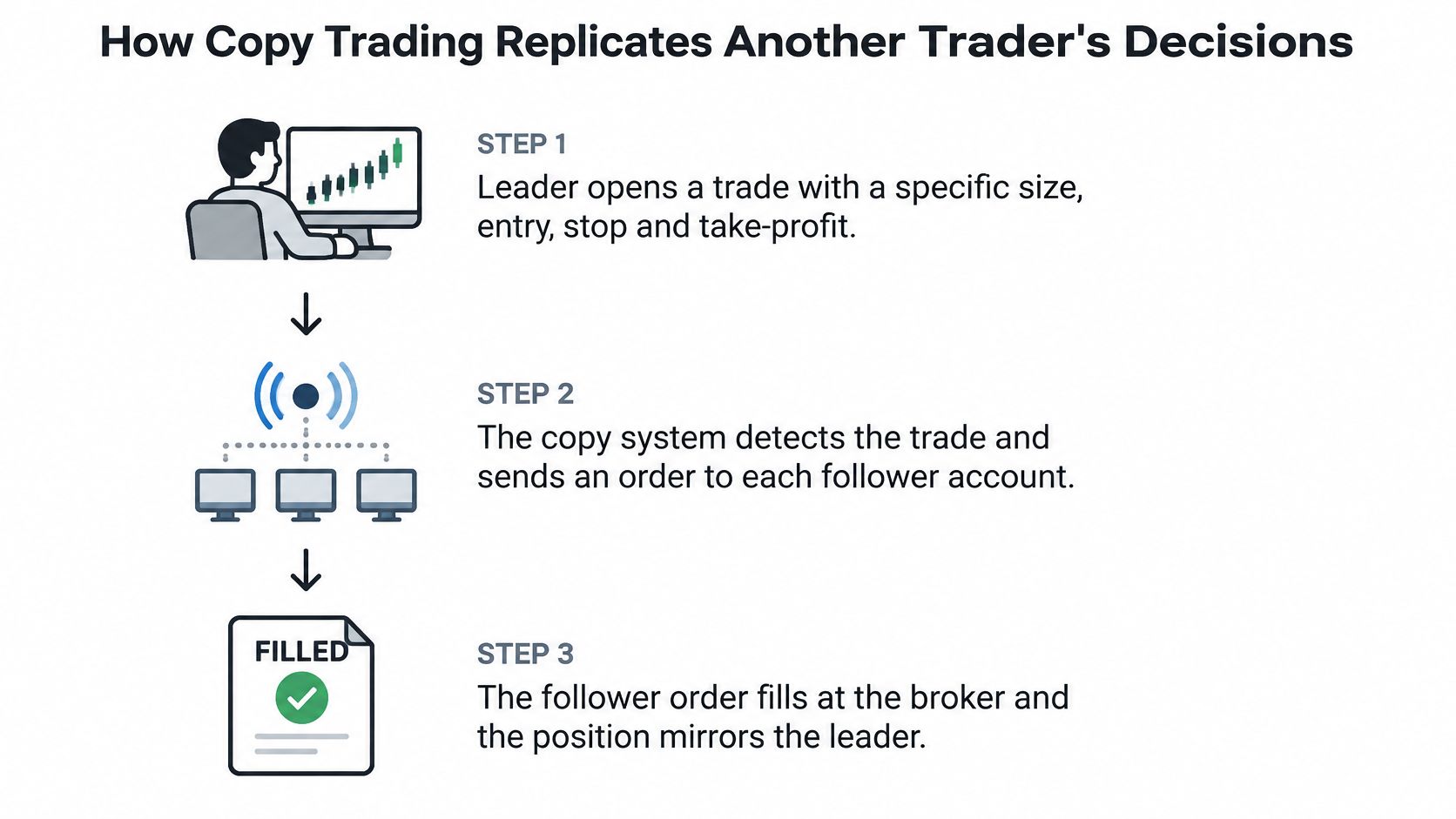
Copy trading looks like mirroring, but it's really a sequence of separate orders. Your account doesn't receive the leader's position. It receives an instruction to create a similar one.
- Leader opens the trade The leader chooses the instrument, size, entry, stop and take-profit based on their own account and judgment.
- System detects and forwards it The copy system notices the new position and sends an order to each follower account.
- Follower order fills Your order fills at whatever price is available at that moment, which may be worse than the leader's fill.
- Size is translated Your position is sized by your copy settings, such as a fixed amount, a percentage, or a multiple of the leader's size.
- Position closes It closes when the leader closes, or when you stop copying and close it yourself.
The Three Gaps in Every Copied Trade
Timing is the delay between the leader's fill and yours. Pricing is the price difference created during that delay. The IOSCO report on copy trading identifies timing and pricing risk as core mechanics, noting that when many followers act on the same signal they may buy at a higher price or sell at a lower price than the lead trader.
Say a leader buys gold at 2,350 and your order fills at 2,351. The idea is identical, but you start one point behind. If the stop is copied at the same level, your distance to that stop is also different, so your actual risk isn't the same as the leader's.
Sizing is the third gap. A percentage setting, a fixed size, and a multiple can produce very different exposure from the same signal. That's why you must check the leader's typical risk per trade and your translation setting together, not separately.
Platform outages, technical glitches and transaction costs still apply to the follower account. Copying doesn't create a guaranteed equivalent portfolio or return.
At MyFundedCapital, copy trading is allowed between your own accounts or when following another trader or a signal service, as long as every trade follows the trading rules. Before funding, record your copy settings, the leader's usual position size, and how you'll stop copying during a drawdown.
How Bot Trading Runs a Strategy Without a Person
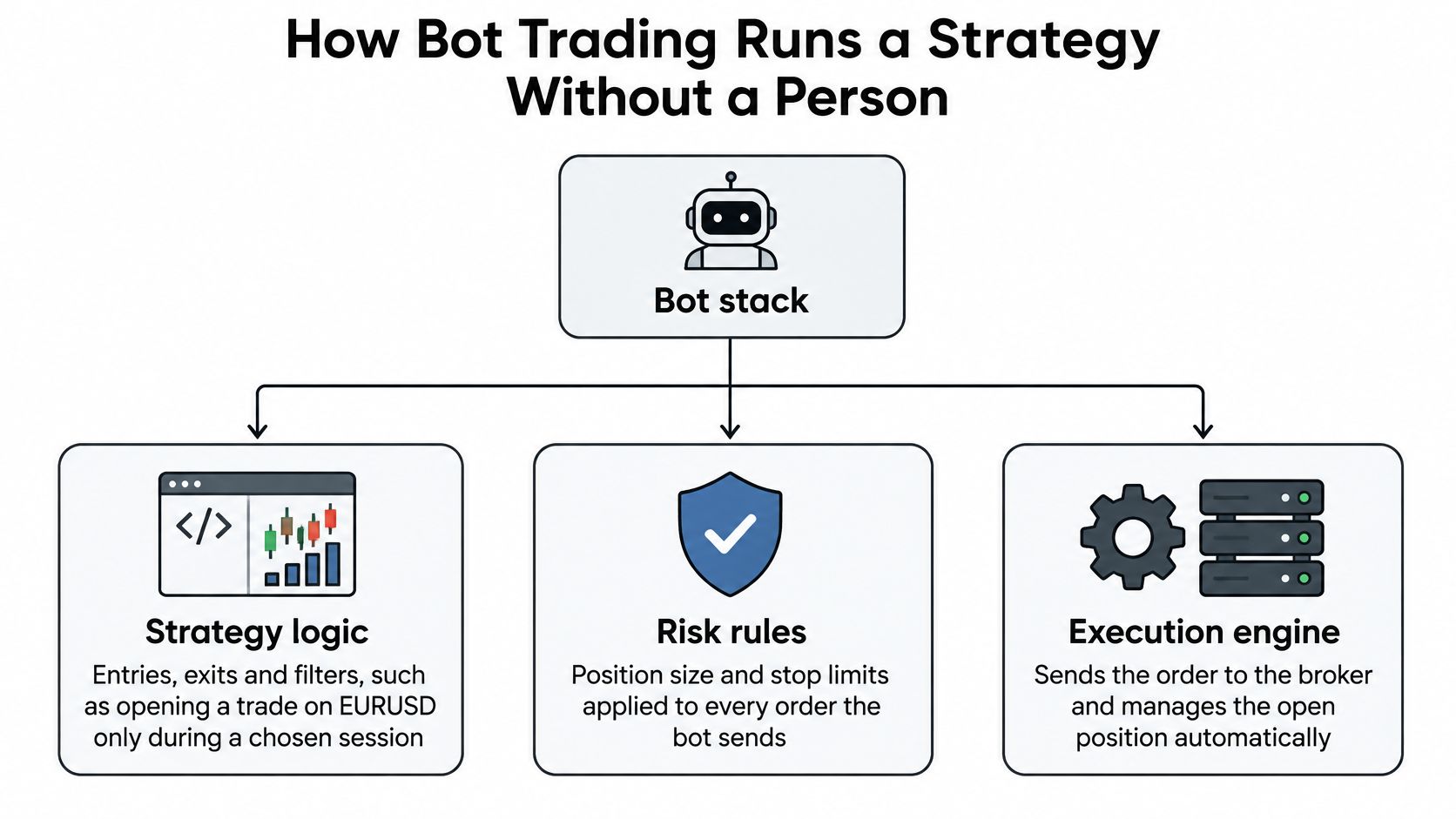
A bot turns a trading strategy into rules that software can execute. Its operation depends on more than entry signals: risk settings, order execution and monitoring all need to work together.
- Strategy logic Defines entries, exits and filters, such as opening a trade on EURUSD only during a chosen session.
- Risk rules Set position size, stop placement, trade-frequency limits and a daily loss limit below the program's own limit.
- Execution Routes orders and depends on connectivity, including stable hosting where uptime matters.
- Monitoring Uses alerts, logs and an emergency shutdown that can be triggered without editing code.
Consistency is the bot's main advantage. It applies the same entry rules, sizing and filters to each signal, even during a losing streak. Algorithmic execution is also established in major markets: a Bank for International Settlements study reported that it accounted for approximately 53.5% of total activity in EBS foreign-exchange data on 6 May, compared with 46.5% executed manually.
That statistic describes execution activity, not profitability. A bot still needs logic tested on out-of-sample data, realistic spread and commission assumptions, slippage estimates, data-integrity checks and platform compatibility. The MyFundedCapital guide to forex algorithmic trading explains how strategy design and execution controls fit into the process. Roles for those who hire algorithmic traders also reflect the specialized work involved in developing automated strategies.
Expert advisors and trading bots are allowed by agreement at MyFundedCapital. Contact support before using one. First, write the bot's rules as a checklist and run them in a demo test; then share the results with support.
Where Each Approach Breaks and What It Costs
Copy trading's underestimated risk isn't a bad leader. It's what copying does to your own risk-taking. A 2020 Management Science study summarized by the Barcelona School of Economics found experimentally that showing investors other participants' success increased risk-taking, and offering a direct copy function increased risk-taking even further. The researchers concluded that copy trading can produce excessive risk-taking.
That effect matters when many followers copy the same leader into the same position. Exposure becomes synchronized, concentration rises, and a leader's normal drawdown can breach your tighter funded-account limits. Our breakdown of copy trading risks explains why account-level caps matter more than trust in any single trade.
How Bots Break Differently
A bot usually doesn't break because it panics. It breaks because code sends the wrong order, a connection drops, a data feed stalls, or order generation runs without an effective limit. A strategy that looked profitable in a backtest can still fail on order accuracy, position limits or repeated execution of logic that no longer fits the market.
A copied trade can be right for the leader and still wrong for your account. A bot trade can follow its rules perfectly and still be the wrong rule.
What Trading Costs on MyFundedCapital
Trading costs 0.01% of the traded value per side, with a $0.50 minimum per side and no platform fee. A round trip has two sides, so open and close both count.
| Traded value | Cost per side (0.01%, $0.50 minimum) |
|---|---|
| $1,000 | $0.50 (minimum applies) |
| $10,000 | $1.00 |
| $50,000 | $5.00 |
| $100,000 | $10.00 |
At $1,000, the $0.50 minimum equals 0.05% per side, five times the 0.01% rate. At $10,000, a round trip costs $2.00, so 20 such trades in a month cost $40 before spreads and any provider terms set by a leader or copy service. Read those provider terms separately, since this guide doesn't assume a figure for them.
Scalping, high-frequency trading and hedging are not allowed, which removes some high-turnover bot designs from consideration before cost even enters the decision. Multiply your expected trade size by the cost per side and your expected monthly trade count before choosing either approach. A high-frequency design that can't survive its own turnover isn't a strategy, it's a cost plan.
How to Audit a Leader or Bot Before Allocating Capital
Don't start with return. Start with evidence that the return could survive your account rules, your fills and a bad month.
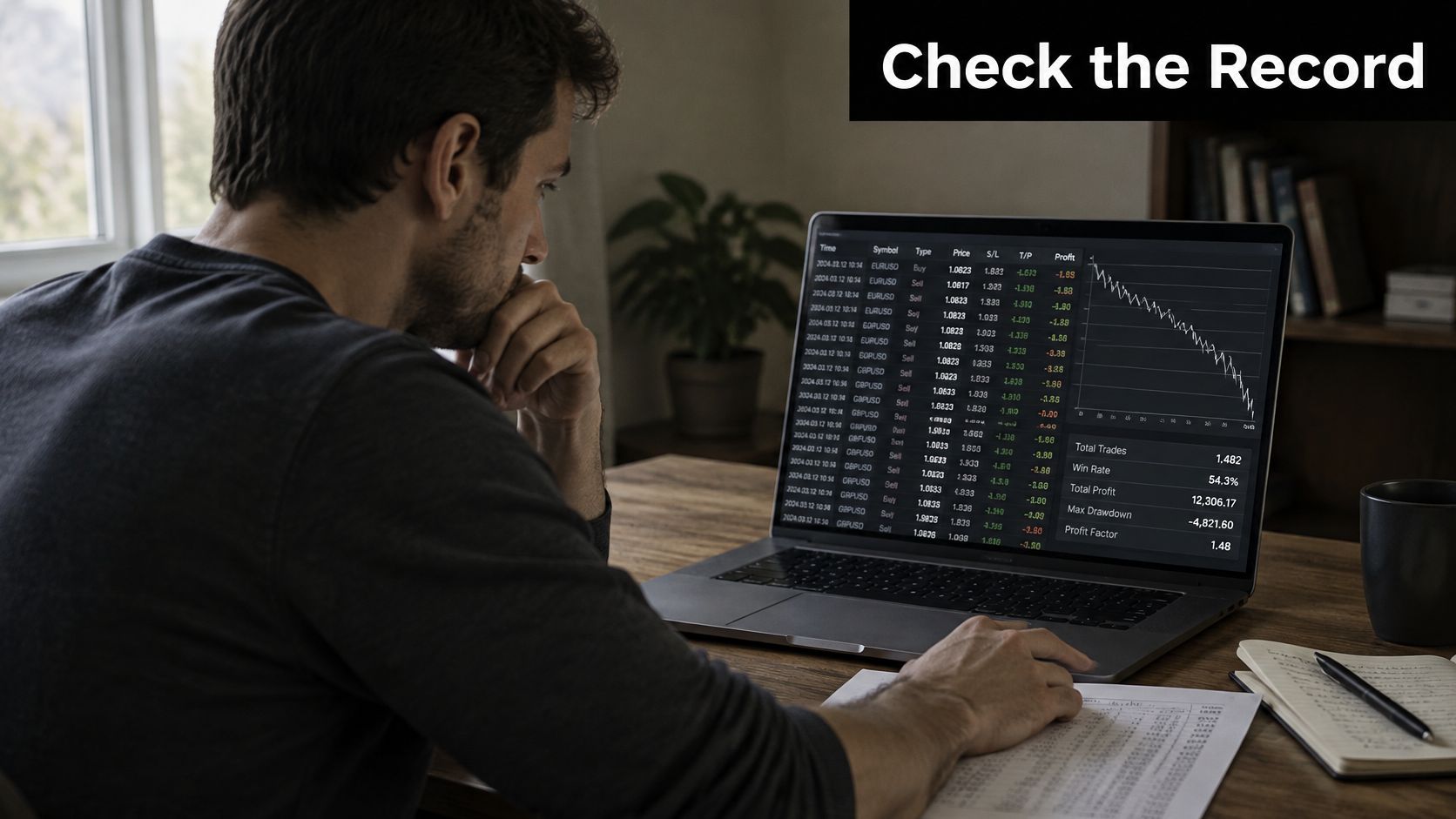
- Ignore the leaderboard rank Pull the full trading history instead. Rank rewards recent visibility, and the common slip is funding after a short gain that pushed a portfolio upward.
- Check maximum drawdown and losing streaks Record the worst peak-to-trough fall and the longest run of losses. If that streak would breach your daily or maximum limits, the headline return is irrelevant.
- Measure holding time and return concentration Check average holding time and whether profits came from one unusually profitable period. A record built on one regime may not repeat in the next.
- Check position sizing and concentration Look for oversized positions, repeated exposure to one instrument, and correlated trades that act like one large bet.
- Test slippage sensitivity Add realistic spread, commission and delay to the history or backtest. For bots, our guide to algorithmic trading backtesting shows why ideal fills flatter results.
- Confirm news and weekend behavior Record exactly what the leader or bot does around major releases, gaps and market reopenings, then compare that behavior with your program rules.
Why Rankings Mislead
Independent research in the ACM study on copy-trading portfolios found portfolio popularity was highly correlated with ranking placement rather than actual performance, and the bottom 25% of promoted portfolios lost more than USD 15,000 within ten days. Promoted portfolios could show short-lived gains before profit and loss fell sharply.
That finding changes the audit order. Popularity is not verification, and a high rank can be the result of placement rather than durable skill. You need drawdown, losing-streak length, exposure, concentration and slippage sensitivity before you allocate capital.
For a funded account, timing makes the audit stricter. A copied entry filled later at a worse price can push you through a fixed daily-loss limit even while the leader remains profitable. For a bot, compare forward results with the backtest on the same instrument, risk per trade and trading hours.
The Report tool shows the account curve, calendar, tags and MAE and MFE for every trade, including how far each trade went against and for you before closing. Use it to check whether copied or automated trades routinely move close to your loss limits before they recover.
Pass or pause rule: If any audit check fails, reduce size or pause until it passes. Don't average a failed drawdown check against a strong return.
Which Approach Fits Your Trader Profile
The right answer depends on your time, skill and rule constraints, not on which method looks more advanced. A method that fits another trader's schedule can be a poor fit for your account.
| Trader profile | Better fit | Why it fits |
|---|---|---|
| Part-time trader with limited screen time | Copy trading | You review the leader's drawdown, not every candle |
| Trader who can code and test a rule set | Bot trading | Rules run the same way every time and the logs can be audited |
| Experienced discretionary trader with a proven edge | Neither; keep trading manually | Copying dilutes the edge, and a bot cannot reproduce judgment |
| Beginner who wants to learn | Copy trading, with a review of each trade | You see decisions in real time and can study why they were made |
| Prop-challenge trader needing rule discipline | Bot trading, after support approval | Fixed limits help, but bots need prior agreement with support |
Reading the Verdicts
A part-time trader usually fits copy trading only with a leader whose drawdown they can tolerate and review regularly. Limited screen time doesn't remove monitoring, it changes monitoring from candles to leader behavior, exposure and fill quality. If you can't review the leader each week, the fit disappears.
A trader who can code and test fits bot trading because they can inspect the logic, reproduce results and read the logs after a fault. Without testing skill, a purchased or borrowed bot becomes another form of copying, except the leader is now hidden inside code.
An experienced discretionary trader with a proven edge should be cautious about both. Copying replaces their judgment with someone else's, while a bot can only encode the parts of that judgment that can be written as fixed rules. Manual trading remains the cleaner fit when context and discretion create the edge.
A beginner who wants to learn fits copy trading only if they review each copied trade and study why it was opened, sized and closed. Without that review, the beginner isn't learning. They're outsourcing decisions and calling it education.
A prop-challenge trader may benefit from bot-enforced limits, but only after support agreement and only with internal limits set below the program limits. The bot should stop before the account rule forces it to stop.
One constraint applies to every profile. Martingale, opposite trades across accounts or firms, and all-in bets are not allowed. A leader or bot that doubles down after losses must be changed or rejected before funding.
Your recommendation should change when your time, coding ability or challenge rules change. Profile fit is a current condition, not a permanent identity.
Choose Your Setup and Confirm the Rules Before Funding
Rules checked before funding are cheap to fix. Rules discovered after a breach can end the account, so work through the setup in this order.
- Pick your profile Match your time, skill and challenge rules to the profile table, then commit to one approach for the first test period.
- Document the strategy For a bot, write the entry, exit, sizing and shutdown rules. For copy trading, record the leader's drawdown, losing streak, holding time and typical risk per trade.
- Contact support for automation Expert advisors and trading bots require agreement before use, so contact support before connecting one.
- Confirm the current rules Read the trading rules and check that your copy settings or bot limits keep every trade inside them, including the daily loss limit.
- Trade in the right place All trading takes place within the MyFundedCapital Terminal, within the risk rules of your program.
- Compare programs before paying Review account prices and program options at compare plans, and remember you pay a one-time fee for the account rather than depositing trading money.
Set Account-Level Protection
Don't rely on the leader's stop or the bot's intended stop as your only protection. Set your own maximum exposure, daily pause point and stop-copying or shutdown procedure before the first live trade. Test that procedure while positions are small, because a shutdown method you've never used isn't a control.
Keep instruments, trading hours and risk per trade consistent during the first audit period. Changing leader, bot settings and position size at the same time makes the results impossible to interpret. You'll know money was made or lost, but you won't know which change caused it.
Choose copy trading or bot trading for the next 30 days based on your profile and audit, and don't add a second approach until the first passes.
That single decision gives you clean evidence. If fills, drawdown or rule compliance fail, pause and fix the specific failure. If the setup passes, you can scale deliberately instead of expanding on hope.
Choose the approach that matches your profile, audit it against drawdown, fills and rule limits, then confirm your setup inside the MyFundedCapital Terminal before you fund. MyFundedCapital allows copy trading within its trading rules and allows expert advisors and bots by prior agreement with support, so you can test one disciplined method instead of mixing two unproven ones. Visit MyFundedCapital to compare programs and start with the rules checked first.
