If you trade FX, CFDs, or crypto, apex trading funding can look attractive at first glance. Then the confusion starts. The rules are built around futures trading, the payout process has firm-specific conditions, and some habits that work in spot or CFD trading don't translate cleanly.
This guide gives you the straight version. You'll learn how Apex Trader Funding works, where traders usually get tripped up, and how to judge whether a futures-focused prop firm fits your strategy at all.
What Is Apex Trading Funding and How Do Prop Firms Work
You might be a forex or crypto trader with a solid system, good risk control, and years of screen time. Then you look at Apex trading funding and hit a wall. The offer sounds familiar, but the rules do not. That is usually the first sign you are not looking at a generic prop firm. You are looking at a futures prop model.
A prop firm follows a simple arrangement. You show that you can trade within a defined set of risk rules, and the firm gives you access to a larger account structure than you may want to fund with your own money. If you perform, you keep part of the profits and the firm keeps part.
The relationship is similar to a record label signing an artist. The trader brings skill, timing, and consistency. The firm brings capital access, operating rules, and a commercial framework. If the trader performs well inside that framework, both sides benefit.
For many traders, the attraction is straightforward. Skill is often easier to build than a large account.

How the prop firm model works in practice
Prop firms usually do not hand out funded accounts without a screening process. They want proof that your trading holds up under pressure and inside a rulebook. That screening process is commonly called an evaluation or challenge.
In practical terms, the path usually works like this:
- You choose an account size based on your experience and the rules you can realistically follow.
- You pay an evaluation fee for access to the challenge account.
- You trade under firm rules such as drawdown limits, trading-day minimums, and profit-distribution requirements.
- You qualify for a funded account if you meet the target without breaking the rules.
- You receive a share of profits according to the firm's payout model.
That sounds clean on paper. Real trading is less forgiving. A trader can finish green and still fail because the gains came with too much concentration, too much heat, or in a way the firm does not allow.
Where Apex fits in the prop firm market
Apex Trader Funding is best understood as a futures prop firm. That point matters more than the headline account sizes or promo pricing, especially if you come from FX, CFD, or crypto.
Apex is built around futures products and futures-style account rules. If you already trade contracts like ES, NQ, or CL, the setup will make more sense. If your normal home is MetaTrader, cTrader, TradingView for spot crypto, or a CFD broker with broad symbol access, Apex can feel like walking into a different sport that happens to use charts.
That is where many traders get misled. They hear "prop firm" and assume the experience will be similar across firms. It is not. A futures prop account and an FX or CFD prop account may both involve an evaluation and a payout split, but the day-to-day trading conditions can differ a lot.
Why FX, CFD, and crypto traders often misread Apex
An FX or crypto trader often expects broad instrument access, familiar platform choices, and rule structures built around those markets. Apex does not center the experience that way.
Here is the practical difference:
- Apex is futures-first, so the tradable products are futures contracts rather than spot forex pairs or CFD versions of indices and commodities.
- Platform compatibility is narrower, which matters if your strategy depends on tools common in FX or crypto workflows.
- Risk rules can feel different, especially if you are used to daily loss limits or holding patterns that are common in other prop models.
- Execution style matters more than many new applicants expect, because futures firms often reward traders who can stay controlled intraday and avoid unstable profit patterns.
A useful comparison is this. Joining Apex as a forex trader is less like switching brokers and more like switching divisions within the same profession. You are still trading, but the instruments, the field conditions, and some of the judging criteria have changed.
That is also why firms built for FX, CFDs, or crypto can be a better fit for some traders. A modern multi-asset prop firm such as MyFundedCapital may line up more naturally with traders who want broader asset access and platform choices that match their existing workflow. Apex can still be a strong option, but mainly for traders whose strategies already fit a futures environment.
The main lesson is simple. Do not judge a prop firm by the advertised buying power. Judge it by the products you can trade, the software you can use, and the rules you will have to follow every session.
The Funded Account Evaluation Process Explained
A trader opens an Apex evaluation after years of trading EUR/USD, gold CFDs, or crypto perp markets. On paper, the goal looks simple. Hit the target and qualify. In practice, the evaluation works more like a driving test in a different vehicle class. You may already know traffic, timing, and risk. You still need to prove you can operate under futures-specific rules.
That distinction matters.
For FX, CFD, and crypto traders, the Apex evaluation is not only a profit challenge. It is a compatibility test. Can your strategy survive in a futures environment, on futures-supported platforms, with rules that often reward controlled intraday execution more than broad, flexible market exposure?
What the evaluation is really measuring
Apex uses a one-step model. You trade a simulated account, aim for the stated profit target, meet the minimum trading-day requirement, and stay inside the rules.
The profit target gets the attention, but it is only one part of the exam.
The evaluation usually asks three questions:
- Can you produce profit without losing control?
- Can you do it across multiple sessions rather than one hot streak?
- Can you follow the firm's rules while doing both?
That last part trips up many capable traders. A trader can be right on direction and still fail on process.
Why the process feels different for FX and crypto traders
If you come from spot forex or crypto, you may be used to more freedom in how you build a position. You might scale in slowly, hold through longer sessions, or spread your attention across several markets at once. Apex tends to feel tighter. The structure favors traders who can execute with discipline inside a defined futures rule set.
A useful way to frame it is simple. The evaluation is less like "prove you can make money" and more like "prove you can make money our way."
That is why reading the full Apex trading rules breakdown before buying a challenge is smart. Small rule details often matter more than the headline account size.
A plain-language example
Take a $50K-style evaluation structure.
You are trying to reach the required profit target while logging the minimum number of trading days and avoiding rule violations. A newer trader often translates that into one bad idea: "I need a huge winner."
That mindset causes rushed entries, oversized positions, and revenge trading after a setback.
A better approach is to treat the evaluation like a seven-session audition. Each day is one vote for or against your discipline. Profit is the scoreboard, but behavior decides whether you stay in the game long enough to reach it.
Why one-step challenges appeal to traders
The attraction is obvious. One-step models shorten the path between signup and a funded account.
That can help a trader who already has a stable process.
It can hurt a trader who confuses speed with ease.
One-step evaluations compress pressure. There are fewer stages, but every mistake matters sooner. For a futures-native scalper, that may feel efficient. For an FX swing trader or crypto trader who performs best with more room to express a thesis, it can feel restrictive very quickly.
How Apex compares with other prop funding paths
Different firms test traders in different ways. The model matters because it shapes behavior.
| Model | What it tends to reward |
|---|---|
| 1-Step challenge | Fast adaptation, tight execution, fewer mistakes |
| 2-Step challenge | Patience, repeatability, gradual proof of control |
| Instant funding | Traders willing to accept stricter account structure in exchange for skipping a long evaluation |
For many FX, CFD, and crypto traders, this is a key comparison point. Apex may be a good fit if you are comfortable trading futures and working within a more structured intraday framework. A multi-asset firm such as MyFundedCapital can feel more natural if your edge depends on broader market access, familiar FX or CFD workflows, or crypto-friendly flexibility.
Before you buy a challenge
Ask yourself a few direct questions.
- Do I already trade futures, or am I trying to learn a new market under pressure?
- Can my strategy work on the platforms Apex supports?
- Am I naturally consistent over several sessions, or do I rely on occasional outsized days?
- Will these rules improve my discipline, or distort my normal decision-making?
Honest answers save money.
An evaluation account is still a stress test. If your process is loose, the rules will expose it fast. If your process is already controlled, the evaluation can be a useful filter rather than a trap.
Navigating The Trader's Rulebook Drawdown and Consistency
A trader can read the chart correctly, finish green, and still fail the account. That usually happens because the rules shape the strategy more than the entries do.
With apex trading funding, two pressure points matter fast. Drawdown and consistency. If you come from FX, CFDs, or crypto, those rules can feel unfamiliar because many traders in those markets are used to wider asset choice, different platform logic, and strategies built around occasional large trend days rather than steady futures-style accumulation.
The consistency rule catches traders who rely on one big day
Apex Trader Funding applies a 30% consistency rule on Performance Accounts. In plain English, one oversized winning day cannot carry too much of your total profit. A trader may feel profitable and still fail the payout check if the gains are too concentrated in a single session.
The logic is simple. The firm is not only asking, "Did you make money?" It is also asking, "Did you make it in a repeatable way?"
That distinction matters a lot for traders crossing over from FX or crypto. Many of them use a return profile that looks uneven by design. A few examples:
- event-driven breakouts
- swing trades that pay after several quiet days
- volatility expansions after compression
- asymmetric setups where one runner covers many small losses
Those approaches can work very well in a personal account. Inside a prop framework built around steadier futures behavior, they can create friction.
A quick example makes this clearer. One trader earns most of the month's profit from a single trend day after a major market move. Another trader builds smaller gains over several sessions. The total profit may be similar, but the second profile fits the rulebook better.
Consistency rules work like a coach watching your training log, not just your best race time. One brilliant day gets attention. A repeatable process gets approval.
If your edge depends on rare outsized winners, review the full Apex trading rules and common friction points before paying for a challenge. It is better to learn that mismatch early than after a denied payout request.
Drawdown changes how you can recover
The other rule traders often misread is drawdown.
Apex uses an end-of-day trailing drawdown structure. For a futures trader who already tracks account thresholds closely, that may feel manageable. For an FX or CFD trader used to a fixed daily loss cap and a separate static maximum drawdown, it often feels like the floor is moving under your feet.
Here is the practical difference:
| Rule type | How it affects decision-making |
|---|---|
| End-of-day trailing drawdown | The account threshold can rise with performance, so risk has to be recalculated as the account grows |
| Flat daily loss limit | The daily boundary stays the same, which makes session planning more predictable |
| Static max drawdown | The outer loss limit does not move, so recovery planning is easier to visualize |
A trailing drawdown is closer to hiking with a campsite that moves uphill each night. Progress is real, but the point you cannot fall below may shift as the account advances. Traders who do not monitor that line carefully often size up after a good day and discover they have less room than they assumed.
That is where strategy fit matters. A scalper with tight risk and frequent sessions may adapt well. A swing-minded FX trader who prefers holding for larger moves may feel boxed in, especially since Apex is futures-focused and does not offer the broader FX, CFD, or crypto product access some modern prop firms are built around.
How to work inside the rules instead of fighting them
The goal is not to find a perfect system. The goal is to use a system that can survive the account structure.
A practical way to test that fit:
- Review your last group of winning sessions. If one or two days produced most of the gains, consistency may be the primary obstacle.
- Track where profits come from by day, not just the total balance.
- Reduce size after an unusually strong session so the next trade does not give back room you just created.
- Practice on the exact platform and product type. Futures execution and contract behavior feel different from many CFD environments.
- Write your size, stop, and daily loss rules before the market opens. Improvisation usually gets expensive when the drawdown line is close.
Good prop traders do not treat the rules as background paperwork. They treat them like the track boundaries in a race. You still need speed, but crossing the line ends the run no matter how strong the performance looked a moment earlier.
Getting Paid Understanding Profit Splits and Payouts
The payout page is where marketing language ends and logistics begin. If you want to use apex trading funding seriously, you need to understand not just the profit split, but the conditions attached to withdrawing money.
The headline split and the hidden part traders miss
According to this Apex funded trader review, Apex's payout structure starts with 100% of the first $25,000 earned, then shifts to a 90/10 split.
That headline gets attention, and it should. But traders often stop reading right there.
The more important question is: what has to happen before a payout is approved?
The same review notes that traders must meet a minimum of 8 trading days between bi-monthly payout requests, and they must also pass a consistency check where no single day's profit exceeds 30% of the profit being withdrawn.
How a payout request really works
Think of a payout like an audit, not a cash-out button.
Before requesting one, a trader needs to confirm:
Trading-day requirement is met
The account needs enough qualifying activity between requests.Profit distribution is acceptable
One oversized day can block the payout even if total profit looks strong.The account remains in good standing
Balance and compliance still matter after the profits are made.
That means a trader can do the hard part, making money, and still stumble on the admin part, structuring that profit in a rule-compliant way.
Why scheduled payouts feel different from flexible payouts
This is one of the biggest mindset shifts for traders coming from personal accounts or newer prop models.
In a personal brokerage account, profit is profit. If it's there, you can usually withdraw based on your broker's process.
In a prop environment, profit is conditional until the firm's checks are satisfied. That doesn't make the model wrong. It just means you need to trade with the payout process in mind from the start.
For traders who want to compare a more flexible withdrawal structure, this overview of step 3 profit and payout options offers a useful contrast.
Build your trading week backward from the payout rules. Don't make money first and hope the account history will fit later.
A simple payout discipline routine
Use this before every request:
- Review your daily P and L breakdown
- Look for one day dominating the total
- Confirm you've met the required trading-day count
- Check whether your recent behavior changed after a big win
- Request only when the account history is clean
That last point matters. Impatient payout requests create avoidable frustration.
Trading involves risk of loss, and prop payouts add operational risk on top of market risk. The cleaner your process, the less drama you'll face when it's time to withdraw.
Is Apex Trading Funding Right for Your Strategy A Comparison
Apex isn't designed for every trader. That's the first thing an honest mentor should say.
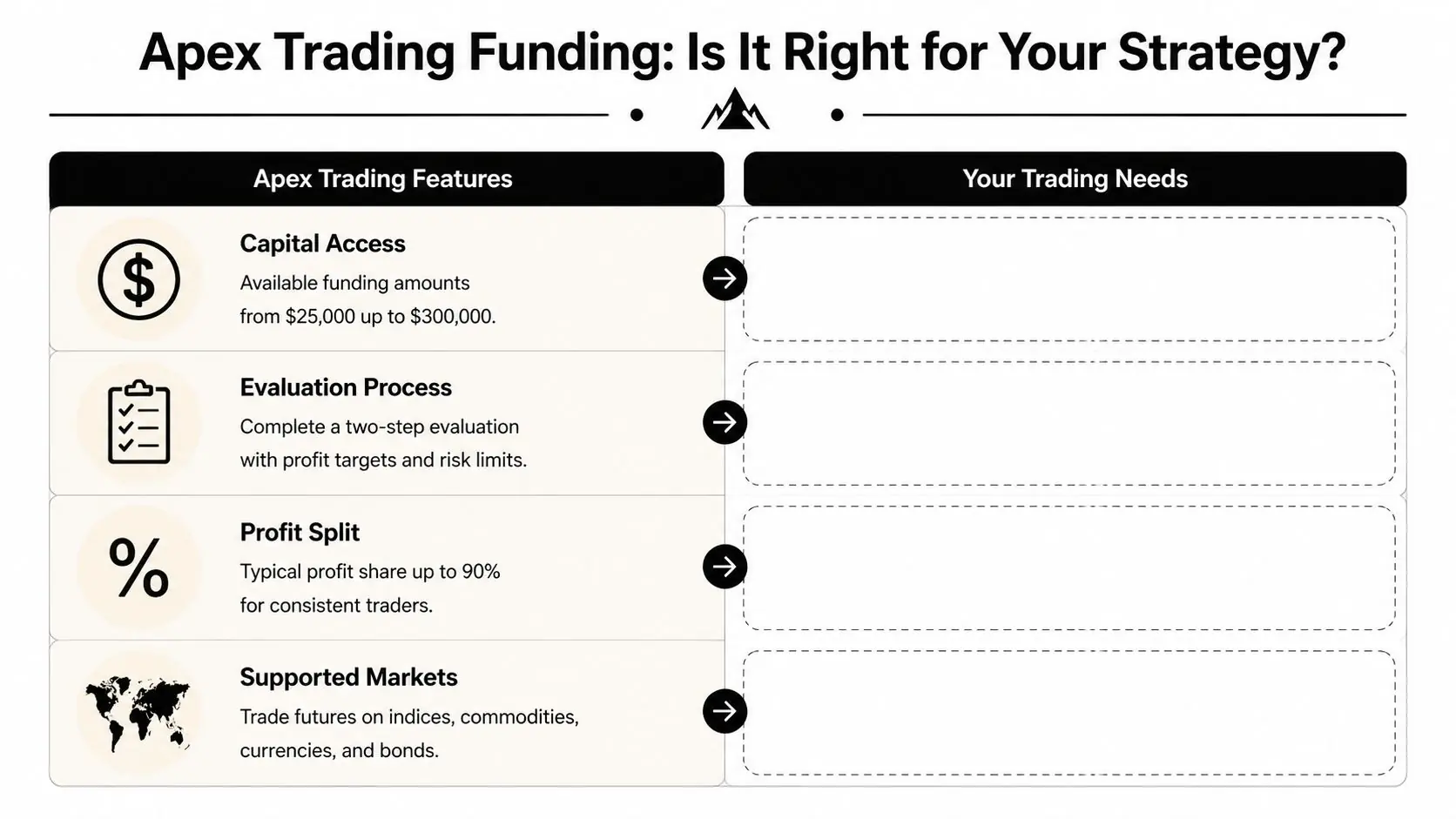
If you trade futures actively and you're comfortable with firm-defined structure, apex trading funding may be a strong fit. If you trade FX, CFDs, crypto, or weekend swing setups, the fit may weaken quickly.
The biggest difference starts with the market itself
A key limitation of Apex Trader Funding is that it focuses only on futures contracts, including instruments like ES, NQ, and CL, as discussed in this video commentary on Apex payout reliability and trader fit.
That matters more than many reviews admit.
If you're an FX or crypto trader, your edge may rely on:
- Pairs and markets Apex doesn't offer
- Holding through weekends
- Reacting to crypto-specific momentum
- Using a platform workflow built around CFD or spot execution
A futures-only environment isn't just a different watchlist. It changes the whole operating system of your trading.
Prop Firm Comparison Apex Trader Funding vs. MyFundedCapital
| Feature | Apex Trader Funding | MyFundedCapital |
|---|---|---|
| Tradable instruments | Futures-focused | Forex, indices, crypto, commodities |
| Best suited for | Traders who already trade futures contracts actively | Traders who want broader asset choice, including FX and crypto |
| Evaluation style | One-step style is a major part of its appeal | 1-Step, 2-Step, and Instant Funding options |
| Core rule challenge | Consistency and trailing-account management can be central | Flat daily loss and maximum drawdown structure |
| Platform fit | Better for traders already comfortable with futures platforms | Built for DXtrade and cTrader users, with MT5 noted as coming soon |
| Weekend and news flexibility | More restrictive fit for many non-futures styles | Optional features for traders who need more flexibility |
| Algo and copy trading fit | Depends on the strategy's behavior inside futures-only rules | Designed to support manual, algorithmic, and copy trading |
For traders researching firms built around digital assets specifically, this roundup of crypto prop trading firms and what they offer can help clarify the gap.
Who usually fits Apex well
Apex tends to make the most sense for traders who already think in futures terms.
That often includes traders who:
- Trade instruments like ES or NQ daily
- Prefer structured intraday sessions
- Understand how trailing drawdown affects risk
- Can build profits without relying on one huge day
- Don't need forex or crypto access
These traders usually struggle less because the firm's rules match their trading environment.
Who should be cautious
FX, CFD, and crypto traders should slow down if any of this sounds like them:
You hold trades across weekends
A futures-only prop setup may not match your rhythm.Your best trades are occasional large runners
Consistency-based payout checks may clash with your edge.Your strategy depends on EAs or copy structures built for another platform
Porting a workflow isn't always clean.You mainly think in terms of pairs, spot flows, or crypto sentiment
Futures index and commodity contracts require a different feel.You want one firm for many asset classes
Apex is specialized, not broad.
A decision test you can use today
Ask yourself these five questions:
- What market do I trade best, not what I'd like to learn next month?
- Does my edge produce smooth gains or uneven bursts?
- Can I adapt to futures platforms without damaging execution quality?
- Do I need crypto, forex, or weekend access?
- Will this firm's payout rules reward my style or fight it?
If your answers point toward futures, structured day trading, and disciplined pacing, Apex may be suitable.
If your answers point toward multi-asset flexibility, broader platform choice, algorithmic portability, or crypto-friendly conditions, a different prop model may be the better match.
The right prop firm doesn't force you to become a different trader. It supports the trader you already are when you're trading well.
Common Prop Trading Pitfalls and How to Avoid Them
Most failed evaluations don't come from a lack of intelligence. They come from behavior changes under pressure.
A trader starts with a proven setup, then the challenge begins. Suddenly they trade more often, size differently, or chase moves they would normally ignore. That's not a strategy problem. That's a discipline problem.

Style drift ruins more accounts than bad analysis
Style drift happens when you abandon your actual edge to satisfy the challenge.
A swing trader starts scalping. A patient intraday trader begins forcing breakouts. A rule-based trader starts taking “just this one” setup because they feel behind.
The account may still look active, but the trader is no longer trading their method.
Trade the evaluation the same way you'd trade your own capital. If the challenge makes you unrecognizable, you're already off plan.
The most common failure patterns
Here are the mistakes I see most often:
Overtrading after a small loss
Traders try to “fix” the day instead of letting the next session come.Oversizing near the target
The closer they get, the less patient they become.Ignoring platform friction
A trader who isn't comfortable with the execution environment often makes avoidable errors.Treating the account like a game
Evaluation money can feel less real than personal money. That mindset is dangerous.Confusing urgency with opportunity
Not every day needs to produce progress.
A better way to approach the challenge
Use a routine, not emotion.
Create a short pre-session checklist:
- What setup am I allowed to trade today?
- What invalidates the day?
- What size is normal for me?
- When do I stop if conditions are poor?
Then add one post-session question:
- Did I follow my process, even if the result was flat?
That question matters more than traders think. Firms evaluate outcomes through rules, but good traders survive by protecting process.
Keep your expectations realistic
Prop trading can help skilled traders scale. It can also expose every weakness in your execution. Both things are true.
Don't treat funded trading as a shortcut. Treat it as a structured performance environment. The traders who last are rarely the most aggressive. They're the ones who stay boring when the pressure rises.
Trading involves risk of loss. Educational content can help you prepare, but it can't remove the need for judgment, patience, and self-control.
Your Next Steps and Frequently Asked Questions
If you're considering apex trading funding, the right move is to match the firm to your actual strategy, not to the excitement of getting funded. Futures traders who already understand structured rule sets may find a clear fit. FX, CFD, and crypto traders should be much more selective.
A good final check is simple. Look at your last month of trading and ask what really drove your results. Was it steady execution in one market, or flexibility across many markets? Did you make money through repeatable sessions, or through a few large moves? Your answer tells you more than any ad copy will.
Frequently asked questions
Can you have more than one account with Apex
Yes. The verified data states that Apex funded accounts range from $25K to $300K and allow up to 20 accounts per trader, as noted in the earlier discussion of the firm's structure.
What happens if you fail an evaluation
You don't move forward to the funded stage on that account. The practical lesson is to review whether you failed because of market execution, rule misunderstanding, or emotional decision-making. Those are different problems and need different fixes.
Is Apex a good fit for forex or crypto traders
It can be a poor fit if your strategy depends on asset classes outside futures, weekend holding, or platform features common in FX and crypto trading. That's one of the most important filters in this whole decision.
Is this educational content financial advice
No. This article is educational only and isn't financial advice. Trading involves risk of loss, whether you're using personal capital or a prop firm model.
If you want a prop firm built for broader market access, MyFundedCapital is worth a serious look. You can compare account types, explore Instant Funding or challenge-based programs, and see whether a setup built for forex, crypto, indices, commodities, manual trading, EAs, and copy trading fits your style better than a futures-only model.