You’re probably staring at Apex’s dashboard, trying to figure out whether you need to trade better or trade differently to stay inside the rules. That confusion is normal. Apex trading rules aren’t hard because they’re advanced. They’re hard because a few small details can turn a good trading day into a violation or a delayed payout.
This guide breaks the rules down the way traders apply them. Not as policy language, but as practical constraints that shape entries, exits, size, news exposure, and payout timing. Trading involves risk of loss. This article is educational only and not financial advice.
Navigating the Complex World of Apex Trading Rules
Apex appeals to active futures traders because the path is clear on paper. Pass the evaluation, activate the funded stage, follow the rule set, request payouts. In practice, most mistakes happen in the gap between reading a rule and trading it live.
The important thing to understand is that Apex’s framework is built to filter out unstable behavior. Big single-day wins, oversized intraday drawdowns, erratic sizing, hands-off automation, and hedge-style positioning all create friction. If your method depends on any of those, the issue usually isn’t your chart work. It’s the fit between your strategy and the firm’s controls.
Practical rule: Don’t ask whether a setup can make money first. Ask whether that setup can survive the rulebook.
That mindset changes everything. Instead of chasing a fast pass or a lucky payout cycle, you start building around compliance first. Traders who do that usually avoid the most common self-inflicted problems: trailing threshold violations, payout denials tied to consistency, and trades that technically worked but broke a risk rule on the way there.
Quick Reference Guide to Core Apex Rules
A trader passes the eval, flips to a PA, has one strong morning, then finds out the actual problem was not the setup. It was the rulebook. That is why a quick reference matters. Apex can be very tradable if your process fits its controls, but it punishes traders who size first and read the fine print later.
Use this list as a desk-level checklist, not a marketing summary.
Evaluation progress still comes down to basic account objectives: You need to complete the required trading days, hit the profit target, and avoid breaching the trailing drawdown. A commonly cited example for a 50K eval uses a 3,000 target and a 2,500 trailing threshold, based on QuantVPS’s Apex consistency rule summary.
Performance Accounts are managed differently from evals: Once you are trading for payout eligibility, the pressure shifts from just passing to staying compliant through the payout cycle. That is the point where traders should compare different funded trading account structures before assuming every firm handles funded risk the same way.
Payout rules shape trade distribution: Apex ties payouts to trading-day and profitable-day requirements, and the first payout tiers are more favorable than the split that applies after the initial threshold. The practical takeaway is simple. A payout plan built on one oversized day often creates problems later.
Consistency matters at payout time: The classic issue is letting one day carry too much of the account’s total profit. Traders who spike a large winner early often have to spend the next several sessions smoothing out the distribution instead of trading normally.
Open risk still counts: Apex’s negative open PnL control matters because unrealized losses can create a compliance problem even before the trade is closed. Traders who swing for larger intraday reversals usually feel this rule faster than scalpers who cut quickly.
Contract limits are not fully open from day one: Position sizing starts constrained relative to the account maximum, then expands after the account reaches the required balance threshold. In practice, that means a strategy that needs full size immediately may fit poorly even if the entries are solid.
Older third-party summaries can blur current rules: Some published guides, including TradingFinder’s Apex rules summary, reference controls such as a 5:1 risk-to-reward rule and one-direction positioning around major news. Always verify whether a rule applies to your account type and signup date before building a trading plan around it.
The practical takeaway is straightforward. Apex rewards controlled, repeatable trading. MyFundedCapital is worth comparing side by side because rule details around payouts, scaling, and funded-stage risk can change which strategy survives after a good week on the chart.
Understanding Evaluation vs Performance Accounts
A trader passes an Apex eval in one strong session, gets the Performance Account, then realizes the rules that mattered most during the test are no longer the rules shaping the next decision. That is where a lot of avoidable mistakes start.
What matters in the evaluation phase
The evaluation is a qualification screen. The job is simple in theory. Reach the profit target, satisfy the required trading days, and stay above the drawdown threshold long enough to earn the next step.
For newer Apex accounts, the eval phase has become more straightforward than many older guides suggest. As noted earlier, third-party summaries have pointed out that several older restrictions discussed in the market no longer apply the same way to current evaluations. The practical point is more important than the rule history. In eval, traders usually have more freedom to pursue the target than they do once they are in a PA.
That changes execution. A momentum trader can often trade the eval aggressively if the setup quality is there and the drawdown is respected. A slower, lower-frequency trader can also fit the model because the account is still being judged mainly on whether it can qualify cleanly.
For traders comparing firms before they commit, the better comparison is not challenge versus challenge. It is funded stage versus funded stage. Reviewing different funded trading account models helps clarify whether your strategy fits Apex’s futures rule structure or a firm with a looser funded-stage framework.
What changes once you move to PA
The Performance Account shifts the focus from passing to keeping the account usable and payout-ready.
This is the phase where traders feel the difference between being profitable and being compliant. A trade plan that worked well in eval can become awkward in PA if profits come in uneven bursts, size fluctuates too much, or the account activity starts looking unstable from the firm’s perspective.
I have seen this repeatedly. Traders treat the PA like a continuation of the test, press for a fast score, then spend the next several sessions managing around payout rules instead of taking their best setups. The issue is rarely entry quality. It is account management after the entry.
Apex is stricter here than many traders expect. MyFundedCapital is worth comparing side by side because this is often where prop firms separate. Some firms are easier during the challenge and tighter after funding. Others are the opposite. If your edge depends on sporadic high-conviction bursts, those differences matter more than the headline profit target.
The eval measures whether you can qualify. The PA measures whether your process is stable enough for the firm to keep backing.
The practical trade-off
The cleanest way to view the two phases is this. Evaluation rewards efficient qualification. PA rewards control over time.
A trader who performs best by pressing hard on a few strong sessions may find Apex evaluations fairly workable, then feel constrained in the PA. A trader running a steady intraday process with repeatable size and cleaner day-to-day distribution usually handles the PA better.
Treating both phases with the same mindset is expensive. One phase tests whether you can reach the benchmark. The other tests whether your results hold up under ongoing firm rules.
Core Risk Management The Trailing Drawdown Explained
The trailing drawdown is the rule that catches traders fastest because it moves with you while you trade. Many people understand it only after they’ve already violated it.
Why the trailing threshold feels harder than a static limit
A static loss limit is easy to visualize. A trailing threshold is more slippery because your room can shrink as the account reaches new highs. Apex has been described as enforcing a 5:1 risk-to-reward ratio across evaluation and PA phases, and that rule is tied to a trailing drawdown system that adjusts from peak balance until it reaches a fixed Safety Net threshold, according to TradingFinder’s Apex rules summary.
That means a trade can be green, your account can hit a new peak, and then the line you cannot cross moves up behind you. If you give back too much after that, the problem isn’t just the losing trade. It’s that the floor rose while you were in motion.
If you need a clean primer on how this kind of mechanism works across prop models, a separate guide on trailing drawdown mechanics helps frame why these rules punish hesitation and oversized intraday swings.
A 50K example traders can actually use
Use the published 50K example with a $2,500 intraday trailing drawdown from the earlier referenced Apex material. Your practical read is this:
- Start with the distance, not the account size. The important number isn’t the 50K label. It’s the amount between your current threshold and where a violation occurs.
- Assume open profit can tighten your leash. If your account reaches a new high during the session, don’t think of that as free room. Think of it as a chance for the threshold to trail upward.
- Flatten faster in unstable conditions. The worst trailing drawdown mistakes happen when traders let a winner turn into a scratch or loser after the threshold has already moved.
A lot of traders mis-handle this because they trade from chart conviction, not account mechanics. They think, “My setup is still valid.” The platform doesn’t care. If the drawdown is breached, the setup being valid is irrelevant.
News exposure and one-direction risk
Apex also restricts behavior around volatility. During high-volatility news events, traders must hold positions in one direction only, which means no straddles or hedging structures under that rule summary. That matters because some traders try to “solve” event risk by splitting exposure long and short. Under Apex, that can create another problem instead of reducing one.
Here’s the practical adaptation:
- Trade the release flat If your edge isn’t built for event spikes, stay out.
- Trade one clear thesis If you participate, choose long or short. Don’t build a synthetic hedge.
- Cut slower swing logic from fast event windows What works in normal intraday flow often fails under news restrictions.
What works and what doesn’t
What works
- Predefining hard exits before entry
- Reducing size after new intraday highs
- Tracking threshold movement manually during active sessions
- Treating open profit as temporary until the trade is closed
What doesn’t
- Letting green trades float without a clear exit
- Using full aggression after one good move
- Assuming correlation hedges will protect you
- Thinking account labels matter more than threshold distance
The traders who last under this rule aren’t always the best readers of price. They’re usually the traders who stop treating unrealized profit like owned money.
The Apex Consistency Rule and Payout Process
A trader finishes a strong morning, books one oversized winner, and starts thinking about a payout. Then the math gets in the way. With Apex, a big day can help the account and still delay the withdrawal if too much of the profit came from that single session.
How the consistency math works
Apex applies a consistency check to payout requests. In plain terms, your largest winning day cannot make up too much of the total profit in the account at the time you request the payout.
The practical effect is simple. If one day produced a large share of the gains, the fix is usually to keep trading carefully until the rest of the profit catches up. Traders get into trouble when they treat a standout day as the finish line instead of one part of the payout setup.
Here is the clean way to read it:
| Scenario | Total Profit | Largest Winning Day | Result |
|---|---|---|---|
| Balanced payout request | $10,000 | $3,000 | Compliant under the 30% rule |
| Oversized payout request day | $10,000 | Above $3,000 | Not compliant under the 30% rule |
Apex has also used evaluation examples that show the same issue on smaller profit totals. The lesson is the same in both cases. A strong day is fine. A payout request built almost entirely on that day is where traders get stuck.
What this means in live trading
I tell traders to stop asking, "Did I have a great day?" and start asking, "Did I just create a payout imbalance?"
That mindset changes behavior fast. After a large win, the job is usually to protect the account, trade smaller, and add a few controlled green sessions. Chasing another home run often turns a payout-ready account into a messy equity curve with a consistency problem and a discipline problem.
Use a simple routine:
- Track your largest winning day after every session
- Check total closed profit before planning a payout request
- Reduce size after an outsized day
- Add normal, repeatable sessions instead of forcing another spike
- Wait for the account to look balanced before submitting
The payout process in practical terms
Payout eligibility is not based on profit alone. Traders also need enough trading days, enough qualifying green days, and a profit distribution that fits the rule set, as noted earlier in the article.
That creates a real trade-off. The trader who pushes hard for a fast score may hit the profit objective sooner, but can still be less payout-ready than the trader who builds a steadier sequence of wins. Apex rewards controlled accumulation more than one-day bursts.
This is one area where firm choice matters. If your strategy naturally produces uneven returns, with one or two large trend days doing most of the work, Apex can feel restrictive during payout planning. A firm with a different growth model may fit better. Traders comparing rule structures should also review how prop firm scaling works in practice, because payout rules and scaling limits often pressure the same style of trader.
What experienced traders do differently
Experienced prop traders separate trading well from getting paid well.
Those are related, but not identical. A trader can read the market correctly and still mishandle payout timing by requesting too early, sizing too aggressively after one standout day, or ignoring how the firm evaluates profit distribution.
The traders who handle Apex well usually keep a running view of three numbers. Total closed profit, largest winning day, and qualifying trading days. That small habit prevents a lot of avoidable payout frustration.
MyFundedCapital is worth comparing here because the right rule set depends on strategy, not branding. Apex tends to demand more attention to how profits are distributed before payout. Traders with smoother day-by-day output may have no issue with that. Traders whose edge comes from occasional expansion days need to account for it from the start, or choose a firm whose risk framework is less sensitive to that pattern.
Navigating Contract Scaling and Position Sizing
A trader passes the eval, opens a PA, catches a clean trend, and wants to press size right away. That is exactly where Apex trips people up. The account may be live, but the sizing leash is still on.
Apex’s scaling framework matters because it limits how quickly you can use full buying power in a Performance Account. As noted earlier in the article’s referenced rule summaries, traders begin with a reduced contract allowance and only get access to larger size after the account clears the required balance threshold. On a 50K account, that often means trading 5 contracts before earning the right to use 10.
That changes the math of your strategy.
If your edge depends on hitting full size from day one, Apex is probably a poor fit. A trader who needs 8 to 10 contracts to make the setup worthwhile will either force trades, widen stops, or overtrade trying to compensate for the cap. I have seen that mistake often. The problem is rarely market analysis. It is using a strategy built for one risk framework inside a different one.
By contrast, traders with a scale-in style or a one-to-three contract base can usually adapt faster. The firm’s rules are still restrictive, but they do not break the strategy.
If you want a broader view of how firms structure account growth, compare Apex’s model with this explanation of how prop trading scaling works. MyFundedCapital is worth reviewing alongside Apex because the better rule set depends on how your system adds size, not on which brand is louder online.
Practical sizing habits that keep traders compliant
The traders who stay out of trouble usually treat the current contract cap as part of the strategy, not as a temporary annoyance.
- Build your trade plan around the size you are allowed to use now. If the account is capped at half size, test entries, exits, and daily risk at that level.
- Keep size static after a strong day. Open profit does not change the rule. A good session can tempt traders into acting as if the account has already graduated.
- Increase size only after both conditions are true. The account has reached the required threshold, and your execution still looks clean at the next tier.
A simple table keeps this practical:
| Stage | Practical posture |
|---|---|
| Starting PA size cap | Trade core setups with the reduced contract limit |
| Near the scaling threshold | Protect progress, avoid impulse size changes |
| After the threshold is cleared | Add size gradually and confirm execution quality holds up |
One more point matters here. Position sizing disputes are rarely legal disputes, but traders who do end up in formal conflicts over account decisions should understand how review processes work in regulated settings. The FINRA arbitration process offers a useful reference point for how trading-related disputes are handled more broadly, even though prop firm agreements follow their own terms.
The practical takeaway is simple. Apex rewards traders who can produce the same quality of execution at smaller size first. MyFundedCapital can be the better fit for traders who want a rule framework that aligns more naturally with their scaling style. The right choice depends on whether your method can stay profitable before full size is available.
Prohibited Trading Activities and Strategies
Apex has a list of behaviors that go beyond normal risk controls. Some are obvious. Some catch traders because they seem harmless until a payout review or compliance check.
What Apex clearly doesn’t want
Based on the referenced Apex rule summaries, prohibited or restricted behaviors include:
- High-frequency trading and contract flipping Fast in-and-out behavior designed to exploit technical quirks or bypass normal trade intent can trigger issues.
- Opposing or hedge-style positions in restricted contexts That includes one-direction news restrictions and bans on correlated opposing trades in examples such as long ES and short YM under the referenced materials.
- Hands-off automation Fully unattended systems are restricted. Active trader involvement is expected in the TradingFinder summary.
- Improper DCA use Dollar-cost averaging may be allowed only when applied consistently and responsibly under the referenced rule description.
- Trading without stop-losses in rule sets that require them Hard exits matter, especially in probationary or newer-rule contexts mentioned in the source material.
Why traders get caught anyway
The problem usually isn’t that traders never heard of these restrictions. It’s that they interpret them loosely.
A trader might think, “I’m not hedging, I’m just offsetting exposure.” Apex may still view the structure as opposing risk. Another trader might say, “It’s my EA, but I’m supervising it.” If the system is effectively hands-off, that distinction may not help much.
Here’s the safer test. Ask whether the trade would still make sense if a compliance reviewer looked only at orders, timestamps, and position structure, not your intent.
News, disputes, and documentation
One practical habit matters here. Keep clean records. If you use semi-automated execution, a recurring DCA approach, or a strategy that could be misunderstood from fills alone, journal the logic, entry plan, and supervision process.
If a dispute ever escalates beyond a normal support exchange, it also helps to understand how formal industry dispute channels generally work. This overview of the FINRA arbitration process gives useful context on how trading-related disputes and evidentiary questions are handled in regulated settings, even though prop firm issues may follow different procedures.
A short do-not-do list
- Don’t straddle major news if the rulebook requires one-direction exposure.
- Don’t use correlated opposing positions and call it diversification.
- Don’t assume “semi-auto” means compliant if you aren’t actively involved.
- Don’t improvise DCA on losing trades if that isn’t part of a documented repeatable plan.
- Don’t ignore stop placement because the setup “just needs room.”
Many traders hurt themselves, not with bad analysis, but with behavior that looks evasive under review.
Apex vs MyFundedCapital A Direct Rule Comparison
A trader can be profitable at one firm and still be a poor fit for its rulebook. I’ve seen that happen often with Apex. The issue usually isn’t trade quality. It’s whether the account structure matches how the trader manages risk, holds positions, and uses size.
Key differences in rule philosophy
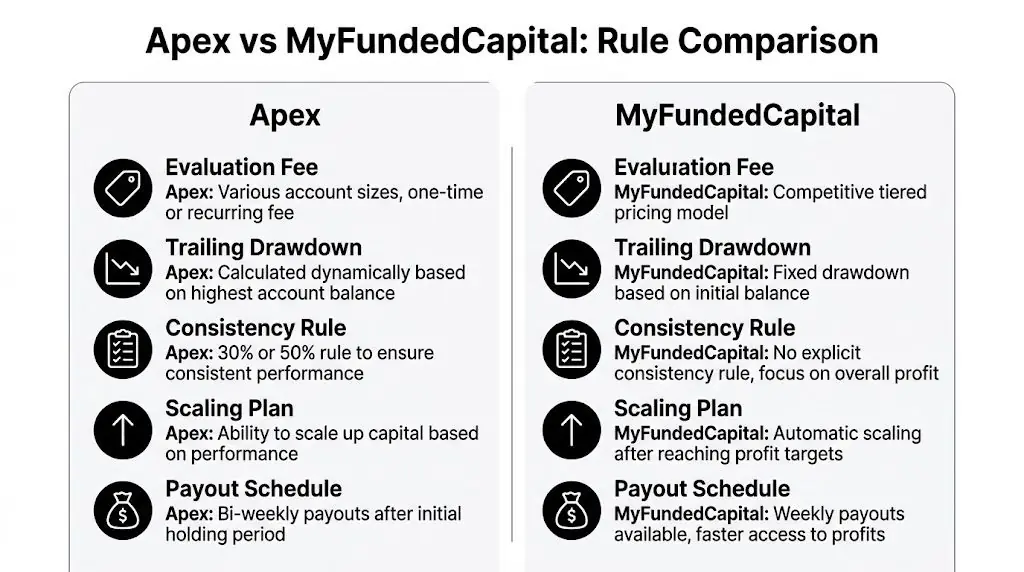
Apex is built around tight control of intraday futures risk. That shows up in the trailing drawdown model, payout-related consistency checks, and restrictions that can limit hedge-style positioning or event-driven tactics. Traders who do best there usually run a clean, directional process and stay very aware of where the drawdown line sits during the session.
MyFundedCapital, based on the comparison angle used in this article, suits a different type of operator. If your strategy depends on fixed loss limits, broader market access, optional news participation, weekend holds, or supported algorithmic execution, that framework may require less adaptation. Apex can still work, but some strategies need to be simplified to fit the rules rather than traded as originally designed.
The practical question is simple. Do you want to trade your existing edge with minor adjustments, or rebuild the edge around the firm’s constraints?
Rule comparison table
| Rule Parameter | Apex Trader Funding | MyFundedCapital |
|---|---|---|
| Drawdown style | Trailing drawdown remains the main risk line you manage throughout the account | Flat daily and max drawdown framework in the provided publisher brief |
| Consistency requirement | Consistency controls affect payout planning under the Apex model | No explicit consistency rule stated in the provided publisher brief |
| News trading flexibility | Restrictions around one-direction exposure and anti-hedging can reduce event-trading options | Optional news-trading add-ons in the provided publisher brief |
| Weekend holding | Less practical for traders who want to carry positions through the weekend under the comparison framing used here | Optional weekend-holding add-ons in the provided publisher brief |
| Instrument focus | Futures-focused structure | Broad CFD-style access across forex, indices, crypto, and commodities in the provided publisher brief |
| Automation posture | Active supervision is expected, and hands-off system use faces tighter limits in the referenced Apex material | Manual, algorithmic, and copy trading supported in the provided publisher brief |
Which trader usually fits each firm better
Apex tends to fit:
- Intraday futures traders
- Traders who actively manage trailing risk
- Traders who can distribute profits across multiple sessions
- Traders who do not rely on hedge-style execution or extended holds
MyFundedCapital tends to fit:
- FX and CFD traders
- Swing traders who want weekend flexibility
- Traders using algos or copy-based models
- Traders who prefer fixed loss parameters over trailing mechanics
One more point matters. Apex often rewards discipline, but it also punishes hesitation around rule mechanics. A trader can make good reads and still lose the account by mismanaging the trailing threshold, overconcentrating one profit day, or using a structure that looks fine in a personal account but creates friction under firm review. For that reason, rule quality is not just about how strict a firm is. It’s about how naturally your strategy fits the framework.
For reference on Apex’s own payout and rule context, see Apex 3.0 payout and trading rules support context.
A good rulebook supports your process. A bad fit forces constant translation, and that usually shows up in execution before it shows up in PnL.
Practical Tips for Staying Compliant
Most Apex problems don’t come from not knowing the rules. They come from knowing them in theory and then trading too fast to apply them.
A daily compliance routine that actually works
Before the session starts, run this checklist:
- Check your account stage Eval and PA don’t demand the same mindset.
- Know your current risk line If you can’t state your remaining room clearly, you’re trading blind.
- Mark any news periods If your strategy becomes messy around event spikes, decide in advance whether you’ll stand down.
- Set exits before entry Don’t rely on manual improvisation in fast markets.
- Review your largest profit day if you’re nearing payout That stops consistency surprises later.
In-session habits that save accounts
During the session, keep your process plain:
- Trade one plan, not three. Rule-heavy environments punish impulsive style switching.
- Reduce size after strong early gains. Protecting progress is often better than pressing for one more home run.
- Flatten when your read degrades. Confusion is expensive in trailing models.
- Avoid “repair trades.” The trade taken to fix the prior mistake is usually the one that creates significant damage.
Weekly review points
At the end of the week, review these areas:
| Review item | What to look for |
|---|---|
| Rule pressure points | Where you felt tempted to bend process |
| Profit distribution | Whether one day is doing too much |
| Position sizing | Whether size matched your current account stage |
| News behavior | Whether volatility changed your discipline |
| Automation oversight | Whether your execution still required active judgment |
A short journal matters here. Not a novel. Just enough to show what you traded, why you traded it, and whether the method stayed inside the framework.
What seasoned traders do differently
They stop treating compliance as a separate task.
The best prop traders bake it into the setup itself. If a trade can only work by flirting with the threshold, relying on a hedge-like workaround, or concentrating too much profit into one burst, they skip it. That discipline feels restrictive at first. Then it starts to feel efficient.
Frequently Asked Questions About Apex Rules
Can I pass the evaluation quickly and then slow down in PA?
You can trade the phases differently, but you shouldn’t assume that what worked in the evaluation will automatically work in PA. The evaluation can reward clean objective-hitting. The PA demands cleaner profit distribution, payout readiness, and tighter behavior around firm restrictions.
What if I have one huge winning day?
That isn’t automatically bad. It becomes an issue if that day makes up too much of your total profit when you request a payout. If that happens, the practical solution is usually to keep trading smaller, controlled sessions until the balance is more evenly distributed.
Can I hedge or hold both directions during news?
Under the referenced Apex rules, traders must hold in one direction only during high-volatility news conditions, and hedge-style or opposing correlated positions can create compliance issues. If your strategy depends on two-sided exposure, Apex may not be the right framework for it.
Is automation allowed?
Not in a fully hands-off way under the referenced Apex summaries. Active trader involvement is expected. If you use automation or semi-automation, keep it supervised and documented so your trade behavior still reflects trader control rather than unattended system activity.
Conclusion Your Path to Compliant Prop Trading
Apex trading rules can work well if your method is built for controlled intraday futures trading. The traders who do best there usually respect the moving drawdown, distribute profits over time, and avoid clever workarounds that look questionable under review.
The hard truth is simple. A profitable strategy still fails if it doesn’t fit the firm’s rulebook. That’s why comparing rules before you buy an evaluation is smarter than learning them after a denial or breach.
Trading involves risk of loss. Use these rules as a filter for fit, not just as hurdles to clear. If the framework matches your style, trade it with discipline. If it doesn’t, look for a model that does.
If you want a prop firm with clearer loss limits, support for manual and algorithmic trading, and flexible paths like instant funding or challenge accounts, explore MyFundedCapital and compare which program best fits your strategy.