Wondering how to trade significant crypto positions without risking your own capital? Crypto prop trading firms offer a solution by providing skilled traders with access to the firm's capital. This guide explains how they work and what you need to know to choose the right one.
The Business Model of Crypto Prop Trading Firms
At its core, a crypto prop firm uses a performance-based model to find and fund talented traders. They are not brokers; they use their own capital to back traders who can prove their skills. It's a mutually beneficial arrangement: the firm profits from your successful trades, and you get to trade with more capital than you might otherwise have access to.
This model has grown significantly. Once a small niche, the prop firm industry is now a multi-billion-dollar market. Driven by interest in leveraged assets like crypto, global searches for prop firms surged by over 600% between 2020 and 2024. Today, with over 40 firms offering crypto trading, it's a primary asset class alongside forex. For more details, you can review this prop firm statistics report.
How the Process Works: A Step-by-Step Breakdown
The journey to becoming a funded crypto trader is structured to identify traders who can manage risk and generate consistent returns.
Here’s a practical look at the steps involved:
- The Evaluation (Challenge) You pay a one-time fee to enter an evaluation on a simulated account. The goal is to hit a specific profit target (e.g., 8-10%) without violating strict risk rules, such as a daily loss limit.
- The Funded Account After successfully passing the evaluation, you are given a funded account. It's important to understand that you are still trading on a simulated account. The firm mirrors your trades with its real capital in the live market.
- The Profit Split You trade the funded account according to the rules. At the end of each payout period (e.g., bi-weekly), you receive a share of the profits you generated, typically between 70% and 90%.
This structure allows firms to manage their capital effectively. By using simulated accounts, they can assess performance without giving traders direct access to live funds, protecting them from catastrophic losses. Your earnings are based on the profit-sharing agreement.
Disclaimer: All trading involves a significant risk of loss. This content is for educational purposes only and should not be considered financial advice.
A Practical Framework for Choosing a Prop Firm
Selecting the right crypto prop firm requires more than just looking at the advertised account size. You need a practical framework to compare firms based on the rules and financial terms that directly impact your trading style. This section provides a step-by-step approach to help you look past the marketing and focus on what matters.
Analyzing the Financials: Profit Splits and Fees
The profit split and evaluation fee are the first numbers you'll encounter, but they don't tell the whole story. A 90% split from one firm may seem better than an 80% split from another, but other factors can change the equation.
Here is a checklist of financial factors to consider:
- Profit Split This is your percentage of the profits. While higher is generally better, a 75% split with flexible rules can be more valuable than a 90% split with rules that are difficult to follow.
- Evaluation Fee Compare the fee against the account size and challenge difficulty. A $500 fee for a $100k account is a common benchmark. Also, consider if the profit targets and drawdown limits are realistic for the price.
- Fee Refunds Does the firm refund your evaluation fee with your first or second payout? A fee refund is a strong indicator that the firm is invested in your long-term success.
Understanding the Rules of Engagement
Trading rules are where most traders succeed or fail. The two most critical rules to understand are the drawdown limits, which define how much you can lose before your account is closed.
- Static Drawdown: A fixed loss limit based on your initial account balance. For example, on a $100,000 account with a 10% static drawdown, your equity cannot fall below $90,000. It is predictable and easier to manage for most trading styles.
- Trailing Drawdown: A dynamic loss limit that follows your account's highest value (high-water mark). If your $100,000 account grows to $105,000, a 10% trailing drawdown would set your new breach level at $94,500 ($105k – 10%). This can feel like a moving target and is often more challenging for traders who hold positions through pullbacks.
Choosing between static and trailing drawdown depends on your strategy. Scalpers might be comfortable with a trailing limit, while swing traders often require the stability of a static drawdown.
Beyond the Basics: Essential Overlooked Details
Finally, look beyond the main financial terms and rules to the operational details that affect your daily trading.
- Asset Availability Can you trade the crypto pairs you specialize in? Some firms only offer majors like BTC and ETH, while others provide a wider range of altcoins.
- Platform Stability Does the firm use a reliable platform like cTrader, DXtrade, or Match-Trader? A platform with poor execution can lead to losses or rule violations.
- Payout Schedule How often can you withdraw profits? Firms offering bi-weekly, weekly, or on-demand payouts provide greater flexibility. Check for any minimum withdrawal amounts.
- Weekend and News Trading The crypto market is open 24/7. A firm that requires you to close positions over the weekend is not aligned with the realities of crypto trading.
Systematically evaluating these points will help you find the best crypto prop trading firms for your specific needs. To learn more about different options, explore various funded trading accounts.
Comparing the Top Crypto Prop Trading Firms
Choosing the right crypto prop firm requires a detailed comparison of their specific rules and funding models. A firm's drawdown type might be ideal for a swing trader, while another's instant funding model may be better suited for a scalper. Understanding these nuances is key to making an informed decision.
Evaluation Models and Profit Targets
Most firms offer one of three evaluation models. The best choice depends on your confidence and trading style.
- 1-Step Challenge A single-phase evaluation where you must hit a profit target, typically 10%, to get funded. This is a good option for confident traders who want to access a funded account quickly.
- 2-Step Challenge The evaluation is split into two phases with lower profit targets. For example, you might need to achieve an 8% profit in Phase 1 and a 5% profit in Phase 2. This model offers more forgiving rules and is suitable for traders who prefer a more measured approach.
- Instant Funding This model allows you to skip the evaluation process by paying a higher one-time fee for direct access to a funded account. However, drawdown limits are often tighter. This is best for experienced traders with a proven track record of consistent profitability.
Drawdown Types and Risk Limits
Misunderstanding drawdown rules is the most common reason traders fail evaluations. This is the single most important factor for long-term success.
A static drawdown is a fixed percentage of your starting balance. With a $100,000 account and a 10% max drawdown, your equity cannot drop below $90,000. This provides a stable floor, which is beneficial for swing traders who need to hold positions through market volatility.
A trailing drawdown adjusts with your account's high-water mark. If a $100,000 account reaches a peak of $105,000, a 10% trailing drawdown means your new breach level is $94,500 ($105,000 – 10%). This type is often better suited for day traders who close positions quickly.
A key factor for crypto traders is whether a firm allows holding trades over the weekend. Since the crypto market operates 24/7, firms that force you to close positions on Friday are not practical for this asset class.
This infographic highlights the three core financial elements to evaluate: the profit split, maximum drawdown, and the joining fee.
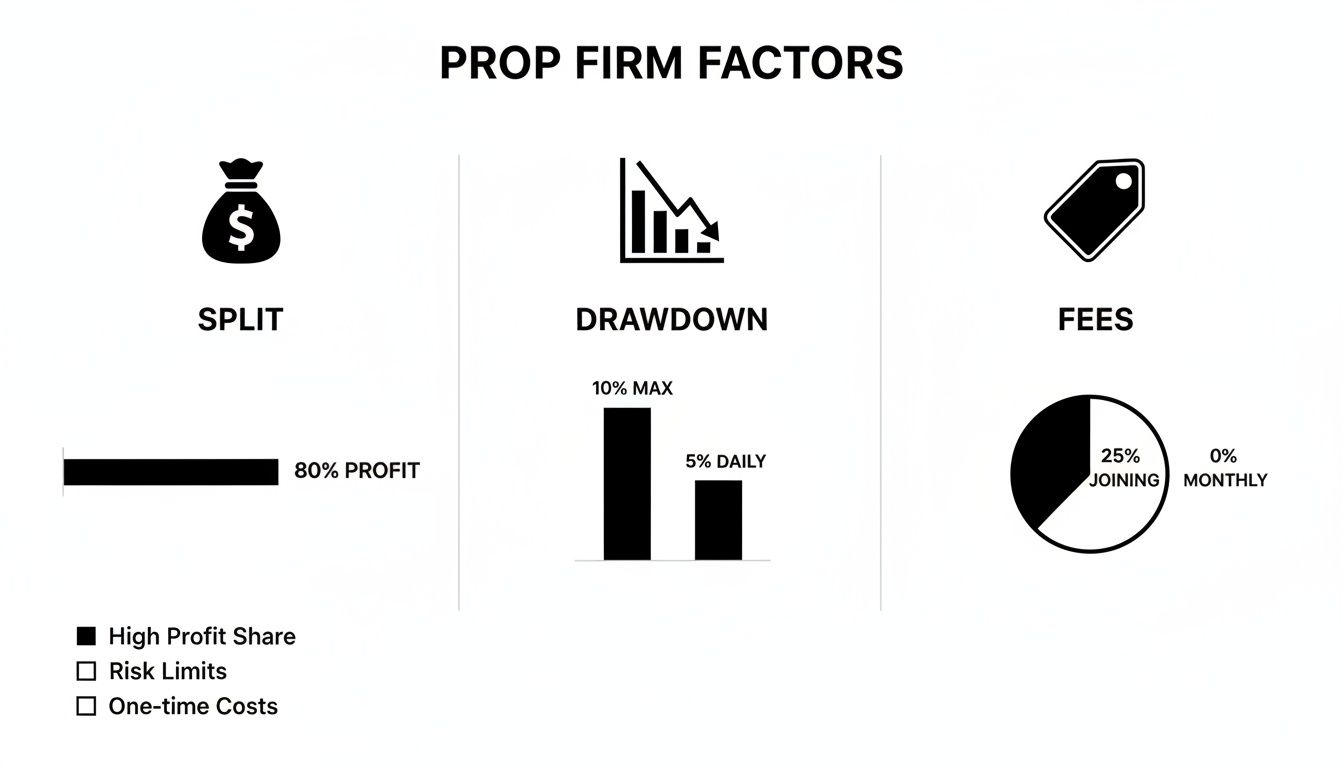
These three components form the financial foundation of your agreement with a prop firm and directly influence your earning potential and risk tolerance.
Fees, Profit Splits, and Payouts
The financial terms offered by crypto prop firms are highly competitive. It's now standard to see account sizes up to $300,000, with scaling plans that allow traders to manage over $1.28 million. Profit splits have also increased, with many firms offering 80–90%. You can find more data on the highest prop firm payouts in the crypto space.
Here are some typical numbers:
- Fees A one-time fee of $400 to $600 for a $100k challenge is common. Look for firms that refund this fee with your first payout.
- Profit Splits 80% or higher is the industry standard. A lower split should be justified by other benefits, such as more lenient rules.
- Payout Frequency Top firms now offer bi-weekly or even weekly payouts, providing greater flexibility for managing your finances.
Crypto Prop Firm Feature Comparison
To help you compare, here is a table illustrating how different firms might structure their offers. This uses hypothetical examples to highlight key trade-offs.
| Feature | MyFundedCapital | Competitor A | Competitor B | Competitor C |
|---|---|---|---|---|
| Evaluation Model | 1-Step, 2-Step, Instant | 2-Step Only | 1-Step Only | Instant Only |
| Profit Target | 10% (1-Step), 8%/5% (2-Step) | 10%/5% | 12% | N/A |
| Max Drawdown | 10% Static | 12% Static | 8% Trailing | 6% Static |
| Daily Drawdown | 5% Static | 5% Static | 4% Static | 3% Trailing |
| Profit Split | Up to 100% | 80%, scales to 90% | 75% flat | 70%, scales to 85% |
| Payout Frequency | Bi-weekly (7-day add-on) | Monthly | Bi-weekly | On-Demand |
| Weekend Holding | Yes (with add-on) | No | Yes | Yes |
As the table shows, there is no single "best" firm. The right choice depends on your individual trading strategy and risk management style.
The Reality of Prop Firm Challenge Pass Rates

While the prospect of a large funded account is appealing, it's important to have realistic expectations. Prop firm challenges are difficult by design. Success requires a solid strategy and disciplined execution.
Understanding the Numbers Behind Prop Firm Challenges
The statistics show that passing a prop firm evaluation is challenging. Across the industry, pass rates are low, highlighting the need for consistency and discipline.
- Industry-wide data indicates that only about 5–10% of traders pass the initial evaluation.
- Of those who pass, only around 7% remain funded long enough to make consistent withdrawals.
- Independent analysis, such as this crypto prop firm statistics report from 2026, suggests that 90–95% of all traders fail.
Most failures are not due to an unprofitable strategy but rather a breach of the daily or maximum drawdown rules. This underscores the importance of risk management.
Common Reasons Traders Fail Evaluations
The high failure rate is often due to common trading mistakes that are amplified under the pressure of an evaluation.
Most failed attempts can be attributed to one of these three issues:
- Breaching Drawdown Limits This is the most frequent reason for failure. A single overleveraged trade can cause you to hit the daily or max drawdown limit, resulting in immediate disqualification.
- Emotional Trading The pressure to meet a profit target can lead to poor decisions, such as revenge trading after a loss or taking excessive risks.
- Lack of a Specific Plan Many traders fail to adapt their strategy to the firm's specific rules. They do not calculate their risk per trade relative to the drawdown limits, leading to accidental breaches.
The evaluation is a test of your ability to follow rules under pressure. Firms are looking for disciplined risk managers.
Balancing High Risk with High Reward
Despite the low pass rates, the reward for success is significant. Access to a $100,000 account provides leverage that would be difficult to obtain otherwise without risking personal savings.
The key is to approach the challenge as a professional audition to demonstrate your ability to manage capital responsibly. The low pass rates act as a filter to identify traders with the discipline required to manage large accounts. By understanding the challenges and building a strategy around the rules, you can improve your chances of success.
Your Step-By-Step Checklist to Get Funded

Ready to pursue a funded account? A structured plan is essential for success. This checklist provides a step-by-step guide to help you stay disciplined throughout the process.
Disclaimer: This checklist is for educational purposes and is not financial advice. All trading involves substantial risk of loss.
1. Build Your Prop-Firm-Ready Trading Plan
Before purchasing a challenge, ensure your trading plan is adapted to the firm's rules. A generic strategy is not enough.
Your plan should answer these questions:
- What is your trading edge? Define a repeatable method for identifying and executing trades in the crypto market.
- What is your risk per trade? Calculate your position size based on the firm's drawdown limits. On a $100,000 account with a 5% daily drawdown limit ($5,000), a 1% risk per trade means your maximum loss on that trade should be $1,000.
- How will you manage trades? Establish clear rules for entry, exit, and stop-loss placement, and adhere to them without exception.
2. Prepare Your Mindset and Environment
The psychological pressure of an evaluation is significant. Your mindset is as important as your strategy.
- Treat it like a job interview Your goal is to demonstrate that you are a consistent and disciplined risk manager.
- Eliminate distractions Create a focused trading environment. The evaluation period requires your full attention.
- Accept the risk View the challenge fee as a business expense. If you fail, you gain experience. If you pass, you get funded.
Focus on executing your plan perfectly on every trade. The profits will follow from good process, not from chasing a target.
3. Track and Review Your Progress
During the challenge, your trading journal is your most valuable tool for making objective decisions.
- Log every trade Record your entry, exit, stop-loss, and the rationale for each trade.
- Review daily performance At the end of each day, compare your trading against your plan. Monitor your proximity to the drawdown limits.
- Take a break if needed If you are approaching a drawdown limit, it is better to stop trading for the day than to risk disqualification.
Passing the challenge is the first step. The same discipline that gets you through the evaluation is essential for long-term success with crypto prop trading firms.
FAQ: Your Crypto Prop Firm Questions Answered
Here are answers to some of the most common questions aspiring prop traders ask.
Can I hold my crypto trades over the weekend?
This depends entirely on the firm. Many traditional prop firms prohibit holding positions over the weekend, which is a significant disadvantage for crypto traders, as the market operates 24/7. Firms designed for crypto, like MyFundedCapital, often provide options that allow weekend holding. Always verify this policy before starting a challenge.
What happens if I break a trading rule?
If you violate a core rule, such as the daily loss limit or maximum drawdown, your account will be closed immediately and automatically. There are no second chances; the evaluation or funded account is terminated. To try again, you must purchase a new challenge. This is why consistent risk management is crucial.
Is the profit I earn real money?
Yes, the payouts you receive are real money. However, you are trading on a simulated account. The prop firm mirrors your successful trades in the live market with its own capital. Your payout is a share of the virtual profits generated in your simulated account. For example, with an 80% profit split, a $10,000 profit in your account results in a real cash payout of $8,000.
Are crypto prop trading firms legitimate?
Yes, many crypto prop trading firms are legitimate businesses that offer a valuable service to skilled traders. However, as with any industry, it is important to do your research. Look for firms with a transparent rule structure, a history of consistent payouts, and positive reviews from other traders. A reputable firm will have clear terms and conditions and responsive customer support.
Think you have what it takes to become a funded trader? Our programs are designed specifically for crypto traders, with clear rules, flexible options, and reliable payouts.