You've passed a trading challenge, but now what? The term "step 3 profit" cuts right to the chase—it’s the critical phase where you transition from proving your skills to earning real, withdrawable cash. This guide breaks down exactly what it takes to reach this stage, manage a funded account, and secure your first payout.
Free tool: find the date your next payout request opens with our payout date calculator.
Free resources: Prop Trading Challenge Survival Guide (the math behind the rules and the habits that get traders through).
What "Step 3 Profit" Really Means for Your Trading
Think of passing a trading challenge as graduating from flight school. You've aced the simulators (the evaluation phases). Now, the prop firm hands you the keys to a real jet with real capital. That's your funded account. In prop trading, Step 3 profit is the money you earn after you’ve proven yourself and are trading with the firm's capital. This is the stage where your performance translates into real cash in your bank account.
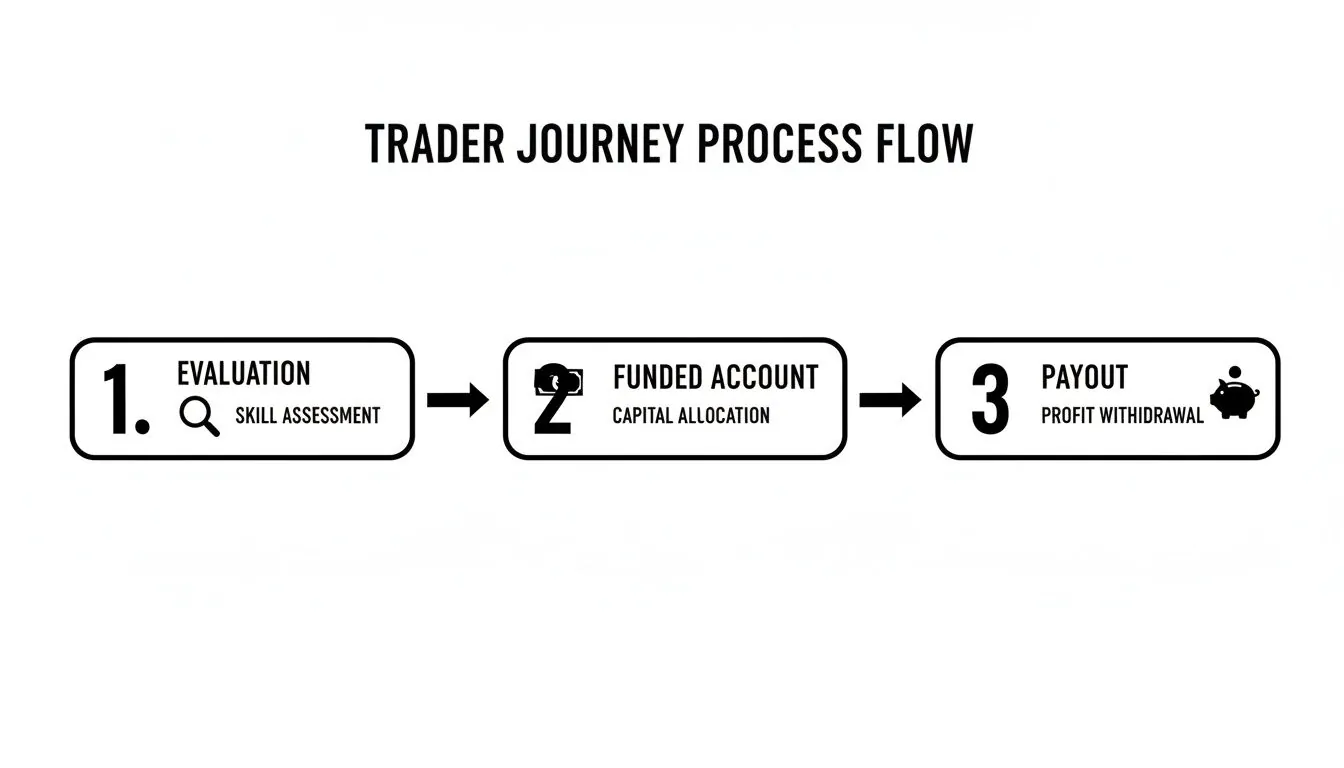
While the term isn't universal, it almost always refers to this final, funded stage where you become eligible for profit splits. It’s the finish line of the evaluation and the starting line of your funded trading career.
Your Path to the Payout Phase
Prop firms offer a few different models to get you to a funded account, but they all end at the same destination: the payout phase. Whether you take a 1-Step, 2-Step, or Instant Funding route, reaching Step 3 is where you finally get paid for your profitable trades.
The table below shows how a trader progresses through each model to finally reach the payout stage.
The Journey to Step 3 Profit Across Different Programs
| Stage | 1-Step Challenge Example | 2-Step Challenge Example | Instant Funding Model |
|---|---|---|---|
| Phase 1: Initial Test | Pass a single evaluation with a profit target (e.g., 10%). | Pass the first evaluation with a profit target (e.g., 8%). | No evaluation phase. |
| Phase 2: Confirmation | Not applicable. | Pass a second, less demanding evaluation (e.g., 5% profit target). | Not applicable. |
| Phase 3: Funded Account | You are funded and can start earning Step 3 profit for payouts. | You are funded and can start earning Step 3 profit for payouts. | You are funded immediately and can earn Step 3 profit from day one. |
No matter how you start, the goal is always to get to that final column—the funded account where you can generate withdrawable profits.
The Mental Shift: From Challenge Target to Capital Preservation
Moving to a funded account is a huge psychological shift. You're no longer chasing a profit target to pass a test. You are now running a business. Your primary job is not just hitting targets; it’s capital preservation. You have to protect the firm's money first, because without it, you have no business.
This final stage is still governed by strict rules. You must stay within the firm's drawdown limits—like daily and maximum loss—to keep your account. One bad day or one reckless trade that violates a rule can get your account taken away. This is where risk management becomes everything. Successfully navigating risk and psychology in the funded stage is what truly separates traders who just pass challenges from those who build a sustainable career. Remember that all trading involves risk of loss and past performance is not indicative of future results.
How Profit Splits and Payouts Actually Work
Making it to the funded stage is a huge win, but turning screen profits into cash in your bank account is the real goal. Understanding how profit splits and payout schedules work is just as vital as mastering your trading strategy. Once you’re trading a live funded account, you’re in a partnership. You bring the skill, and the prop firm provides the capital.
From PnL to Payout: A Practical Example
For the small percentage of traders who successfully navigate the challenges, the journey to step 3 profit can be significant. However, a deep dive into over 300,000 prop firm accounts showed that only about 7% of traders ever make it to a withdrawal. This statistic isn't to discourage you; it's to ground you in reality. For more details, see this full analysis of prop trading account performance.
The money you take home is determined by your profit split—the percentage of the net profit you’re entitled to. To better understand how profit is tracked, it's worth reading up on what PnL stands for.
Let's break it down with a concrete example:
- You're trading a $100,000 account with an 80% profit split.
- You have a good month and generate $5,000 in net profit.
- The math is simple: $5,000 x 80% = $4,000.
- You receive $4,000, and the firm keeps the remaining $1,000.
It’s a straightforward calculation that directly connects your trading skill to your bank account. The crucial catch? You must follow all account rules. Any profits made while violating a rule (like the maximum drawdown limit) are almost always forfeited.
Understanding Payout Cycles
Firms process withdrawals on a set schedule, which dictates how often you can get paid. Knowing these cycles is key to managing your cash flow.
Here are the most common schedules:
- Bi-Weekly This is a popular standard. You can request a withdrawal every 14 days.
- Weekly A faster option some firms offer, sometimes as an add-on, allowing you to get paid every 7 days.
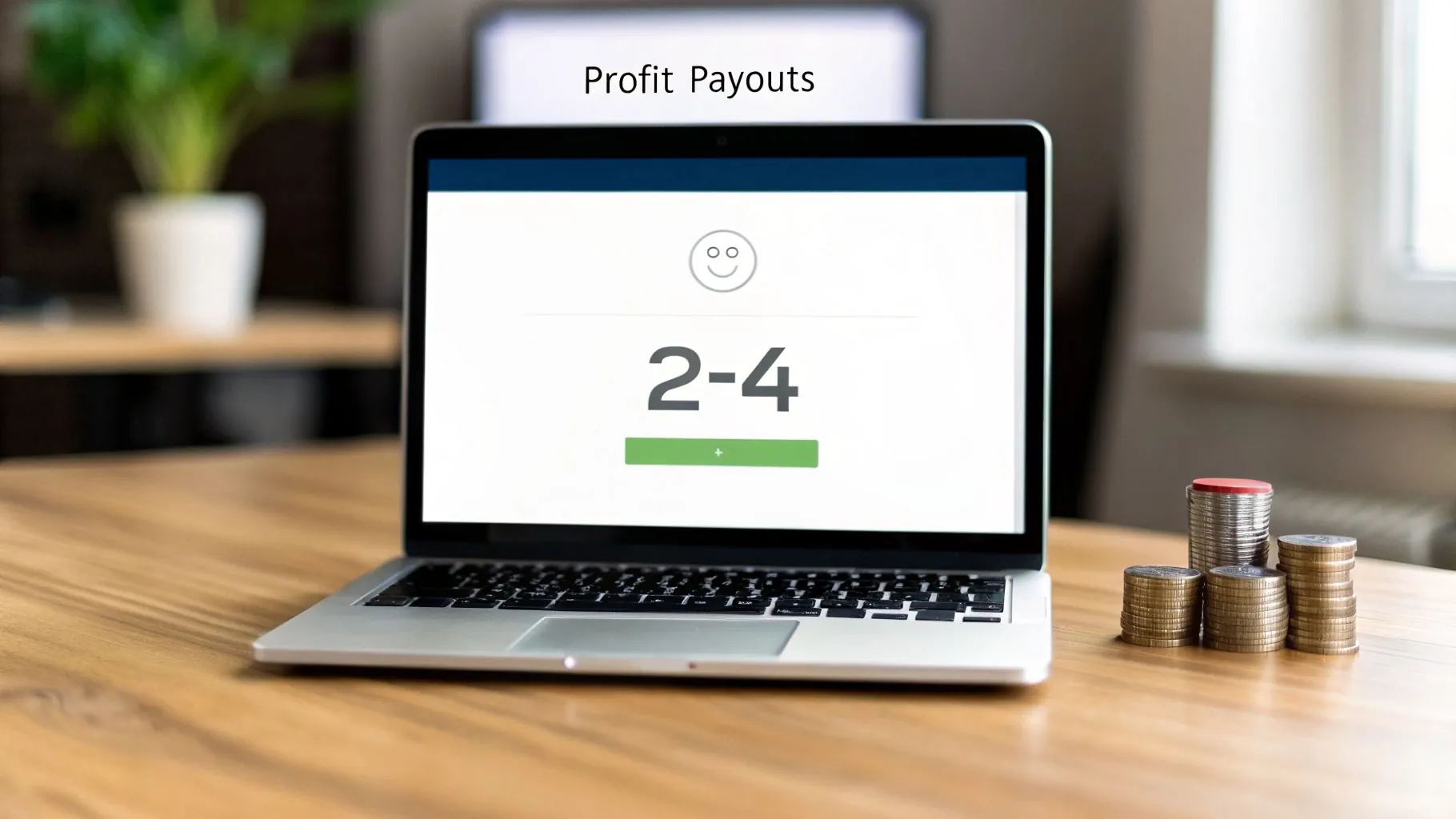
- On-Demand The most flexible choice. After an initial waiting period (typically 14-30 days), you can request a payout whenever you want.
The process itself is usually painless. You submit a request via your dashboard, and the firm sends your funds. Just be aware that the very first payout often has a longer waiting period, as the firm establishes a baseline of your performance.
Navigating the Rules to Secure Your Profits
Passing the challenge is a huge win, but keeping the funded account is a different game. This is where your ability to protect capital—and lock in that Step 3 profit—gets tested. The rules that felt like a concept during the evaluation are now the guardrails keeping you in the game. You must play by these rules. Two numbers, above all others, will decide whether you're cashing a payout or getting an "account breached" email: maximum daily drawdown and total drawdown.

The Two Rules That Matter Most
On a live account, every tick counts. The mindset has to shift from chasing a profit target to defending your account balance.
Let's break it down with a scenario:
- Account Size $100,000
- Maximum Daily Drawdown 5% ($5,000)
- Total Drawdown 10% ($10,000)
Your daily drawdown is the most your account is allowed to lose in one day, calculated from your starting equity or balance. A 5% limit means your account balance can't drop by more than $5,000 in a 24-hour window. If your equity dips to $94,999, even for a second, you've violated the rule.
The total drawdown is the absolute floor for your account. A 10% limit means your account equity can never fall below $90,000. Some firms use a static drawdown, while others use a trailing one. It is critical to understand the difference. If that sounds confusing, read our guide explaining what trailing drawdown is.
How a Funded Account Can Disappear
It’s easy to lose a funded account. The pressure of trading real firm capital changes things, and an aggressive style can become your biggest liability. Your number one job as a funded trader is to protect the account. Profit is a byproduct of great risk management, not the other way around.
Picture this: you're trading that $100,000 account. You put on a trade with a slightly-too-large position, and it immediately moves against you. Your loss swells to $5,500. Boom. You just breached the 5% daily drawdown limit, and the account is gone. This scenario plays out far too often, fueled by emotion and a chain of poor risk decisions.
From Rule Follower to Profit Taker
To avoid this common pitfall, you must switch to a defense-first mindset.
Essential Habits for Staying Funded:
- Define Your Risk Per Trade Never risk more than 0.5% – 1% of your account on any single idea. On a $100,000 account, that means your max loss is capped at $500-$1,000.
- Use a Stop-Loss Religiously Every trade needs a pre-defined stop-loss. No exceptions. This is your non-negotiable safety net.
- Know Your Daily Limit If you find yourself down 2-3% on the day, consider shutting it down. Don't be a hero.
- Focus on Consistency, Not Size Stick to the strategy that got you here. Don't suddenly increase your position size trying to hit a home run.
When you respect the rules and manage risk with an iron will, you're not just trading—you're building a sustainable career.
Actionable Strategies to Reach and Protect Step 3 Profit

Passing a challenge is one thing; getting paid is another. Locking in that first Step 3 profit requires unshakable discipline. Let's break down the three pillars that separate traders who earn payouts from those who don't: mastering the mental game, enforcing ironclad risk rules, and executing with precision.
The Psychological Game of Live Capital
The second your account goes live, the pressure changes. It’s no longer about hitting an abstract profit target; it's about protecting real capital. This is where fear and greed creep in. The most successful funded traders play defense first. Their primary goal isn't to hit a home run today; it's to make sure they're still in the game tomorrow. This mental flip is everything.
Bulletproof Risk Management Checklist
Strict risk management is your only shield. These are the non-negotiable rules you set before you're in a trade.
- Strict Risk-Per-Trade Limit Decide on the maximum you're willing to lose on any single trade, typically 0.5% to 1% of your account.
- Always Use a Stop-Loss Every trade needs a pre-calculated stop-loss set the moment you enter. This is your circuit breaker.
- Know Your Daily Loss Limit Have a "kill switch." If you hit a certain loss level (e.g., 2% daily loss), you shut it down and walk away.
Practical Example: On a $50,000 account, risking 0.5% per trade caps your maximum loss per position at $250. With a rule like that, you could take several losses in a row and still be nowhere near your drawdown limits.
High-Probability Trade Execution
Being a funded trader means you've earned the right to be incredibly picky. You don't have a deadline, so the temptation to overtrade can be immense. Resist it. Consistent profitability comes from quality, not quantity.
Only take your A+ setups—the ones that tick every box in your trading plan. If it's not a "hell yes," it's an immediate "no." This patience keeps you from chipping away at your capital with low-probability trades born out of boredom. By combining psychological discipline, a rigid risk framework, and selective execution, you create a robust system to not only reach your Step 3 profit but protect it long enough to get paid.
Choosing the Right Prop Firm Program for Your Style
The path to a funded account isn't one-size-fits-all. Choosing the program that fits your trading style is your first strategic decision on the road to step 3 profit. At MyFundedCapital, we've built a few different ways to get funded so you can align the program's rules with your personal edge.
Comparing Your Funding Options
Let's look at the three main models, each designed for a different type of trader.
- 1-Step Challenge Built for the decisive trader. If you’re confident in your strategy, this is your most direct route. You have one job: hit a 10% profit target.
- 2-Step Challenge The classic path for traders who prefer a more measured approach. It splits the goal into two phases (Phase 1: 8%, Phase 2: 5%), taking some of the psychological heat off.
- Instant Funding For traders with a solid track record who want to skip evaluations entirely. You get a live simulated account from day one and can become eligible for your first payout in as little as 14 days.
The "best" program is the one that minimizes your psychological stress and lets you trade your system cleanly. Be honest with yourself about your strengths. To see how they stack up, check out our guide on the best funded trader programs we offer. Getting this choice right is a crucial first move.
Frequently Asked Questions (FAQ)
What is the most common reason traders fail to reach payouts?
The most common reason is a failure to switch from an aggressive "challenge" mindset to a defensive "capital preservation" mindset. Many traders pass challenges with a high-risk style that isn't sustainable on a live funded account. Once funded, they break risk management rules, hit drawdown limits, and lose the account before securing a payout.
How is the profit split calculated at MyFundedCapital?
It's based on the net profit in your funded account per payout cycle. If you're on an 80% split and generate $5,000 in profit, your share is $4,000. We offer splits up to 95% with an add-on. Payouts are on a fixed schedule (e.g., bi-weekly), with faster options like weekly or on-demand withdrawals available through add-ons.
Can I lose my funded account after taking a payout?
Yes. Earning a payout does not grant immunity from the rules. You must still respect the daily and maximum drawdown limits every single day. A single rule violation, even after successful withdrawals, will result in the account being forfeited.
Is there a minimum number of trading days for payouts?
For MyFundedCapital's Instant Funding programs, there are no minimum trading day requirements. On our challenge-based programs, your first payout is typically available after a set period, often 14 days from your first trade on the funded account. Always check the specific rules for your account type.
This content is for educational purposes only and is not financial advice. Trading involves a substantial risk of loss and is not suitable for every investor.
Ready to put this knowledge to work?
Explore our funding programs and find the right fit for your trading style.