You wire a machine-learning classifier into a trading account, watch the equity curve climb in backtests, and assume the difficult part is finished. Then live spreads, slippage, news gaps, data delays, and a prop firm's loss limits turn a promising signal into a losing system. This guide focuses on what keeps algorithmic trading using AI alive after deployment, from model choice and feature design to validation, execution, and hard risk controls.
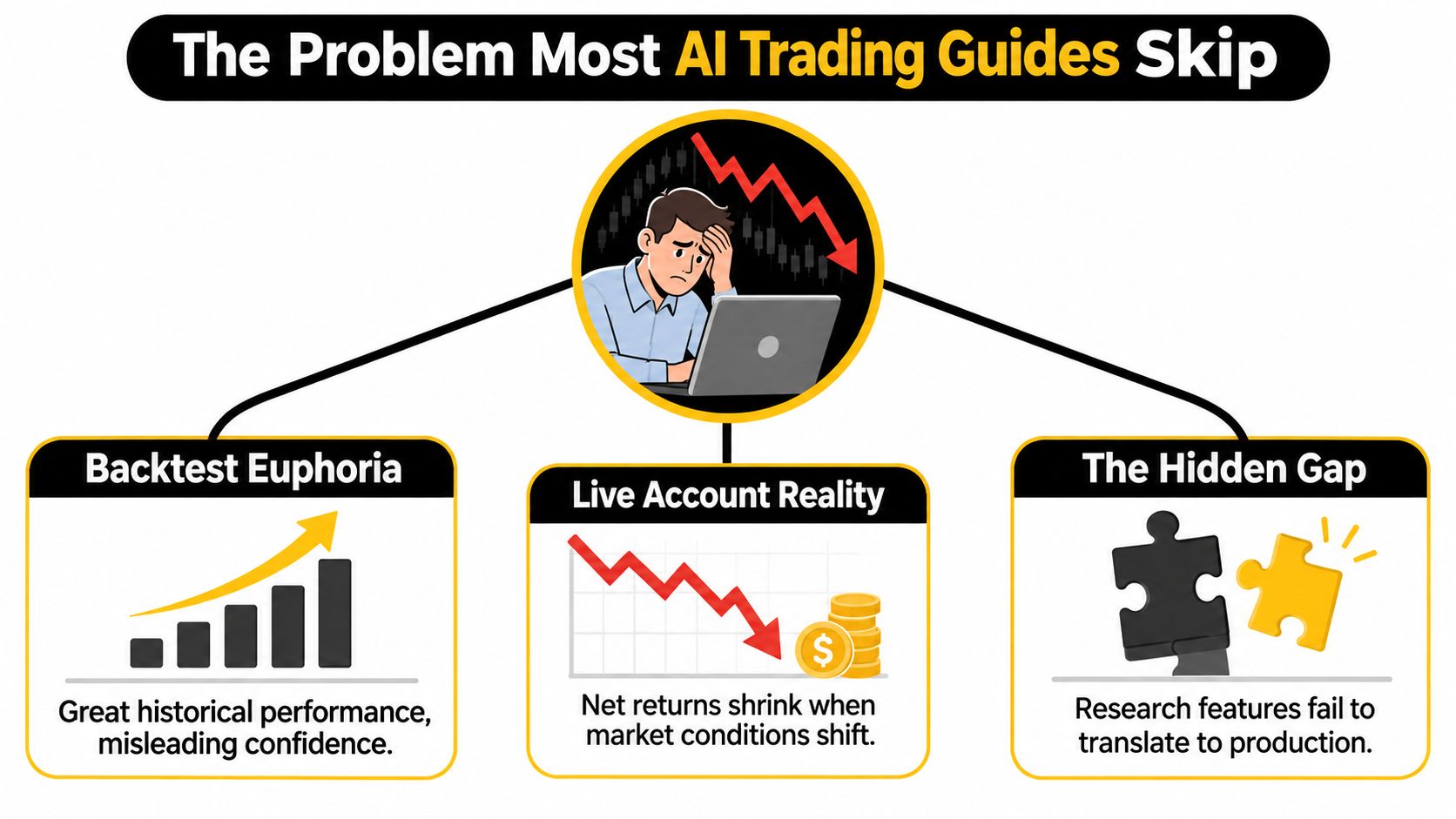
The Problem Most AI Trading Guides Skip
A classifier can be correct often enough in historical data and still lose money in a live account. The reason is simple: the backtest usually sees clean fills, stable data, and unlimited time to recover. A funded account sees changing liquidity, imperfect execution, correlated positions, and a fixed point at which trading must stop.
The useful question isn't “How accurate is the model?” It's “What evidence would justify continuing to run it after the market changes?” That question shifts attention from prediction alone to net performance, drawdown behavior, operational reliability, and evidence across different market conditions. Trading involves risk of loss, and no AI system guarantees profits.
Automation is older than modern AI
Algorithmic trading is broader than AI trading. It means using programmed rules to generate, route, or manage orders. Its roots extend to the 1970s, and the Toronto Stock Exchange's Computer Assisted Trading System, developed in 1977 and introduced for financial trading in 1990, was an early system capable of automating price formation. Similar electronic trading technologies spread across exchanges during the 1980s. Academic research on AI's development in financial markets places the wider implementation of AI engines in markets from the mid-2010s onward, after decades of electronic infrastructure.
A thermostat that turns heating on below a set temperature is rule-based automation. A learning thermostat studies household routines and adjusts its behavior from data. Both automate an action, but only one infers patterns or adapts model parameters.
That distinction helps you evaluate vendor claims:
- Supervised learning predicts a labeled target, such as next-bar direction or a realized-volatility bucket.
- Unsupervised learning groups observations, detects anomalies, or identifies possible market regimes without a labeled outcome.
- Reinforcement learning trains an agent through actions and rewards, often simulated P&L.
A simple moving-average crossover is algorithmic trading, even if it has no machine learning. A model that estimates whether a currency pair is likely to move over the next interval is an AI layer inside that automated process. Production quality still depends on data quality, execution technology, latency, position controls, and resilience when conditions change.
Practical rule: If a vendor can't explain what the model learns, what data was available at decision time, and how orders are controlled, “AI” may be a marketing label rather than a useful technical description.
Where AI Fits Best Across FX, Indices, and Crypto
AI is most useful when the task is narrow, the data is available at decision time, and the output connects directly to a trading decision. It's less convincing when it promises to forecast a distant price without defining the execution and risk process around that forecast.
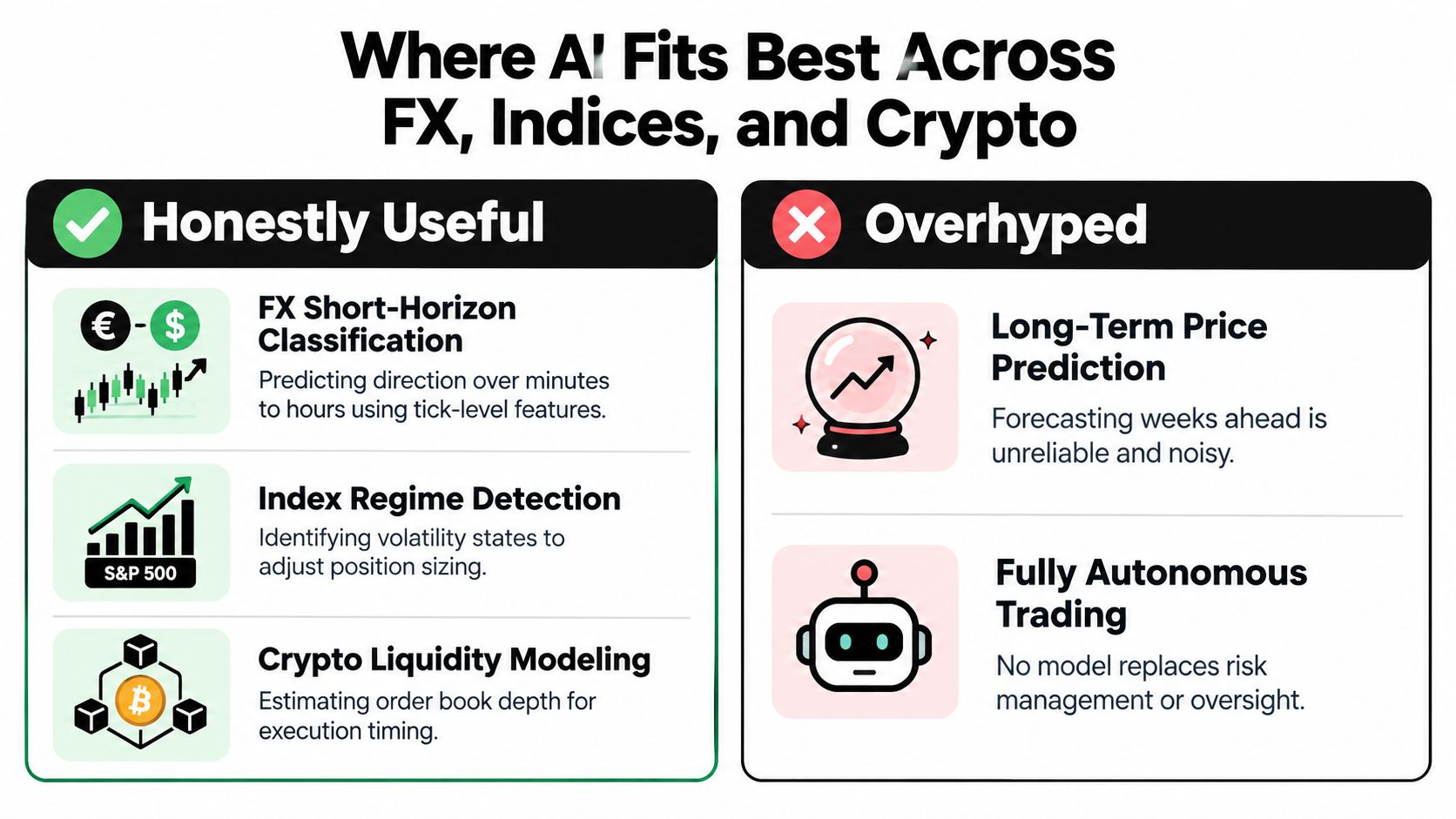
For FX, short-horizon classification can combine recent returns, spread, volatility, session information, and order-flow variables to estimate whether a move is more likely to continue or reverse. For indices, regime detection can identify changing volatility states and adjust exposure rather than pretending to know the exact next price. For crypto, sentiment and liquidity models can help interpret order-book depth, funding conditions, and trading activity across a market that doesn't have a traditional daily close.
Execution is another practical use. A model can decide whether to enter immediately, wait for improved liquidity, or divide a larger order into smaller pieces. That can be more defensible than asking an AI system to predict where an index will trade weeks from now.
The market is already heavily automated. The Alan Turing Institute reports estimates of approximately 50–70% of equity-market trades, around 60% of futures trades, and about 50% of Treasury trades being generated by computers, while another estimate places overall algorithmic participation closer to 40%. The Alan Turing Institute's finance report explains why these figures should be treated as ranges, not one universal ratio.
Asset details change the engineering decision:
- FX spreads and session liquidity can dominate a small short-term edge.
- Indices scheduled events can create abrupt jumps and poor fills.
- Crypto continuous markets, exchange fragmentation, funding, and changing liquidity require explicit assumptions.
- CFDs weekend gaps and broker-specific execution rules can invalidate otherwise clean research.
For broader guidance on structuring financial datasets before modeling, PlotStudio AI's financial analysis guide is a useful complementary resource. If you're comparing markets available for automated strategies, review MyFundedCapital's supported funded-trader markets before committing to an instrument.
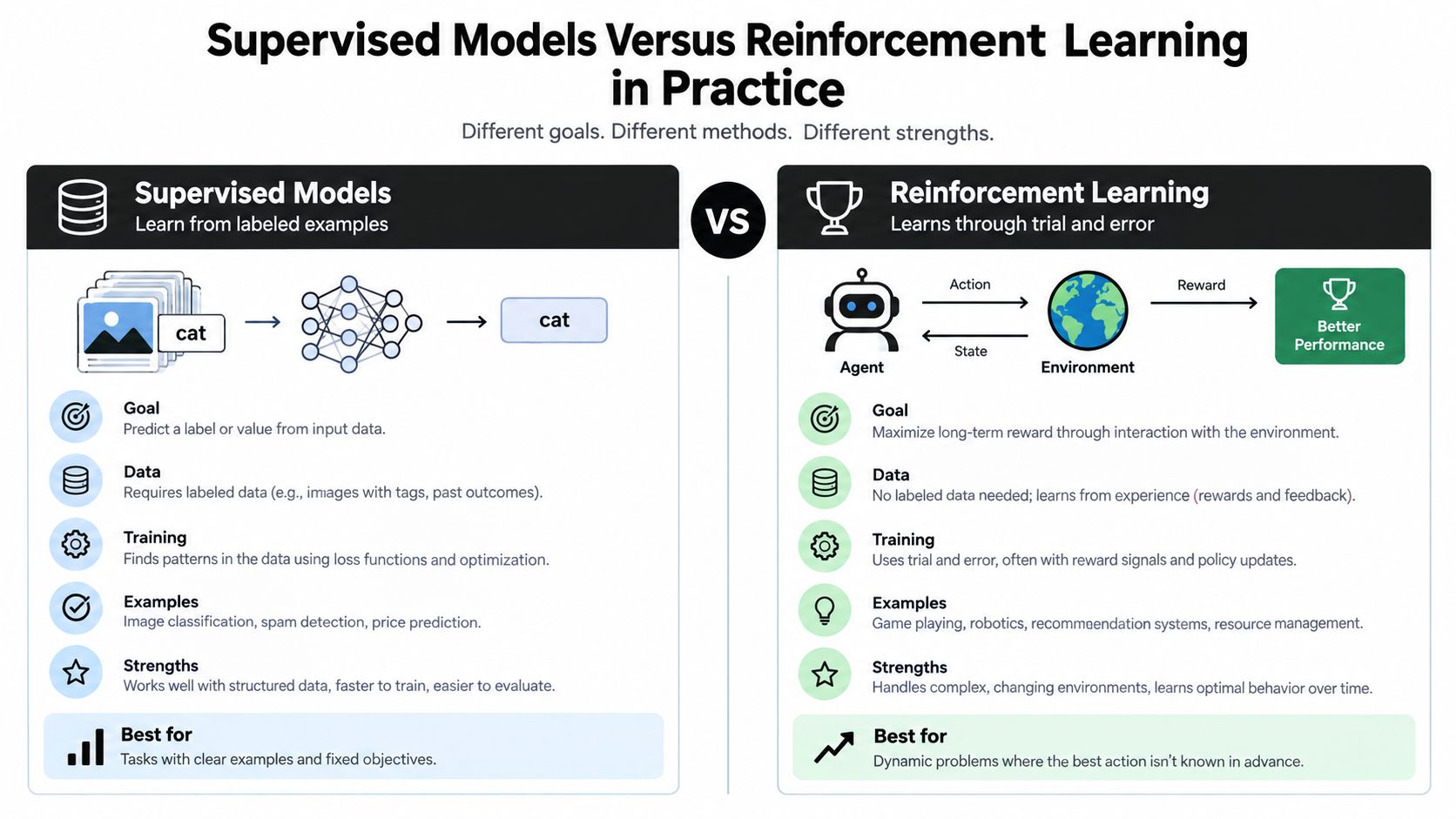
Supervised Models Versus Reinforcement Learning in Practice
Supervised learning resembles studying flashcards. You show the model examples with known outcomes, such as whether the next bar closed higher, and it learns a mapping from features to labels. Gradient-boosted trees are often practical for tabular market data, while sequence models can process ordered observations. The important point isn't the architecture's reputation. It's whether the target is stable, available without leakage, and useful after costs.
Reinforcement learning resembles learning to drive. The agent chooses an action, observes the result, and receives a reward. That flexibility makes it attractive for execution, position sizing, and portfolio decisions, but the simulator becomes part of the model. If the environment gives unrealistic fills or omits market impact, the agent learns to exploit the simulator instead of the market.
| Approach | Useful for | Common failure |
|---|---|---|
| Supervised learning | Direction, volatility, regime labels, and trade filters | Labels leak future information or predict a target that has no net trading value |
| Reinforcement learning | Execution policies, allocation, and sequential decisions | The agent exploits unrealistic simulation assumptions |
| Rules plus ML | Adding a filter or sizing adjustment to a transparent baseline | The ML layer adds turnover without adding net edge |
A deep-reinforcement-learning study provides a practical template by comparing DQN and PPO agents with buy, hold, and sell actions while applying a 0.1% cost per trade in the environment. The transaction-cost-adjusted reinforcement-learning study shows why the reward should reflect net trading friction rather than gross returns.
For most new systems, supervised learning is easier to validate and debug. I'd start with a transparent baseline, add a small model as a filter, and only use reinforcement learning when the problem requires sequential decisions. If the agent can make money only because the simulator grants perfect fills, it hasn't learned a tradable policy.
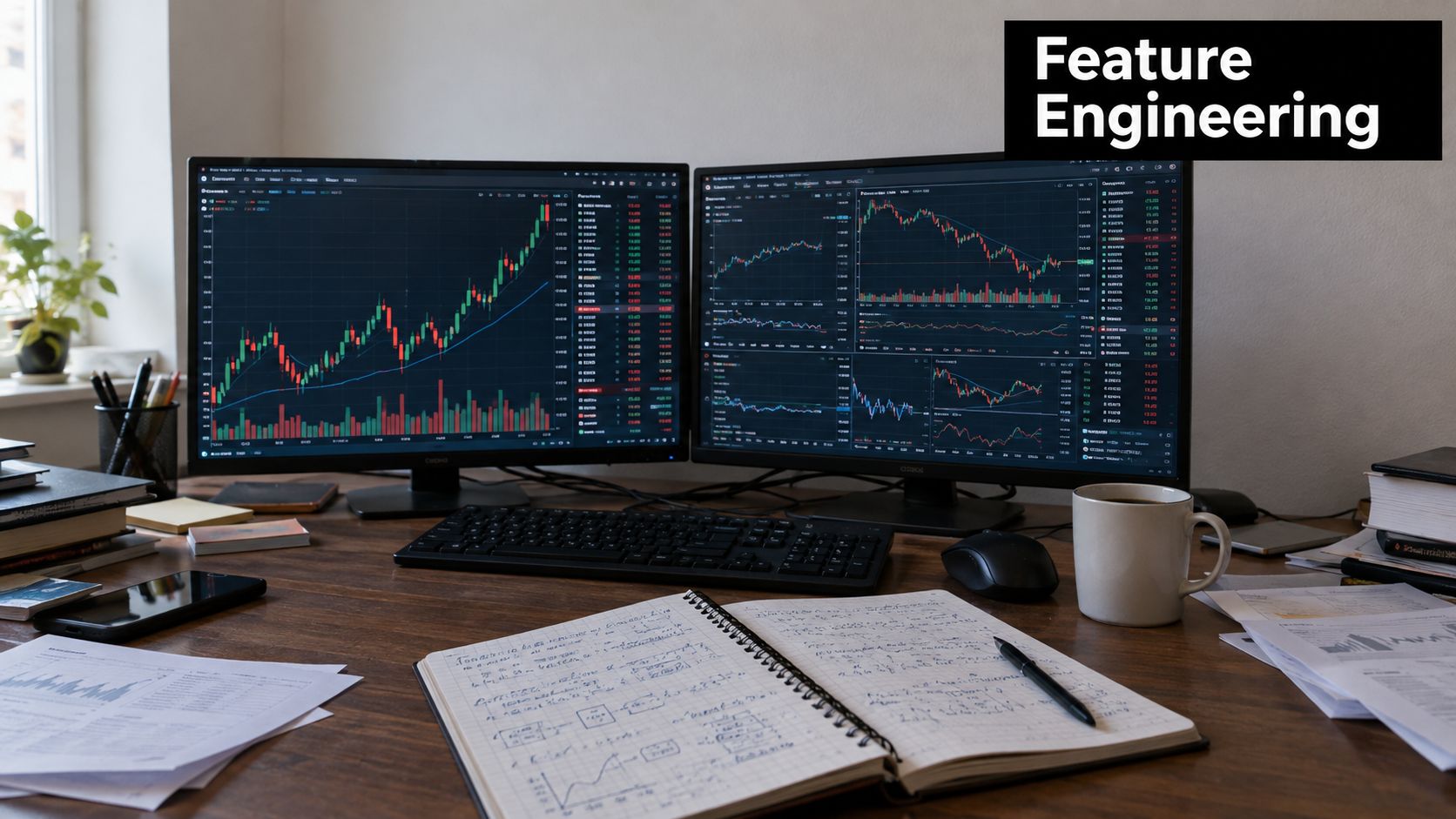
Feature Engineering That Survives a Live Account
Features fail in production when the research pipeline knows more than the live pipeline. A model can appear complex while depending on a timestamp, quote, sentiment release, or spread value that wasn't available when the order decision occurred.
Start with features that have a clear economic or microstructural interpretation:
- Price-derived inputs log returns, rolling volatility, range expansion, and order-flow imbalance.
- Cross-asset context rolling correlations, basis, term structure, or relative strength.
- Alternative data news sentiment, crypto funding rates, and options skew when the feed is timely and reliable.
- Calendar variables trading session, day of week, and time until a scheduled event.
Suppose each one-minute candle produces a row containing recent returns, realized volatility, current spread, and a sentiment score. Standardize variables when scale differences would distort training, and winsorize extreme values only through a process that can run identically in live trading. Store the calculation timestamp beside every feature so you can audit what the model knew.
A leakage checklist
Before training, ask:
- Was every input published before the decision timestamp?
- Did the feature use a completed bar or accidentally include the current bar's close?
- Were labels shifted correctly so the model never sees the outcome it predicts?
- Did the preprocessing fit only on training data?
- Can the live system recreate the exact same transformation?
The final question catches many failures. If research uses a cleaned vendor dataset but production uses delayed or incomplete broker data, the model isn't receiving the same inputs. Feature engineering should create an auditable pipeline, not a mysterious collection of columns that happened to rank well in a notebook.
Backtesting Pitfalls That Destroy Real Returns
The strongest backtest is often the one that has survived the fewest questions. Run enough combinations of features, symbols, time windows, and hyperparameters, and something will look exceptional by chance. That's multiple-testing bias, not proof of a durable edge.
Look-ahead bias is more direct. It appears when labels aren't shifted properly, when a revised data series replaces the information originally available, or when a trade receives the same bar's idealized closing price. Survivorship bias creates another distortion by leaving failed or delisted instruments out of the historical universe.
A validation protocol that earns trust
Use a process that makes leakage and selection bias difficult:
- Separate training, validation, and test periods. Keep the final forward period untouched until model selection is complete.
- Purge overlapping observations. Remove training samples whose labels overlap with validation labels.
- Add an embargo. Leave a gap around validation windows so adjacent observations can't transfer information.
- Run walk-forward tests. Refit only with information that would have existed at each historical point.
- Use combinatorial purged cross-validation. Compare several train and test paths rather than trusting one convenient split.
- Log every experiment. Save features, parameters, code version, dataset version, and selection criteria.
Research on model-confidence-set procedures shows that conventional selection remains vulnerable to multiple testing and needs a high signal-to-noise ratio to be reliable. Related evidence reports that combinatorial purged cross-validation can outperform conventional K-fold, purged K-fold, and walk-forward methods in controlled tests, including lower Probability of Backtest Overfitting and stronger Deflated Sharpe Ratio statistics. The model-confidence-set and validation research gives the statistical context.
A model that works only on one symbol, one parameter neighborhood, or one volatility regime should be rejected or reduced to a research hypothesis. Before using this practical guide to backtesting trading strategies, define the no-trade benchmark and model realistic spread, slippage, latency, partial fills, financing, and contract fees. The test should answer whether the strategy earns more than doing nothing after friction, not whether its gross curve looks attractive.
Productionizing the Strategy With Hard Risk Controls
A research notebook becomes a trading system only when it can reject bad data, refuse dangerous orders, and recover from failure. Version the dataset, feature code, model file, and configuration. Test core components in a separate development environment, validate workflow inputs, and repeat the review after material code or parameter changes.
FINRA guidance covers the full algorithm lifecycle, including development, deployment, and post-implementation monitoring. Its recommendations support maintaining test procedures and results, checking data integrity, and periodically evaluating whether controls remain adequate. FINRA's algorithmic-trading guidance is a useful operational reference even for teams building smaller systems.
For derivatives workflows, pre-trade controls should act before an order reaches the market. The CFTC framework addresses position size, order size, margin, automated compliance screening, and mechanisms intended to reduce market disruptions. The CFTC's derivatives risk-control rules provide the regulatory context.
Pre-trade risk controls for an AI strategy
| Control | What it caps | Why it matters for AI strategies |
|---|---|---|
| Position limit | Total exposure per instrument | Prevents a confident but wrong model from concentrating risk |
| Order-size limit | Quantity per order | Restricts runaway outputs and duplicate submissions |
| Margin check | Required collateral before routing | Blocks orders that could breach account constraints |
| Instrument eligibility | Approved symbols and contract types | Stops feature or configuration errors from reaching unsupported markets |
| Order-rate monitor | Abnormal order frequency | Detects loops, duplicated signals, and unstable agents |
| Price sanity check | Orders far from valid market prices | Catches stale data and corrupted model outputs |
| Kill switch | New orders during critical faults | Creates a fast stop when feeds, fills, or risk limits fail |
For a funded-account structure with a 5% daily loss limit and 10% maximum drawdown, don't wait for the firm's platform to be the first control. Set internal thresholds below those hard boundaries, reduce size after losses, and require human approval before restarting. Guidance on how to define AI risk and measure impact can help organize model, data, and operational risks. If you're evaluating automated trading programs, check whether the platform and account rules match the controls your system needs.
Interpretability, Crowding, and Surviving Regime Change
A model doesn't need to be simple, but the trading team needs to understand its behavior. Track feature importance, partial-dependence patterns, and SHAP-style attributions where appropriate. A simple proxy model can also approximate why the larger model acts, although it shouldn't be treated as a perfect explanation.
Interpretability matters most when behavior changes. If a classifier suddenly relies on spread instead of momentum, or a sizing model increases exposure during a liquidity contraction, the right response is investigation before escalation. Save the explanation alongside each decision, not just the final order.
Crowding creates a different failure mode. Many AI traders can learn from similar prices, news, volatility measures, and technical features. Experimental research from Wharton found that other AI traders can inject noise into price processes, contaminate the return signals agents learn from, and reduce trading profits, market efficiency, and liquidity relative to a rational benchmark. The Wharton research on AI-trader interaction also discusses coordinated, extreme dynamics among reinforcement-learning agents.
Rules for a changing environment
Use operational signals rather than waiting for a dramatic equity-curve collapse:
- Shrink exposure when live feature distributions move materially away from training distributions.
- Pause the strategy when realized slippage or spread consumes the expected edge.
- Cap correlated positions when multiple models are reacting to the same signal.
- Randomize execution timing within defined constraints when simultaneous entry creates avoidable crowding.
- Throttle during liquidity shocks instead of allowing the agent to increase activity.
- Require human override after a drawdown breach, data outage, or unexplained behavior change.
Academic research summarized by the American Finance Association reports out-of-sample performance reductions ranging from 13% to 40%, while also finding that costs significantly reduce average returns. The American Finance Association research summary supports treating regime change and transaction costs as deployment risks, not footnotes.
A strategy can lose because its forecast is wrong, but it can also lose because competitors learned the same relationship and entered together. That's why model behavior, cross-strategy correlation, liquidity, and drawdown should determine position size.
Taking an AI Strategy Through a Funded Evaluation
Start with the account rules, then design the system around them. Choose supported instruments across FX, crypto, and commodities, and test each instrument with its actual spread, financing, holding, and news assumptions. Size positions so ordinary losses don't approach the 5% daily loss limit or 10% maximum drawdown.
For a 1-Step or 2-Step Challenge, track net P&L, turnover, slippage, rejected orders, feature drift, daily loss, and correlation between strategies. For Instant Funding, use the same internal controls rather than treating immediate access as permission to increase risk. If crypto exposure needs weekend holding or news trading, verify the relevant add-ons before deployment. Organize withdrawals around the available 7–14-day payout cycle instead of forcing trades to meet a calendar.
Trading involves risk of loss. Even a carefully validated AI strategy can fail when volatility changes, liquidity disappears, or other systems crowd the same signals. A funded evaluation is useful only when you treat it as a controlled live-style test, not as evidence that the model is guaranteed to work.
MyFundedCapital offers simulated accounts for manual, algorithmic (by agreement with support), and copy trading across FX, crypto, and commodities, with Instant Funding plus 1-Step and 2-Step Challenges. Compare the account rules, confirm that your EA or automated strategy fits the risk limits, and visit MyFundedCapital when you're ready to test your process under defined funded-account conditions.