You've placed a trade during a major economic release, and now your prop firm's compliance desk wants a written explanation. The issue may not be whether the trade made money. It may be whether the position, timing, strategy, account rules, and records complied with the rules governing your activity. This guide explains the main trading compliance rules affecting active and funded traders, how regulator requirements differ from firm policies, and how to build a practical compliance routine.
What Trading Compliance Rules Actually Cover
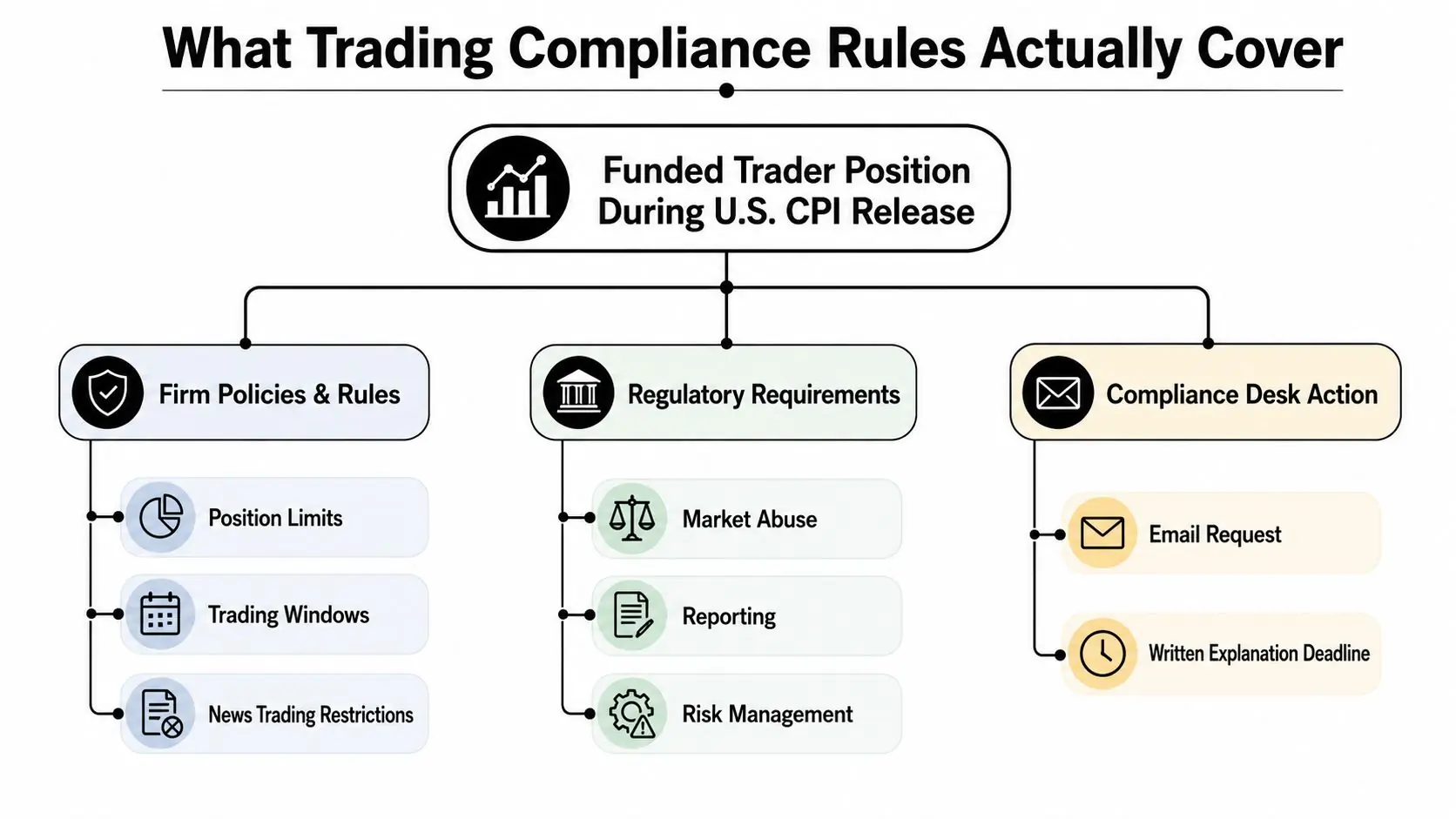
A compliance email can feel disproportionate when you've taken a trade during a volatile session. A funded trader may receive a request to explain a position opened during a U.S. CPI release, with a deadline set by the firm. The request doesn't automatically mean misconduct occurred. It means the firm needs to understand the order, the timing, the strategy, and whether the trade followed its conditions.
Trading compliance rules are the duties, restrictions, controls, and reporting obligations that govern how you access markets and operate an account. They cover conduct such as using confidential information, manipulating prices, placing suspicious orders, failing to maintain accurate records, or ignoring account-level restrictions.
Two layers usually apply.
Regulator-level obligations
Regulators and legislation establish the legal floor. The relevant framework depends on the instrument, venue, jurisdiction, and business model. Important names include FINRA, ESMA, the FCA, the SEC, MAR, MiFID II, and Dodd-Frank.
The EU Market Abuse Regulation, or MAR, was adopted on 16 April 2014 and became applicable on 3 July 2016. It created a common framework covering insider dealing, unlawful disclosure of inside information, and market manipulation across the EU. It applies to instruments traded on regulated markets, MTFs, and OTFs, as well as related OTC products such as CFDs when their value depends on listed instruments. MAR's official text also covers attempted insider dealing and attempted manipulation.
MAR requires market operators and investment firms to maintain effective systems for preventing and detecting abuse. Firms must report suspicious orders or transactions without delay to the relevant trading venue authority.
Firm-level controls
A broker or prop firm can add stricter internal conditions. These may include news-trading restrictions, position limits, maximum drawdown, daily loss limits, prohibited strategies, trading windows, or special requirements for automated systems.
Practical rule: A trade can be legal under market-abuse law and still violate your funded account agreement.
Compliance protects market integrity, counterparties, firms, and traders. Good controls also give you a defensible record when someone asks why an order was placed. Before trading, read both layers. The regulator's rules determine what conduct may breach the law. The firm's agreement determines whether you remain eligible to trade its capital or simulated account.
The Core Regulatory Areas You Must Follow
A funded trader can place a legal-looking order and still create a compliance problem. The useful test is practical: what information did you use, how did the order affect the market, can the firm identify you and your funds, and can anyone reconstruct what happened? These six areas turn broad regulation into checks you can apply before, during, and after a trade.
Six Regulatory Pillars at a Glance
| Area | What It Prohibits | Example Breach | Typical Consequence |
|---|---|---|---|
| Insider dealing | Trading or disclosing material non-public information | Buying before an earnings release using confidential information | Investigation, sanctions, and possible criminal referral |
| Market manipulation | Conduct that creates a false or misleading market impression | Layering, spoofing, or wash trades | Enforcement action, financial penalties, and trading restrictions |
| AML and KYC | Using an account without accurate identity and funding information | Failing to update identity or address information when requested | Account restriction or enhanced due diligence |
| Trade reporting | Omitting or misstating required transaction details | An incomplete transaction report | Record-keeping or reporting enforcement |
| Insider lists | Failing to control access to restricted information | Allowing an unauthorized person to remain on a restricted list | Internal investigation and regulatory scrutiny |
| Personal account dealing | Trading personal accounts without required approval | Entering a restricted personal trade without pre-clearance | Disciplinary action, account closure, or reporting |
Insider dealing involves using material non-public information, or MNPI, to trade or disclose it improperly. Buying shares before an earnings announcement after receiving confidential results is the clear example. MAR also covers unlawful disclosure and attempted conduct, so a losing or abandoned trade is not automatically harmless. Review the official MAR framework before treating an incomplete order as irrelevant.
Market manipulation distorts supply, demand, price, or the market's impression of activity. Layering and spoofing use orders without a genuine intention to execute. Wash trading creates artificial activity between accounts with a shared interest. A prop trader should not use rapid orders, cancellations, or coordinated accounts to manufacture a signal.
The FCA states that MAR does not require proof that the person intended market abuse. The order trail, system controls, and trader's explanation therefore matter even when the outcome was not deliberate. The FCA Handbook's MAR guidance explains this intent principle.
AML and KYC checks establish who you are, where funds came from, and whether account activity fits your profile. Keep identity, tax, and address information current. If a review finds a gap, the firm may restrict access while it verifies the account.
Trade reporting and recordkeeping allow authorities and firms to rebuild the sequence of events. MiFID II transaction data can include the instrument, venue, execution details, and parties involved. Keep broker statements, order IDs, timestamps, strategy notes, and messages connected to unusual trades. A complete record is the trading equivalent of a receipt: it shows what happened and when.
Insider lists and personal account dealing become especially important when you work for a regulated firm or receive confidential information through employment or a business relationship. Ask for written approval before trading a restricted instrument. Your personal account does not sit outside professional obligations.
Digital assets and tokenized products add questions about classification, offering restrictions, custody, and investor protection. Traders working in that field can consult these security token compliance guidelines as a separate educational reference.
The regulatory layer is only half of the operating rulebook. Compare it with MyFundedCapital's published risk management standards for funded accounts, including the account conditions that govern your trading. Regulators may revoke permissions or impose sanctions. A firm may close an account, block withdrawals during a review, or end the trading relationship. Before placing an order, check both sets of rules and keep evidence that your process followed them.
Algo Trading, Risk Limits and Position Sizing
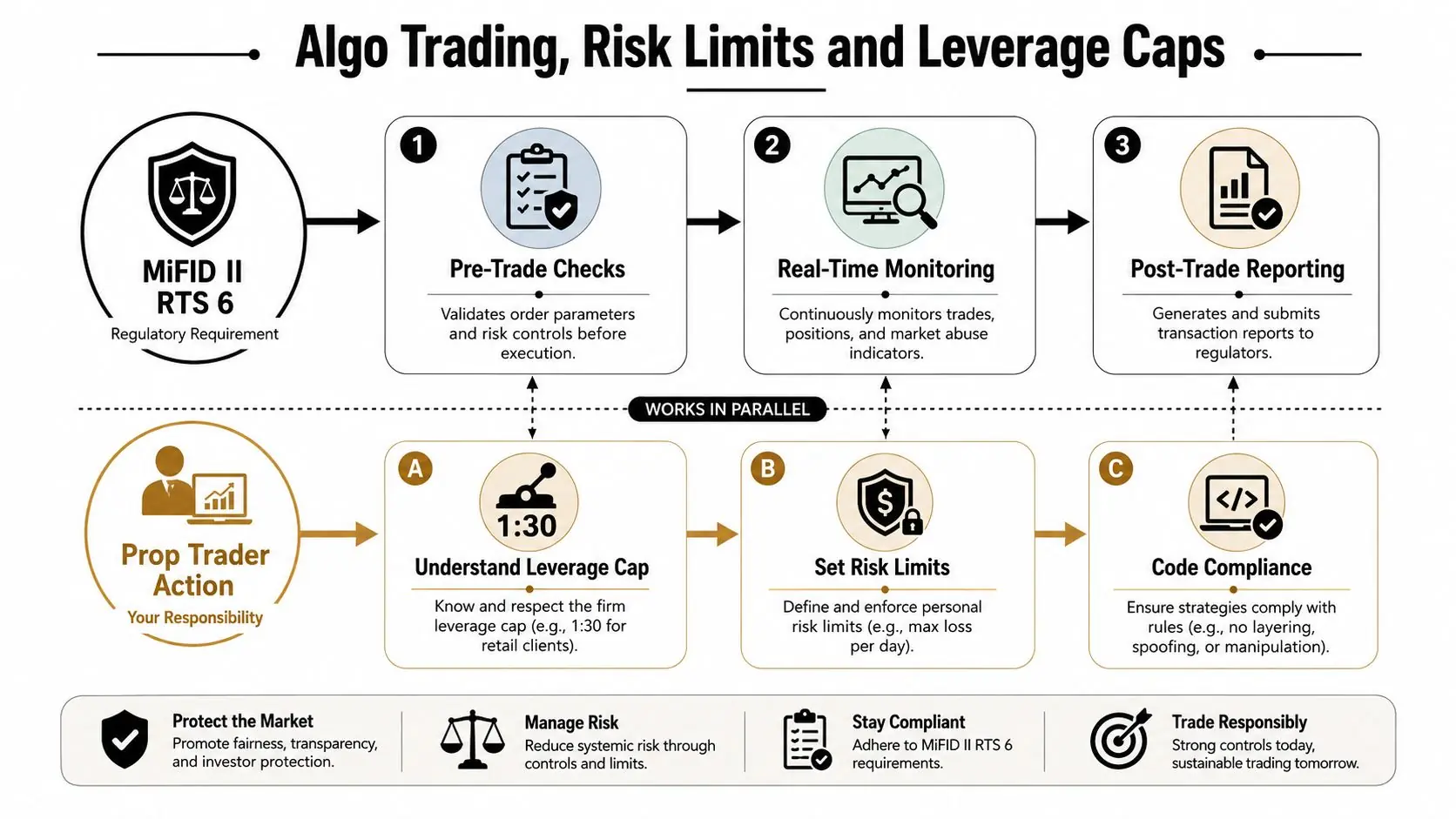
A funded trader connects an Expert Advisor, sees clean execution, and assumes the setup is compliant. That assumption can fail quickly. Algorithmic trading compliance begins before code sends an order. Under MiFID II and RTS 6, firms operating algorithmic systems need resilient infrastructure, enough capacity, stress testing, and business-continuity arrangements. They also retain time-sequenced records of orders, cancellations, executions, and quotes, allowing supervisors to reconstruct the order lifecycle. ESMA's report on algorithmic trading explains the operational expectations behind these controls.
The controls behind an automated strategy
A compliant workflow uses several gates:
- Pre-trade validation Check order size, price, instrument, account permissions, and available risk capacity before transmission.
- Real-time monitoring Watch order behavior, exposure, cancellations, and unusual patterns while the strategy runs.
- Emergency interruption Keep a kill switch, or an equivalent control, ready to stop new orders if the system acts unexpectedly.
- Testing and records Test the algorithm before deployment and preserve a time-ordered record for review.
These institutional controls do not all sit with an individual trader. Your responsibility is to understand what the platform permits, how the Expert Advisor behaves, and whether the firm accepts that strategy.
Position sizing also needs a clear reference point. ESMA's retail CFD measures set caps of 30:1 for major currency pairs, 20:1 for non-major FX pairs, gold, and major indices, 10:1 for commodities other than gold and non-major equity indices, 5:1 for individual equities and other uncovered reference values, and 2:1 for cryptocurrencies.
A prop firm can apply its own schedule, even where the retail cap does not directly govern the account structure. Check the multiplier for each instrument instead of treating one setting as universal across forex, indices, commodities, equities, and crypto. Review the rules for automated trading programs before connecting an EA or copying orders.
Your daily check should cover position size, total exposure, order frequency, cancellation behavior, and loss thresholds. An algorithm can run without technical errors while still producing a prohibited pattern. Approval therefore requires both reliable code and behavior that fits the applicable trading rules.
Prop Firms vs Regulators How the Two Rule Sets Stack
A funded trader can place an order that raises no immediate regulatory concern and still violate the account agreement. Regulators focus on market integrity, investor protection, and orderly trading. A prop firm focuses on whether your activity fits the contract governing access to its capital or simulated evaluation.
| Compliance Area | Regulator Rule | Prop Firm Rule | Breach Consequence |
|---|---|---|---|
| Market conduct | No insider dealing or manipulation | No spoofing, arbitrage, or prohibited execution patterns | Regulatory action or account termination |
| Loss control | Firms must maintain appropriate systems and controls | Daily loss and maximum drawdown thresholds | Position closure or account failure |
| News trading | Suspicious activity and disorderly trading remain supervised | News windows may be restricted or require an add-on | Trade cancellation or account breach |
| Margin limits | Instrument-specific requirements may apply | Firm-defined exposure caps and margin conditions | Forced reduction or violation |
| Strategy behavior | Orders must not create a false market | Martingale, grid, HFT, or account hedging may be restricted | Account closure |
| Reporting | Firms maintain transaction and surveillance records | Trader must explain activity when requested | Review, delay, or loss of access |
The two rule sets stack rather than replace one another. Regulatory compliance is the floor. Prop firm compliance is an additional operating boundary. A trader may avoid conduct that concerns a regulator while still breaking a firm's daily loss limit, news restriction, or consistency condition.
Consider a firm rule that limits daily drawdown to 5%. That limit addresses account loss. ESMA's 30:1 cap for major currency pairs addresses retail CFD exposure by asset class. They manage different risks, so meeting one checkpoint does not satisfy the other.
Before placing a trade, clear both checkpoints:
- Legal checkpoint Does the order comply with market-abuse, reporting, and conduct obligations?
- Contract checkpoint Does it comply with the firm's account rules, platform settings, and strategy restrictions?
The agreement works like the operating manual for the funded account. It may set tighter conditions than the regulatory baseline, particularly around permitted strategies, trading times, loss calculations, and requested explanations.
Educational resources such as the Colibri Trader homepage can provide broader trading context. For a focused explanation of how prop firm regulation relates to funded trading eligibility, compare the firm's terms with the rules that apply to your trading activity. Read those conditions before trading, not after an automated breach notice arrives.
Real Compliance Failures and What They Cost
Most compliance failures don't begin with an elaborate attempt to deceive a regulator. They begin with an overlooked document, an unchecked setting, or a trader who assumes a soft rule is optional.
Case one involves a stale identity record
A trader changes address and continues trading without updating the firm's KYC record. During a routine review, the firm identifies a mismatch between the account information and the documents supplied through its verification process. The compliance team flags the account, pauses a withdrawal, and asks for updated documentation.
The audit trail may include the original verification record, the later address discrepancy, the withdrawal status, the support ticket, and the trader's response. During the review, the trader shouldn't open new positions if the firm has restricted activity. The sensible response is to provide accurate documents, answer the questions directly, and keep copies of every submission.
This scenario isn't a finding of fraud. It's an example of how an administrative omission can interrupt trading access and payout processing.
Case two involves a loss-limit breach
A trader holds one position while the market moves against the account. The loss reaches 4.8% on a day when the firm's limit is 5%. The position hasn't breached the threshold yet, but spread changes, financing, slippage, or other open trades can push the account beyond the permitted level.
If the firm records a breach, the notice may identify the account, equity reading, timestamp, instrument, and rule triggered. The trader should compare that record with platform history and avoid deleting or altering logs. A clear explanation can correct a data misunderstanding, but it won't automatically override a genuine hard breach.
Keep your own file: Save platform exports, statements, support correspondence, and notes explaining unusual orders. Memory is a poor substitute for a timestamped record.
The common lesson is uncomfortable but useful. Trading compliance rules often fail at the edges of ordinary workflow. A missed KYC update and an unmanaged open position can create more trouble than a strategy ever does. Build controls around routine behavior, especially during volatile sessions.
Your Trader Compliance Checklist and Fast Fixes
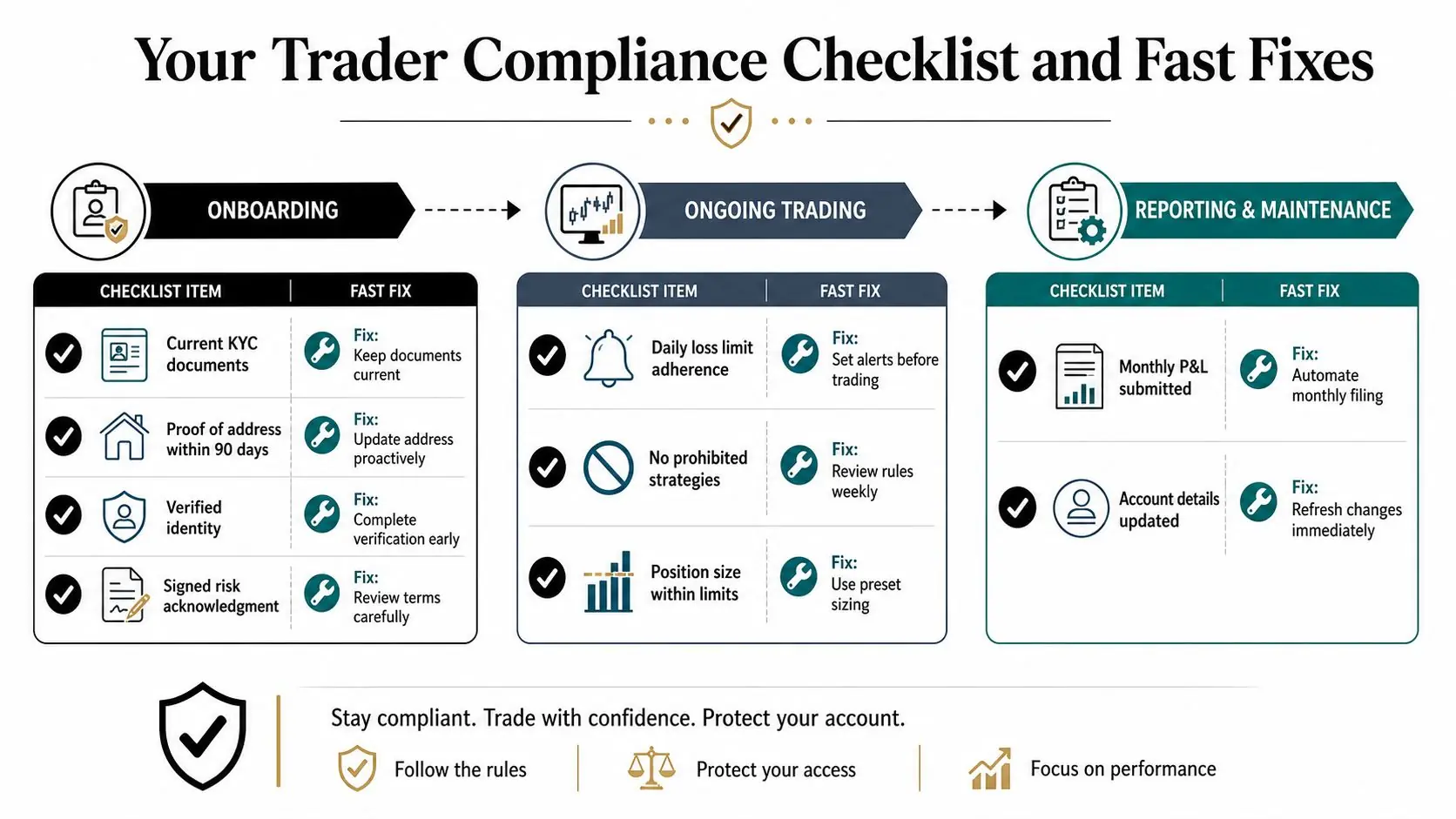
A useful checklist turns broad compliance duties into actions you can repeat. Run it before trading, during weekly review, and after the firm changes its conditions. The aim is to catch a missing document or unsafe setting before it becomes a trading interruption.
Onboarding
- Confirm current KYC documents. Make sure your identity details match the account record.
- Verify your address record. Keep acceptable proof available and update the firm after a move.
- Complete risk acknowledgments. Read the trading agreement, prohibited-strategy list, loss limits, and payout conditions.
- Record platform permissions. Note the approved instruments, position sizing limits, trading sessions, news conditions, and automation rules.
Per-trade controls
- Check the position size. Confirm that the order fits the instrument and exposure limits.
- Check margin. Apply the relevant asset-class cap or the stricter firm setting.
- Check the trading window. Confirm whether the instrument is restricted around scheduled news or market closures.
- Check the strategy behavior. Avoid layering, spoofing, wash trading, martingale, grid trading, unauthorized copying, and cross-account hedging.
- Check automation. Before an EA sends orders, confirm that throttles, monitoring, and emergency shutdown controls are active.
Weekly review
- Review account risk Compare current equity with daily loss and maximum drawdown conditions.
- Reconcile activity Match platform history with broker statements and your own journal.
- Investigate soft warnings Resolve alerts before they become repeated behavior.
- Read support messages Respond promptly and factually to every compliance request.
Monthly maintenance
- Export the audit log Preserve orders, cancellations, fills, timestamps, and strategy notes.
- Review policy changes Firms can revise account conditions, so acknowledge updates before the next session.
- Organize records Keep documents related to identity, tax reporting, payouts, and trading activity together.
For broader operational guidance, Lighthouse Consultants compliance services provide a reference for documented controls and remediation.
Fast fixes after a warning
- Contact support quickly Reply within the stated deadline and ask what evidence the firm needs.
- Pause new positions Avoid increasing the issue while the account is under review.
- Document the incident Record what happened, when it occurred, which rule applied, and what you changed.
Keep the checklist close to the platform, not buried in a policy folder. A funded trader's daily routine should reflect both regulatory expectations and the firm's own risk parameters.
Trading Risk Disclaimer and Next Steps With MFC
This article provides general educational information about trading compliance rules. It isn't legal, tax, or financial advice, and it doesn't replace the terms of a regulator, broker, platform, or prop firm agreement.
Trading involves a substantial risk of loss, including the loss of all capital committed to a trading activity or the loss of access to a funded account. Past performance, challenge outcomes, payout history, and funded evaluations don't guarantee future profits. Compliance rules apply regardless of account size, strategy, experience, or whether the account uses manual or automated execution.
Before starting, identify the rules that control your activity. Separate legal obligations from firm-level conditions. Then test your process against the actual limits for news trading, drawdown, position size, automation, and recordkeeping. If you can't explain why an order was allowed, your process needs work before your strategy does.
MyFundedCapital offers funding programs with Instant Funding and 1-Step or 2-Step Challenge routes, simulated trading environments using real market quotes, and support for manual, algorithmic, and copy trading subject to its stated conditions. Review the firm's current rule set, challenge options, payout terms, and support process carefully before making a decision.
Explore MyFundedCapital to compare funding programs and challenge types against the compliance checklist in this guide. Check the applicable risk limits, trading conditions, payout cadence, and support options first, then choose an account structure that matches how you trade.