

On EBS, a major electronic interdealer FX venue, algorithmic trading handled just 2% of spot-trading volume in 2004. By 2010 it handled 45%, while manual execution had fallen from roughly 98% to 55%, according to BIS research on FX market structure.
That migration didn't happen because algorithms forecast better than people. It happened because venues got faster, order protocols standardized and connectivity improved, which made order submission something software could do reliably. Framed as a straight contest, manual trading vs automated trading looks like instinct against code. In practice it's a question about who holds each decision, and whether you can show that your arrangement survives a broken connection or a market that stops trading normally.
Manual and Automated Trading Side by Side
Manual trading means you decide each entry, exit and position size yourself, reading price, context and your own conviction in the moment. Automated trading means rules or an algorithm place the orders, with a human designing the logic, setting the parameters and monitoring what comes back. Neither definition removes the other: a manual trader can attach a preset stop, and an automated strategy still needs someone to shut it down.
Algorithmic execution has moved well past the specialist desk. In 2025 institutions accounted for 61.16% of the global algorithmic-trading market by revenue, while the retail segment is forecast to grow at 8.32% a year through 2031, according to Mordor Intelligence's algorithmic trading market report. The table below is the reference point for the rest of this analysis.
Manual vs automated trading on key criteria
| Criterion | Manual trading | Automated trading |
|---|---|---|
| Decision maker | Trader decides each entry, exit and size | Rules or algorithm decide, with human design and monitoring |
| Speed | Limited by human reaction time, usually seconds | Orders sent by code, often far faster, depending on connection quality |
| Consistency | Varies with fatigue, mood and attention | Same logic applied to every signal |
| Emotional control | Exposed to loss aversion and hesitation | Removes in-the-moment bias but can lock in flawed rules |
| Adaptability to unexpected events | Can reinterpret news and unusual price action | Follows only the scenarios its designers anticipated |
| Typical failure mode | Mistakes usually occur one trade at a time | Bad code, disconnection or duplicate orders can repeat quickly |
| Skills and setup needed | Chart reading and screen time | Strategy coding or EA setup, testing and continuous monitoring |
| Best-fit setup | Discretionary, context-heavy trades | Repeatable rules applied across many trades |
Reading the rows that decide the outcome
No column wins every row. Code takes speed and consistency. Judgment takes adaptability and the interpretation of a market that stops behaving. The rows that decide most traders' results are the ones people skim: failure mode and skills required. A manual trader's mistakes usually arrive one trade at a time, which is survivable. An automated trader's mistakes can repeat across every position at once, which isn't.
Everything else is conditional. Emotional control favors automation only if the rules were right to begin with, because a coded bias is still a bias, just faster and harder to spot. Speed favors automation only if the fill improves after costs.
A comparison built on fill data is only as good as the data underneath it, and the PlotStudio AI guide to cleaning and backtesting financial datasets covers the splicing, adjustment and gap handling that make a fill-price study trustworthy.
Manual trading relies on judgment at the moment of decision; automated trading relies on rules fixed in advance and monitored afterward.
Who Controls Each Step
Manual trading places decisions at the point of execution; automated trading applies rules set in advance, with a person monitoring the system. The BIS defines manual electronic trading as instructions executed by people on electronic platforms. Automated trading uses algorithms with little or no human intervention but remains subject to human monitoring, according to its working paper on the FX market. The paper reports that more than 70% of spot trading has been executed electronically since 2013, and roughly 70% of orders on EBS are submitted by algorithms rather than by hand.
The useful comparison is not “human versus machine.” It is who controls each part of a trade, and where human oversight remains. Seven decisions make that division visible.
The seven decisions in every trade
- Strategy design. A person defines the strategy, even when choosing a ready-made template.
- Parameter setting. You choose the thresholds; an algorithm applies them without reconsidering.
- Entry signal. You judge whether the setup is present, or the system acts when its conditions are met.
- Position size. You calculate size for each trade, or a formula applies the chosen risk rule.
- Order submission. You click to place the order, or code submits it.
- Stop management. You adjust the stop, or a trailing rule changes it.
- Monitoring and risk limits. Both approaches require oversight. With automation, you must monitor the system as well as the market.
A hybrid workflow assigns different decisions to each. You might enter manually when a setup looks right, then let an attached stop and trailing rule manage the exit. Or an expert advisor might handle entries and exits while you retain an override to disable it when spreads or news make conditions unrecognizable. That override needs a written trigger and a test; otherwise, it is another discretionary decision made under pressure.
At MyFundedCapital, traders trade within the browser-based Terminal and follow the risk rules of their program. For each of the seven steps, mark whether you or the software makes the decision. Every delegated step needs a defined control, including who can override it and under what conditions.
Where Automation Beats Human Discipline
A study of more than 100 million trades on Nasdaq Copenhagen across 2016 and 2017 found that human traders showed a strong disposition effect: they realized profitable positions more often than losing ones. Algorithmic traders realized gains and losses at nearly equal rates, according to Norges Bank's review of the working paper.
Human day traders averaged about 695 trades per day, compared with roughly 763 for algorithms. Their average daily turnover was broadly comparable, at about €5.7 million for humans and €5.1 million for algorithms. The difference in closing behavior, rather than a large gap in trading activity, is the more relevant finding.
The advantage is discipline, not frequency
An algorithm can apply an exit rule consistently when a trader is tempted to hold a loser or close a winner too soon. That consistency does not make the rule profitable by itself. It makes the result more faithful to the strategy being tested.
A written plan can assign software a hard exit, a position-size cap and a cooldown after a set number of losses or a daily drawdown. The trader still defines the conditions and decides when they no longer fit. An override policy should specify what triggers intervention, who can pause the system, and how the decision will be reviewed.
Trailing stops can support this discipline, but their settings change the trade-off. They can trail by a fixed distance, a percentage or ATR. A tighter trail may turn more winners into small scratches; a wider one allows more of a move to be given back.
Write it down or lose it: an exit rule that exists only as a feeling gets renegotiated the first time it costs you money.
A defined process can reduce skipped steps under pressure, a benefit also discussed in NZ Apps on automation benefits. In trading, however, process consistency and strategy quality are separate questions: an automated rule can execute a weak idea with perfect consistency.
Speed only counts when it improves the fill
Faster execution does not guarantee better net performance. When the NYSE's Hybrid Market cut market-order execution time from roughly 10 seconds to under one second, effective spreads widened by about 10%, attributed to greater adverse selection, even as prices incorporated information faster, according to an SEC-hosted study of speed and market quality. Research on high-frequency trading also suggests that moving to still faster execution does not necessarily improve market quality and may bring costs such as greater cancellations and reduced market depth.
For an individual account, compare each realized fill with the mid-price when the trading decision was made. Track slippage, spread paid, rejection rate, latency and adverse selection by instrument and session. If deterministic order placement does not improve those measures over manual execution, speed adds operational complexity without a demonstrated execution benefit.
A useful test is to review your last 30 trades and count how often you closed earlier or later than your written plan. That helps distinguish a strategy problem from inconsistent execution. A hybrid workflow should then be tested with a written override policy, so intervention is deliberate rather than another form of discretionary drift.
Where Manual Judgment Still Wins
The Flash Crash shows the failure mode that no amount of testing removes. An automated execution of a very large sell order confused and dislocated other algorithms, many participants stopped buying, and liquidity fell sharply, producing turbulence that fed on itself, as BIS analysis of electronic trading and financial markets describes. The same analysis makes the point that matters: mechanistic algorithms may not respond properly to unprecedented events the way a human can using common sense.
Human judgment earns its place in exactly those moments, when the screen stops behaving like the model.
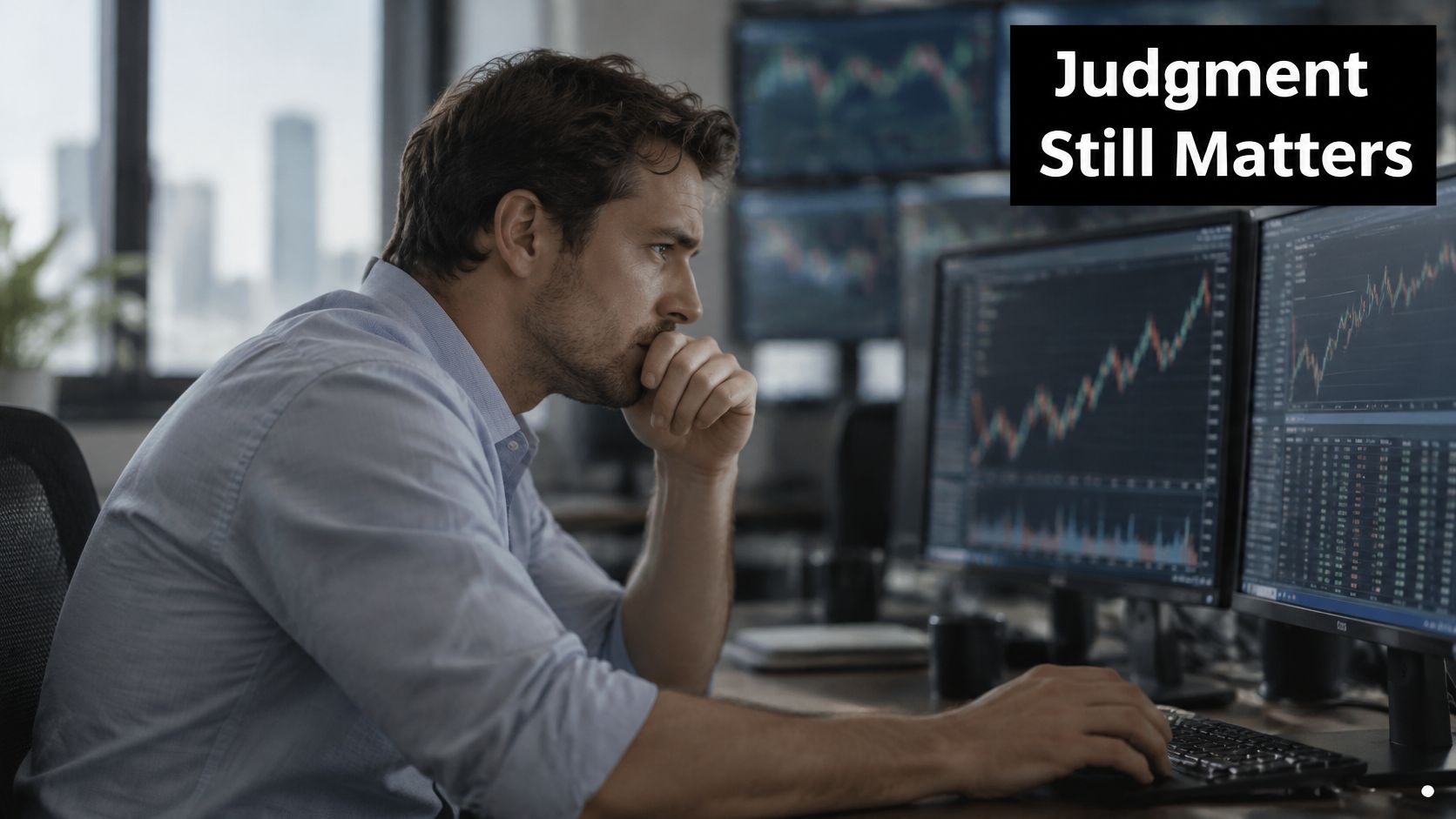
None of that makes manual trading safer overall. It identifies a difference in kind: a human can reinterpret a headline, a strange print or a market that stops responding before acting, while a system depends on scenarios someone anticipated in advance.
When liquidity goes missing
Algorithmic liquidity is more strategic than it looks. BIS research finds that algorithmic liquidity can decline as volatility rises, creating "air pockets" where trades become difficult or impossible to execute during sharp moves, and that algorithmic trading can amplify volatility when systems stop or withdraw, as BNN Bloomberg's report on the BIS findings notes.
A manual trader has three options a fixed rule set doesn't: cut the size, wait for spreads to normalize, or read the news and stand aside. An automated system takes none of them unless a volatility filter, a spread limit or an event block was built in first.
Automation also relocates execution risk. The BIS notes on FX execution algorithms point out that algorithmic execution changes how participants reach FX markets and raises demands for data, technical skill and risk management, and that algorithms running similar parameters can herd, amplifying a price move rather than merely following it.
Funded rules make the override question concrete. On 1-Step and 2-Step funded accounts, no new trades can be opened 2 minutes before or after high-impact news, so an automated news strategy has to be designed around that window rather than through it. Knowing which days and which releases deserve that treatment is judgment, and it sits closer to developing a trading mindset than to writing a better trigger condition.
A backtest rarely answers the question you have. It shows how the logic behaved inside the data that built it, not inside the conditions that broke other systems. Define the override conditions before the market forces the issue:
- Abnormal spreads, where the cost of entry exceeds the expected edge.
- Market closures and halts, where orders can't be filled or cancelled cleanly.
- Major news, including releases outside the calendar you planned for.
- Platform outages, when the order path itself is in doubt.
- Regime changes, where volatility or correlation shifts outside the tested range.
Operational Risks Automation Adds
A sound strategy can still fail in execution. Strategy risk comes from a bad idea executed correctly; operational risk comes from a working system placing the wrong order, at the wrong size, or at the wrong time. Examples include duplicate orders, stale prices, rejected hedge legs, expired sessions and unmanaged positions. Model error, overfitting and training-data artifacts can also undermine results, as described in this comparison of systematic and discretionary workflows.
Operational failures may be infrequent but severe. A wrong quantity or disconnected order path can breach a risk limit before a human notices. The key question is what the system does when it fails or encounters conditions outside those it was tested against. A useful risk map for algorithmic trading starts with specific failure modes and assigns each a control.
Pair each failure with a control
Controls are more effective when tied to a named failure:
- Duplicate orders: Use an order tag that makes retries idempotent, preventing one intent from placing twice.
- Stale prices: Reject quotes older than a defined age using a timestamp check.
- Expired sessions: Monitor the connection heartbeat and alert when it goes silent, rather than waiting for the next fill.
- Rejected hedge legs: Reconcile every partial fill to confirm the position is flat or fully covered.
- Runaway size: Enforce a maximum order size outside the strategy code so a bug cannot raise it.
- Platform failure: Document a failover path and use a kill switch to cancel working orders.
- Abnormal slippage: Require human confirmation before sending the next order.
FINRA guidance recommends reviewing and testing trading algorithms during development, deployment and post-implementation monitoring. Its market-access rules also identify kill switches for stopping aberrant algorithm behavior or responding to market-wide events, according to FINRA's market access guidance. A manual trader can stop placing orders; an automated strategy needs an emergency mechanism built into its workflow.
MyFundedCapital's Terminal shows daily and overall loss room before a trader clicks Buy, and stop loss and take profit are set on the chart. Those controls do not remove the need to plan for a process failure. Report strategy performance both with outages, news shocks and rejected orders included and without them. The difference helps show how much results depend on operational reliability and how to govern finance automation.
Test before you trust it: Run a disconnection test on a demo or simulated account with no live capital. With a position open, time how long the system takes to flatten or halt. That result measures its response to a connection failure, not its strategy performance.
Choose and Test Your Workflow
A workflow should be judged by how reliably it follows its rules when conditions change. Automate repeatable entries, sizing, stops and logging; keep a human override for strategy validity, regime shifts and abnormal spreads. Define in writing when an override is justified, then test whether it improves decisions rather than giving emotion another route into the process.
A 2025 artificial-market experiment found that investors were more willing to adopt algorithms when the systems traded actively and allowed human overrides. Adoption depended more on relative performance than on the trader's original style, according to the 2025 experiment on algorithm adoption. The practical question is whether your override policy distinguishes a reasoned response from a reaction to a loss.
Match the workflow to how you actually trade
| Trader profile | Better fit | Rule to check first |
|---|---|---|
| Discretionary trader with varied setups | Manual, with stops and size set on the chart | News and weekend rules in the trading rules |
| Repeatable intraday strategy | Automated EA or bot | Contact support before using an EA or bot |
| Copy trader following another trader or signal service | Copy trading | Every copied trade must follow the trading rules |
| Scalper or high-frequency trader | Redesign the strategy before funding | Scalping, high-frequency trading and hedging are not allowed |
| Swing trader holding over weekends | Manual or automated, with the weekend add-on reviewed | Weekend holding is off by default |
| Trader who needs both methods | Hybrid with a written override policy | Test all three modes before committing |
About 63% of hedge-fund respondents in 2025 said they relied on algorithms for more than half of their traded value, compared with 59% in 2024, according to The TRADE's report on hedge-fund algorithmic usage. That adoption rate does not show which approach will keep an individual trader within a loss limit.
MyFundedCapital allows expert advisors and trading bots by agreement, but traders must contact support before using one. Scalping, high-frequency trading and hedging are not allowed. Copy trading is permitted between your own MyFundedCapital accounts or when following another trader or a signal service, provided each trade follows the rules. News trading and weekend holding are off by default.
The seven-step test
- Write the rules on one page. Specify entries, exits, sizing and override conditions in language another trader could apply.
- Forward test three modes. Compare fully manual trading, full automation and automation with predefined overrides over the same period, instruments and session times.
- Choose metrics before you start. Track rule adherence, drawdown, execution quality and recovery after losing streaks alongside returns. Review what backtesting can and cannot establish before relying on a simulated performance curve.
- Review trades individually. The Report tool shows the account curve, calendar, tags and MAE and MFE for each trade, including how far it moved against you and in your favor before closing.
- Check program constraints. Compare your approach with the daily loss limit, maximum drawdown, and news and weekend policies.
- Include the program cost. Compare available program tiers and account sizes with the workflow you intend to run.
- Choose the mode with fewer breaches. A strong backtest matters less if the method stops following its rules when markets behave unusually.
The test that matters: run all three modes through the same losing streak, then check which still follows its rules by trade 40.
Commit only to a workflow that holds up in the three-mode test. A written override policy should specify who or what can intervene, under which conditions, and how to record the decision. That makes strategy risk easier to assess separately from operational failures such as a disconnected system or an unexecuted order.
MyFundedCapital assesses trading skills on simulated accounts, with traders working within their program's risk rules. Accounts trade in the browser-based Terminal, with daily and overall loss room visible before you click Buy, stops set on the chart, and EAs, bots and copy trading permitted inside the trading rules. Profit splits start at 80/20 and can be upgraded to 90/10 or even 100%. To compare your tested workflow with a program, visit MyFundedCapital.
