Most advice about the risks of algorithmic trading starts with “check your code” and “avoid overfitting.” Those warnings matter, but they miss the danger that destroys experienced traders too: a sound strategy can fail when liquidity vanishes, infrastructure misbehaves, or many algorithms respond to the same signal at once. This guide covers the market, execution, model, operational, and governance risks that matter most, then turns them into controls for protecting capital.
Understanding the Core Risks of Algorithmic Trading
The most dangerous assumption in automated trading is that good mathematics creates passive income. Automation removes hesitation and emotional interference, but it also removes the human pause that can stop a bad order, recognize abnormal market conditions, or question a misleading signal. A bot doesn't understand that a price move looks irrational. It follows its rules until an external control interrupts it.
A useful starting point is the distinction between four risk families:
- Market risk The market moves against the position, gaps through an intended exit, or becomes too volatile for the strategy's assumptions.
- Execution risk The order fills later, at a different price, partially, or not at all because liquidity and routing conditions change.
- Operational risk A broker API, exchange, data feed, server, network connection, or deployment process fails.
- Model risk The strategy's assumptions stop describing the market, even though the code runs exactly as designed.
The basic explanation of algorithmic trading is useful for understanding automation, but a definition doesn't tell you whether a system can survive a stressed session. That requires testing the complete chain from data arrival to order confirmation and position reconciliation.
Why backtests create false confidence
A backtest usually assumes that historical prices are available, orders can be placed when signals appear, and fills reflect a simplified cost model. Live trading adds queue position, spread changes, rejected orders, stale quotes, disconnections, duplicate messages, and competing participants. A strategy can therefore be profitable in a clean simulation while remaining unsafe in production.
The practical question isn't “does the backtest make money?” Ask instead:
- What happens if the data feed freezes?
- What happens if an order acknowledgement never arrives?
- Does the system know whether a rejected order reached the venue?
- Can it reconcile broker positions with its internal state?
- What is the maximum loss before a human or hard control intervenes?
Capital-preservation rule: Treat every untested assumption as an open position. Size the system only after you know how it behaves when its assumptions fail.
Trading involves a risk of loss, including rapid loss. Educational analysis can't make an automated strategy safe or guarantee profits. The correct objective is controlled participation, with a clearly defined point at which the system stops trading.
How Market Liquidity and Systemic Fragility Impact Bots
Liquidity is not a permanent feature of a market. A book can look deep while its displayed quotes are already being canceled, repriced, or withdrawn. In fast markets, this transient liquidity leaves large orders exposed precisely when volatility and execution risk rise. Norges Bank Investment Management links rapid quote cancellation with unreliable displayed depth and identifies wider systemic vulnerabilities, including adverse selection, herding, correlated positions, technology-driven concentration, and weaker price discovery in some conditions. Its discussion note on high-frequency trading provides the market-structure context.
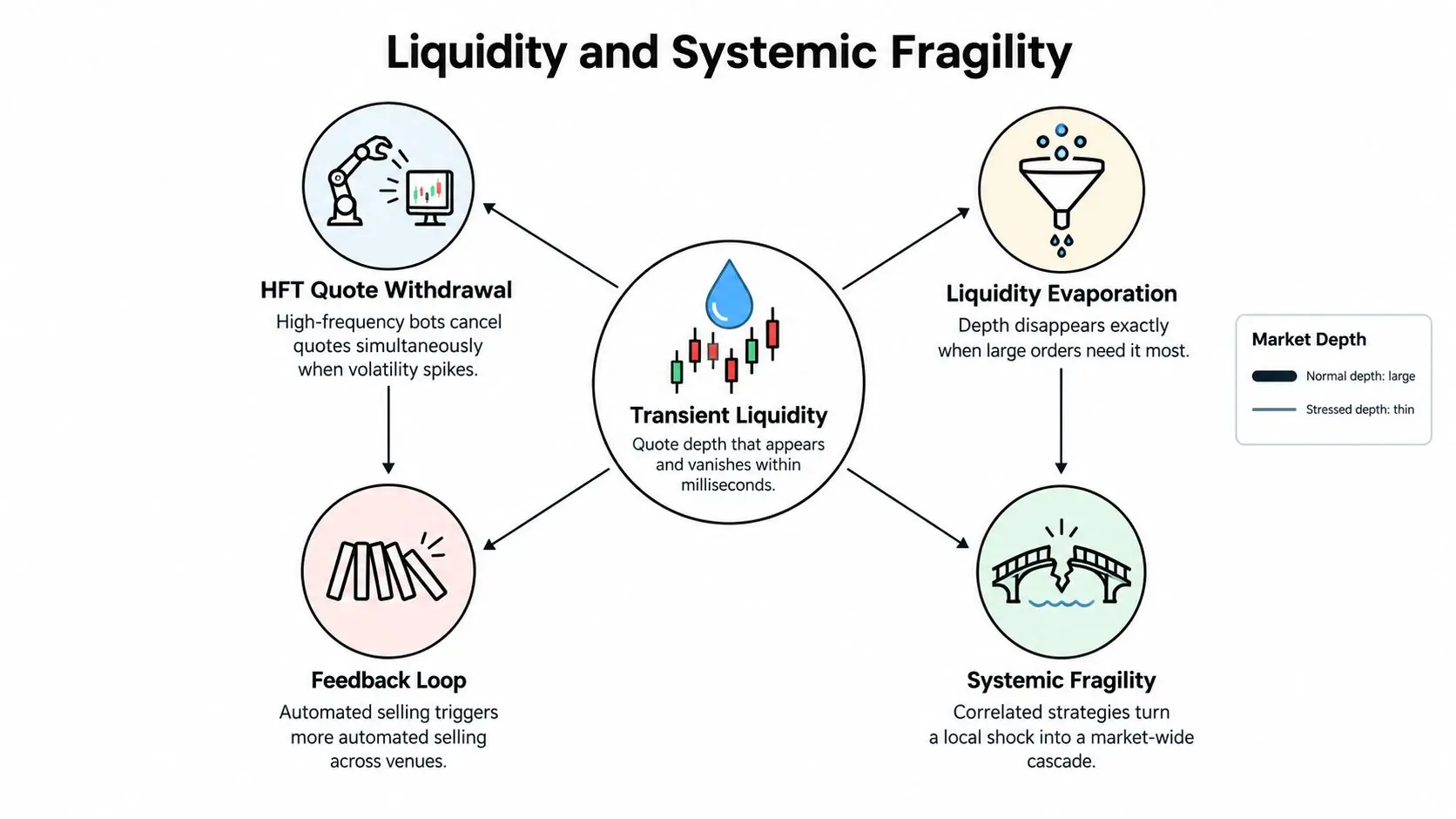
An order book can show enough quotes to support a large trade, yet those quotes may disappear before the order reaches the venue. The bot then receives partial fills at progressively worse prices. A planned exit becomes an uncontrolled liquidation, especially if several strategies are trying to reduce exposure at the same time.
What a flash crash teaches
The May 6, 2010 U.S. flash crash lasted roughly 36 minutes. During the episode, the Dow Jones Industrial Average fell by nearly 1,000 points, and about $1 trillion in market value was erased at the low. More than 20,000 stocks and ETFs traded at prices as much as 60% away from their 2:40 p.m. reference levels. The CFA Institute analysis of flash crashes documents these conditions.
The practical lesson is about execution, not blame. Machine-driven order flow can push prices away from fundamentals when available liquidity vanishes. A stop-loss instructs the system to submit or execute an exit under defined conditions. It does not guarantee the expected fill price.
Feedback loops and correlated exits
Several individually defensible strategies can become dangerous together. One cuts exposure after a price break, another follows momentum, and a third reacts to rising volatility. Their orders move the market, trigger additional rules, and create a feedback loop. The government review of crashes and high-frequency trading describes rapid interaction between algorithms as a systemic risk in interconnected markets.
BIS research identifies a quieter form of execution damage. Algorithmic execution can shift risk from dealers to end users, while latency-sensitive traders compete for small timing advantages. Research cited in that material estimated latency arbitrage at about 20% of FTSE stock trading volume, with an associated cost of roughly 0.5 basis point. The same review discussed an average of about 14 smaller flash crashes per trading day in U.S. data. These events rarely make headlines, but repeated micro-disruptions can become a normal cost of trading. See the BIS research on high-frequency trading in foreign exchange.
For a risk manager, the key question is whether the bot can reduce exposure when the market's liquidity is only apparent. Individual strategies may be sound in isolation, yet correlated signals, shared infrastructure, and common exit rules can turn them into one crowded position during stress.
Navigating Execution and Technical Failures
A bot can make the correct decision and still lose because the order pathway fails. The sequence is simple in theory: receive market data, calculate a signal, send an order, receive confirmation, update the position, and manage the exit. In production, every handoff can introduce delay or ambiguity.
Latency is measured in microseconds, and the Chicago Fed notes that participants remain exposed while waiting for execution confirmation. Its analysis of latency in electronic markets makes the key point: the system doesn't know it has a fill until information travels back through the execution chain.
The order lifecycle under stress
Consider a momentum bot that detects a breakout and submits a marketable order. The market moves before the request reaches the broker. The broker accepts the message, but the confirmation is delayed. The bot retries, assuming the first request failed. Both requests fill, and the intended position doubles before the internal state catches up.
This is why order management must be idempotent and state-aware. The system needs unique order identifiers, explicit handling for pending and unknown states, and reconciliation against the broker's actual position. A timeout should not automatically mean “send the order again.”
Regulators identify several related hazards, including duplicative or erroneous orders, overloaded trading systems, and algorithms that overreact to market events. The ESMA consultation paper on algorithmic trading treats these as risks to orderly markets.
Infrastructure failure modes
The most common failures aren't exotic:
- Bad data A stale, malformed, or misaligned feed produces a valid calculation from invalid inputs.
- Exchange outage The strategy keeps generating orders while the venue can't process or confirm them.
- Software defect A deployment changes a price conversion, quantity calculation, or risk check.
- Connection failure The trading process loses visibility of fills while the market continues moving.
- Clock mismatch Event timestamps arrive out of sequence, causing incorrect signal or risk decisions.
The Knight Capital incident shows how broad the damage can become. A software malfunction in 2012 caused unusual volatility in more than 100 stocks and created massive financial exposure, as documented in the PRMIA case study on Knight Trading.
A solid setup needs pre-production testing, staged deployment, independent risk checks, and a kill switch that can block new orders without relying on the strategy's own logic. Tools and programs designed for automated execution should be assessed against these controls, not just against their entry signals. MyFundedCapital describes automated trading programs in the context of systems that still require disciplined risk management.
The Hidden Dangers of Model Monoculture and AI Trading
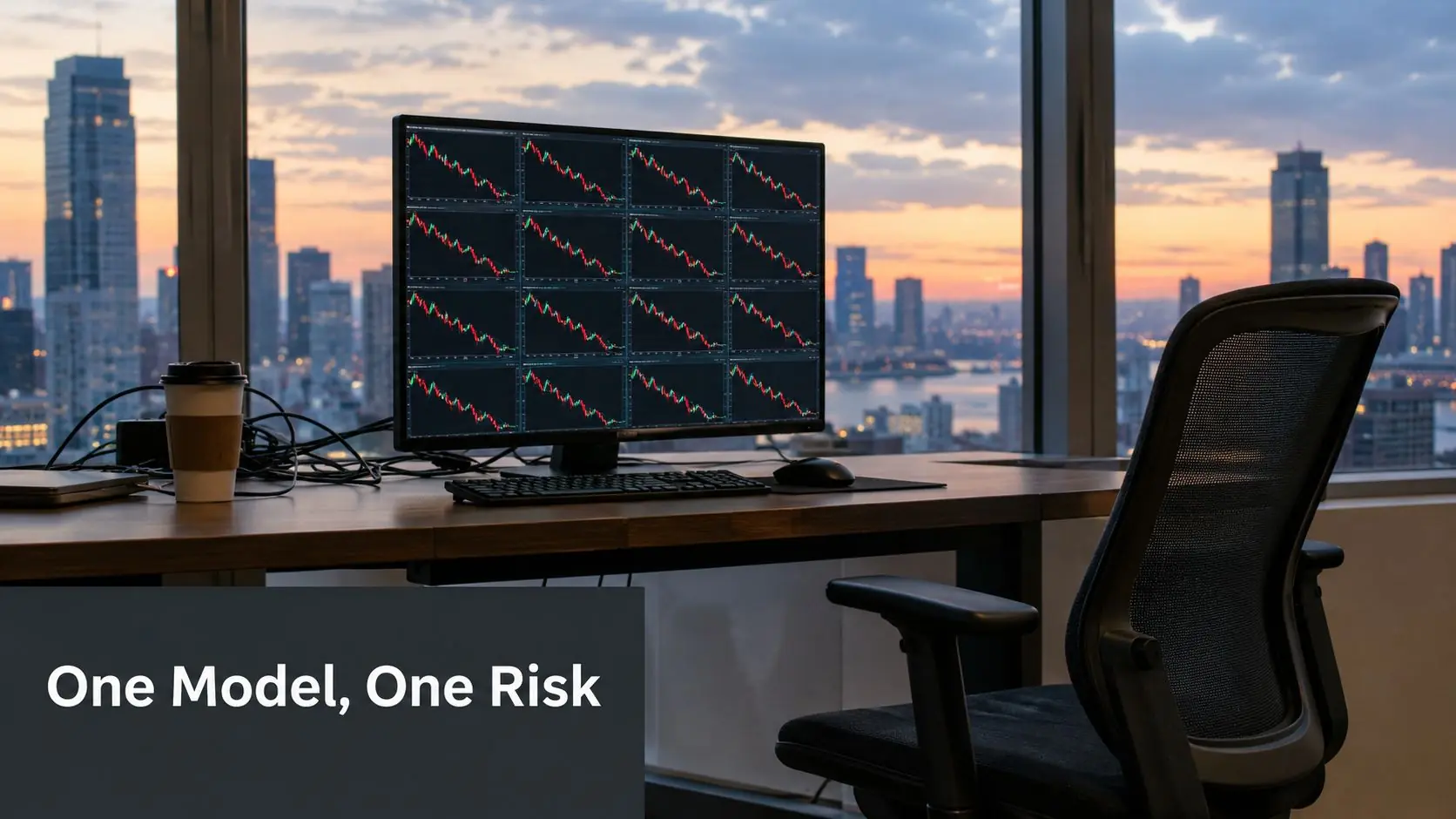
A strategy can be profitable, well tested, and correctly implemented yet fail because other firms are making the same trade. That is algorithmic monoculture. Shared data, objectives, infrastructure, and risk rules can push many systems toward the same position at the same time. Once available risk-bearing capacity disappears, individually rational orders can become a collective liquidation.
The CFA Institute identifies algorithmic monoculture as a systemic risk. Research also links correlated behavior to common models, objectives, infrastructure, and market narratives. ESMA notes that software-determined order parameters can threaten market integrity and orderly trading. Its guidance is set out in the ESMA supervisory briefing on algorithmic trading.
Why diversification can be misleading
Several bots do not guarantee several independent risks. Systems trading the same instruments, reading similar volatility signals, and reducing exposure after the same price move may hold different code but one underlying trade. Correlation tends to rise during the exact stress that makes diversification valuable.
Review the portfolio by behavior rather than by strategy label. Compare signal timing during fast moves, instruments and sessions, directional exposure, exit triggers, data vendors, execution venues, and reactions to widening spreads or changing volatility. If systems respond alike under stress, assign them to one risk bucket and size them accordingly.
AI adds governance risk
AI systems introduce uncertainty through training data, objective design, vendor controls, model updates, and regime changes. A model can produce convincing reasoning while using stale, incomplete, or irrelevant information. AI-driven systems create governance challenges that require oversight, as discussed in this overview of AI in forex.
The AFM report discusses investor harm from false or exaggerated AI claims. ECB material also raises concerns about unpredictable behavior and tacit collusion among independently operated AI systems. The AFM report on AI in capital markets summarizes these concerns.
An opaque AI agent should not receive unrestricted execution authority. Set version control, immutable logs, pre-trade limits, and human approval for material changes. Test abnormal and adversarial inputs, then verify that every consequential action can be explained, stopped, and reconstructed.
The risk question extends beyond whether one bot contains a defect. Ask how it interacts with other bots built on similar assumptions, especially when liquidity is thinning and everyone is trying to exit.
Real-World Examples of Algorithmic Trading Disasters
Historical failures expose the gap between a strategy diagram and a live trading system. A model can be locally rational and still become dangerous when many automated systems respond to the same thinning liquidity.
The 2010 flash crash showed how interconnected algorithms could produce an extreme move and recovery within minutes. Rapid order-flow reactions met fragile market depth, allowing automated activity to push prices far from fundamental valuation. As noted in the earlier market-fragility discussion, the CFA Institute review documents the event's scale and abnormal pricing.
Knight Capital demonstrates a different failure mode. A software malfunction sent erroneous orders into the market, creating unusual volatility in more than 100 stocks and causing massive losses. The lesson is operational: deployment controls, feature flags, rollback procedures, and independent order limits must sit outside the strategy code. They are trading controls, not optional engineering extras.
Small disruptions still matter
A market-wide crash is not required to cause serious damage. Research on algorithmic execution describes how execution risk can shift toward end users when automated trading replaces dealer judgment. It also examines latency arbitrage and recurring smaller flash crashes. Repeated adverse fills can steadily erode a strategy even when no individual session looks catastrophic. The earlier discussion of high-frequency trading and execution risk supports that distinction.
What these incidents have in common
The shared failure is a mismatch between local logic and system-wide conditions:
- A component assumes liquidity will remain available.
- Multiple processes react faster than humans can inspect them.
- Monitoring records activity without identifying abnormal intent.
- The exit mechanism relies on infrastructure that is also failing.
- Loss limits activate only after exposure has expanded.
These incidents do not make automation unusable. They show why production systems must account for uncertain state, partial failure, and correlated behavior. A bot that works only while every dependency behaves normally is not ready for live capital. The same standard applies when individually sound strategies share data, execution venues, or model assumptions. During stress, their combined behavior can become the risk.
Practical Steps to Monitor and Mitigate Bot Risks
Risk controls should sit outside the strategy. If the same code decides to enter, size, monitor, and rescue a position, a defect can defeat every layer at once. Separate signal generation from exposure permission, order routing, and emergency shutdown.
A useful operating checklist looks like this:
Before deployment
- Define hard loss boundaries Set a daily loss limit, maximum position size, maximum aggregate exposure, and a limit for correlated instruments. The control must block new orders, not merely issue a warning.
- Test abnormal inputs Feed the system stale prices, missing fields, duplicated ticks, wide spreads, and out-of-order timestamps.
- Reconcile positions Confirm that internal positions, broker positions, working orders, and account equity agree before the system starts.
- Stage releases Run new code in observation mode first, then with restricted size. Keep a tested rollback version available.
- Document assumptions Record the spread, fill, volatility, liquidity, and timing assumptions that make the backtest work.
During live operation
Use a dashboard that shows more than profit and loss. Monitor order rejects, acknowledgement delays, fill ratios, spread changes, data age, position drift, and exposure by instrument and direction. A sudden change in any of these can be an earlier warning than a loss figure.
A redundant data feed can help, but redundancy isn't automatically protection. Two feeds may share the same upstream failure or disagree in ways that create new signals. Define which feed has authority, how disagreements are handled, and when the strategy must stop.
Operational rule: A kill switch should be tested during calm conditions, because discovering that it doesn't work during a runaway order sequence is not a test.
For a broader framework, Technovation LLC on risk strategy offers useful context on identifying, prioritizing, and controlling operational threats. Apply that logic specifically to trading: assign an owner to each control, define the trigger, and record the response.
For prop firm accounts
Read the account rules before connecting an EA or copy system. Check whether news trading, weekend holding, copying, scaling, and automated execution are permitted. Then encode the firm's loss and drawdown limits inside your own risk layer with a buffer. Don't make the platform's breach threshold your bot's target.
Run a daily shutdown review:
- Did the bot exceed its expected trade count?
- Did exposure remain within the intended range?
- Did any order remain unresolved?
- Did actual fills differ materially from the model?
- Did the system trade during an unapproved condition?
Trading involves a risk of loss, and a funding account doesn't remove that risk. It changes the capital arrangement, not the need for disciplined controls.
Frequently Asked Questions About Algorithmic Trading Risks
Are algorithmic trading strategies safer than manual strategies?
Not automatically. Automation can reduce emotional decisions and enforce rules consistently, but it introduces software, data, connectivity, execution, and model risks. A manual trader may hesitate during a fast market. A flawed algorithm can repeat the same mistake across many orders before anyone notices.
Safety depends on controls, testing, position sizing, monitoring, and the ability to stop the system. Treat automation as a different risk profile, not as a lower-risk version of discretionary trading.
Can a stop-loss guarantee my exit price?
No. A stop can trigger when the market reaches its condition, but execution depends on available liquidity and the order type. During a fast move, the fill can differ from the stop level, and a market with limited depth may produce partial or unfavorable execution.
Test stop behavior under widened spreads, gaps, disconnections, and rapid price changes. Also define what the system does when the stop order is rejected or its status is unknown.
Can I use an EA with a prop firm account?
That depends on the firm's current rules and the platform it supports. Confirm whether algorithmic trading, copy trading, news activity, weekend holding, and the specific execution environment are allowed before deployment. Your EA should also enforce limits more conservatively than the account's formal breach rules.
No prop firm can guarantee profits. Evaluations and funded arrangements still involve trading risk, and simulated capital doesn't make a losing strategy safe.
How should I evaluate an AI trading system?
Start with governance, not marketing. Ask for version history, data sources, validation methods, known failure modes, monitoring procedures, and a clear explanation of when the system stops trading. Be skeptical of unsupported performance claims, especially when you can't reproduce the test or inspect the assumptions.
Require restricted permissions, pre-trade limits, complete logs, and human review for model or parameter changes. If you can't reconstruct why the system placed an order, you don't have adequate operational control.
MyFundedCapital offers simulated-capital funding through Instant Funding and 1-Step or 2-Step Challenges, with support for manual, algorithmic, and copy trading across a broad range of instruments. Review its account types and risk parameters at MyFundedCapital, then test whether your strategy can operate within defined loss and drawdown limits before committing capital.