Your backtest looks convincing, and you're close to switching your trading bot on in a funded account. The harder question is whether it can survive a change in volatility or liquidity without breaking the account's rules. You'll learn how to choose algorithmic trading models, test their weak points, and build controls around the losses you're allowed to take.
What Every Trader Should Know Before Building an Algo
Consider a hypothetical EUR/USD trader whose mean-reversion bot performs well in historical testing. Once deployed, the trader encounters a persistent trend, keeps buying declines, and breaches the funded account's daily loss limit before prices recover.
The code might have followed its instructions perfectly. The failure was treating eventual recovery as acceptable when the account required survival throughout the trading day.
Profitability and rule compliance are different objectives. A model can finish a historical sample in profit while taking an unacceptable path to get there. For a funded trader, that path matters as much as the ending balance.
Start with the account, not the indicator
Before choosing a model, write down the account's loss calculation, trading permissions, and platform restrictions. Check whether floating losses count, when the daily calculation resets, and how existing positions affect available risk.
Then resolve these questions:
- Market and timeframe What behavior are you trying to exploit, and how long should it persist?
- Stress survival What happens when trends strengthen, correlations change, or spreads widen?
- Deployment controls What prevents the bot from placing another order when trading becomes unsafe?
Don't begin with an optimization target such as maximum historical profit. Begin with a trading hypothesis and a failure condition.
Practical rule: If you can't describe when your model should stop trading, you haven't finished designing it.
A useful first deliverable isn't executable code. It's a short specification describing the entry logic, exit logic, position sizing, operating conditions, and account-level shutdown behavior.
How Algorithmic Trading Models Are Actually Categorized
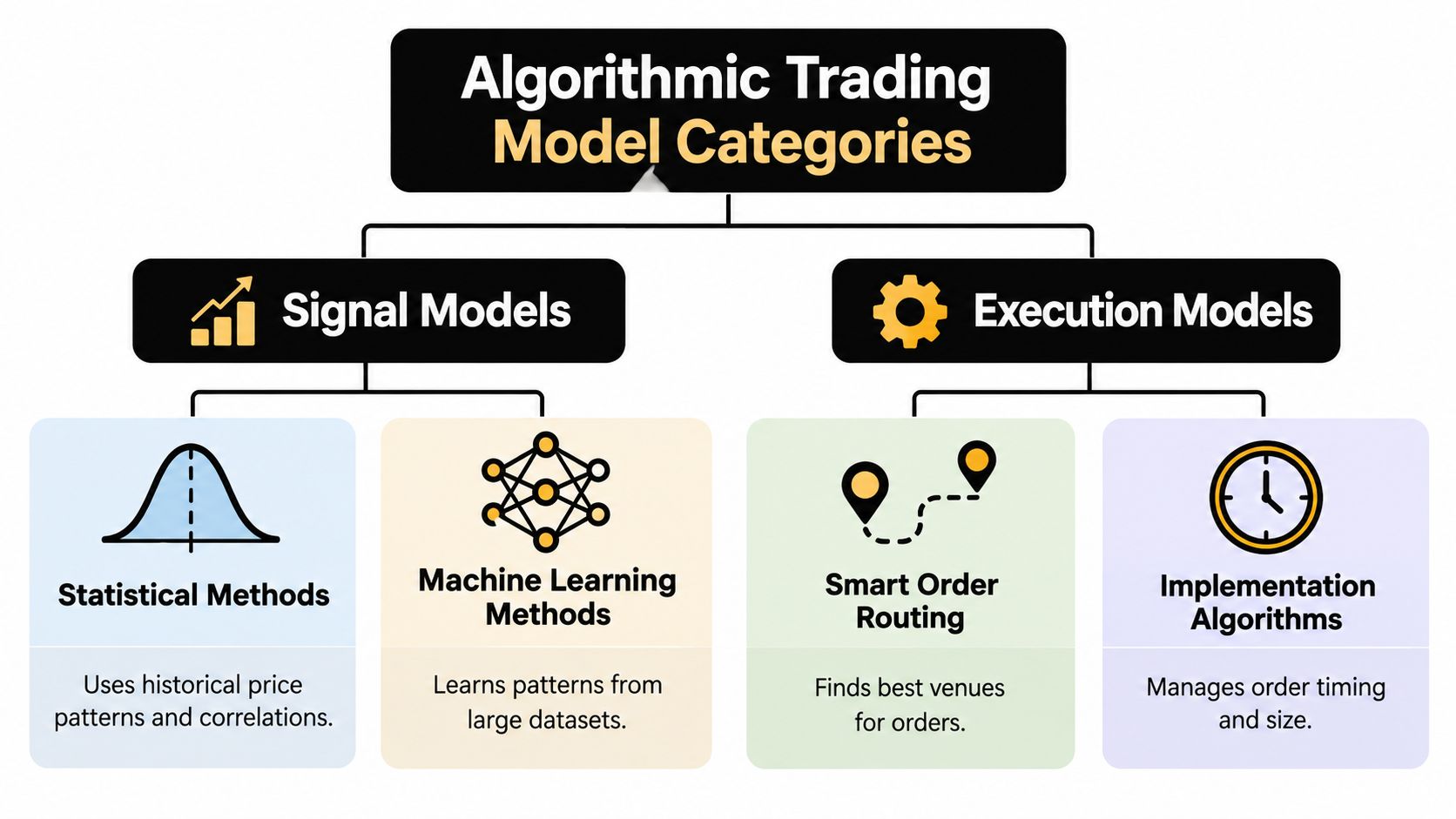
Algorithmic trading models aren't a single technique. The most useful distinction is between models that identify an opportunity and models that determine how to trade it.
A signal model estimates something relevant to a trading decision: expected direction, volatility, relative value, or the current market regime. An execution model determines order timing, size, and aggressiveness after a trading decision exists.
Separate the forecast from the fill
Signal methods include statistical frameworks such as ARIMA, GARCH, and cointegration, alongside machine-learning approaches such as gradient-boosted trees, LSTMs, and reinforcement-learning agents. These labels describe methods, not proof of a trading advantage.
Execution methods include volume-weighted average price scheduling, participation-rate algorithms, and smart order routing. Their purpose is different: implementing a trade without unnecessary cost or exposure.
Academic market-structure material estimated algorithmic trading at at least 30% of U.S. equity volume around 2009, roughly 360–750 billion shares annually against total annual volume of 1.2–2.5 trillion shares, while other contemporary estimates exceeded 50%, reflecting differences in definitions and measurement (algorithmic trading adoption and execution models).
That history explains why execution deserves its own engineering budget. Automated trading includes institutional order scheduling over minutes or hours, not just high-frequency decisions in milliseconds.
- Signal example A relative-value model identifies a divergence between related instruments.
- Execution example The system decides whether to enter immediately, wait for a limit fill, or skip the trade.
- Risk overlay Independent controls can reject the order even when both models approve it.
For a funded account, keep that separation explicit. Improving a forecast shouldn't automatically increase order size, relax liquidity filters, or override the remaining loss budget.
Comparing Time-Series, Ensemble, and Neural-Net Families
Choose a model by the effect you need to represent, not by how its name sounds. My starting preference is a transparent baseline that is easy to inspect when live behavior differs from expectations.
Model families at a glance
| Criterion | Time-series | Ensemble methods | Neural nets |
|---|---|---|---|
| Data needs | Useful starting point for compact, structured datasets | Require informative features and representative samples | Usually require more data and careful training design |
| Interpretability | Often easier to inspect | Feature effects need additional analysis | Internal representations are harder to explain |
| Regime sensitivity | Explicit assumptions can break | Learned feature relationships can shift | Learned representations can fail outside training conditions |
| Infrastructure cost | Generally manageable for a baseline | More training and feature-pipeline work | Greater training and monitoring complexity |
| Potential fit | FX volatility, relative value, commodity relationships | FX and index regime filters, crypto feature models | Sequence or multi-asset research where simpler methods fall short |
Time-series methods provide different tools for different jobs. ARIMA represents temporal structure, GARCH models changing volatility, Kalman filters estimate evolving states, and cointegration frameworks support relative-value hypotheses. Don't confuse a volatility forecast with a direction forecast.
Ensemble methods, including random forests and gradient boosting, are candidates when interactions matter. For example, a trend signal might behave differently depending on session, spread, and recent volatility. The engineering burden shifts toward maintaining clean features and preventing future information from leaking into training.
Complexity needs an acceptance test
Neural-network candidates include CNNs for structured pattern inputs, LSTMs for sequences, and transformers for broader contextual relationships. Reinforcement learning adds another challenge: the training environment must represent execution costs and constraints credibly.
For context when developing trend hypotheses, consult market trends from WebscrapingHQ. Treat contextual research as input to a testable idea, not as confirmation that an entry rule works.
A more complicated model should earn its place through better independent results, not a better-looking training curve.
For FX, indices, commodities, or crypto EAs, use the same decision rule: add complexity only when it solves an observed weakness. If the larger model makes shutdown decisions harder to understand, its apparent forecasting improvement may not justify deploying it under fixed loss limits.
Designing the Execution Layer So Edge Actually Survives
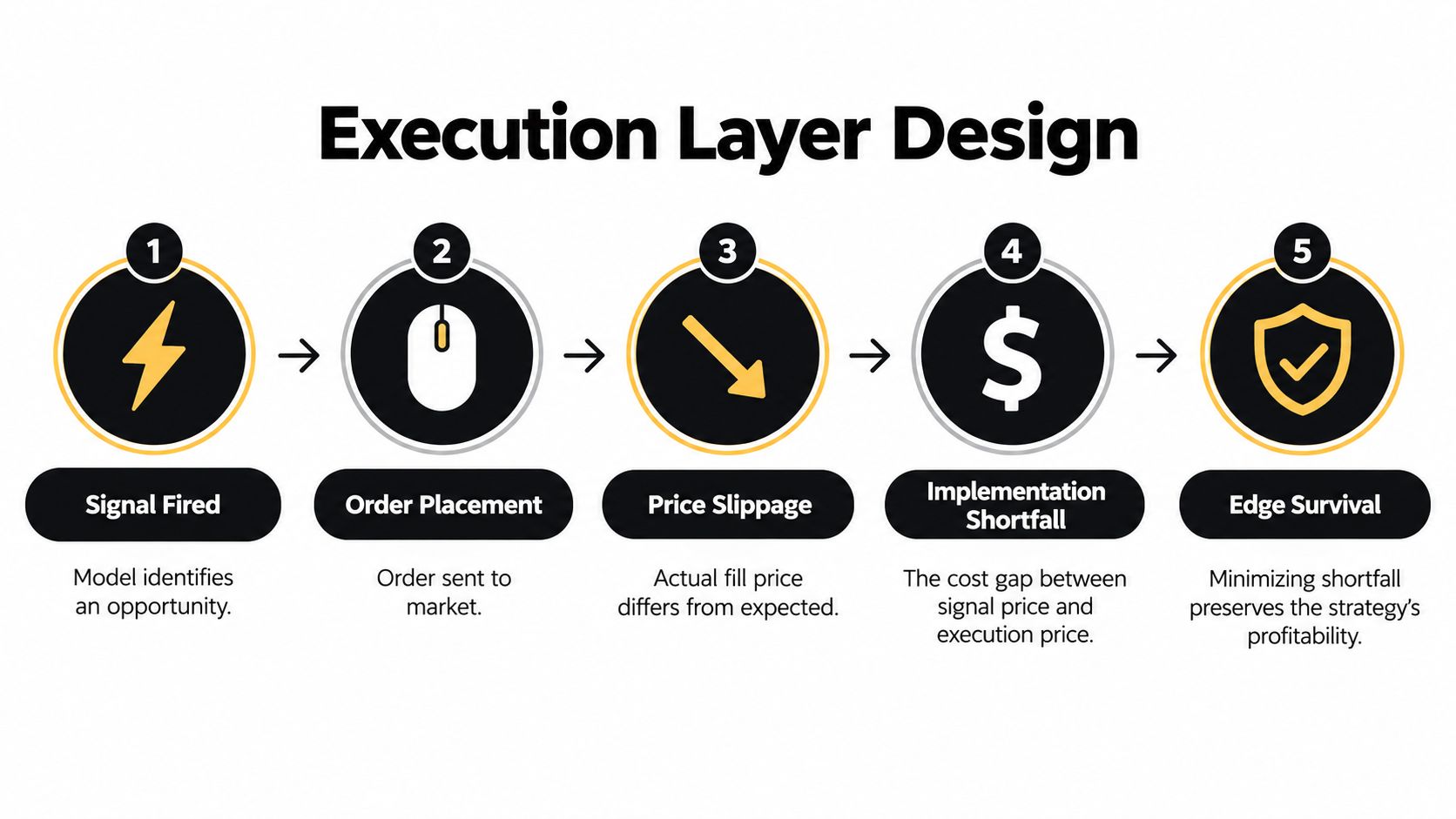
A directional forecast isn't the same as an executable opportunity. Implementation shortfall measures the gap between the decision-price benchmark and the realized trading outcome, including execution costs and, where relevant, the cost of unfilled orders.
Evidence covering 42 equity markets found that greater algorithmic-trading intensity generally narrowed spreads, improved informational efficiency, and reduced institutional execution shortfalls, while increasing short-horizon volatility (international evidence on algorithmic execution). Better average liquidity doesn't mean every order will receive a good fill.
Turn the forecast into an order decision
Estimate alpha decay, meaning how quickly the expected opportunity disappears, separately from transaction cost. A fast-decaying signal may justify immediate execution; a slower signal may permit a limit order, provided missed fills are represented accurately.
Use this execution checklist:
- Spread filter Reject entries when the current spread exceeds the model's tested operating range.
- Volatility-scaled sizing Reduce exposure when plausible adverse movement increases.
- Participation control Cap order flow against credible liquidity measurements, rather than assuming unlimited capacity.
- Fill handling Reconcile partial fills and rejected orders before submitting replacements.
There's no defensible universal spread threshold or participation percentage for every instrument. Set actual values from observed execution and stress tests, then check that stressed losses remain inside the account's available budget.
For a plain-language explanation of fill-price differences, review slippage in trading. For data-pipeline planning, Streamkap's Flink market data guide is a relevant resource to consult alongside your own feed documentation.
Measure costs where you trade
Don't transfer equity market-impact assumptions unchanged into currency pairs, index CFDs, commodities, or crypto. Record performance by instrument and session, including quote freshness and execution delay.
Place conservative notional caps and a session circuit breaker above the order-selection logic. Those controls should reject an otherwise attractive trade if its stressed execution loss would consume the account's remaining room.
Validating Models Under Regime Change, Not Just in Backtests
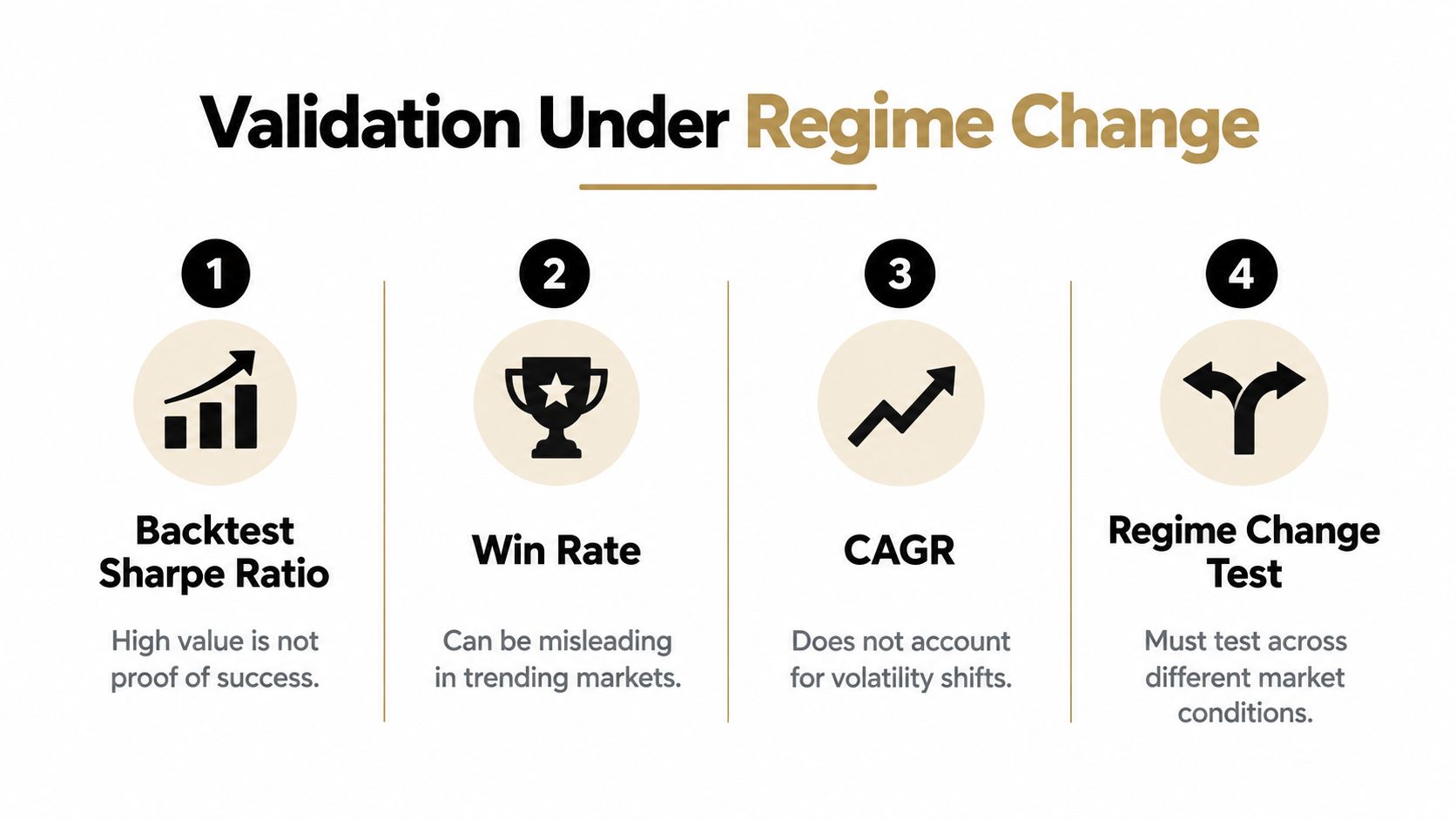
A high backtest Sharpe ratio is evidence about a historical simulation, not proof of deployable skill. It may reflect a genuine effect, favorable conditions, or repeated experimentation that selected noise.
Research on model selection warns that common procedures can suffer from backtest overfitting and may require a very high signal-to-noise ratio to be reliable (research on backtest overfitting). The more alternatives you try, the less persuasive the winning backtest becomes without independent validation.
A defensible validation protocol
- Split chronologically Separate training, validation, and an untouched forward-test period. Don't randomly mix future observations into earlier training.
- Run walk-forward tests Refit using only information available at each historical decision point.
- Perturb parameters Test neighboring settings. A narrow optimum surrounded by poor results deserves suspicion.
- Simulate stress Include crisis conditions, spread expansion, delayed data, slippage, financing, and position restrictions.
- Reshuffle trade sequences Use Monte Carlo analysis to examine loss clustering, while recognizing that reshuffling alone doesn't reproduce changing market relationships.
- Record the search Log the indicators, symbols, timeframes, and parameter combinations examined.
Evaluate each run against the funded account's rules, not just its final return. Report daily-loss breaches, peak drawdown, recovery behavior, and sensitivity to trading costs.
Test conditions the model hasn't learned
The Bank of England's 2025 analysis warns that unknown data or model flaws can mismeasure exposures and that autonomous models may behave unpredictably outside training conditions (financial-stability analysis of artificial intelligence). The CFA Institute's related warning about shared algorithmic reactions amplifying stress reinforces the need to examine correlated behavior, not just individual signals.
Use risk-on and risk-off conditions to organize regime scenarios. For a broader governance perspective, consult Visbanking's bank model validation practices.
Deployment standard: Prefer less impressive historical returns with stable stress behavior over exceptional returns that depend on uninterrupted liquidity.
Start forward deployment at reduced risk, with predefined acceptance criteria for drawdown, profit-factor deterioration, and slippage. Changing those criteria after losses appear defeats their purpose.
Why Reasonable Models Can Still Cause a Flash Crash
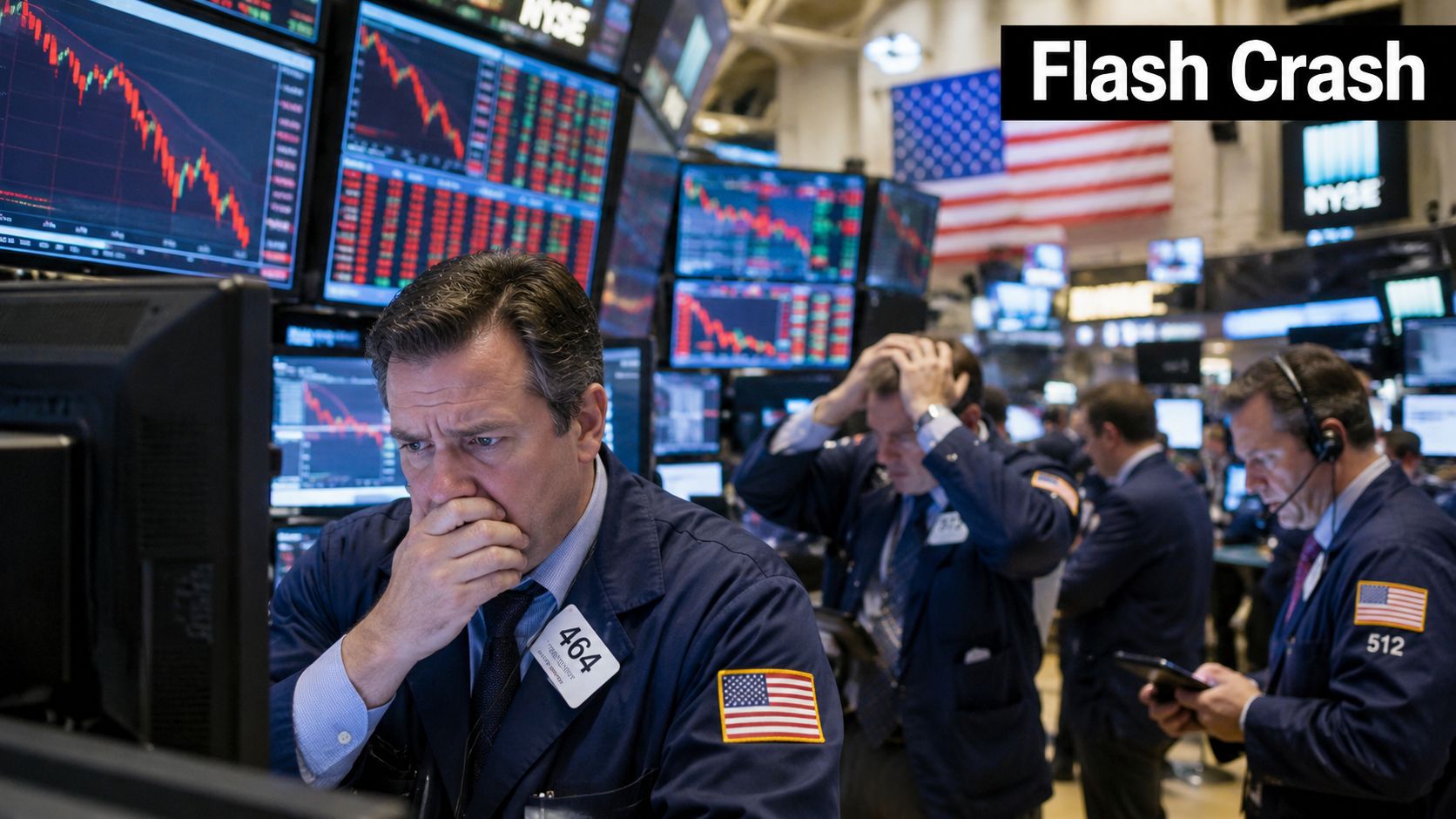
The U.S. Flash Crash illustrates a risk that ordinary strategy tests can miss: algorithms react to other algorithms. A locally sensible instruction can become unsafe when other participants change their behavior at the same time.
The historical account of May 6, 2010 describes an institutional hedge selling 75,000 E-mini S&P 500 futures contracts, worth approximately $4.1 billion, through an algorithm targeting 9% of the previous minute's volume without regard to price or time, completing execution in about 20 minutes; the Dow fell nearly 1,000 points intraday before closing down 342 points, while approximately 8,000 stocks reportedly experienced declines of 5% to 15% (Flash Crash reporting and investigation context).
Volume isn't a complete liquidity safeguard
Automated participants reacted to aggressive selling and to each other as liquidity deteriorated. Disturbances spread across futures, exchange-traded funds, and individual equities.
The important distinction is between observed trading activity and liquidity available for your next order. A participation rule tied to recent volume doesn't, by itself, establish that the current market can absorb continued selling safely.
For a funded trader, examine what happens when several strategies receive the same instruction:
- Shared signals Related bots may all enter or exit together.
- Shared exposure Positions across symbols may express the same underlying directional risk.
- Shared failure response Simultaneous stop-outs or retries may increase execution pressure when quotes are already unstable.
Test the interaction, not just the strategy
Run portfolio-level stress scenarios with correlated exits and degraded fills. Don't assume different instruments provide diversification when their stress behavior points in the same direction.
The event helped drive circuit-breaker pilots and greater attention to execution-rate controls. The practical lesson isn't that automation is dangerous. It's that order safeguards must remain effective when other participants withdraw liquidity, prices gap, and multiple systems attempt to reduce exposure together.
The Pre-Deployment Checklist That Actually Catches Bugs
Regulatory controls are useful engineering references, but their legal scope matters. A retail funded trader shouldn't assume that broker-dealer obligations apply identically to their account.
Under SEC Market Access Rule 15c3-5, broker-dealers with market access must maintain documented controls addressing aggregate exposure, preset credit or capital thresholds, erroneous price or size parameters, and duplicative orders, whether orders are manual or automated (SEC market-access risk-control guidance).
Convert principles into executable checks
| Control | Configuration to document | Test that can expose a bug |
|---|---|---|
| Maximum order size | Instrument-specific volume cap | Submit an oversized request |
| Maximum position value | Aggregate exposure ceiling | Open related positions concurrently |
| Price collar | Permitted deviation from a fresh reference quote | Send an order using stale prices |
| Duplicate detection | Unique intent identifiers and reconciliation rules | Retry after a missing acknowledgement |
| Loss circuit breaker | Internal stop below the contractual limit | Include floating loss and pending exposure |
| Emergency disable | Block entries and define existing-position handling | Trigger it during partial execution |
| Monitoring | Named owner, alerts, logs, and restart procedure | Simulate an unattended failure |
Populate thresholds with actual account rules and measured execution behavior. Don't choose a price collar from an arbitrary spread multiple or set the internal shutdown exactly at the contractual breach boundary.
Test operational failures deliberately
FINRA identifies pre-production testing and ongoing review as essential controls, including normal and stressed conditions, extreme volatility, malfunction detection, and rapid disengagement (FINRA algorithmic-trading guidance).
Test connection loss, delayed quotes, order rejection, duplicate callbacks, and process restarts. Confirm that restarting the bot doesn't erase its exposure history or daily-loss state.
Apply this checklist to your actual DXtrade, cTrader, or MT5 integration, not merely the strategy logic. Platform behavior, permissions, and order semantics must be verified separately before automated trading begins.
Putting It Together and Trading It Under Real Rules
The useful model isn't necessarily the one with the highest historical score. It's the one whose assumptions you can explain, whose execution you can measure, and whose failures you can contain.
Before deployment, assemble a compact evidence pack: the trading hypothesis, independent test results, stressed execution assumptions, account-rule mapping, and operational test log. If any part is missing, keep the model in research or forward testing.
Match the funding route to your readiness
One available route is a simulated funded environment rather than trading solely with personal capital. The firm's trading compliance rules should be checked alongside the current program terms: options include Instant Funding and 1-Step or 2-Step Challenges, account sizes from $5K to $100K with scaling paths up to $500K, a 5% daily loss limit, and up to 10% maximum drawdown; published commercial options include profit splits starting at 80/20, upgrades to 90/10 or 100%, and scheduled or on-demand payouts averaging around 24 hours to process.
These are simulated accounts with real market quotes, not a promise of live brokerage capital or guaranteed payouts. Confirm algorithm permissions, platform compatibility, optional trading permissions, and the applicable payout conditions before choosing a program.
FAQ
Which algorithmic trading model should a beginner choose?
Start with a transparent statistical or rule-based baseline that represents an effect you understand. A neural network isn't a substitute for a defensible hypothesis.
Can an EA pass a funded challenge and still be unsuitable afterward?
Yes. Passing an evaluation doesn't establish resilience across future regimes. Continue monitoring execution and account-level risk after qualification.
Does a kill switch guarantee that I won't breach a loss limit?
No. Gaps, delayed data, and poor fills can produce losses beyond an intended stopping point. Keep a safety buffer and test shutdown behavior under degraded conditions.
Algorithmic and manual trading involve substantial risk of loss. Past backtest performance doesn't guarantee live results, and this content is educational only, not financial advice.
MyFundedCapital offers Instant Funding and challenge-based access to simulated trading accounts for eligible manual and algorithmic traders. Compare the account types and current rules against your model's stress-test results before starting a challenge or selecting a funding program.