Copy trading can be profitable for some participants, but it isn't guaranteed to be profitable: 74%–89% of retail CFD accounts lost money in the European regulator's reported national studies. A copied strategy still carries market and position-sizing risk, and a follower's results depend on execution, costs, and risk controls, not just the lead trader's returns.
The gap between a trader's personal profit and a follower's net result is the central issue. Here's how to assess that gap, spot risks that leaderboards can hide, and decide whether copying fits your own loss limits.
The Short Answer and the Base Rate
The retail CFD loss rate is a warning about the starting conditions for copy trading. In 2018, the European Securities and Markets Authority reported that approximately 74%–89% of retail CFD accounts lost money, with average losses ranging from about €1,600 to €29,000 per client across national studies (ESMA data summary). The UK Financial Conduct Authority separately found that 82% of sampled retail CFD clients lost money over a one-year period in 2016, with an average loss of approximately £2,200. Both sets of figures describe CFD accounts, not copy-trading outcomes.
These figures do not establish the probability that a copier will lose. They do show that copying does not remove the pressures that make retail trading difficult. In the 2024 financial year, ASIC reported that 68.42% of retail CFD clients realised a net loss after fees (ASIC data summary). That base rate is relevant to followers because they still bear market risk and trading costs, while their results may differ from the lead trader's.
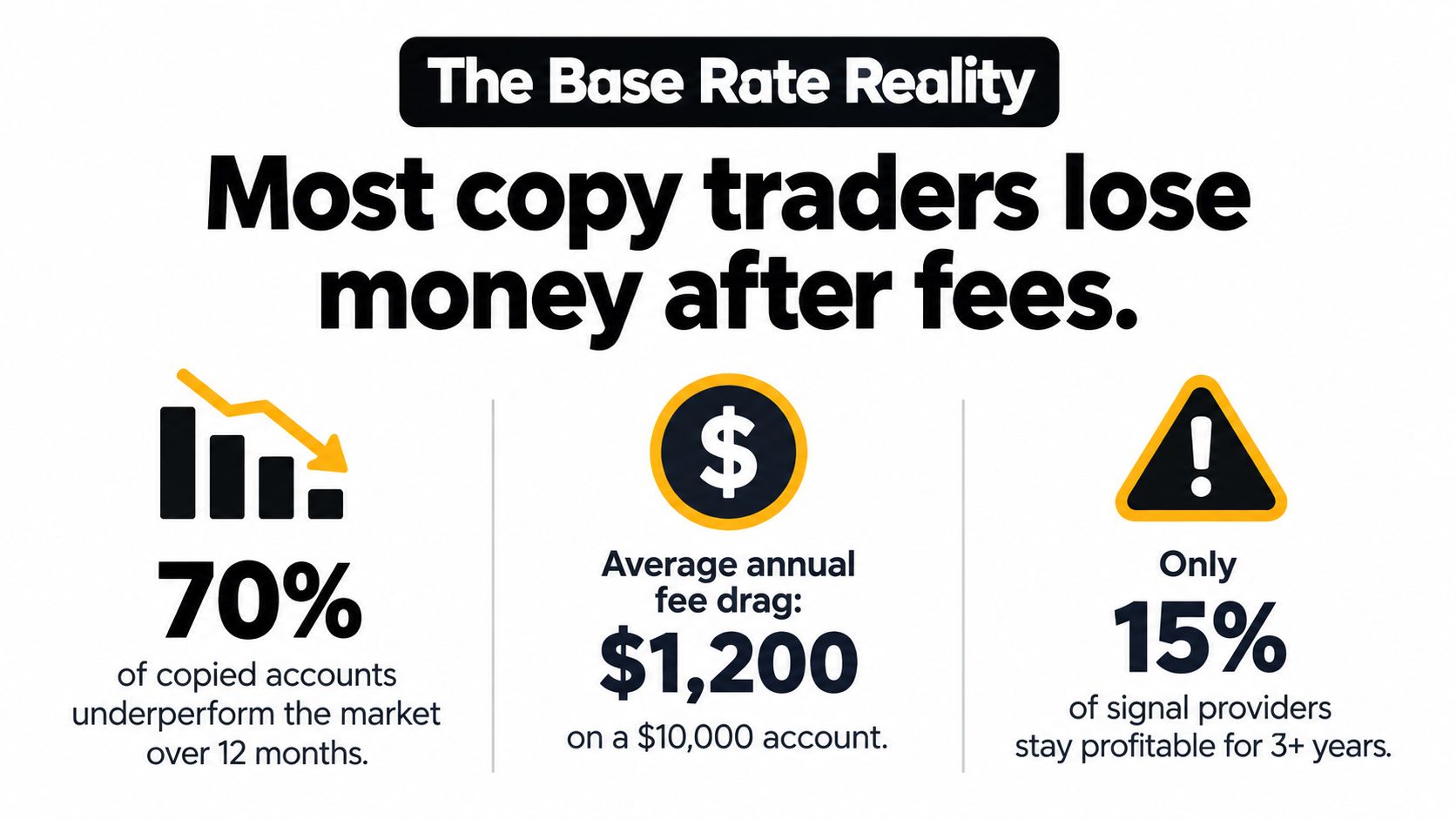
Why the base rate applies to copiers
A copied position remains exposed to the same underlying price movement as a manually placed trade. The copying service transmits trading decisions; it cannot remove spreads, commissions, slippage, or losses. Followers may also enter or exit at different prices from the lead trader, so a profitable lead-trader record does not guarantee a profitable follower account.
A historical equity curve is evidence of past performance, not proof of resilience. Short records, survivorship bias, amplified exposure, and the absence of adverse market conditions can make returns look stronger than the strategy's capacity to withstand losses. The key distinction is between the lead trader's P&L and the follower's net outcome after costs and execution differences.
Better question: Can this specific strategy remain profitable for you after costs, execution differences, and a drawdown you can tolerate?
Win rate alone cannot answer that. When average losses exceed average gains, a trader can win often and still lose money. This explanation of why a 50 win rate trader still shows why counting winning trades is not enough to assess profitability.
How Copy Trading Actually Works
Copy trading is a live chain of decisions, signals, and orders. The follower isn't handing money to a trader to manage as a fund. Instead, the platform or service attempts to reproduce that trader's transactions in the follower's account, subject to the platform's settings and execution.

Like ordering from a restaurant, the chef chooses and prepares the dish, but you still pay for the ingredients, cover service costs, and receive what the kitchen can deliver at that moment. In trading, spreads and commissions are part of the cost, while execution price determines whether your fill matches the provider's.
Three points where the mirror can diverge
- Signal transmission The service detects that the lead trader opened, adjusted, or closed a position. Delays or a technical interruption can mean the follower's order arrives later.
- Execution The platform sends an order to the follower's account. Price movement, liquidity, and platform conditions can change the fill, especially in fast or thin markets.
- Risk transfer The follower takes the market exposure created by that position. Losses transfer along with gains, but the amount of risk depends on account size, position-sizing rules, and any settings used to increase exposure.
Copy services may use proportional sizing, which adjusts the copied position based on the follower's allocation or account size, or fixed-lot copying, which uses a set trade size. For example, a $5,000 follower copying a $100,000 lead account might receive positions scaled to a smaller allocation under proportional sizing. The exact calculation depends on the platform, so check how it handles minimum trade sizes and open positions.
Platform-native tools and external signal providers can also differ in how they transmit orders and display performance. Before connecting an account, compare those mechanics using a social trading platform comparison guide. Don't assume a copied trade is an audited, managed investment or that the lead trader has a fiduciary duty to the follower.
What the Follower Data Shows
Lead-trader performance and follower performance diverge sharply. A 2025 analysis of 100,236 crypto copy-trading outcomes across Binance, Bybit, and MEXC found that 97.04% of lead traders were profitable on their own accounts, while 43.61% generated positive returns for followers. Across the study, 48.48% of follower outcomes were profitable over 90 days (cross-platform outcome analysis).
These results describe the outcomes in that analysis, not every platform or every follower. They show why a leader's return cannot stand in for a copier's result. Followers may begin copying at different times, use different amounts of borrowed capital, pay different fees, and face different liquidation rules. Even when they follow the same signal, their trade prices can differ.
| Metric | Lead Trader | Follower |
|---|---|---|
| Account performance | The trader's own realised results | The result after the follower's own settings and costs |
| Trade price | The lead account's entry and exit | May differ because of timing, liquidity, and slippage |
| Risk settings | Set by the lead trader | May reflect follower allocation and platform controls |
| Profitability signal | Can attract attention on a leaderboard | Must be checked using the follower's net P&L |
Why activity can hurt
ASIC's Report 828 summary states that 19% of the most active retail CFD traders, those making more than 50 trades per month, were profitable after costs. The summary also reports losses above A$458 million, including approximately A$73 million in fees (ASIC Report 828 summary). These figures concern retail CFD traders, not copy-trading followers specifically. They still make turnover relevant: spreads, commissions, financing, and execution differences can reduce the net result of a frequently traded strategy.
The practical test is the follower's own record. Compare the leader's equity curve with the follower's net profit and loss, drawdown, and position sizing. A leaderboard can identify candidates, but only follower-level results show what copying delivered after costs and account-specific execution.
Hidden Risks Most Articles Skip
Copy trading can increase activity rather than reduce it. IOSCO's 2025 report identifies risks including misleading disclosures, unclear conflicts and remuneration, excessive risk-taking, high turnover costs, timing and pricing differences, and technical failures. The report also cites experimental evidence that participants who could copy a high-performing user made 18% more trades than a control group (IOSCO report).
That finding challenges the idea that copying automatically creates a calmer or more disciplined process. More trades can raise trading costs, and a follower may be tempted to chase a recent run of returns instead of examining how the strategy handles losses. If a lead trader changes style or position sizing, continuing to copy without review can leave the follower exposed to a different risk profile than the one they originally assessed.
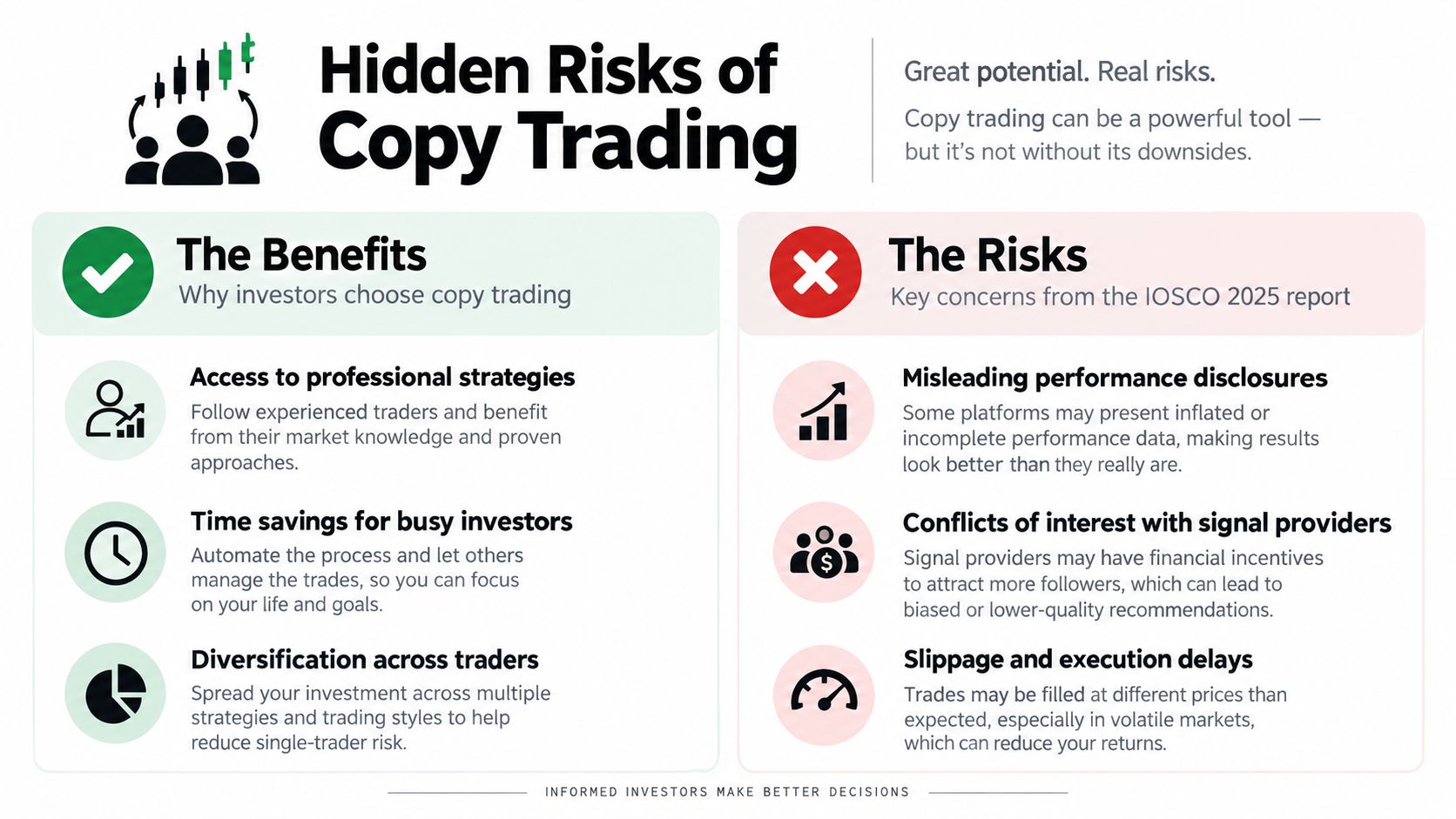
The risk a leaderboard can conceal
A strong headline return may conceal a position-sizing method that increases exposure after losses, no effective stop-loss, or concentrated exposure to one instrument. An account can also look stable because it hasn't yet faced market conditions that expose its weaknesses. If the trader's drawdown is unexplained or results depend on a small number of unusually large wins, the headline performance offers little comfort.
A French regulator study of 14,799 active retail clients trading forex and CFDs found that 89% lost money, with average losses of €10,887 per client over the study period (French regulator study summary). The study did not measure copy trading, but it reinforces a practical point: copying does not neutralise the risks of geared retail products.
Before following a strategy, check whether its trading costs, instrument exposure, and currency risk fit your account. A plain-language overview of currency hedging and foreign exchange risk can help clarify how currency exposure differs from the trader-selection question. For a closer look at the risks specific to mirrored trades, review copy trading risks.
How to Evaluate a Trader Before You Copy
Don't choose a trader by total return alone. Compare candidates using the same measures, and reject a strategy when its risk or execution requirements don't fit your account.
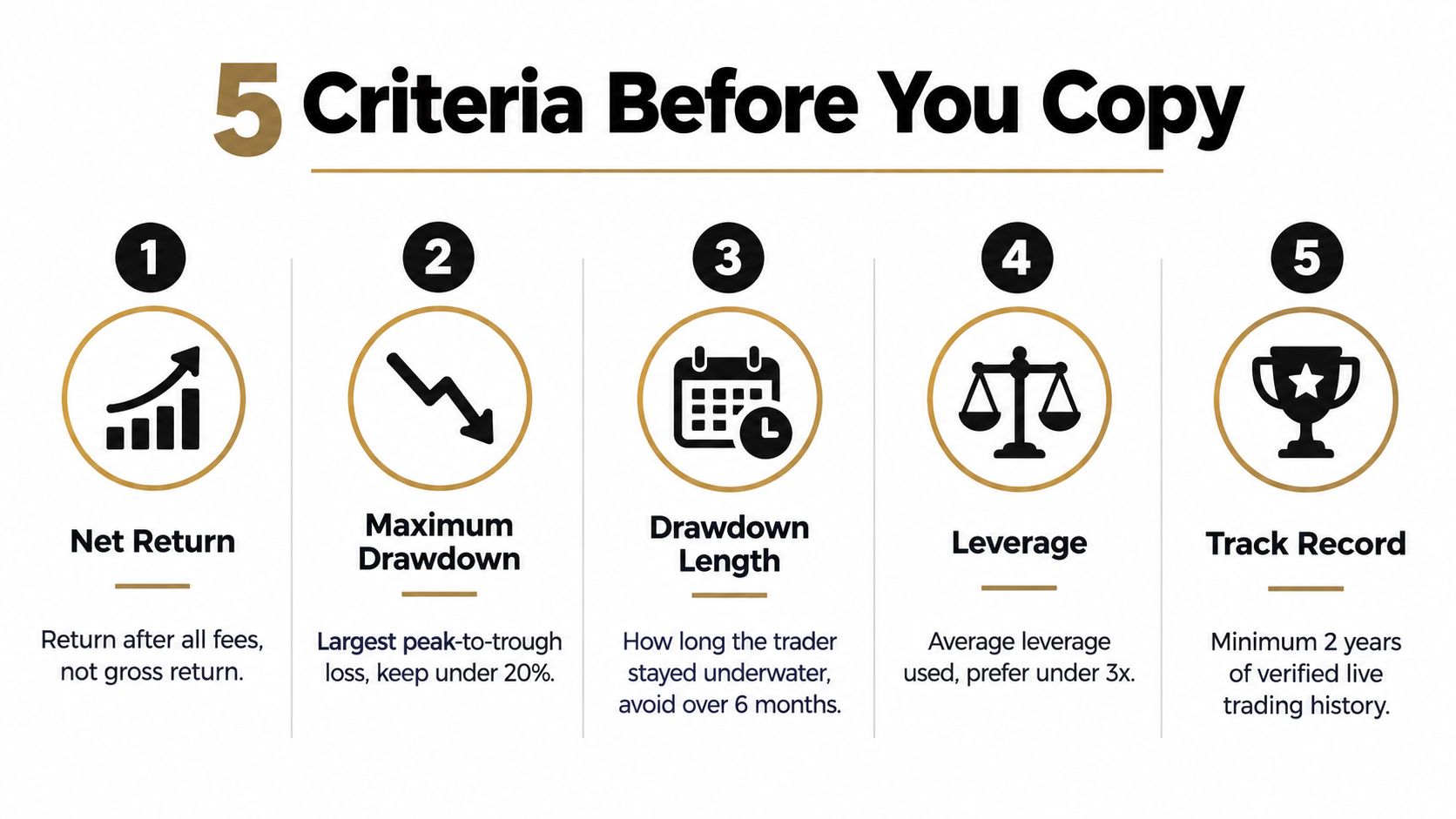
Five criteria to compare
- Net return after costs. Ask whether the displayed return includes commissions, spreads, financing, and any platform or provider charges. Gross profit can overstate what a follower keeps.
- Maximum drawdown. Identify the largest peak-to-trough decline and ask whether your own capital and risk limits could withstand a comparable loss. A high return doesn't offset a drawdown that would force you to stop copying.
- Drawdown duration. Check how long the account has remained below its previous peak. A long recovery period can test your finances and patience differently from a brief decline.
- Position sizing. Look at exposure across trades, not just the stated ratio setting. Reject a provider whose sizing grows after losing positions or whose concentrated exposure exceeds your tolerance.
- Execution sensitivity. Ask whether the strategy depends on rapid entries, narrow profit targets, or frequent trades. If small fill differences can erase its edge, your account may not reproduce the lead trader's results.
A risk-adjusted measure can help place returns in context, but it shouldn't replace drawdown and net-return checks. See this guide to Sharpe ratio calculation for a way to compare return with volatility.
Red flags to reject
- Short or selective history A brief record may not show how the strategy handles adverse conditions, and visible winners can exclude traders who failed.
- Unexplained drawdowns If the provider can't explain losses, position sizing, or exposure, you can't assess what you're copying.
- Unusual equity jumps A return driven by a few outsized trades may hide an inconsistent or fragile approach.
- Changing risk without notice A shift in position sizing, instruments, or trading style can make past performance less relevant.
Use the same checklist for every candidate. A polished equity curve is a starting point for questions, not a reason to waive them.
A Practical Workflow for Copy Trading
Treat copying as an operating process with rules for sizing, monitoring, and stopping. Decide those rules before a losing streak makes the decision harder.
- Set the allocation limit. Choose how much of your capital can be exposed to one strategy, then set a separate ceiling for your total copy-trading allocation. Leave room for other positions and unexpected losses.
- Choose the sizing method deliberately. Proportional sizing can scale positions to your allocation, while fixed lots may create more exposure than you intended. Confirm how the platform handles open trades and minimum order sizes before enabling replication.
- Set an independent loss limit. Your limit should apply even if the lead trader hasn't closed the position. Decide in advance when you'll pause copying and whether you'll close open trades or manage them separately.
- Track execution differences. Compare copied entry and exit prices with the provider's reported prices. Include commissions, spreads, financing, and platform fees when you calculate the follower's net result.
- Monitor turnover and exposure. Review how frequently the strategy trades and whether several copied traders hold similar positions. The number of providers alone doesn't show whether the risks are diversified.
Practical rule: Stop copying when the provider changes leverage, instruments, or trading style in a way that breaks your original risk assessment.
Review the account on a regular schedule. Use a 30/60/90-day check-in cadence as an operational routine, not as evidence that the strategy will become profitable by a particular date. At each review, compare follower net P&L with the lead account, check drawdown and execution, and decide whether the strategy still fits your rules.
Write down a stop condition before you begin. For example, you might pause replication when a defined loss limit is reached or when copied fills repeatedly differ from the provider's prices. The threshold is yours to set; it should reflect your account and risk tolerance, not a trader's promise of recovery.
Copy Trading Inside a Funded Account
Copy trading may suit some disciplined participants, but the copying mechanism doesn't change market, financing, or execution risk. In a funded-account setting, risk limits can make a trader's rules more concrete, provided the account terms allow the method and the trader follows them.
MyFundedCapital offers simulated capital for traders who pass its Instant Funding, 1-Step, or 2-Step routes. Account sizes range from $5K to $100K, with scaling paths up to $500K. It supports manual, algorithmic, and copy trading on DXtrade and cTrader, subject to its account rules, with profit splits starting at 80/20 and scaling up.
The firm's stated risk parameters include a 5% daily loss limit and up to 10% maximum drawdown. Read the drawdown rules before trading, then check whether your strategy's exposure, position sizing, and stop conditions can operate within them. Simulated capital can provide a setting to practise a disciplined workflow, but it doesn't remove the risk of loss or establish that a strategy will be profitable with personal funds.
This article is educational only and isn't financial advice. Trading involves risk of loss, including when trades are copied.
If you want to test your risk process within defined account rules, compare MyFundedCapital's funding routes and account terms before choosing a challenge. Visit MyFundedCapital to review the available programs and decide whether their simulated-capital setup fits your approach.