You see a trader open a futures position using borrowed funds, watch the account move in the right direction, and think copying the trade should produce the same result. In practice, your fill, margin, account rules, and loss limits can turn an apparently identical order into a very different outcome. This guide explains how copy trading futures works, why execution and governance matter more than the follow button, and which checks to complete before enabling replication.
Why Copy Trading Futures Looks Easy but Isn't
A follower copies an ES or crude oil trade during a volatile session. The leader gets filled first, the follower enters a little later, and the market reverses before the follower's stop is active. On the screen, both accounts show the same idea. In the risk report, they may show different entries, different losses, and different reasons for failure.
That difference is the central problem. Futures copy trading isn't a shortcut to someone else's skill. It adds an execution system and a governance layer to an already margin-intensive product. You have to control what happens when the follower receives a worse price, has less available margin, reaches a daily loss limit sooner, or loses connection to the copying platform.
Three failure modes deserve attention:
- Execution divergence delayed entry, slippage, pricing differences, rejected orders, partial fills, or platform problems can produce a different position.
- Drawdown mismatch the leader's account size, margin buffer, and risk tolerance may not match yours.
- Rule conflicts news restrictions, weekend policies, contract limits, daily loss controls, and maximum drawdown rules can interrupt a copied strategy.
Academic experimental evidence published in Management Science found that performance information increased willingness to take risk, while a direct copy function increased risk-taking further. The researchers concluded that followers can infer skill from recent results and underestimate the role of luck or unusually favorable conditions. Read the peer-reviewed copy-trading study before treating a leaderboard as evidence of durable skill.
Practical rule: Before you copy a trader, prove that your account can survive the trader's worst plausible execution outcome, not just the trader's recent return.
How Copy Trading Works in Futures Markets
Copy trading means that one account's orders are replicated in another account. The leader may trade one contract and the follower may receive the same contract, a proportional position, or a size adjusted by an account-level multiplier. The copier can operate through a platform-native module, an API, or a bridge that receives the leader's order events and sends new instructions to follower accounts.
That differs from signal-following. A signal provider might publish an entry and exit for you to place manually. A social trading service may let you allocate funds to another trader whose positions are automatically reproduced. A mirror or managed account may give a provider broader control over the follower's portfolio. The label matters less than the actual authority, sizing model, and execution path.
A typical order travels through six stages:
- The leader decides to enter, exit, or modify a position.
- The leader's platform confirms an order event.
- A copy module, API, or bridge reads that event.
- Allocation logic converts the event into follower quantity.
- The follower platform sends the order to its execution venue.
- The follower receives a fill, rejection, partial fill, or cancellation.
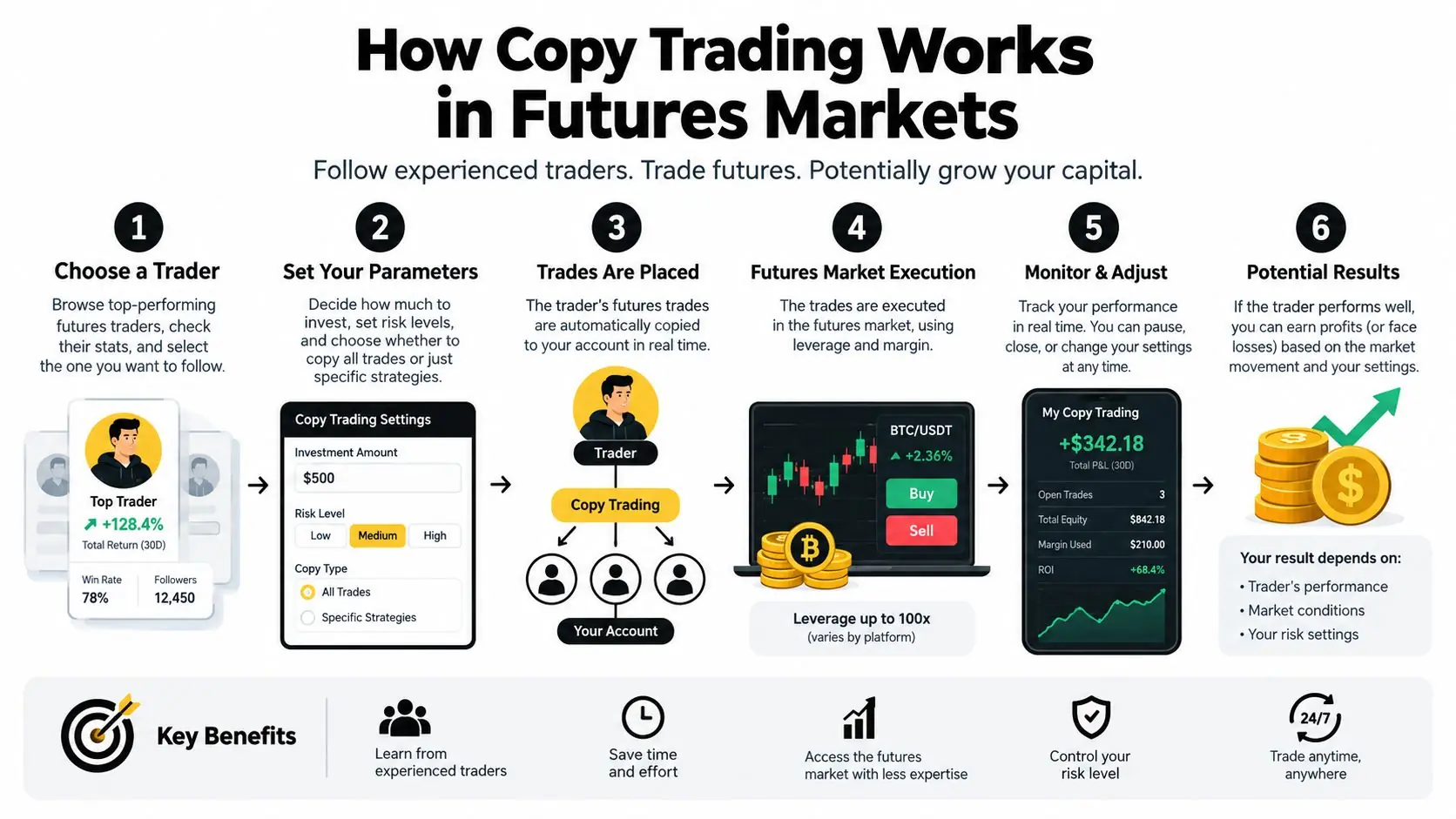
Think of the system like a satellite dish receiving a signal. The follower can receive the same message, but not necessarily at the same instant or with the same clarity. A fast market can move between the leader's fill and the follower's order, while a disconnected API or rejected contract can stop the message from becoming a position.
Futures add another layer. Contracts have fixed specifications, contract multipliers, exchange-set margin requirements, and instrument-specific trading hours. Copying one contract-for-one contract may be inappropriate if the follower's account has a different balance, margin allowance, or permitted instrument list. Before enabling replication, identify whether the system copies contracts, notional exposure, risk, or a percentage of equity.
Margin and Leverage Implications for the Follower
The first distinction to understand is between notional exposure and posted margin. CME explains that a futures performance bond, commonly called margin, may represent only about 3% to 12% of a contract's total value. The CFTC separately describes futures margin as typically around 2% to 10% of total contract value, with additional variation margin required if an account falls below maintenance requirements. See the CME futures trading guide for the mechanics.
Margin isn't a down payment that caps your loss. It's collateral supporting a magnified position. A small market move can create a large change in account equity because the contract controls a larger notional amount than the cash posted.
The three margin terms you need
- Initial margin is the amount required to open the position.
- Maintenance margin is the minimum account equity required to keep it open.
- Variation margin is the additional money required when losses reduce the account below the maintenance threshold.
A copied trade can consume margin faster than the leader expects because the follower might have fewer open-equity resources, a different account size, or a stricter risk rule. CME's standardized risk disclosure warns that a sharp adverse move can require substantial additional margin on short notice. If you can't provide it, the broker may liquidate the position, and you may remain liable for a resulting deficit. Futures trading involves risk of loss, and losses may exceed the initial margin deposited. Review the CME risk disclosure before connecting a copier.
Size against the loss allowance
Suppose you have a simulated funded account with a $10,000 advertised balance, and your program applies a 5% daily loss limit and up to a 10% maximum drawdown. Those figures describe the account's rules, not permission to risk the entire balance. If a copied position uses five micro contracts, the relevant question isn't whether five contracts look small. It's how much each contract can lose at the planned stop, how many positions can open at once, and how much loss allowance remains after commissions, slippage, and open trades.
Use a futures position size calculator to work from the stop distance, tick value, contract quantity, and permitted loss. Then reduce the result if the leader adds positions, holds through news, or trades instruments with fast price movement.
Your usable risk budget is the remaining loss allowance after current exposure, not the account balance printed in the dashboard.
Before copying, record:
- Maximum contracts per instrument.
- Dollar risk per copied event.
- Maximum simultaneous positions.
- Initial and maintenance margin.
- The account's daily loss and total drawdown rules.
- The action taken after a rejected, partially filled, or unprotected order.
Copying doesn't diversify borrowed capital exposure. If several accounts follow the same futures position, they can reach their loss thresholds together. The CFTC found retail activity during specific silver and WTI crude oil episodes exceeded normal futures-market activity by more than three times, with silver's retail-interest score reaching 100 on February 1, 2021, and WTI crude oil reaching 100 on April 20, 2020. Its market-microstructure study linked these short bursts of engagement with volatile conditions and heightened social-media interest. Synchronized copying can add slippage, wider spreads, delayed fills, and correlated stop-outs when attention clusters around one contract.
Platform Support, Supported Instruments, and Rule Conflicts
A platform can support copying without supporting the exact instruments or controls you need. cTrader, DXtrade, Match-Trader, and MT5 may differ in their copy modules, broker connections, contract lists, sizing rules, bracket handling, and account permissions. Check the platform's actual instrument catalog rather than assuming that a visible symbol can be copied safely.
MyFundedCapital offers 350+ instruments across forex, indices, crypto, and commodities on DXtrade and cTrader, with MT5 coming soon. That breadth doesn't remove the need to verify whether your chosen leader's instrument, contract size, trading hours, and order type are available in the follower account.
A pre-copy platform check
- Latency: Measure the time between the leader's confirmed fill and the follower's order submission.
- Slippage: Check how the system handles a price that has moved before the follower order arrives.
- Contract sizing: Confirm whether sizing uses fixed contracts, proportional equity, or a risk multiplier.
- Position limits: Identify the maximum simultaneous positions and total contracts.
- News windows: Determine whether the follower blocks trades that the leader regularly opens.
- Weekend policy: Confirm what happens to open positions before market closure and during gaps.
- Brackets: Test whether stops and targets copy on entry and continue copying after modification.
- Failure handling: Find out whether a rejected follower order pauses the account or leaves it out of sync.
A leader who trades major news can conflict with a follower's 5% daily loss limit. A strategy that swings through open positions can collide with a 10% maximum drawdown rule. A follower with a weekend-holding add-on may still face a different result from a leader who scales into an overnight gap. The issue isn't whether the leader's strategy is good in isolation. The issue is whether it remains executable under the follower's rules.
Prop-firm account features relevant to copy trading futures
| Feature | Standard | Note for copy followers |
|---|---|---|
| Daily loss control | Flat 5% limit | Size from remaining daily allowance, including open losses and execution costs. |
| Maximum drawdown | Up to 10% | Compare the leader's drawdown profile with the follower's equity path. |
| Instruments | 350+ across forex, indices, crypto, and commodities | Confirm that every copied symbol and contract is supported. |
| Platforms | DXtrade and cTrader | Match the copier's bridge and order-management capability to the platform. |
| Trading modes | Manual, algorithmic, and copy trading | Verify account ownership, authorization, and firm-specific copying rules. |
| Optional conditions | News trading, weekend holding, and faster payouts | Check whether the leader depends on an add-on the follower doesn't have. |
For a more detailed product-specific review, examine the copy-trading app information and compare it with the provider's own documentation. Choose the platform attribute that can stop the trade first, usually instrument access, loss rules, or order propagation.
Why a Copied Trade Is Not the Same Trade
"Automated" describes the instruction process, not identical exposure. IOSCO identifies delayed entry, pricing differences, funding-cost and position-sizing mismatches, transaction costs, and platform or connectivity problems as causes of performance divergence. Its report on copy trading also warns that frequent trading costs can erode gains or extend losses.
Consider a simple illustration. If a copied ES position contains 10 contracts, a 0.25-tick price difference, and a $25 multiplier, the gross difference is calculated as 10 × 0.25 × $25, or $62.50 before other costs. That is an example of how a small fill difference can become meaningful when position size increases. It isn't a forecast of actual slippage.
Five divergence points
- Delayed entry The leader may enter before a breakout, while the follower's order arrives after the price has moved.
- Pricing differences Separate accounts may receive different bid, ask, or fill prices.
- Sizing mismatch A fixed contract copy can be oversized for a smaller follower account.
- Transaction costs Commissions, spreads, and other charges can turn a leader's gross edge into a follower's weaker net result.
- Connectivity or platform failure A disconnected bridge can miss an entry, stop modification, or exit.
Run a stress test before following a new leader. Compare expected latency during quiet and volatile conditions, modeled slippage, maximum simultaneous contracts, margin usage, and your follower-specific loss limit. Then ask what happens if the follower misses the entry but receives the stop, or receives the entry but not the bracket.
A copier can reproduce the leader's instruction while creating a different drawdown path for the follower.
Review the leader by worst drawdown, losing streak, margin usage, average holding time, and exposure correlation, not only recent returns. The follower's worst day is the worst combination of the leader's decision, your fill, your sizing, your costs, and your account rules.
Compliance, Disclosure, and Behavioral Risk
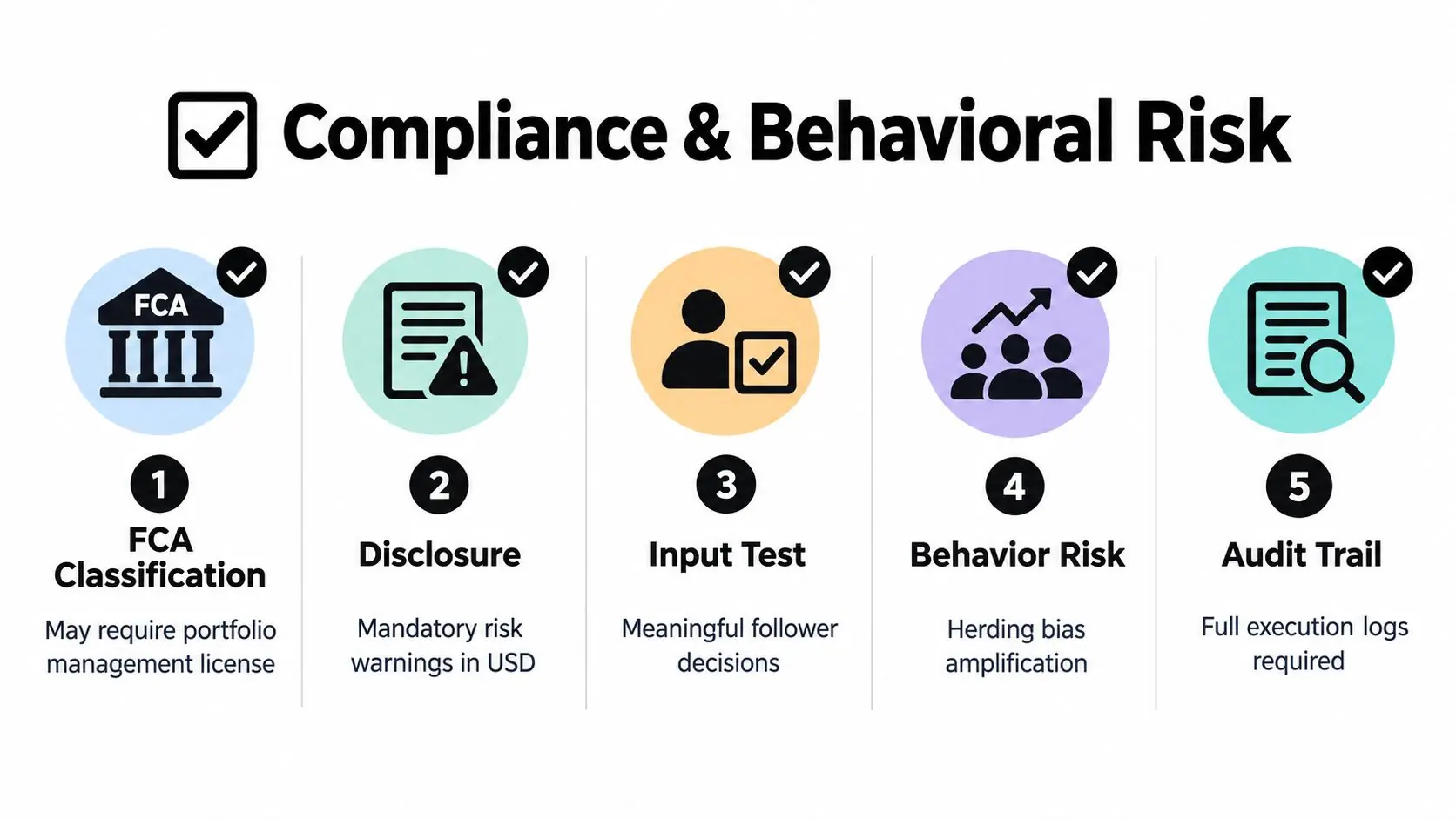
Copy trading can involve more than a software connection. The UK Financial Conduct Authority classifies copy trading without meaningful manual input as portfolio or investment management. Its copy-trading guidance describes a mechanism in which a proportion of available funds is allocated so another trader's transactions execute automatically in the follower's account.
That classification matters because authorization, disclosures, suitability, and conduct obligations may apply. Ask the provider whether it is authorized for the service offered in your jurisdiction, who controls the account, how trades are sized, and whether the system copies contracts, exposure, or equity percentage. Also ask what happens when the leader changes stops, opens several positions, or trades an instrument you can't access.
ESMA's supervisory briefing highlights information about the service, marketing communications, costs and charges, product governance, suitability and appropriateness, remuneration and inducements, and the qualifications of copied traders. Convert those expectations into a practical document request:
- Performance Request realized and unrealized results, worst drawdown, losing streak, position sizing, and average holding time.
- Costs Identify commissions, spreads, funding charges, performance fees, and any subscription charge.
- Execution Request fill timestamps, rejected-order records, partial-fill handling, and stop-modification logs.
- Incentives Check whether the leader or platform benefits from more frequent trading or larger positions.
- Data use Understand what account, trading, and identity information the provider stores and shares.
- Suitability Confirm whether the service explains the risks of futures trading to the follower.
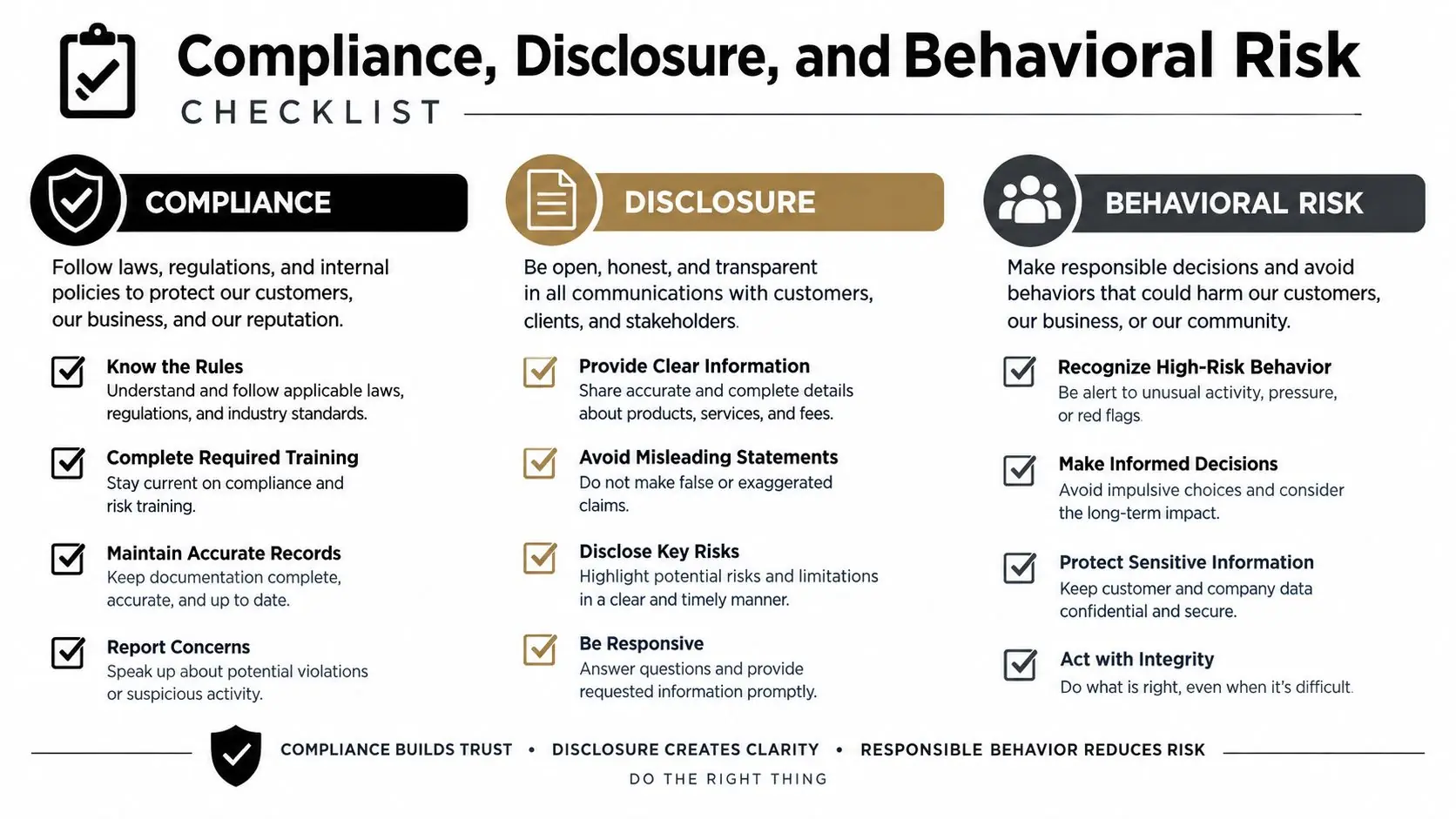
Behavior creates another trap. The peer-reviewed experiment described earlier found that performance information alone increased willingness to take risk, and direct copying increased it further. A recent winning streak can make you increase size precisely when uncertainty about the strategy's true skill remains high. Review fintech compliance insights for broader context on disclosure, governance, and regulated financial technology practices.
MyFundedCapital states that its evaluations and funded accounts run on demo environments with real market quotes to assess skill and discipline. Treat that transparency as a baseline question for any prop firm or provider: What exactly is simulated, which rules are enforced, and how are copied orders recorded? For additional risk-specific considerations, review copy-trading risks before connecting an account.
A Practical Setup Playbook for Copy Trading Futures
Don't start by choosing the trader with the highest recent return. Start with the operating record. Look at worst drawdown, losing streak, position sizing, average holding time, instruments traded, and response to volatile sessions. Reject any leader whose risk profile can't fit your account's loss rules.
Then size the follower independently:
- Set a maximum dollar risk for one copied event.
- Set a hard ceiling for contracts and simultaneous positions.
- Use the follower's remaining loss allowance, not the advertised balance.
- Reduce size when the leader adds positions or trades through major news.
- Define whether the account pauses after a daily-loss breach or a connectivity failure.
Before live activation, use a paper-copy or observation period. Compare the leader's fill with the follower's submitted order, actual fill, stop placement, target placement, and exit. Test modifications, cancellations, partial fills, and rejected orders. If the follower can hold an unprotected position after a bracket failure, don't enable automatic copying.
On a MyFundedCapital-style simulated account using DXtrade or cTrader, confirm the account's permitted instruments, daily loss rule, maximum drawdown, news permissions, weekend permissions, and copying authorization. The firm's broader platform and instrument offering doesn't override the specific rules attached to your account.
Maintain the system like an operational process:
- After each session Check open positions, rejected orders, missing brackets, and unexpected follower exposure.
- Weekly Reconcile leader and follower fills, costs, position sizes, and realized results.
- Monthly Review the leader's drawdown, losing streak, margin use, holding time, and correlation with other leaders.
- Quarterly Reassess whether the account rules, platform connection, and allocation still fit the strategy.
A killswitch should pause copying after a daily-loss breach, repeated order rejection, abnormal slippage, or a broken connection. Add a news pause and a weekend-gap policy only if they match the account's permissions and the leader's trading behavior. Diversifying across leaders doesn't automatically diversify risk if they trade correlated futures or react similarly to the same macro shock.
FAQ and Next Steps
Can copy trading work on a prop-firm funded account?
Sometimes. The firm must permit it, you must own or be authorized to use the copier, and you must retain exclusive control of the participating accounts. Check the current account rules before connecting anything.
What is the realistic worst-case loss?
A copied futures position can hit its stop, breach the account's daily or maximum drawdown limit, trigger liquidation, or lose more than the initial margin deposited. Your result can be worse than the leader's because of fills and sizing.
How do I verify a copy provider?
Check authorization, disclosures, costs, execution logs, trader qualifications, drawdown history, position sizing limits, and conflict-of-interest policies. Don't rely on a return chart alone.
How does the MyFundedCapital environment handle copying?
MyFundedCapital supports manual, algorithmic, and copy trading within its programs, while evaluations and funded accounts operate in demo environments with real market quotes. Confirm the current rules for your chosen account and platform.
Copy trading futures is an execution and governance decision, not a guaranteed path to profit. Trading involves risk of loss, and this article is educational content, not financial advice.
MyFundedCapital offers Instant Funding plus 1-Step and 2-Step Challenges with simulated capital, support for manual, algorithmic, and copy trading, and access to DXtrade and cTrader across a broad instrument range. Review the account rules, compare account types, and start a challenge only after confirming that your position sizing and copier controls fit your risk limits through MyFundedCapital.