

 AR
AR
 NL
NL
 FR
FR
 DE
DE
 ES
ES
 IT
IT
 PL
PL
 SV
SV
 PT
PT

You've watched an NFP, CPI, or central-bank release send EUR/USD through a huge candle, clicked in, and then discovered that the price moved in your direction without your account benefiting. A workable news trading forex strategy starts with a less exciting truth: the headline is only one part of the trade. This playbook focuses on event selection, spread and slippage control, post-release confirmation, position sizing, drawdown protection, and a disciplined route from demo testing to live execution.
Why Most News Trading Losses Come From Execution, Not Predictions
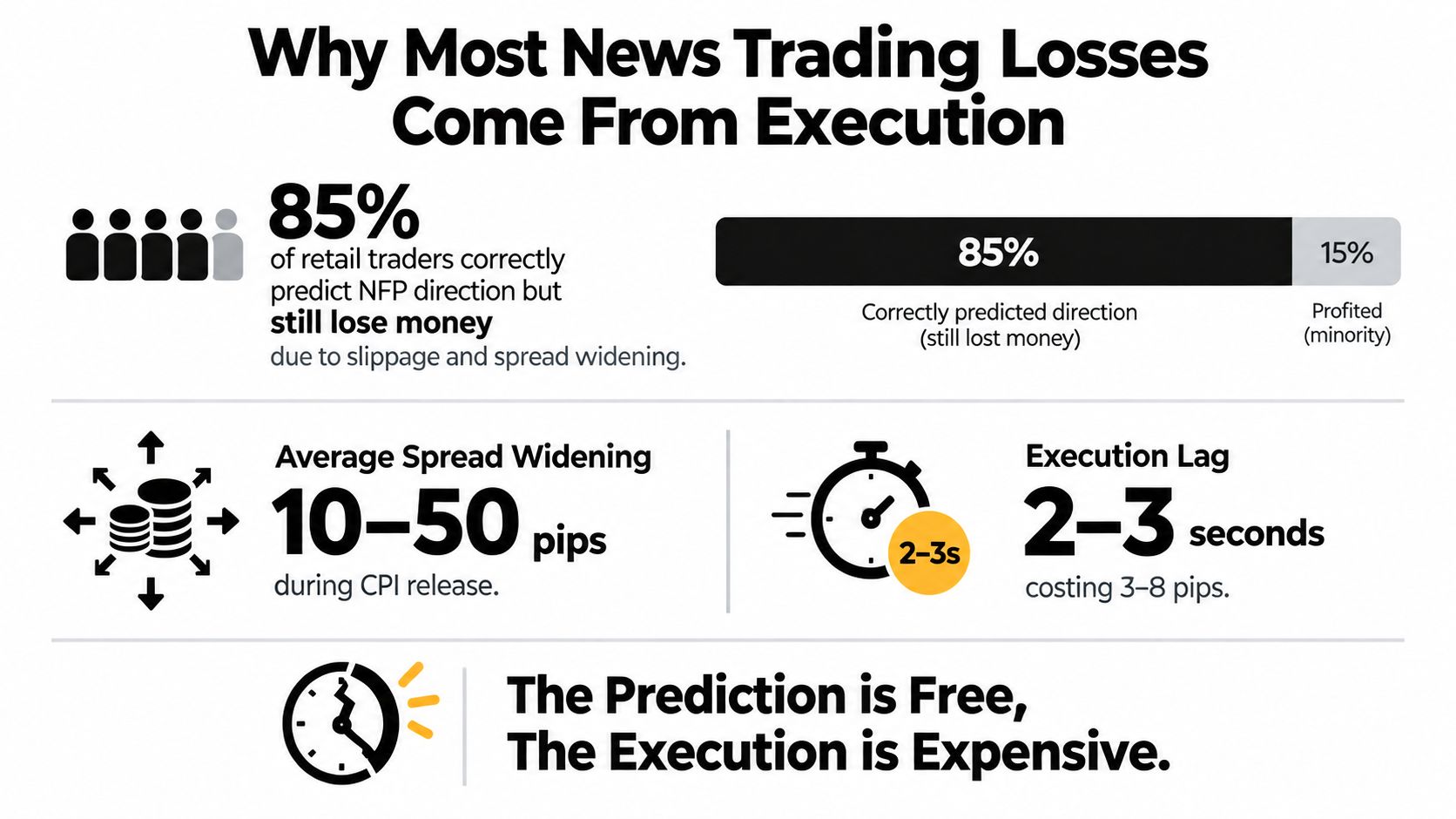
News trading is often framed as a forecasting contest. Traders study NFP, CPI, or a Federal Reserve decision, choose bullish or bearish, and assume the correct direction should produce a profit. In practice, many losses happen after the directional idea is already right. The trader enters into a spread spike, receives a poor fill, gets stopped by the first wick, or chases a move that reverses once liquidity returns.
The U.S. dollar sits on one side of about 88% of all currency trades, which helps explain why U.S. releases can reprice several major pairs at once. Research discussed by Investopedia's forex news trading guide also indicates that a news shock is usually concentrated in the first or second day, can linger through the fourth day, and can retain pronounced order-flow effects on the third day. The implication is important: news trading isn't only about capturing the first candle. It can involve a broader adjustment process.
Separate the headline reaction from the follow-through
I divide every release into two observations:
- Headline reaction: the first few minutes, when algorithms and thin liquidity can create a violent spike.
- Post-event follow-through: the later period, when spreads begin to normalize and traders assess whether the data changed rate expectations or merely caused a temporary imbalance.
A theoretical trade can be directionally correct and still fail after spread widening, slippage, requotes, and partial fills. This explanation of slippage in trading is useful because the requested entry price isn't always the price available when liquidity disappears.
The practical edge therefore comes from controlling what you can control. Select fewer events, predefine the order logic, use smaller size, measure the actual fill, and refuse trades when execution conditions invalidate the setup. Trading involves risk of loss, and this article is educational rather than financial advice.
Which Releases Actually Move the Majors
A calendar label such as “high impact” isn't enough. The useful question is whether a release can alter interest-rate expectations, growth expectations, or the broader macro narrative for the currencies in your pair.
The releases I place in the top tier are U.S. nonfarm payrolls, U.S. and Eurozone CPI, FOMC rate decisions with press conferences, ECB and BoE policy statements, and U.S. GDP. These events can produce substantial repricing in EUR/USD, USD/JPY, and GBP/USD because traders compare the actual result with expectations and then reassess the likely policy path.
Second-tier releases include retail sales, PMI data, jobless claims, and ADP. They can move the majors, but their initial reaction is more likely to be absorbed by spread and slippage unless the result is a genuine surprise or changes the interpretation of higher-tier data.
Compare the event, not just the number
| Tier | Typical EUR/USD Reaction | Examples | Notes for News Traders |
|---|---|---|---|
| Tier 1 | Can be a large, fast repricing | U.S. NFP, U.S. CPI, Eurozone CPI, FOMC, ECB, BoE, U.S. GDP | Check the policy implication, core data, revisions, and press-conference guidance |
| Tier 2 | Often a smaller or less persistent reaction | Retail sales, PMI, jobless claims, ADP | Trade selectively because costs can consume the available move |
| Tier 3 | Often unreliable for major-pair execution | Housing data, consumer confidence, minor-country releases | Usually better treated as context than as a standalone trigger |
The headline versus core distinction matters. A strong headline CPI number can receive a different response if core inflation is soft, while an employment beat can lose force if revisions or wage details point the other way. A result that's exactly in line with consensus may produce little sustained movement, even if the number looks strong in isolation.
Central-bank events deserve separate treatment. The rate decision may trigger the first move, but the press conference can reverse it when the chair or governor changes the interpretation of future policy. Avoid stacking a Tier-1 release with a Tier-2 release in the same hour unless your plan explicitly accounts for both. The economic news trading guide offers a useful foundation for checking the calendar and interpreting scheduled events.
Building Your Pre-News Routine
The hour before a major release should feel repetitive. If you're still deciding your lot size, stop, or entry method seconds before publication, the market has already taken control of the process.
Sixty minutes before the release
Start by confirming that the event is on your trading list. Check the calendar, the consensus, the forecast range, and any revisions to the previous release. A wide forecast range signals uncertainty, but it doesn't tell you which direction price will take. It tells you to prepare for more variable execution.
Then inspect the market context. Mark the prior session high and low, the daily pivot, and the closest areas where resting stops may sit. Use the higher-timeframe chart to form a bias, but treat that bias as conditional. A major surprise can invalidate a technical level quickly.
Your platform preparation should include:
- Order controls: Enable one-click trading only if you're comfortable with it, and preload the stop, target, and order type.
- Position size: Calculate size from a fixed risk percentage before the release. Don't calculate while the candle is expanding.
- Structural stop: Place the stop beyond a meaningful swing or liquidity boundary, not at an obvious round number.
- Entry condition: Choose a pending limit, a confirmation-based market alternative, or no trade.
- Invalidation rule: Write down the spread condition that cancels the setup.
The final minutes
Five minutes before publication, confirm that the platform is stable, the symbol is correct, and the order size matches the plan. Remove unrelated alerts and close positions that could distort your decision-making. If the spread is already abnormal, don't treat that as a minor inconvenience. It may be an early warning that liquidity is deteriorating.
Write the trade plan in your journal before the number appears. Include the event, consensus, directional scenario, entry trigger, stop location, maximum loss, maximum holding time, and the condition that voids the setup. A plan that says “buy if bullish” is incomplete. A plan that says “stand aside if the spread exceeds the predefined threshold or if the first candle closes back inside the range” is executable.
Practical rule: If you can't describe the entry and the failure condition in one sentence, you haven't finished preparing.
Entry and Exit Rules Around the Release
There are two setups worth testing, and neither requires a blind market order at the exact publication second. The first attempts to fade an overextended wick. The second waits for the market to reveal whether the initial move has acceptance.
Spike and fade
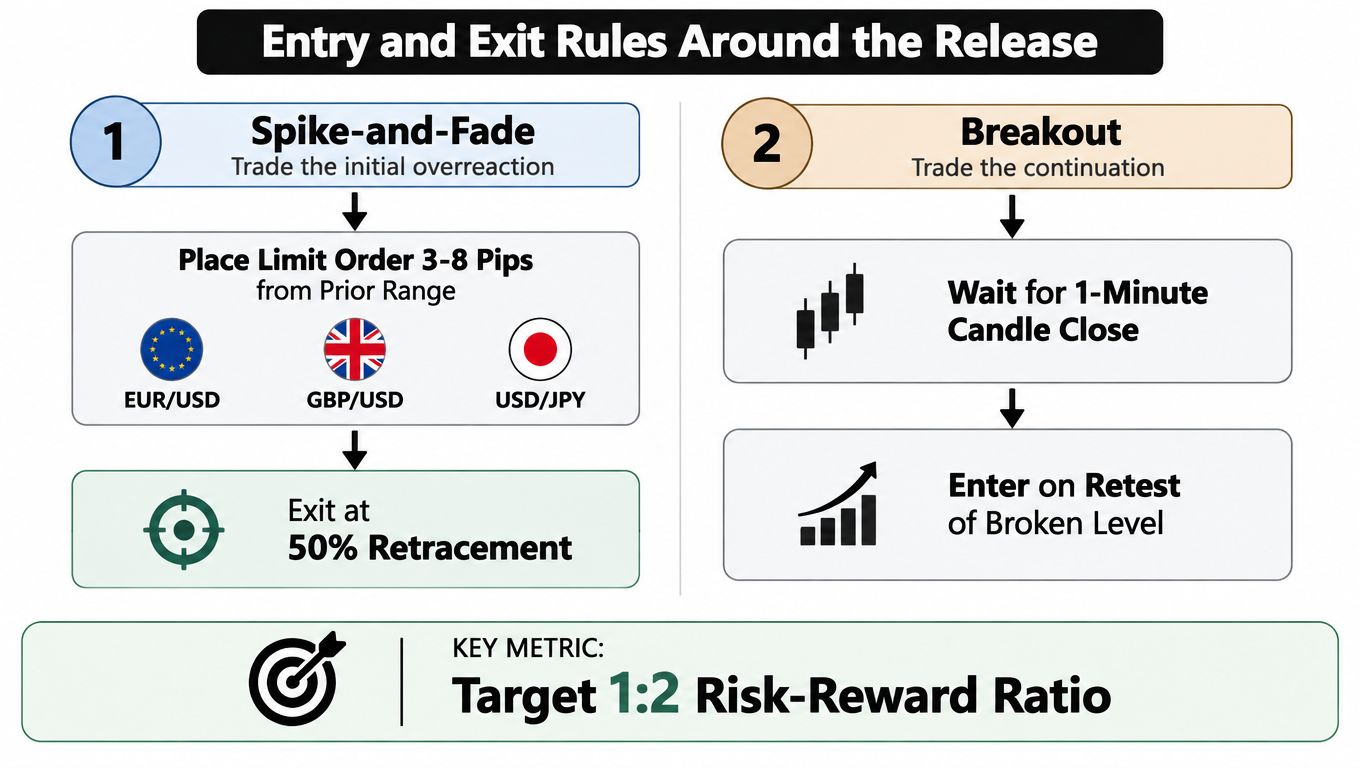
Map the prior range before the release. On EUR/USD, GBP/USD, or USD/JPY, place a limit order 3 to 8 pips above or below that range when the setup calls for a fade. The trade assumes the first extension is exaggerated and that price can retrace toward the prior balance area.
The initial wick is your reference, not an invitation to chase. Take the planned exit around the 38.2% to 61.8% retracement of that wick, and use a hard stop 12 to 15 pips beyond the entry. Those distances aren't universal. They need testing against the pair, event, and broker's actual fill quality.
Breakout and pullback
For continuation, wait for the first one-minute candle to close. If the candle breaks a meaningful level and the macro interpretation supports continuation, look for a retest of its open or VWAP rather than buying the vertical move.
Set the stop at a distance equal to the first candle's range. Cancel the order if there's no fill within five minutes. The cancellation rule prevents a stale setup from triggering after the market has already changed character.
Manage the position after entry
Use a pending order rather than a market order when your plan permits it. During NFP, CPI, and rate decisions, spreads can widen to several times normal, so a market order can convert a good chart location into a poor fill.
After entry, close half at 1R, where R represents the initial risk. Trail the remaining position after a one-minute structure break, using a lower high for a long trade or a higher low for a short trade. Don't move the stop farther away to survive a losing spike. If the spread exceeds 8 pips on EUR/USD or 12 pips on GBP/USD at the scheduled time, skip the trade. Also skip it when the prior candle's ATR is below 70% of its 20-event average, because unusually quiet conditions can leave the market vulnerable to a disorderly first move.
These rules won't eliminate slippage or whipsaws. They define when the trade is no longer worth taking.
Risk Management That Survives a Whipsaw
News trades need a separate risk budget because the normal assumptions behind stops and fills can fail. A stop is still essential, but the executed loss can differ from the intended loss when price gaps through the level or liquidity disappears.
For Tier-1 events such as NFP, CPI, FOMC, and ECB decisions, cap risk at 0.5% of equity per trade. For Tier-2 releases such as PPI, retail sales, and ADP, use 0.25%. The lower allocation reflects the fact that a smaller event can still produce an abrupt reversal without offering enough follow-through to compensate for transaction costs.
| Parameter | Tier-1, NFP, CPI, FOMC, ECB | Tier-2, PPI, Retail Sales, ADP |
|---|---|---|
| Risk per trade | 0.5% of equity | 0.25% of equity |
| Stop requirement | Mandatory before entry | Mandatory before entry |
| Daily loss ceiling | 1.5% across news trades | 1.5% across news trades |
| Account response after limit | Stop new entries for the remainder of the week | Stop new entries for the remainder of the week |
| Review trigger | 4% weekly drawdown | 4% weekly drawdown |
The daily ceiling is 1.5% across all news trades. Once reached, stop opening new news positions for the rest of the week. A weekly drawdown of 4% should force a return to demo and a review of the last 10 trades before live sizing resumes.
Calculate risk from the actual fill
Position size must reflect the actual entry, not the intended entry. If slippage makes the fill 5 pips worse, that extra distance belongs in the risk calculation. If the resulting size is too large, reduce it or cancel the trade.
Don't widen a stop after a 30-pip spike. That action doesn't improve the original idea. It turns a defined loss into an uncontrolled one and often encourages revenge trading.
A profitable 55% win rate can still produce painful losing streaks, which is why capital preservation comes before setup frequency. News trading should be treated as a high-variance part of the overall book, not as permission to expand position size.
Testing the Setup and Going Live
A strategy isn't ready for live money because it looks convincing on a chart. News candles are easy to select after the fact. The test has to capture the ugly details, including the spread at entry, the requested price, the fill price, the first wick, and the later follow-through.
Run the full playbook in demo across at least 30 scheduled releases, including at least three Tier-1 events and 15 Tier-2 events. Use a demo environment that mirrors the live broker's platform, account type, server location, order rules, and symbol specifications.
Journal the execution, not just the outcome
Record these fields for every trade:
- Event context: Release, consensus, actual result, revisions, and your initial interpretation.
- Execution: Spread at the order, requested entry, actual fill, and slippage in pips.
- Trade structure: Stop distance, target, holding time, and whether the planned trigger occurred.
- Result: R-multiple, maximum favorable excursion, maximum adverse excursion, and the reason for exit.
- Chart note: One sentence describing how the setup looked in real time, without hindsight language.
After the sample, calculate expectancy as:
Expectancy = win rate × average win minus loss rate × average loss
Include slippage and transaction costs. A positive expectancy below 0.2R isn't sufficient for this approach because execution costs may be consuming nearly all of the theoretical edge. Public strategy writeups have reported directional news-trading win rates around 55% to 70% and profit factors around 1.4 to 1.8 for strong execution, while typical retail execution can degrade profit factors to 0.8 to 1.2 when costs dominate, as summarized in this practical forex news trading guide. Treat those figures as benchmarks from public writeups, not as a promise for your account.
Move to live with the smallest lot size your broker allows. Keep the rules unchanged for the first 20 live trades. Scale only in 25% increments after a verified +3R weekly net.
Before using a prop environment, read its news rules. Some firms restrict trading around red-news events, and a violation can invalidate an account. MyFundedCapital offers a paid news-trading add-on for funded programs, with access to opening positions within 3 minutes before or after major news events. Confirm the current terms directly before trading because firm rules can change.
For broader testing methods, use this guide to backtesting trading strategies and make sure the test includes realistic spread and slippage assumptions. A setup that works only at the mid-price isn't a strategy. It's a chart hypothesis.
Key Takeaways and Common Questions
The durable version of a news trading forex strategy is execution-first:
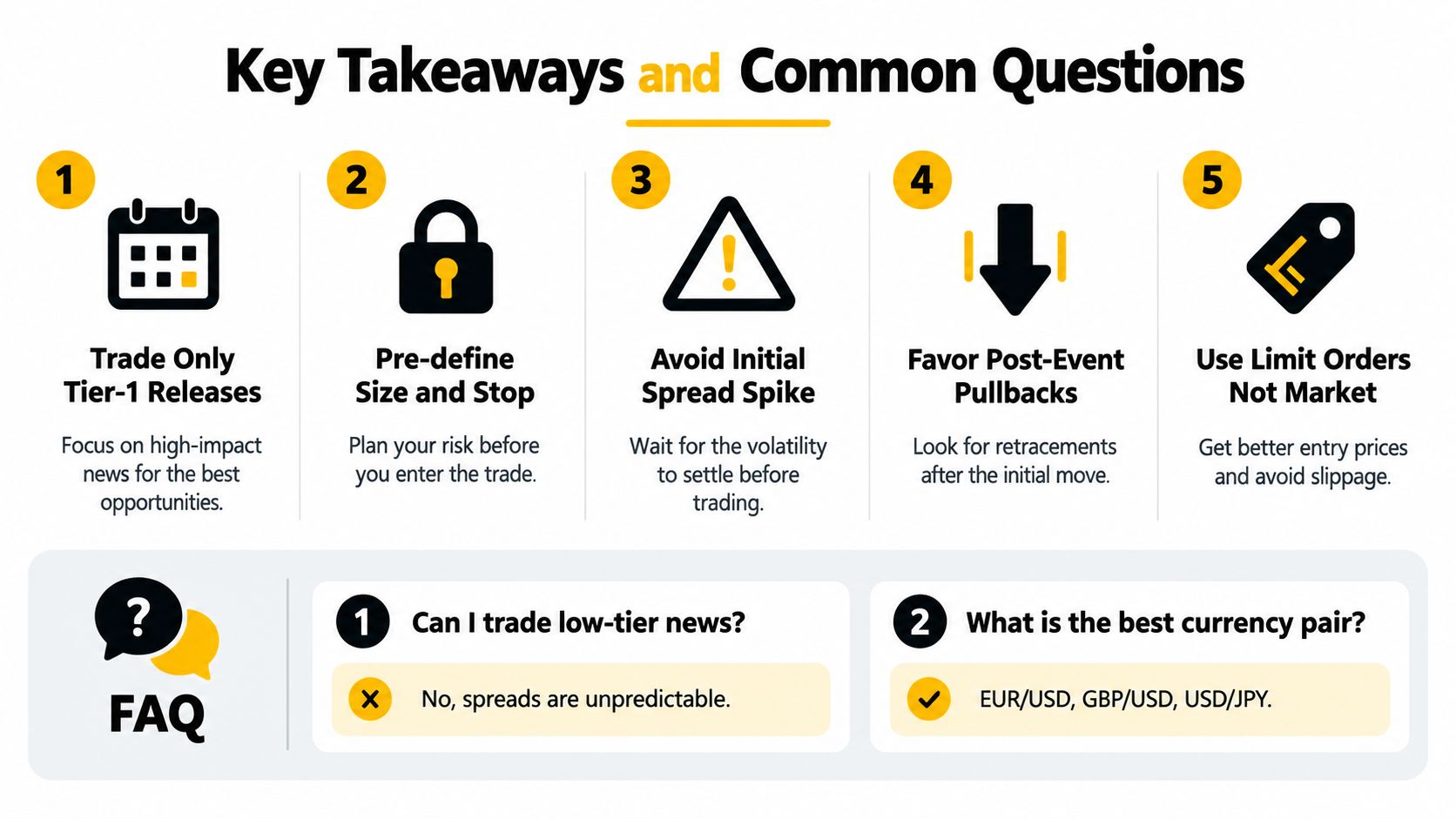
- Trade only Tier-1 releases when the event can change the policy or macro narrative.
- Predefine size and stop before the release, and calculate risk from the actual fill.
- Avoid the initial spread spike unless your tested order logic specifically handles it.
- Favor post-event pullbacks when the first move confirms rather than immediately chasing it.
- Cap daily loss at a fixed percentage and stop trading when the limit is reached.
Common questions
Can a broker trigger my stop during a spread spike
Yes. Depending on the platform and order type, a stop can be triggered by the broker's quoted bid or ask even when the broader market later reverses. Check the broker's execution policy, monitor the spread in your journal, and size the position for adverse execution rather than assuming the displayed stop price is guaranteed.
Why do limit orders often fail at the release second
A limit order may not fill because price gaps through the level, available liquidity is insufficient, or the broker rejects the order under its execution rules. A missed trade is preferable to forcing a market entry after the move has already expanded.
Can a trailing stop trigger during the spike
Yes. A brief wick can activate a trailing stop before the post-event direction becomes clear. Trailing logic should match the event's volatility, and a trader should test whether the stop survives the first reaction without turning normal noise into an exit.
How should prop-firm news rules affect the plan
Check whether news trading requires an add-on, whether positions can remain open through releases, and whether restrictions apply to both entries and exits. A prop account's loss limits and trading clauses are part of the strategy's risk model, not administrative details.
Trading involves risk of loss. Don't judge this approach by the size of the first candle. Judge it by the fill quality, post-event follow-through, average R result after costs, and whether the account can survive a sequence of failed trades.
MyFundedCapital provides Instant Funding and 1-Step or 2-Step Challenge options, with simulated capital accounts ranging from $5K to $100K and scaling paths up to $500K, plus an optional news-trading add-on for eligible programs. Review the current rules and account types at MyFundedCapital, then choose a funding route that matches your tested risk limits rather than increasing size before your execution data supports it.
