You've watched a news trading EA produce a clean backtest, then lose money on the first live CPI or Non-Farm Payrolls release. The strategy looked right, but spreads widened, fills slipped, and a prop-firm loss limit became more important than the entry signal. This guide shows how to build, test, and operate a news trading EA around those constraints.
What a News Trading EA Does
A news trading EA connects scheduled economic releases with automated order execution. It reads a calendar, filters events by impact, stages orders before the release, and manages positions while prices move sharply. Its job differs from a trend-following EA, which waits for price patterns, and a grid EA, which adds positions at predefined levels.
The workflow has four parts:
- Calendar ingestion The EA reads releases such as CPI, Non-Farm Payrolls, GDP, and central-bank decisions.
- Impact classification It filters low, medium, and high-impact events rather than reacting to every headline.
- Order staging It prepares stop, stop-limit, or other pending orders before the scheduled release.
- Event management It cancels unfilled orders, manages triggered positions, and stops trading when execution conditions become unsafe.
The model becomes harder to trust when it meets a live broker. Around major releases, spreads can widen from roughly 1–2 pips to 10–25 pips on major pairs, with the sharpest widening often occurring during the first 10–60 seconds after the announcement, according to guidance on forex spreads during news events. A stop that appeared safe in testing may fill far from its intended price. Quotes can freeze, both sides of a pending setup can trigger during a whipsaw, and a market order may arrive after the initial move has already faded.
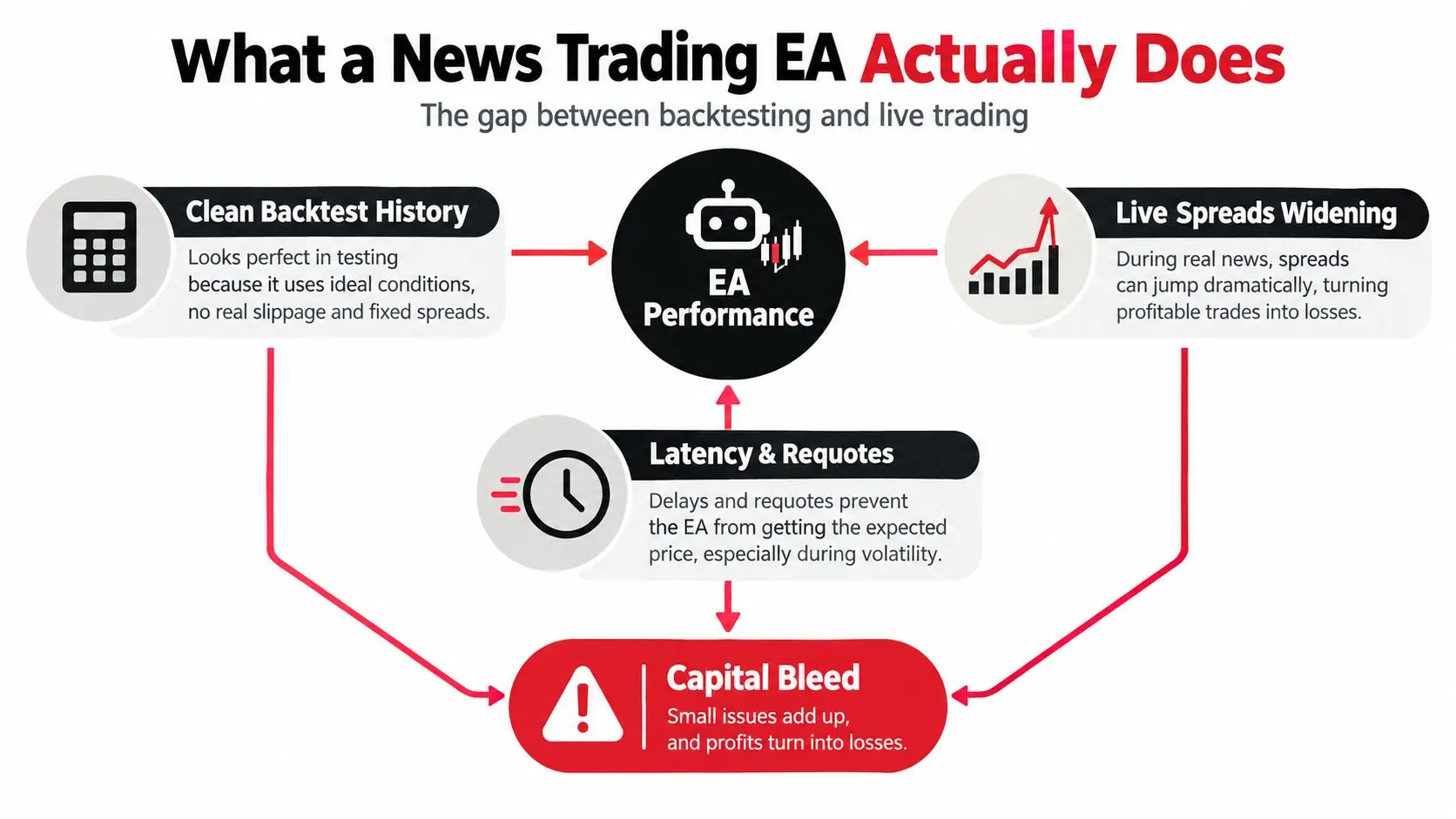
The signal is only one part of the strategy
The practical edge is execution tolerance. The EA must account for whether the broker will quote, fill, and manage orders under pressure, not only whether EUR/USD rises after CPI. Research on S&P 500 ETF order data found that a 300-millisecond delay reduced returns by 3.08%, while a 1-second delay reduced returns by 7.33% versus instantaneous execution around announcements (study summary).
The EA's specification should therefore include spread limits, slippage tolerance, timestamp controls, cancellation logic, and a kill-switch. A forex expert advisor overview can provide useful background, but broker-specific forward testing remains necessary. Prop-firm rules add another constraint: a single bad fill can consume the risk allowance even when the signal was correct. If the system cannot tolerate real event conditions, a smarter entry signal will not repair the result.
How Speed Around Announcements Changes the Math
Latency is a trading cost, not a technical footnote. Around a major release, the EA must receive the calendar update, convert its time to the broker's server clock, classify the event, calculate order levels, send orders, receive acknowledgement, and manage the fill. A delay or mismatch at any stage can turn a planned breakout into a late entry.
The calendar feed sets the first constraint. Forex Factory, Investing.com, an MQL calendar, and paid providers can use different timestamps, event labels, and revision rules. Normalize each release to one time standard, then log the original and normalized timestamps, expected value, previous value, and actual value when available. Page polling creates avoidable delay because the EA may detect the release only after price has already moved.
What happens inside the event window
Build the event logic around these decisions:
- The EA selects only high-impact releases. It avoids stacking trades on correlated events.
- It sets order distances from current volatility. A fixed distance can become too tight when spreads widen.
- It stages orders before the announcement. The lead time must be configurable because brokers do not behave identically.
- It checks spread and trading permissions immediately before sending.
- It cancels stale orders and limits attempts.
Co-location research on Australian futures markets found faster adjustment to new information and stronger price discovery on macroeconomic announcement days (market microstructure research). The practical lesson is narrower than “faster always wins.” Infrastructure affects the conditions in which the EA competes, while broker rules and the account's risk cap determine whether that speed is usable.
A separate review reported that algorithmic traders reacted faster and more accurately than non-algorithmic traders around earnings announcements, with the first 90 seconds particularly important for trade quality and profitability (review of algorithmic trading around announcements). In FX, that pressure appears through fast quote changes, thinner liquidity, and abrupt spread expansion. A prop-firm account can turn one failed fill into a rule breach even when the directional read was correct.
Latency is an operating cost
Place the VPS near the broker's trading servers, then verify the result from logs rather than a hosting claim. Record order-send time, broker acknowledgement time, requested price, fill price, and cancellation time. Compare those records by event type and session.
A fast connection cannot repair a poor order model. If the EA sends market orders into a spread spike, lower latency may just produce a worse fill sooner. Speed pays only when spread filters, order types, cancellation rules, and the account's risk limits are designed for the same event conditions.
Picking a Broker That Won't Sabotage Your EA
Broker selection should be treated like a pre-trade audit. Run the test on a demo account during real high-impact releases, because ordinary-session execution tells you very little about the conditions your EA needs.
Start with a pass or fail scorecard. Don't award partial credit for attractive normal spreads if the broker changes its execution rules during news.
| Criterion | Pass condition | Fail signal |
|---|---|---|
| Execution model | ECN or raw-spread pricing with commission clearly disclosed | Unclear dealing-desk or markup structure |
| Server proximity | VPS location produces consistently low measured latency | Unstable or unexplained delays |
| News feed | Push or server-side event delivery with timestamp logs | Frequent polling or late calendar updates |
| High-impact access | New orders remain available during permitted events | Leverage cuts or order restrictions without workable notice |
| Slippage policy | Written policy explains fills, rejections, and partial fills | Support cannot explain event-time execution |
| Testing environment | Demo reproduces live symbols, sessions, and trading rules | Demo behaves materially differently from live |
Test the broker under pressure
The broker should explain whether it accepts partial fills, how it handles rejected stops, and whether it modifies margin requirements or margin levels before events. Some providers restrict new orders or adjust margin around major releases. Those controls may be reasonable from a risk perspective, but they make the broker unsuitable for an EA that assumes uninterrupted order access.
Ask support specific questions, then compare the answer with your logs:
- Are pending orders accepted during major releases?
- Can the broker widen the minimum stop distance?
- What happens when the requested price is unavailable?
- Are partial fills possible?
- Does the platform cancel or reject orders when margin requirements change?
A broker can advertise tight spreads during quiet hours and still be a poor fit for event execution. The relevant question is not “what is the average spread?” It is “what does the broker do when the calendar turns red and multiple clients send orders at once?”
Use the news trading EA broker selection guide as a checklist for the broader trade-offs, but verify every operational detail directly with the provider. Your EA should store broker-specific rules in configuration, not assume that one execution model works everywhere.
Slippage and Spread Controls That Decide Live Results
Slippage isn't an unfortunate side effect to mention after the backtest. It is a core input. During a release, the requested price may disappear before the broker processes the order, and the fill can occur at a materially worse level.
One education source recommends caution with market orders and highlights limit orders as a way to control entry price, although limit orders also create the risk of missing the move (slippage risk guidance). The correct choice depends on whether your strategy values participation or price control.
Build explicit controls
Configure the EA with separate settings for ordinary trading and event windows:
- Maximum slippage Set a hard ceiling per order, then test what happens when the ceiling is reached.
- Spread filter Block new trades when the current spread exceeds the event-specific threshold.
- Order-type selector Prefer limit entries when pre-news positioning is viable, and use market execution only when the model accepts price uncertainty.
- Partial-fill handling Keep or cancel the remainder according to the strategy's risk budget.
- Requote handling Limit retries. Repeatedly resending an order can turn one failed setup into several uncontrolled attempts.
- Logging Store requested price, filled price, spread, timestamp, order type, and rejection reason.
A news strategy source describes event-time spreads in the 15–40 pip range and warns that slippage can make a small stop ineffective, including an example where a 15-pip stop becomes irrelevant after 30 pips of slippage (prop-firm news trading risk discussion). Treat these figures as stress-test scenarios, not universal broker settings.
| Parameter | Pre-News (T-5 min) | At Release (T+0 to T+30s) | Post-News (T+2 to T+15 min) |
|---|---|---|---|
| Spread filter | Compare with normal session spread | Use a strict event ceiling | Reopen only after spread normalizes |
| Entry style | Pending order or controlled limit | Avoid blind market retries | Reassess direction and liquidity |
| Slippage rule | Conservative maximum | Hard rejection or one controlled attempt | Restore ordinary-session setting |
| Position size | Reduced event allocation | No automatic increase after rejection | Keep original risk budget |
| Logging | Record baseline spread | Record every fill and rejection | Compare execution with baseline |
Model ugly fills
A backtest that assumes ideal execution isn't a news backtest. Add spread expansion, delayed fills, rejected orders, partial fills, and gaps to the test. Use observations from your own broker rather than copying a convenient assumption from a vendor report.
The practical decision rule is simple. If realistic slippage changes a strategy's apparent win rate from 70% to 55%, the signal isn't the main edge. Execution is. The EA should then be redesigned around fewer events, wider safety conditions, smaller risk, or a different entry method. You can also review this explanation of slippage in trading while building the execution log.
Don't disable fill protection just to increase the number of trades. A partial fill can be safer than a rejected order followed by an uncontrolled market entry, but only if the EA recalculates exposure and cancels excess orders. Every fill must remain inside the maximum loss defined before the event.
Backtesting and Forward Testing the Right Way
A news trading EA needs more than a visually attractive equity curve. Historical calendars often contain clean timestamps, while live feeds arrive with delays, revisions, missing fields, and broker-specific time conversions. Validation must reproduce the chain that creates the trade, not just the price movement that follows it.
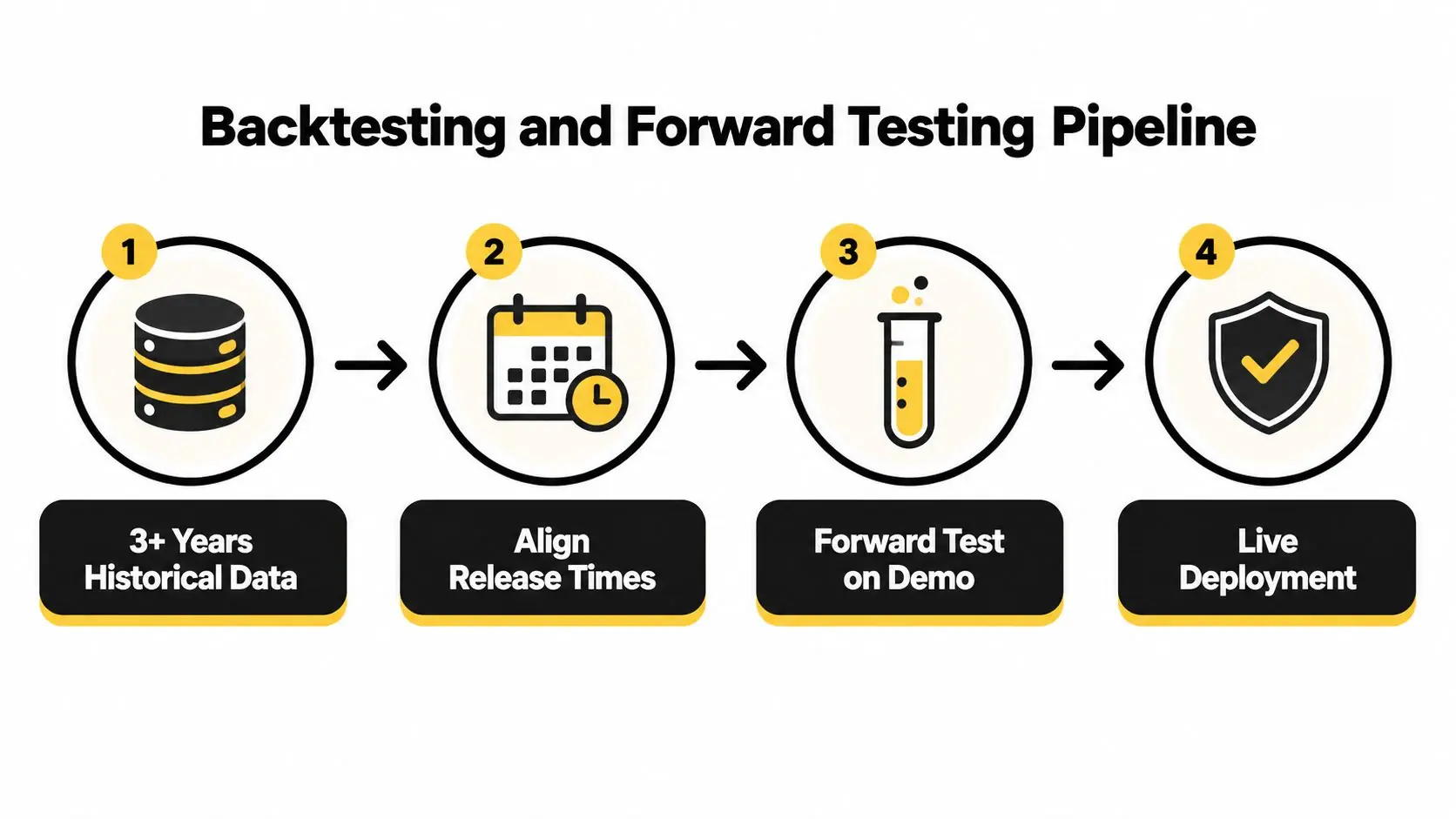
Use a four-stage pipeline
Stage one, assemble and normalize data. Collect several years of timestamped news and tick or high-resolution price data from sources such as Forex Factory, the MQL calendar, or a paid provider. Convert release times to broker server time and retain the original source timestamp for auditing. A missing daylight-saving adjustment can shift every event in a test.
Stage two, separate development from judgment. Use the earlier portion of the dataset for in-sample development and hold later events out of the optimization process. Model spread expansion, slippage, rejected orders, and gaps. Don't optimize the EA until it wins under the execution assumptions it will face live.
Stage three, run walk-forward tests. Roll the training window forward in blocks, re-estimate only the permitted parameters, and test the next block without changing the settings. Stable behaviour across windows matters more than one exceptional period.
Stage four, forward-test on the same environment. Run the demo EA with the same broker, VPS, platform, symbol settings, and news feed intended for live use. A practical benchmark is at least 20 high-impact events before committing capital, as suggested in the news-trading automation guidance.
Define the release gate
Before live deployment, set objective thresholds. The proposed gate is a profit factor above 1.4, maximum drawdown under 8% of account, and demo-to-live slippage deviation below 15%. These are operating standards, not guarantees. If the system misses them, keep testing instead of lowering the standard to justify deployment.
Run a Monte Carlo check by reshuffling the sequence of returns 1,000 times and inspecting whether the strategy still survives plausible adverse ordering. This tests sequence risk, not the quality of the original signal. For traders who need a structured introduction to automation concepts, the Pineflows beginner automation pipeline can provide useful process context before the technical validation work begins.
Document every event in a test journal. Include the release, currency, forecast and actual fields when available, spread before entry, spread at fill, requested and executed prices, latency, order status, stop outcome, and rule compliance. The guide to backtesting trading strategies is a useful companion, but the final evidence must come from the exact broker and feed you plan to use.
Risk Controls That Keep You Funded
For a prop-firm trader, risk controls are not a protective layer added after the strategy. They define whether the strategy can exist. A news EA that occasionally produces a large fill gap may survive in a personal account with discretionary intervention, but it can fail an evaluation after one release.
Use layered limits:
- Daily loss cap Keep the EA below 2% of account equity as an internal ceiling. Some prop-firm structures use daily limits such as 4.5%, but your own lower limit gives the algorithm room for calculation differences and slippage (prop-firm guidance).
- Per-trade exposure Risk 0.25–0.5% per event, calculated from the actual stop distance and worst expected fill, not the planned entry alone.
- Currency concentration Allow only one open event position per currency at release time.
- Kill-switch Stop new trades after two consecutive losses or one loss larger than 1.5R.
- Session shutdown Close or block positions ahead of major releases unless the account rules and EA configuration explicitly allow event exposure.
A strategy should never increase size because the first order was rejected. That is a common path from an execution problem to a drawdown breach. Grid and martingale logic is especially dangerous around news because the EA can add to a losing position while spreads and margin requirements are changing.
Map the rules before you connect the account
Prop firms can differ on trailing drawdown, overnight holding, treatment of margin requirements, and whether news trading is allowed. Some environments restrict overnight positions when the ratio exceeds 1:100, while others require an add-on or prohibit a news window altogether. A single EA configuration can't safely cover every firm.
| Risk Rule (Prop Firm) | EA Parameter | Recommended Value | Breach Consequence |
|---|---|---|---|
| Daily loss limit | Internal equity stop | Set below the firm's hard limit | Trading account can fail for the day |
| Maximum drawdown | Equity and balance guard | Stop well before the published cap | Evaluation or funded account termination |
| Trailing drawdown | Peak-equity tracker | Block new risk as the buffer narrows | A normal retracement can breach the trail |
| News restriction | Event allowlist and time filter | Trade only approved releases | Rule violation or disqualification |
| Position concentration | Currency exposure limit | One event position per currency | Correlated losses can compound quickly |
| Loss streak rule | Consecutive-loss counter | Disable after two losses | Further attempts can accelerate drawdown |
Test the controls separately from the entry signal. Disable the signal and feed the EA synthetic loss sequences, gaps, rejected orders, and spread spikes. If the risk engine fails those tests, the entry logic is irrelevant. A 30-day forward test with the caps active should be a minimum operational gate before a funded submission.
Realistic Expectations and Your Next Step
A well-configured news trading EA can have an edge, but the edge is narrow and expensive to access. One published summary reports typical news-algorithm ranges of 55–65% win rate, 30–60% annual returns before fees and slippage, and 15–25% maximum drawdown, while stating that approximately 60–70% of retail traders attempting this style lose money (published benchmark summary). Those figures are benchmarks, not promises, and the “before fees and slippage” qualification is the part many sales pages bury.
Another operational commentary gives a more conservative profile of 45–60% win rate, a 1.5:1 to 3:1 risk-reward range, 10–20% maximum drawdown, and only 3–10 tradable events per week across a basket of pairs (news EA market commentary). The practical conclusion is that event selection matters more than constant activity. A system that trades every release may generate more tickets but expose itself to more poor fills, overlapping signals, and rule conflicts.
Failure modes that deserve attention
Signal stacking occurs when CPI, a central-bank speaker, and a currency-specific release overlap. The EA may treat them as separate opportunities while the account experiences one concentrated risk event.
Stop miscalibration happens when a fixed stop is copied from a quiet-market backtest. The release may move through the level before the broker can fill it, creating a loss much larger than the model allows.
Broker freezes can leave pending orders active while quotes stop updating. The EA needs timeouts and state reconciliation, not just a retry loop.
Prop-firm triggers occur when a fast move breaches daily or trailing limits before the platform records the final fill. The firm's rule engine, not your intended stop, determines the account outcome.
A practical operating budget should be conservative. Cap total monthly drawdown around 3–5% if survivability is the priority, and treat any higher result as a period to review rather than a new baseline. The strategy's return should never be the reason to loosen the loss controls.
Challenge or Instant Funding
The account path changes how you configure the EA. A Challenge commonly uses a profit target around 8–10%, with drawdown structures often described as 10% trailing or 5% daily. Instant Funding removes the target but can impose a stricter static drawdown from the first trade. These figures vary by provider and account type, so verify the current rules before you connect an EA.
| Feature | Challenge Account | Instant Funding |
|---|---|---|
| Main objective | Reach the published evaluation target | Trade within drawdown rules without a target |
| News EA approach | Use a conservative event allowlist | Keep exposure smaller while protecting static room |
| Drawdown focus | Avoid failing during the evaluation | Protect the initial equity buffer from day one |
| Add-on requirement | Confirm whether news trading is permitted | Confirm whether news and weekend holding are included |
| Best preparation | Forward-test the exact rule set | Prove the EA can operate without target pressure |
A paid news add-on may be required, and some firms may require the EA to declare, cap, or disable event trading. MyFundedCapital offers Instant Funding, 1-Step, and 2-Step Challenge routes, supports algorithmic trading, and provides a News Trading Add-On for eligible use cases, subject to the applicable account rules.
Your next 72 hours
- Audit the broker. Run the pass or fail checklist, verify event permissions, and record execution during a real high-impact release.
- Audit slippage. Export every fill, compare requested and executed prices, and update the EA's spread and slippage parameters.
- Forward-test on demo. Use the same VPS, platform, feed, symbols, and risk caps planned for the funded account.
- Submit only after the evidence is clean. Choose the account path whose news permissions and drawdown model match the EA, then start with the smallest acceptable risk.
Trading involves a risk of loss, and this article is educational only, not financial advice. A news trading EA should earn the right to trade through execution logs, stress tests, and rule compliance, not through a vendor's backtest screenshot.
If your EA has passed its broker and slippage audits, review MyFundedCapital to compare Challenge and Instant Funding options that support algorithmic trading and eligible news-trading add-ons. Confirm the current account rules, choose the route that matches your event exposure, and start a challenge only when your forward-test results show the system can protect funded-account drawdown limits.