The final minute before a major release feels the same for almost everyone at first. Spreads start to look different, price gets jumpy, and you can feel the temptation to hit a trade just because something big is about to happen.
That's where most newer traders get hurt. Economic news can create clean opportunity, but it can also blow through weak execution and loose risk control in seconds. If you want to learn how to trade economic news properly, you need a process for preparation, timing, execution, and risk, especially if you're trading under prop firm rules.
Introduction
If you've ever watched Non-Farm Payrolls or CPI count down on your platform, you already know the appeal. A market that barely moved all morning can suddenly explode into life. The problem is that the same volatility that creates opportunity also punishes hesitation, oversized positions, and bad entries.
Most traders don't lose on news because they picked the wrong event. They lose because they treat the release like a coin flip. They guess direction, ignore spreads, and confuse a fast move with an easy trade.
A better approach is more mechanical. You prepare the watchlist in advance, focus only on high-impact events, define what would count as a real surprise, and choose one playbook before the number hits. Then you manage execution with more respect for slippage, wider spreads, and fast reversals than you would in normal conditions.
Markets react to the difference between the actual release and what traders expected, not to the number in isolation.
That single idea explains most of news trading. If the data is strong but already expected, the move can stall or reverse. If the data sharply deviates from consensus, price can reprice hard and fast.
Trading involves risk of loss. This article is educational only and not financial advice.
Preparing Your Watchlist and Mindset
Most bad news trades are already bad before the release happens. The trader is watching too many instruments, following too many calendar items, and has no clear idea what matters.
Start by cutting the noise.
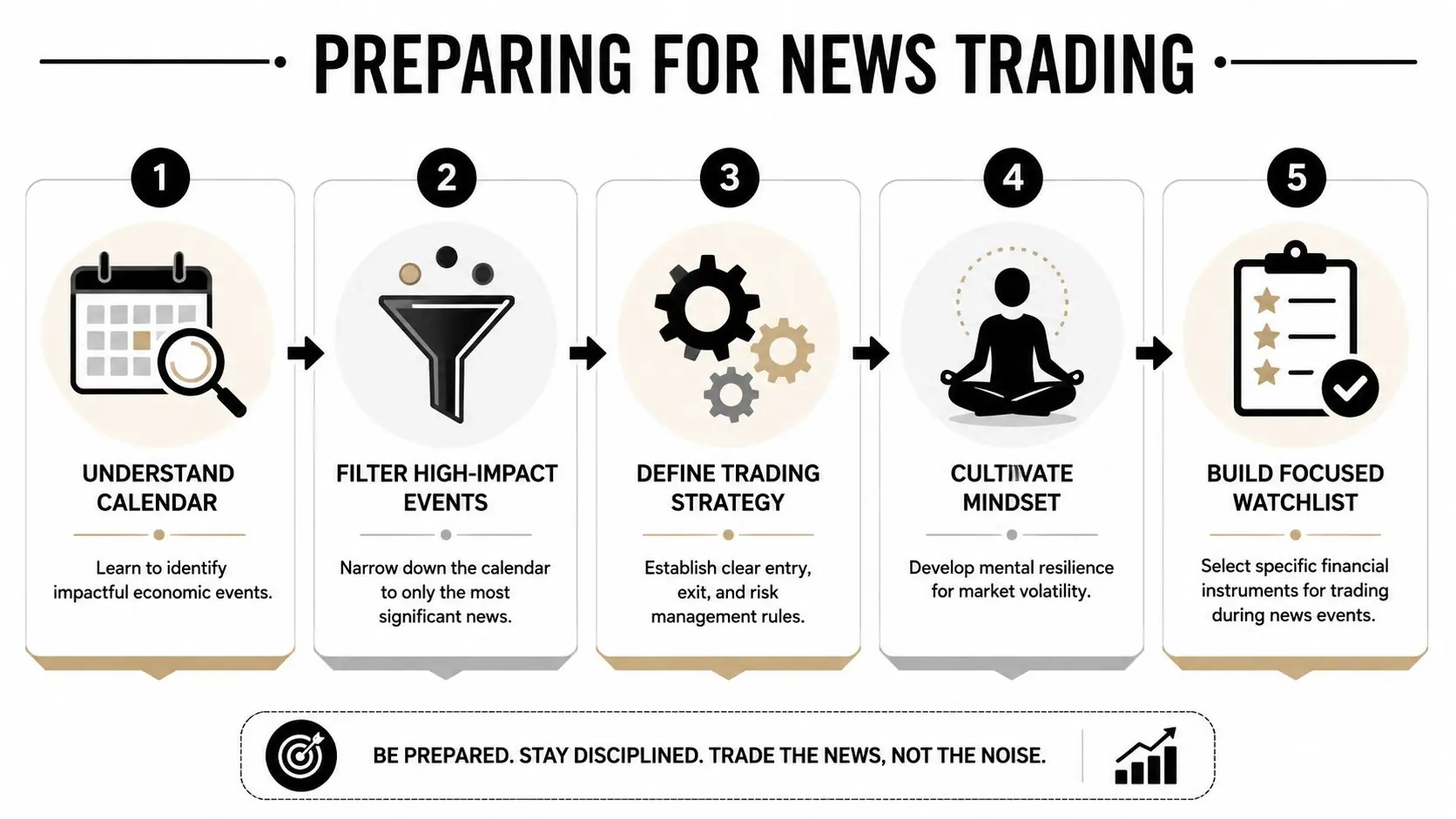
Filter the calendar hard
You don't need to trade every red-folder event. You need a short list of releases that can move the instruments you trade.
Key calendar optimization strategies require traders to remove irrelevant data by filtering out countries they do not follow and excluding low-impact indicators, focusing exclusively on high-impact releases like US Non-Farm Payroll, FOMC rate decisions, and CPI inflation data, which historically generate the largest directional moves according to RealTrading's guide on news trading.
For most active FX and CFD traders, that means building a watchlist around a few categories:
- Labor data NFP and major employment releases
- Inflation data CPI and related inflation prints
- Central bank events FOMC and similar rate decisions
- Growth data GDP when it matters for trend repricing
Keep the list tight. If you mainly trade EUR/USD, gold, NASDAQ, or DXY-related moves, that's enough to build a serious routine around.
Know the forecast before you care about the actual
A raw number means nothing by itself. A foundational principle in trading economic news is that markets react to the deviation from consensus expectations, not the raw data itself as outlined in Charles Schwab's explanation of trading the news.
Their example is simple and useful. If NFP prints 250,000 jobs added and the consensus was 180,000, the move is driven by the 70,000-job surprise in that release, not by the headline number alone. The same expectation logic applies to CPI, GDP, and major releases across the US, EU, UK, and Japan in that source.
That changes how you prepare. Before the event, write down:
- The release time down to the minute
- The consensus number the market's baseline
- The instrument most likely to react don't scatter attention
- The current trend bullish, bearish, or range-bound
- Your no-trade condition if execution looks ugly, stay out
Build a repeatable pre-news checklist
This is the routine I'd want any newer prop-style trader to use before touching a news event:
- Pick one event: Don't trade CPI, a Fed speaker, and crude inventories in the same session.
- Pick one or two instruments: EUR/USD and gold is manageable. Six charts isn't.
- Mark key levels: Session high, session low, pre-news range, and obvious higher-timeframe structure.
- Define the scenario: What would count as a genuine positive or negative surprise?
- Choose your strategy in advance: breakout, fade, or wait-and-see
- Set max risk first: the trade idea comes after the risk cap
- Check your mental state: if you're frustrated, tired, or trying to make back a prior loss, skip it
Mindset matters more than most traders admit. If your psychology is unstable, news volatility will expose it quickly. A useful companion read is developing a trading mindset for consistent execution.
Practical rule: If you need the trade to work, you shouldn't be in the trade.
Backtest the event, not just the setup
A normal breakout setup doesn't behave the same way during NFP. Candle speed changes. Spreads change. The first move can fail even when the higher-timeframe direction was right.
Go back and review prior releases on your platform. Watch how your instrument behaved around the same event type. You're not trying to predict the next print. You're trying to understand how your chosen market usually responds so you stop mistaking chaos for edge.
Core Strategies for Trading News Volatility
There isn't one correct way to trade economic news. There are a few valid approaches, and they suit very different personalities.
Three primary strategies govern how traders position for economic news releases: Pre-News Positioning, Fade the Reaction, and the Wait-and-See Approach. Fade the Reaction waits for an initial sharp spike, often exceeding 50-100 pips in forex pairs like EUR/USD within seconds, and then trades the reversal if the market overreacts according to NordFX's breakdown of economic news strategies.
Comparison of News Trading Strategies
| Strategy | Risk Level | Timing | Best For | Major Pitfall |
|---|---|---|---|---|
| Pre-news positioning | High | Before release | Experienced traders with a strong macro view | Getting run over by the opposite surprise |
| Fade the reaction | High | Immediately after the spike | Fast traders who read overextensions well | Fading a move that keeps running |
| Wait-and-see approach | Lower | After the first reaction settles | Traders who value confirmation over speed | Missing part of the move |
Pre-news positioning
This is the aggressive play. You take a position before the data because you believe the market is mispriced or leaning too far one way.
It can work. It can also fail brutally because you're exposed to the release itself, not just the aftermath.
A clean use case is when price has trended strongly into a release and you believe expectations are too optimistic. You're effectively betting on disappointment or on a sell-the-news response if the market already front-ran the outcome.
This style suits traders who already think in macro terms. If you're still learning how different data points interact with rates, inflation expectations, and currency strength, this usually isn't the best place to start.
Fade the reaction
This is the strategy newer traders are drawn to because it looks smart after the fact. Price spikes too far, then snaps back. On replay it looks obvious.
Live, it's harder.
A common example is fading an oversized EUR/USD spike after NFP when the first move exhausts quickly, spreads begin to settle, and price re-enters the pre-spike range. The setup can be excellent if the move was emotional or heavily one-sided. It can also turn into a train wreck if the release genuinely changes market pricing and the trend extends.
Use this approach only if you can read three things well:
- The quality of the surprise
- The speed of rejection after the spike
- Whether liquidity has normalized enough to execute cleanly
Wait-and-see approach
For most traders, this is the most professional way to trade news. You let the initial burst happen, allow the market to show its hand, and then trade with confirmation instead of adrenaline.
That patience matters. In the NordFX material above, the wait-and-see approach is described as letting the dust settle for 15-30 minutes after the release before entering with more confirmation. That fits traders who prefer a measured entry over trying to win the race to the first candle.
If you trade prop-style rules or care about consistency more than excitement, this is often the better base strategy.
When the number hits, your first job isn't to trade. Your first job is to decide whether the market is offering a trade worth taking.
What about straddles
A lot of retail traders try a straddle. They place pending orders above and below price and hope to catch whichever direction breaks first.
It sounds logical, but execution can be rough. News spikes can trigger one side, reverse into the other, and leave you paying for slippage, widened spreads, and bad fills. In thin conditions, both orders can become expensive mistakes fast.
That doesn't mean straddles never work. It means they're usually sold as simpler than they are.
If you're trying to make sense of the bigger macro backdrop behind rate-sensitive markets, this piece on navigating the changed rate market is useful context before you decide whether a release is likely to extend a move or just shake out weak hands.
For traders who want to sharpen timing around fast-moving sessions more broadly, how to trade volatility is also worth reviewing.
A Framework for Trade Execution and Management
Preparation is what keeps you out of bad ideas. Execution is what keeps a decent idea from turning into a stupid loss.
Major news releases don't move like normal market conditions. Major forex news events follow three distinct phases: pre-news positioning, the initial price spike characterized by slippage and imperfect execution, and the post-event trend or reversal, with the most reliable entry opportunities occurring only after volatility stabilizes and spreads normalize, typically 15–30 minutes post-release according to Axiory's guide to news trading.
Pick the order type before the release
If you hit a market order into a violent candle, you're accepting that your fill may be worse than the chart suggests. That isn't a theory. It's standard during fast releases.
A practical framework:
- Market orders best used when confirmation matters more than exact entry, but expect slippage.
- Stop orders useful for breakout participation, but they can fill badly if the spike is too fast.
- Limit orders better for pullbacks or fades, not for chasing a breakout into the release candle.
Most newer traders overestimate how much control they have in the first seconds after a release. In reality, your edge often improves once the obvious panic or euphoria starts to cool.
Respect the stabilization window
Many traders improve quickly as they make a key shift. They stop trying to be first and start trying to be right.
A simple execution model looks like this:
- Before release mark the high, low, and nearest structural levels.
- At release do nothing for the first reaction unless your plan explicitly allows it.
- During stabilization watch spread behavior, candle quality, and whether price holds above or below the breakout zone.
- After confirmation enter only if structure, momentum, and risk all align.
That sounds less exciting than pressing a trade at the exact second of the number. It is. It's also usually cleaner.
Position sizing has to get smaller on news
News trading doesn't justify bigger size. It usually demands smaller size because the environment is less forgiving.
Use a simple position-sizing formula:
Position size = account risk ÷ stop-loss distance
If your stop has to be wider because post-news candles are larger, your size must come down. Don't force your usual lot size into unusual volatility.
A short checklist helps:
- Define account risk first fixed amount or fixed percentage of your allowed risk
- Measure stop distance accurately not the stop you wish you could use
- Reduce size if spread is unstable bad execution is part of risk
- Cancel the trade if the required stop makes the setup unattractive no trade is a valid decision
A smaller, well-timed position after the move settles usually beats a larger, emotional position during the spike.
Managing the trade once you're in
Once price starts moving, the job changes. Don't widen the stop just because the trade feels uncomfortable. Don't move to breakeven so fast that normal noise knocks you out of a good setup either.
A practical approach is to manage around structure:
- For breakouts hold only while price continues to respect the post-news direction
- For fades get more defensive, because reversals can fail fast
- For partials scale out at logical levels, not random round numbers
If you're trading on cTrader or DXtrade, set up one-click trading, predefine position templates, and make sure your hotkeys and trade panel are familiar before the event. News is the worst time to learn your platform.
Trading News with a Prop Firm Like MyFundedCapital
News trading inside a prop environment is a different game from trading your own unrestricted personal account. The issue isn't whether a release can move. It's whether that move can push you through firm rules before your thesis has time to play out.
That's why a lot of prop firms limit or restrict major event exposure. A violent spike can hit daily loss limits quickly, especially if spreads widen, fills slip, or a trader adds size trying to catch up to the move.
The structure matters even more when the firm has clear loss rules. In the publisher information for this article, MyFundedCapital operates with a 5% daily loss limit and up to 10% maximum drawdown. Those aren't theoretical boundaries. They shape every news decision because one badly managed release can do damage much faster than an ordinary session.
Why the rules exist
A news release creates clustered risk:
- Execution risk entries and exits can fill worse than expected
- Volatility risk candles can invalidate a setup instantly
- Behavior risk traders tend to overtrade after a fast win or loss
Inside a prop structure, the right question isn't “Can this move pay?” It's “Can I express this idea without putting the account at unnecessary rule risk?”
That's the adult version of news trading.
A practical way to adapt
If you want to trade economic news under prop-style limits, tighten your process:
- Trade fewer releases only the events you understand well
- Cut size harder than feels comfortable preserve room for imperfect execution
- Prefer post-stabilization entries especially if the release environment is messy
- Predefine account damage limits stop trading if the session becomes emotional
- Know the firm's event policy in advance assumptions get traders disqualified
A general primer on firm structure helps if you're still learning that environment. This overview of what a prop trading firm is gives the basic model.
Where a news add-on fits
Some firms offer a separate news-trading feature rather than forcing one blanket rule for everyone. In the publisher details provided for this article, MyFundedCapital offers a News Trading add-on that allows traders to trade around major economic events. That can suit traders with a proven process, but it doesn't remove the underlying risk.
If anything, it puts more responsibility on the trader. Access without discipline is still a bad combination.
Trading involves risk of loss. In a prop setting, that includes the risk of violating evaluation or funded-account rules even when the market later moves in your original direction.
Advanced Nuances and Common Mistakes
Most guides on how to trade economic news stop at “trade the breakout” or “wait for the dust to settle.” That's useful, but it leaves out two details that often decide whether a setup is clean or expensive.

The post-spike pullback matters
One underserved area is the entry after the first move, not during it. Recent analysis of FX volatility states that 68% of false breakouts occur within the first 3 minutes post-release, and the median pullback window for valid continuation is 7–12 minutes.
That's practical. It means many traders get trapped not because their directional idea was wrong, but because they entered inside the messiest part of the move.
Cross-currency context gets ignored
If you're trading a pair, one country's data isn't the whole story. EUR/USD is not just a US-news chart. It's a relative-strength chart between the euro and the dollar.
Before trading a pair on news, compare the broader backdrop on both sides. If US inflation has been sticky while euro area data has been soft, a US release may land differently than it would in isolation. That relative context often explains why a “good” number doesn't always create the move a newer trader expected.
The cleaner trade often comes from understanding which currency is stronger on a relative basis before the release, not just from reacting to the headline.
Common mistakes that cost traders money
- Chasing the first candle fast doesn't mean tradable.
- Widening the stop mid-trade that turns planned risk into hope.
- Revenge trading after a loss news sessions punish emotional follow-up trades.
- Ignoring the forecast without expectations, the actual number is incomplete.
- Trading too many instruments at once split attention leads to weak execution.
- Assuming the first move is the sustained move sometimes it is, often it isn't.
Frequently Asked Questions and Your Next Step
Is news trading suitable for complete beginners
Usually not at first. A beginner is better off observing several major releases, replaying the price action, and practicing one setup on demo before risking real capital. The speed and execution issues around news can overwhelm traders who still struggle with basic risk management.
Which markets respond best to economic news
Major FX pairs, gold, and index products tied closely to rate expectations tend to react clearly. The best choice is usually the instrument you already know well, not the one with the biggest candle after the fact.
How do I reduce slippage when trading news
You won't eliminate it completely. You reduce it by trading smaller size, avoiding blind market orders into the first spike, and waiting for cleaner conditions when spreads and price action normalize.
Should I hold through the release or wait
That depends on your playbook and risk tolerance. For most newer traders, waiting for post-release confirmation is the safer choice than trying to predict the exact first move.
Trading economic releases can become a real edge, but only if you treat it like a process instead of a gamble. Build a watchlist, narrow your event focus, choose one strategy, and keep risk small enough that one bad release doesn't wreck the account or your decision-making.
If you're ready to apply that discipline in a prop environment, take a look at MyFundedCapital to compare funding programs, review account types, and decide whether an Instant Funding account or a challenge model fits your trading style.