Roughly two-thirds of customers at registered U.S. OTC forex dealers lose money, so the right forex prop firm for a U.S. trader isn't the one with the biggest account badge. It's the one whose leverage, drawdown, platform, payout, and compliance rules your strategy can survive.
That loss profile is exactly why experienced traders look beyond personal deposits and consider funded accounts. This guide breaks down the regulatory constraints, platform choices, risk rules, and challenge structures that determine whether a U.S. trader stays funded or blows up another account.
Why US Traders Are Switching to Prop Capital
The uncomfortable starting point is the CFTC customer advisory finding that roughly two-thirds of customers at registered OTC forex dealers lost money after credits, financing charges, fees, and other expenses were included. About one-third were profitable, according to the same summary of CFTC data (CFTC customer advisory summary).
That isn't just a story about undisciplined beginners. Retail traders deal with spreads, financing costs, execution conditions, and emotional pressure while putting their own capital on the line. A strategy can be valid and still fail if the trader sizes too aggressively, trades through poor liquidity, or treats a temporary drawdown as a reason to increase risk.
Consider a competent trader with a tested intraday setup and limited savings. The trader may have an edge, but personal capital creates a bad choice. Risk too little and progress feels negligible. Risk too much and a short losing sequence damages the account and the trader's confidence. A prop model changes that equation by placing the trader inside an evaluation or funded-account framework, where the central test is risk control under defined rules.
Prop capital isn't a shortcut
A proprietary trading account isn't free buying power. It normally involves an evaluation, a simulated or broker-linked trading environment, limits on losses, and a profit-sharing arrangement. The trader pays for access to the program and must prove that the strategy can operate within the firm's conditions.
That distinction matters because the account balance displayed on a dashboard doesn't represent cash sitting in the trader's bank account. The usable resource is the permitted drawdown. A trader who understands this thinks in terms of loss limits, position exposure, and execution quality rather than the headline account size.
The real product isn't the account balance. It's the risk budget attached to that balance.
MyFundedCapital operates as a global fintech proprietary trading firm using simulated capital and real market quotes to assess trader skill and discipline. Its programs accommodate manual, algorithmic, and copy trading across forex, indices, crypto, and commodities, with DXtrade and cTrader access. That makes it one example of the modern structure, but the same inspection standard applies to every firm.
What U.S. traders should compare first
| Decision factor | What matters in practice | Why it affects your account |
|---|---|---|
| Regulatory structure | Whether the firm clearly explains its U.S. availability and operating model | Access and compliance risk can change without much warning |
| Leverage | Internal leverage by instrument, not the advertised account size | Leverage determines position size and margin pressure |
| Drawdown | Daily loss calculation, reset time, and maximum drawdown method | A rule breach can end the account before a strategy recovers |
| Platform | Stability, charting, order handling, and automation support | Platform friction can turn a normal trade into a rule violation |
| Payout terms | Eligibility, timing, restrictions, and documentation | A high split means little if the conditions are unclear |
| Trading permissions | News, weekend, overnight, EA, and copy-trading rules | Your strategy must be legal under the firm's terms |
Trading involves a risk of loss. A prop firm can reduce the amount of personal capital exposed, but it can't remove execution risk, strategy risk, or the possibility of losing the challenge fee.
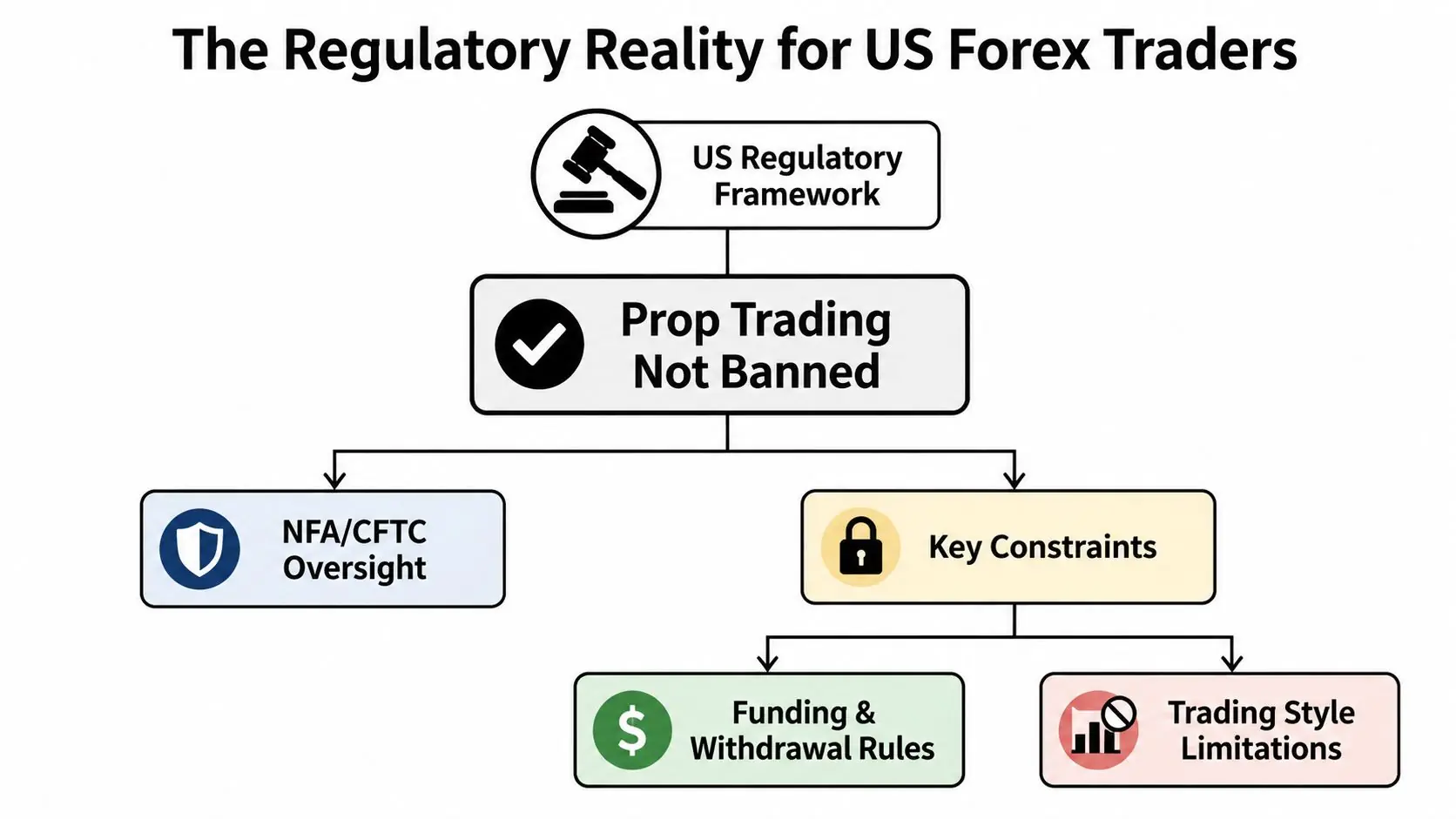
The Regulatory Reality for US Forex Traders
U.S. traders don't approach forex with the same retail margin structure available in every offshore market. CFTC and NFA rules cap margin at 50:1 on the seven major currency pairs and 20:1 on all other pairs, while retail accounts also face FIFO position-closing requirements and restrictions on same-account hedging (NFA forex rules overview).
The practical consequence is simple. A $10,000 retail-style account can notionally control up to about $500,000 on major pairs and about $200,000 on non-major pairs under those margin limits. Those figures describe notional control, not a sensible risk target. Margin capacity doesn't tell you how much the account can lose before the broker or prop firm intervenes.
Leverage changes the passing math
Many traders see a funded account and immediately calculate the largest position the platform will permit. That's backward. Start with the maximum loss allowed, then work backward to the position size, stop distance, spread, and likely slippage.
A major-pair position with high notional exposure can consume a large portion of a daily loss allowance after a relatively small adverse move. The same trade may also become harder to manage if the account's execution environment applies a different margin schedule or if several correlated positions move together.
U.S. rules also require more attention to trade sequencing. FIFO means positions in the same currency pair may need to close in the order they were opened. Restrictions on same-account hedging can interfere with methods that depend on offsetting long and short positions. A trader who uses layered entries, partial exits, or opposing exposure must confirm that the firm's environment supports the exact workflow.
Judge the firm's structure, not its badge
Before buying a challenge, read the firm's rules as an operating document. The MyFundedCapital regulation guide is a useful starting point for understanding why U.S. access deserves separate scrutiny, but it isn't a substitute for checking the current program terms yourself.
Use this checklist:
- Confirm U.S. eligibility Don't rely on an old review, affiliate page, or social media comment.
- Identify the execution model Determine whether the account is simulated, broker-linked, or described through another structure.
- Check position rules Look for FIFO, hedging, netting, scaling, and partial-close restrictions.
- Read withdrawal conditions Understand what triggers eligibility and whether trading behavior affects approval.
- Test the platform Place practice orders and verify that stops, partials, and pending orders behave as expected.
The U.S. framework doesn't make prop trading impossible. It does make careless comparisons expensive. Account size is a marketing label. The drawdown floor and execution rules are the actual constraints.
Comparing Prop Firm Platforms for US Accounts
Platform selection became a serious U.S. access issue after MetaQuotes withdrew MT4 and MT5 access from most prop firms in 2024, causing many firms to restrict American clients (coverage of the U.S. prop-firm legal gray zone). Traders who built their process around MetaTrader can't assume that familiar software will remain available through a particular firm.
For most U.S. forex prop traders, the practical comparison now centers on DXtrade and cTrader. Neither platform automatically creates an edge. The right choice depends on how you execute, whether you run automation, and how much platform complexity your routine can tolerate.
Platform Comparison for US Traders
| Feature | DXtrade | cTrader |
|---|---|---|
| Best fit | Traders who want a straightforward multi-asset trading interface | Discretionary traders and developers who prefer advanced charting and order tools |
| Charting | Clean and functional for routine analysis | Strong charting and detailed order management |
| Manual execution | Suitable for structured entries, stops, and targets | Well suited to active discretionary workflows |
| Automation | Confirm the firm's supported automation method before trading | Strong ecosystem for cTrader-compatible automated strategies |
| Migration concern | Familiarity varies for traders moving from MetaTrader | Requires adjustment if your process depends on MetaTrader tools |
| U.S. suitability | Practical where the firm offers it and explains its conditions | Practical where the firm offers it and supports your strategy |
DXtrade tends to suit traders who value a clean interface and direct execution without a crowded toolset. It can be a good fit for a rules-based discretionary trader who marks levels elsewhere, waits for confirmation, and manages risk through predefined orders.
cTrader is often more attractive to traders who want deeper chart interaction, detailed order controls, or a cTrader-compatible automated workflow. EA and copy-trading users still need to check the firm's specific permissions. A platform may support a function technically while the firm's rules restrict the way it's used.
MyFundedCapital offers DXtrade and cTrader for its simulated trading programs, with MT5 identified as coming soon in its product information. That combination gives a trader a choice between a simpler execution environment and a more feature-rich workflow, but the trader remains responsible for confirming current availability and program rules.
If you're evaluating a platform for a broader trading business, an exchange development framework can also help explain how trading interfaces, execution systems, and asset support fit together. Don't confuse platform polish with counterparty quality. Check uptime, order behavior, symbol specifications, and support response before paying for a challenge.
Decoding Risk Rules Daily Loss versus Max Drawdown
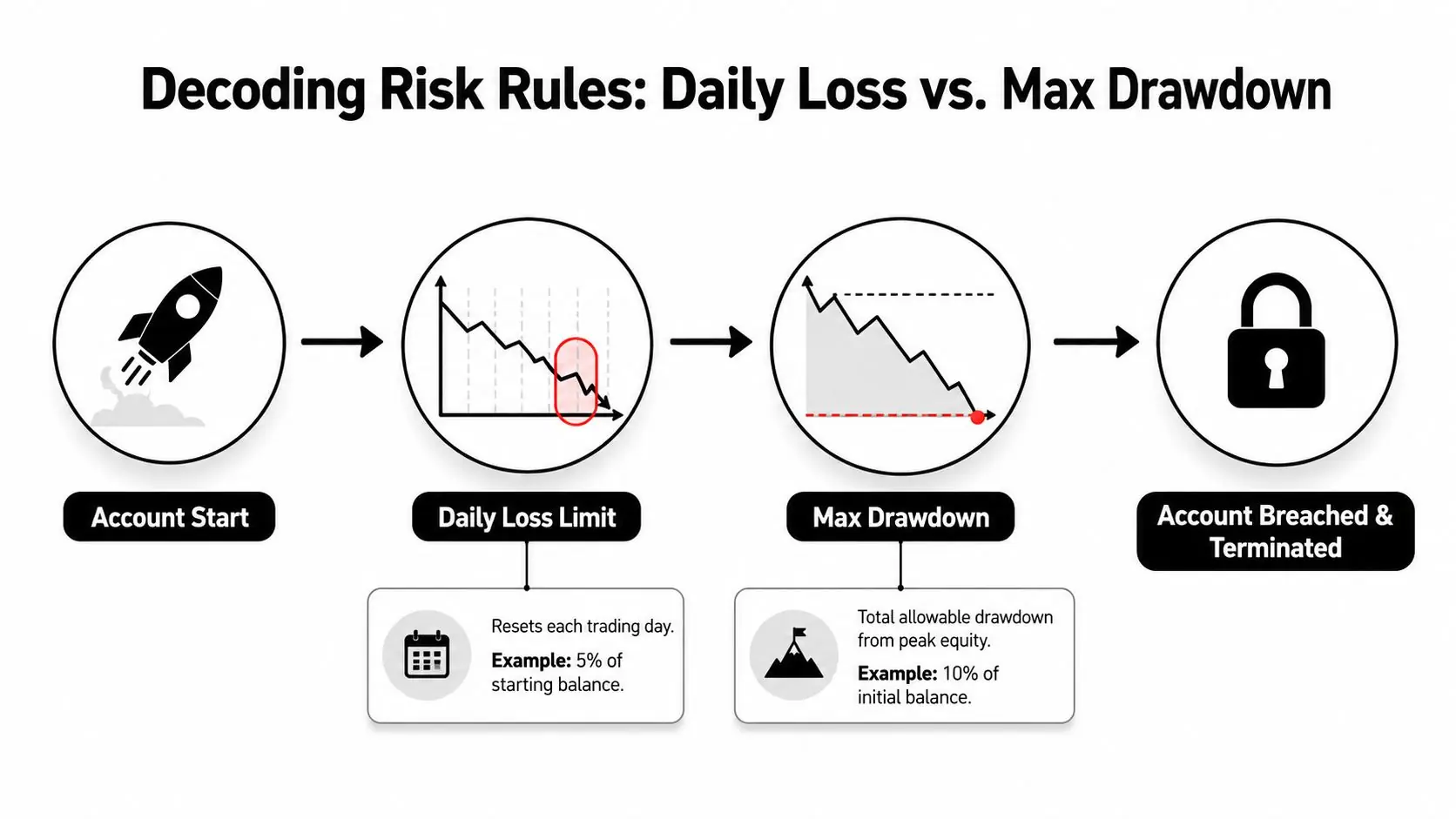
Most funded accounts are lost through a misunderstanding of two separate limits. The daily loss limit controls damage inside a trading day. Maximum drawdown controls the total decline permitted across the evaluation or funded period.
A common industry benchmark pairs a 5% daily loss limit with roughly 10% maximum drawdown, with the daily cap resetting at the start of the trading day and the broader limit applying across the full account period (prop-firm risk rules explained).
Read the daily rule correctly
On a $10,000 account using that example, a 5% daily loss limit equals $500, while a 10% maximum drawdown equals $1,000. Those calculations use the initial account value as the reference for the example, but firms can calculate losses using balance, equity, starting balance, or a high-water mark. The exact definition matters more than the headline percentage.
Daily loss usually includes more than closed-trade results. Floating losses, commissions, swaps, and slippage may affect the calculation depending on the firm's terms. An EA can appear safe based on closed positions and still breach the rule when several open trades lose simultaneously.
Max drawdown is the account floor
Maximum drawdown gives the account a wider loss allowance, but it doesn't make recovery easy. If the account falls toward its overall limit, reducing risk becomes essential because normal variance can finish the account before the strategy has time to recover.
A separate daily rule can be stricter than the overall drawdown and may lock or fail the account as soon as it's breached (prop-firm rules reference). That means a trader can remain above the maximum drawdown and still lose the account during one volatile session.
Use a pre-trade control process:
- Record the reset time Know exactly when the firm's trading day begins.
- Calculate the remaining daily allowance Include open equity, costs, and realized losses.
- Group correlated trades Treat positions driven by the same dollar or risk factor as one exposure.
- Set a personal stop below the firm limit Never trade directly against the platform's hard boundary.
- Disable automation during abnormal conditions Slippage and spread expansion can stack losses quickly.
Specialist guidance commonly places evaluation risk per trade around 0.5% to 1%, with more conservative approaches using 0.25% to 0.5% (prop-firm risk management guidance). Those ranges aren't guarantees and shouldn't replace your own testing. They illustrate the discipline required when several losses can accumulate inside a single daily window.
The maximum drawdown explanation should be read alongside the firm's daily-loss definition. Never assume one limit protects you from the other.
Risk rule: If your strategy needs one oversized trade to pass, it isn't ready for a funded account.
Choosing Your Challenge Instant versus One-Step versus Two-Step
The choice between Instant Funding, a one-step challenge, and a two-step challenge is a choice about friction, proof, and capital access. It isn't a ranking where one model wins for everyone.
Instant Funding suits a trader who already has a stable process and doesn't need an evaluation to demonstrate basic execution. The trade-off is that instant access can expose weak discipline immediately. Without a structured proving period, an impulsive trader has fewer barriers between a bad idea and a rule breach.
Match the path to your evidence
A one-step challenge is a middle route. It reduces the number of evaluation phases while still requiring the trader to demonstrate that the strategy can operate under the firm's limits. This can suit an experienced trader who has a repeatable setup but doesn't want to spend multiple stages proving it.
A two-step challenge creates more checkpoints. That's useful for a trader who needs a controlled test of consistency, drawdown behavior, and platform execution before handling a larger allocation. The extra phase isn't automatically a disadvantage. For many traders, it exposes overtrading before the account reaches the funded stage.
MyFundedCapital describes account paths from $5,000 to $100,000, with scaling paths up to $500,000, and profit splits beginning at 80/20, with upgrade paths to 90/10 or 95/5. Those figures come from the publisher's stated program information, so review the current terms before purchasing.
A practical decision matrix
| Your situation | More suitable starting point | Reason |
|---|---|---|
| You have verified execution and strict daily controls | Instant Funding | Avoids repeating a test you can already pass, but demands immediate discipline |
| You have a tested strategy and limited funded-account experience | One-step | Provides a defined checkpoint without a long evaluation sequence |
| You need to prove consistency under platform rules | Two-step | Adds another stage for testing risk and execution habits |
| You run an EA or copy system | Whichever path permits the exact method | Technical permission and risk behavior matter more than phase count |
| You trade news or hold over weekends | A program with the required add-ons or permissions | The strategy must fit the firm's restrictions before payment |
Read the firm's explanation of two-step challenges carefully, especially the phase objectives, loss calculations, and transition conditions. Don't choose a path because the account size looks impressive. Choose the shortest structure that still gives you enough evidence that your process can survive the rules.
Trading involves risk of loss, and a challenge fee should be treated as an expense you can afford to lose, not as an investment guaranteed to produce a payout.
The Legal Gray Zone and Future Outlook
Forex prop firms for U.S. traders operate in an awkward space. The model isn't banned in the United States, but independent coverage describes it as sitting in a registration-law gray zone under CFTC and NFA oversight (U.S. prop-firm legal analysis). That distinction matters because “legal” doesn't mean every firm, platform, product, or marketing statement carries the same level of regulatory protection.
Firms may restrict U.S. residents because of their legal structure, broker relationships, platform access, or internal compliance policy. Traders should therefore treat U.S. availability as a current operational fact to verify, not a permanent feature of a brand.
Why rankings can mislead
A ranking that emphasizes account size, profit split, or entry price may ignore the variables that determine actual trader outcomes:
- Platform continuity Can you still execute your method if a platform relationship changes?
- Rule clarity Does the firm define daily loss, drawdown, news, weekend, and automation rules plainly?
- Payout conditions Can you understand when and why a payout becomes available?
- Strategy compatibility Do FIFO, hedging, consistency, or position-size rules interfere with your process?
- U.S. access Does the firm accept American traders under its current structure?
Recent independent comparisons describe material changes in U.S. access during late 2025 and 2026, including firms reopening or restructuring for American traders and a shift toward futures-focused alternatives (2026 comparison of prop firms for U.S. traders). The important question isn't whether futures are universally better. It's whether your strategy benefits from futures market structure more than it benefits from forex access under U.S. retail constraints.
A forex prop account remains viable for a trader whose edge depends on currency pairs, who can operate within the buying power and position rules, and who values access to a familiar FX session structure. Futures may deserve more attention from traders frustrated by platform restrictions, retail forex buying power caps, or compliance uncertainty. Compare the contract mechanics, trading hours, loss rules, and payout terms rather than following the latest ranking.
My recommendation is blunt. Don't buy a challenge until you've simulated the firm's exact daily-loss calculation, tested every platform feature your strategy needs, and confirmed U.S. eligibility in writing. Marketing claims don't keep accounts funded. Small risk, clean execution, and a rule set you understand do.
MyFundedCapital offers Instant Funding plus 1-Step and 2-Step Challenge paths, simulated trading across forex and other markets, and access through DXtrade and cTrader for traders who need a modern alternative to legacy platform access. Visit MyFundedCapital to review the current funding programs, compare account types, and start a challenge only if its rules fit your tested strategy.