If you're exploring prop firm trading, you've likely encountered the term "two-stepping" or "2-step challenge." This is the most common evaluation model prop firms use to find disciplined traders, but what does it actually involve? This guide will break down what two-stepping is, how the process works, and the practical steps you need to take to pass.
Free resources: Prop Trading Challenge Survival Guide (the math behind the rules and the habits that get traders through).
What Is Two-Stepping in Trading?

In prop trading, two-stepping refers to a 2-Step Challenge, an evaluation where you must prove your trading skills across two distinct phases in a simulated environment. The goal isn't just to hit a profit target; it's to demonstrate that you can manage risk and trade with discipline. It's a structured audition for a funded account.
Passing both phases shows the firm you have a repeatable strategy and can be trusted with their capital. This is the primary pathway to securing a funded account and earning a real profit split. You can learn more about the business model in our complete guide on proprietary trading firms.
The Two Phases of Evaluation
The two-phase structure is designed to filter out traders who get lucky from those who have a consistent, repeatable edge. It's one thing to have a profitable week; it's another to prove you can do it again under slightly different conditions.
This structure tests for a disciplined process. It ensures traders can not only generate returns but, more importantly, protect the firm's capital from significant losses.
The 2-Step Challenge at a Glance
The table below outlines the core purpose of each stage in a typical evaluation.
| Phase | Primary Objective | Key Focus |
|---|---|---|
| Phase 1 | Demonstrate Profitability | Hitting a higher profit target (e.g., 8%) while staying within strict risk rules. |
| Phase 2 | Prove Consistency | Reaching a lower profit target (e.g., 5%) to confirm your strategy is sustainable, not just a fluke. |
Think of it this way:
- Phase 1 asks "Can you generate profit with your strategy?"
- Phase 2 follows up with "Can you do it again consistently while protecting capital?"
Successfully navigating both phases sends a clear signal: you have a viable trading strategy and the discipline needed to manage a funded account.
Understanding the Rules of a 2-Step Challenge
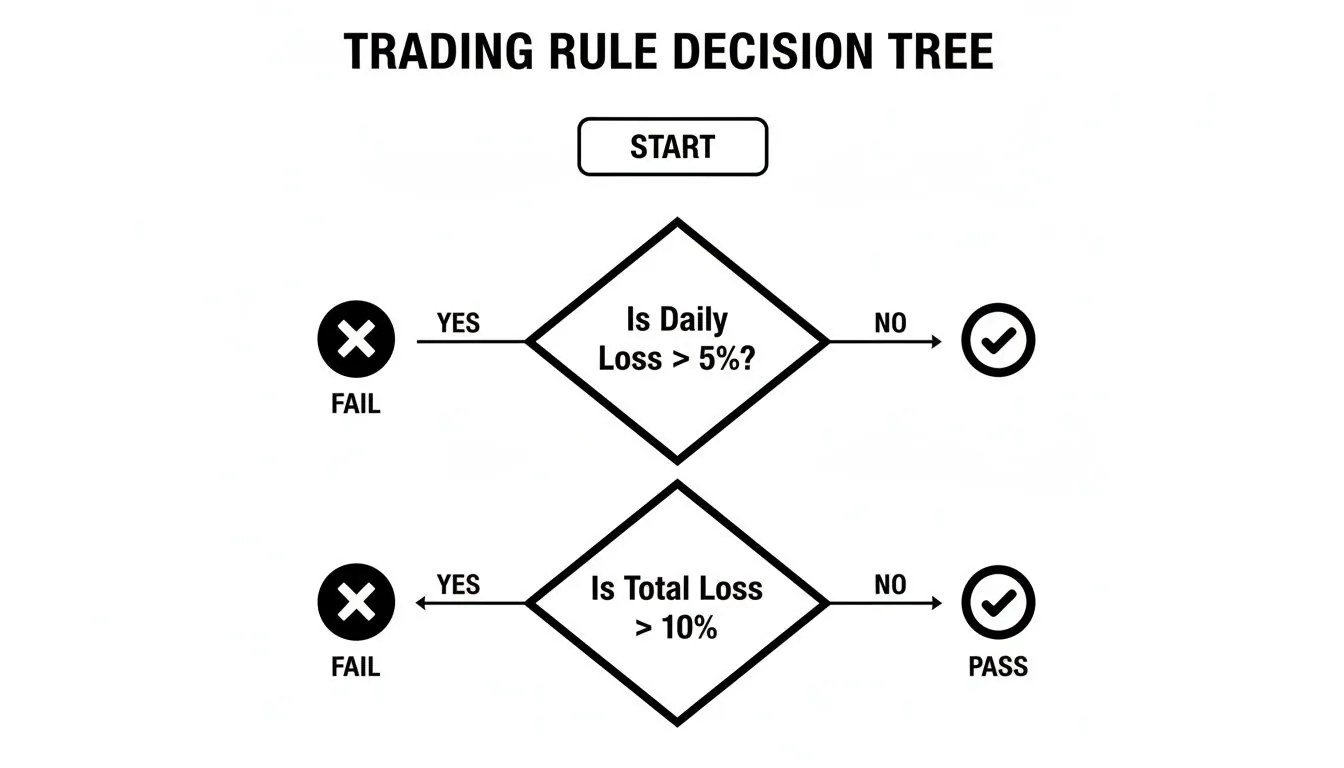
Passing a 2-step challenge comes down to understanding and respecting the rules. These aren't just arbitrary restrictions; they are the blueprint for building real trading discipline. While every prop firm has slight variations, the core rules are almost always the same.
Profit Targets: Phase 1 and Phase 2
Your first job is to demonstrate that your strategy is profitable. A 2-step challenge splits this test into two distinct sprints.
- Phase 1 Profit Target This is the bigger hurdle, typically set around 8%. The goal is to prove you can execute your strategy effectively to generate a significant return.
- Phase 2 Profit Target After passing Phase 1, the pressure eases slightly. This target is lower, often 5%, and focuses on consistency. It confirms that you can protect your gains and steadily grow the account without taking excessive risks.
Drawdown Limits: The Most Important Rules
Profit targets are what you're aiming for, but drawdown limits are the lines you must never cross. Breaching these rules will result in failing the challenge, regardless of your profit. Trading involves substantial risk of loss, and these rules are designed to enforce risk management.
There are two types of drawdown you must respect:
- Maximum Daily Drawdown This is the most your account's equity can fall in a single day. At MyFundedCapital, this is a fixed 5% of your initial balance. For example, on a $100,000 account, your daily loss limit is a hard $5,000. If your equity dips below $95,000 at any point during the day, you've breached the rule.
- Maximum Overall Drawdown This is your account's ultimate safety net. It’s the total amount you can lose from your starting balance, typically set at 10%. On a $100,000 account, if your equity ever drops to $90,000, the challenge is over.
These rules aren't designed to make you fail; they're designed to mirror how real investment firms manage risk. Mastering two-stepping means making these drawdown limits the foundation of your trading plan.
How a 2-Step Challenge Works: A Real-World Example

Let’s walk through what a two-step challenge looks like for a trader in a practical, step-by-step scenario.
Meet Alex, a trader who signs up for a $50,000 2-Step Challenge. After paying the one-time fee, Alex receives credentials for a $50,000 simulated account with a clear objective.
Phase 1: The Initial Push
The first hurdle is to hit an 8% profit target, which is $4,000 on this account. Alex must achieve this without breaking the two critical risk rules:
- Maximum Daily Drawdown (5%) Alex cannot let the account's equity drop by more than $2,500 in a single day.
- Maximum Overall Drawdown (10%) The account’s equity can never fall below $45,000.
Alex starts by risking just 0.5% ($250) per trade. After two weeks of disciplined trading, a well-timed trade on a news event banks a $1,500 profit, pushing the account to $52,100. The next day, a sharp market reversal causes a $1,200 loss. Alex remains calm, knowing the loss is well within the $2,500 daily limit. By the end of the third week, a series of steady trades brings the account to $54,050. Phase 1 is complete.
Phase 2: Proving Consistency
Alex now moves to Phase 2. The profit target is lower—just 5%, or $2,500. The drawdown rules remain the same, anchored to the initial $50,000 balance. This phase isn't about hitting home runs; it’s about demonstrating a sustainable strategy.
Alex focuses only on high-probability setups. The progress is methodical. Within two weeks, the account balance reaches $52,500. Alex met the target without getting close to the drawdown limits.
By successfully navigating both phases, Alex has demonstrated the ability to generate profit and the discipline to protect capital. The evaluation is passed, and Alex is now eligible to sign the funded account agreement and start trading for real profit splits.
How to Pass a 2-Step Evaluation

Passing a 2-step evaluation isn't about finding a secret indicator or getting lucky. It's a test of your discipline and process. Approaching it professionally from the start dramatically increases your chances of success.
1. Create a Risk-First Plan
Your primary job is not to chase the profit target; it's to protect the account. If you make capital preservation your priority, the profits will follow.
- Define Your Risk Per Trade Before you start, decide on your maximum risk. Most successful traders risk 0.5% to 1% of the account balance per trade. On a $100,000 challenge, this means never risking more than $500 to $1,000 on a single idea.
- Know Your Numbers Always be aware of your exact daily and maximum drawdown levels. This allows you to make calm, calculated decisions instead of emotional ones. Knowing you have a $5,000 daily loss limit on a $100k account helps you size your positions appropriately.
2. Maintain Trading Discipline
Your mindset is just as critical as your strategy. The pressure of an evaluation can lead to unforced errors.
- Don't Over-Trade Stick to your predefined plan and only take high-quality setups. More trades often lead to more mistakes, not more profit.
- Never Revenge Trade After a loss, walk away. The urge to "make it back" immediately is the fastest way to hit your daily drawdown limit and fail the challenge.
- Warm-Up First Before trading your normal size, place a few trades with minimum risk to get a feel for the platform and its execution. This can prevent costly mistakes.
Building a solid risk management framework isn't just a trick to pass an evaluation—it's the foundation of a long-term trading career. For more, read our complete guide on Forex risk management strategies.
Two-Step vs. One-Step vs. Instant Funding
While the 2-step challenge is the most popular route to a funded account, it’s not the only one. Choosing the right funding model depends on your trading style, confidence, and risk tolerance.
- 2-Step Challenge Best for methodical traders who are confident in their edge but want a structured, two-part process to prove it. It's typically the lowest-cost option but takes longer to complete.
- 1-Step Challenge Ideal for decisive traders with a fully tested strategy who want to get funded faster. It involves a single, more demanding phase (e.g., a 10% profit target).
- Instant Funding Suited for experienced traders who want to bypass evaluations and start earning profit splits immediately. This convenience usually comes with tighter risk parameters and a higher upfront cost. You can explore the details of prop firm instant funding to see if it's right for you.
There's no single "best" choice—only the one that aligns with your personal strategy and goals.
Two-Stepping FAQ
Here are answers to some of the most common questions traders have about 2-step evaluations.
What happens if I don't reach the profit target in time?
Most reputable firms, including MyFundedCapital, offer a free retry or extension if you run out of time. The main condition is that your account must be in profit and you haven't violated any drawdown rules. This policy gives you a second chance to prove your strategy without paying for a new challenge.
Can I use Expert Advisors (EAs) or copy trading?
Yes, you can use Expert Advisors (EAs) and copy trading services. However, your strategy must be unique. To ensure fair evaluation and prevent group gambling, firms have rules to ensure your performance reflects your own edge, not a duplicated one from a large pool of identical users.
Is the funded account real money or a demo?
All evaluation and funded accounts operate in a simulated (demo) environment connected to live market data feeds. This allows prop firms to manage risk effectively while testing traders in a realistic setting. Your payouts, however, are very real and are calculated based on the profits you generate in this simulated account. It's a system that rewards proven skill with real earnings.
Take the Next Step in Your Trading Journey
You now have a clear understanding of what two-stepping is and how a 2-step evaluation works. It's a structured process designed to identify traders who can manage risk and generate consistent profits. Trading involves risk, and funded challenges are not a guarantee of profits. However, for prepared and disciplined traders, they offer a clear path toward trading with significant capital.
If you believe your strategy and discipline are ready for the test, consider exploring a challenge.
Ready to prove your skills? Learn more about our funding programs and start a challenge today.