You've got a profitable setup on EURUSD, yet the same rules keep losing on USDJPY and XAUUSD. Before you rewrite the strategy, inspect the instrument. This guide gives you practical instrument selection criteria for liquidity, volatility, execution cost, strategy fit, and prop-firm rules, with specific thresholds you can apply to a watchlist today.
Why Your Watchlist Might Be the Real Problem
A funded trader can post a 52% win rate on EURUSD and still bleed risk on USDJPY and XAUUSD. The natural reaction is to blame the entry model, tighten the stop, or reduce position size. Often, the model isn't broken. The watchlist is.
Most traders inherit their markets from a broker's symbol list, a YouTube video, or a prop-firm marketing page. They then apply identical entry rules to every instrument, regardless of spread, session behavior, liquidity, or volatility. That's a mistake. A setup designed around tight-spread major pairs behaves differently on gold, exotic FX, crude oil, or a thin crypto pair.
The leak usually appears in three places:
- Split attention You monitor too many charts and miss the execution details that matter.
- Inconsistent fills Wider spreads and slippage turn valid entries into poor trades.
- Edge decay A short-horizon strategy can lose its advantage when transaction costs consume too much of the expected move.
EURUSD may offer clean execution during London and New York overlap. USDTRY can introduce a wider spread and less predictable movement. XAUUSD may produce excellent reactions around major news but become expensive and erratic for an overnight scalp. These are not interchangeable markets.
Practical rule: A market isn't suitable because it moves. It's suitable when it moves enough, trades cleanly during your session, and fits your risk rules.
Start with objective data. A useful Altymo tool for retail traders can support broader market research, but your broker or prop-firm platform remains the authority for live spreads, contract specifications, and trading hours. You should also verify the symbols and conditions available through the MyFundedCapital funded trader markets page before building assumptions around a market.
The framework is simple: apply four hard metrics, filter against prop-firm constraints, match the instrument to the strategy, measure real execution cost, and prune without sentiment. You'll get thresholds rather than vague advice.
The Four Core Metrics Every Instrument Must Pass
Every instrument earns a place on your watchlist by passing four tests. The order matters because an attractive chart can't compensate for poor execution.
1. Range must fit the stop
Measure the instrument's average range against your strategy's stop distance. A scalper needs enough movement to reach a target without relying on a rare burst. A swing trader needs a meaningful daily range, not just occasional spikes.
For practical screening, a swing trader can start with FX instruments showing more than 80 pips of daily range, or markets such as US30 showing more than $15 of daily range. Those thresholds come from the intended holding period, not from a universal law. A stop that works on EURUSD may be structurally wrong for XAUUSD.
2. Spread must be small relative to the opportunity
For major FX scalps, target spreads below 0.5 pips. For metals and indices, a useful screen is a spread below 0.03% of price, provided the market also shows consistent two-sided quotes. These thresholds are practical editorial filters, not guarantees of profitability.
A spread that looks small in isolation can be large relative to a scalp's expected move. Review the broader spread guidance for trading before treating a symbol as execution-friendly.
3. Liquidity must exist during your actual session
Average volume matters, but your trading window matters more. A market can be liquid during New York and poor during your Asian-session setup. For stocks, a minimum average daily volume of 1 million shares is used in swing-trading screening, while an active day-trading screen may require average daily volume above 2.5 million shares and prices between $10 and $200 (practical market-selection thresholds).
For crypto, one market-selection rule uses 24-hour volume above $50 million and order-book depth of roughly $300,000 to $1 million at 0.1%, depending on account size (crypto liquidity guidance). Treat those figures as screening gates, then validate fills on your platform.
4. Realized volatility must match expectations
Don't select an instrument because its historical chart looks active. Compare expected volatility with what the market is delivering now. A swing guide identifies an ATR-to-price range of 1.5% to 4% as a practical volatility sweet spot (swing-trading selection framework).
A fifth check sits behind these four: correlation. Holding EURUSD, GBPUSD, and another USD-short position doesn't create genuine diversification. Your exposure may be concentrated in one currency factor.
| Metric | Scalper | Day Trader | Swing Trader |
|---|---|---|---|
| Range | Must support the target and stop quickly | Needs consistent intraday movement | More than 80 pips on FX or $15 on US30 can be a starting filter |
| Spread | Below 0.5 pips on major FX, or below 0.03% of price on metals and indices | Low relative to the expected move | Wider spreads can be acceptable when the holding period is longer |
| Liquidity | Deep two-sided quotes during the trading window | High turnover during the chosen session | Consistent volume and reliable exits |
| Volatility | Stable enough for repeatable stops | Active without constant gap risk | ATR-to-price range of 1.5% to 4% can be screened |
EURUSD usually fits a tight-spread session strategy. USDTRY fails if its spread consumes the expected scalp. XAUUSD can fit a news strategy but fail for an overnight scalp. BTCUSD may pass only during US overlap hours, when its order book and execution conditions meet your requirements.
Prop-Firm Rules That Quietly Decide What You Can Trade
Your prop firm's rule sheet can disqualify an instrument before market quality becomes relevant. Filter the account rules first, then assess charts and spreads.
Drawdown changes the instrument shortlist
Gap-prone or fast-moving markets can make a position incompatible with a fixed loss limit. Crude oil and crypto may look attractive, but overnight gaps, weekend moves, or sudden liquidity changes can punish a trader who sizes them like EURUSD.
MyFundedCapital's published framework lists a 5% daily loss limit and up to 10% maximum drawdown for its programs, while the supplied guidance also highlights daily drawdown ranges of 4% to 5% and the importance of understanding trailing-drawdown behavior. Confirm the current terms directly before trading, because account rules and specifications can change.
Leverage and margin can make a setup inefficient
Leverage isn't the same as risk control. A pair may offer a strong technical pattern while consuming too much margin for the position size your stop requires. GBPJPY and XAUUSD can become margin-inefficient under tighter leverage, particularly when the account's daily drawdown leaves little room for error.
A GBPCAD setup can become untradeable under a 1:30 ratio cap combined with a 4% daily drawdown. EURUSD or US30 may remain cleaner choices if their contract terms and volatility fit the same risk plan.
News, weekends, and trading hours are hard filters
Some firms restrict news trading, weekend holding, or specific symbols. That changes the viable strategy. A trader who depends on NFP reactions can't assume those entries are allowed. A crypto trader who holds from Friday to Sunday must check weekend permissions and associated fees.
Symbol-specific blackouts also matter. Liquidity providers and platforms may close, widen spreads, or restrict order activity around rollovers and market holidays.
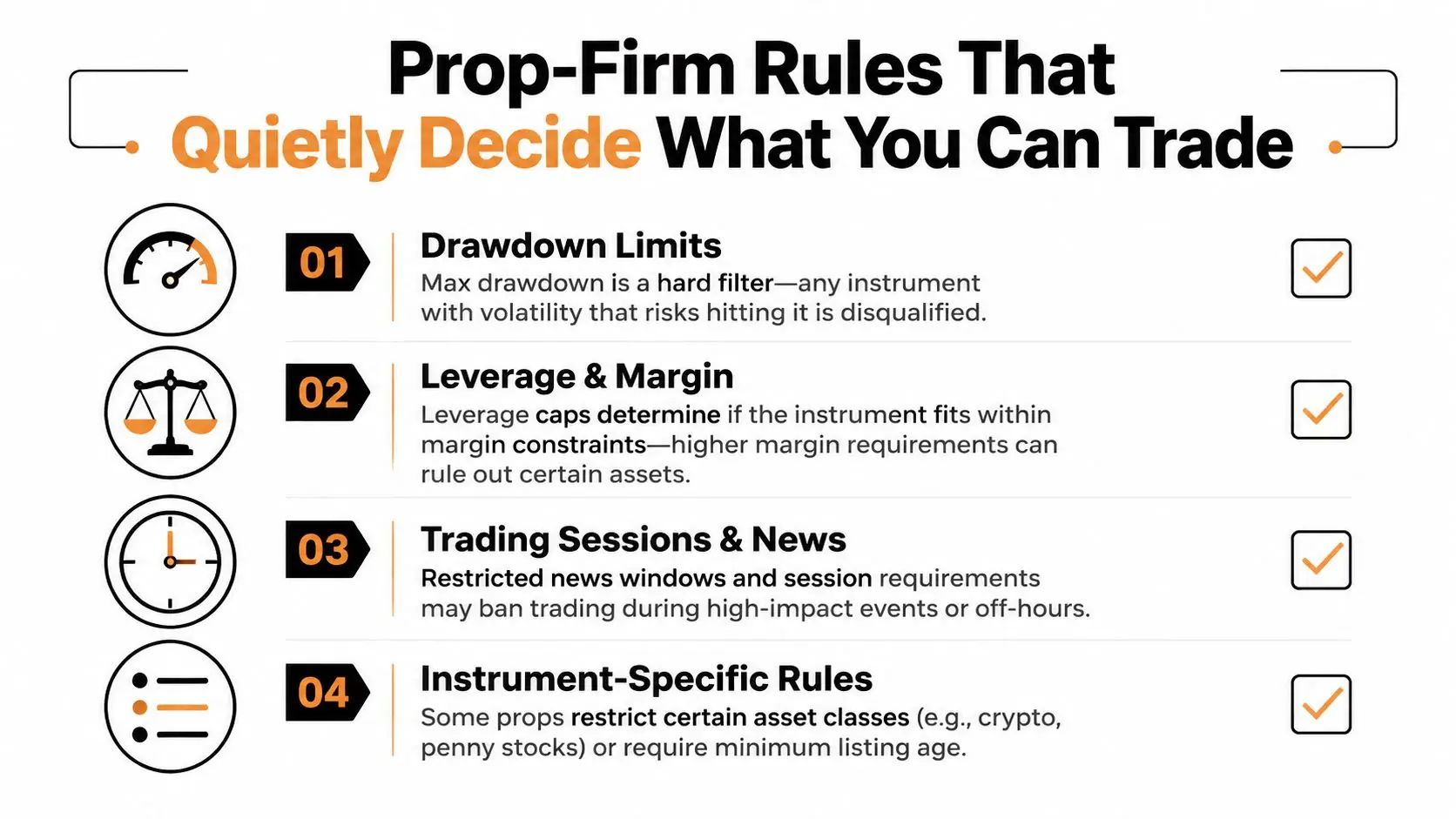
Before you commit to a symbol, confirm:
- Loss limits Daily and maximum drawdown calculations, including whether floating loss counts.
- Margin Maximum margin, margin requirements, and contract size.
- Event restrictions News windows, weekend holding, and rollover conditions.
- Symbol rules Trading hours, restricted markets, minimum order sizes, and platform availability.
The sequence is essential. Read the firm's rule sheet before filtering by liquidity or volatility. A profitable setup is irrelevant if the account rules prohibit its execution.
Matching Instruments to Scalping, Swing, Algo, and News Strategies
Instrument selection starts with the strategy's execution demands. Don't ask which asset class is best. Ask which market gives this specific method the cleanest chance to operate.
Scalping
Scalpers need tight spreads, quick fills, and deep liquidity. Major FX pairs such as EURUSD and USDJPY, along with liquid indices such as NAS100 and US30, are sensible starting candidates.
Do:
- Trade during the session where spreads and liquidity are consistently acceptable.
- Track order-book behavior and slippage, not just the chart.
- Keep stops and targets consistent with the instrument's normal movement.
Don't:
- Apply major-pair rules to exotics.
- Trade gold during low-volume hours without measuring the cost.
- Assume a fast candle means reliable liquidity.
Swing trading
Swing traders can tolerate a wider spread because the expected move is larger, but they still need clean daily ranges and follow-through. EURUSD, GBPUSD, XAUUSD on the daily timeframe, and liquid equity CFDs can fit this style when the account permits overnight holding.
The position-size calculation must reflect the stop distance, contract specification, and margin. A wider stop doesn't make a volatile instrument safer. It can reduce the position size required to keep risk controlled.
Algorithmic trading
Algorithms need stable feeds, predictable symbol specifications, and consistent execution. Major FX pairs, NAS100, SPX500, and supported crypto majors can be suitable candidates.
Test the exact platform feed your algorithm will use. A backtest built on one symbol specification can become misleading if the live environment uses different trading hours, commissions, swap rules, or minimum lot steps.
News trading
News traders need instruments with clear reaction windows and acceptable execution during volatility. GBPUSD and EURUSD can be relevant around FOMC or CPI. Gold may fit NFP reactions, while oil may suit EIA-related setups, subject to firm rules and execution conditions.
Before trading an event, review the guidance on trading economic news and confirm whether your account permits the method.
| Strategy | Best-Fit Instruments | Do | Don't | Example Watchlist |
|---|---|---|---|---|
| Scalping | EURUSD, USDJPY, NAS100, US30 | Demand tight spreads and deep liquidity | Trade exotics or thin crypto during quiet sessions | EURUSD, NAS100, US30 |
| Swing | EURUSD, GBPUSD, XAUUSD daily, liquid equity CFDs | Match range and stop size | Hold markets that violate weekend or overnight rules | GBPUSD, XAUUSD, US30 |
| Algo | Major FX, NAS100, SPX500, supported crypto majors | Test the exact platform feed | Trust a backtest that ignores costs | EURUSD, NAS100, SPX500 |
| News | GBPUSD, EURUSD, gold, oil | Verify news permissions and slippage | Enter restricted events blindly | EURUSD, XAUUSD, US30 |
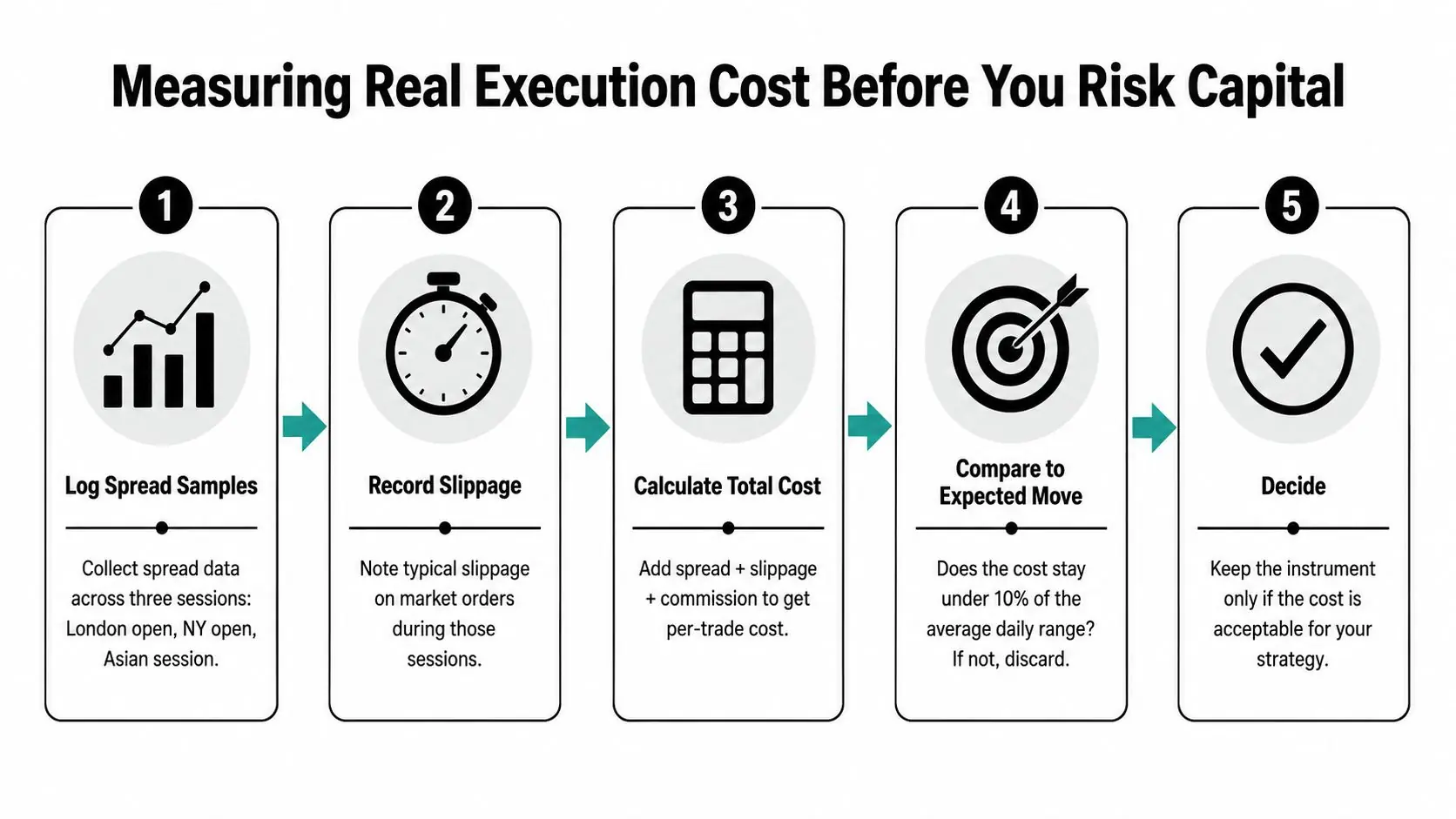
Measuring Real Execution Cost Before You Risk Capital
Backtests often fail because traders measure chart movement but ignore the cost of participating. Build an execution log on the platform, account type, and session you'll use.
Step one, sample the spread
Collect spread observations at London open, New York open, and the Asian close. Don't record one favorable quote and call the market cheap. Capture enough samples to identify the normal condition and the stressed condition.
Reject an instrument when its typical spread consumes the strategy's expected edge per trade. The same symbol can pass during New York and fail during your preferred overnight window.
Step two, record slippage
Place five market orders per session in a controlled demo environment and compare the requested price with the fill. Record direction, time, spread, volatility, and whether the order was filled normally or partially.
Then test the platform's order types. A limit order, stop order, and market order can behave differently around fast movement. Note requotes, rejected orders, partial fills, and stop-distance restrictions.
Step three, add financing and commissions
For an overnight test, record swap or financing charges. Calculate:
All-in cost = spread + slippage + swap + commission
Compare that figure with the average expected win, not with the instrument's headline volatility. The execution-cost framework should also test whether total cost remains below 10% of the average daily range, as reflected in the supplied measurement guidance.
Step four, mirror the challenge
Run a demo challenge for two weeks, using the firm's drawdown cap, news restrictions, weekend rules, and intended position size. Don't use perfect fills or remove trades that would have violated the account rules.
For a 1:50 challenge account, compare EURUSD and XAUUSD using the same risk budget. EURUSD may produce more consistent spread and fill behavior, while XAUUSD may offer a larger move but greater cost and volatility around events. Keep whichever produces the better net execution after all charges, not whichever creates the more impressive chart.
Step five, make a binary decision
Keep the instrument only if it passes every hard test:
- Cost Total trading cost stays below your defined edge threshold.
- Fills Slippage and order behavior remain acceptable.
- Access Trading hours and platform conditions match your method.
- Rules The instrument remains allowed under the account.
- Risk Stop placement and position size fit the drawdown limit.
The Case for Trading Fewer Instruments Better
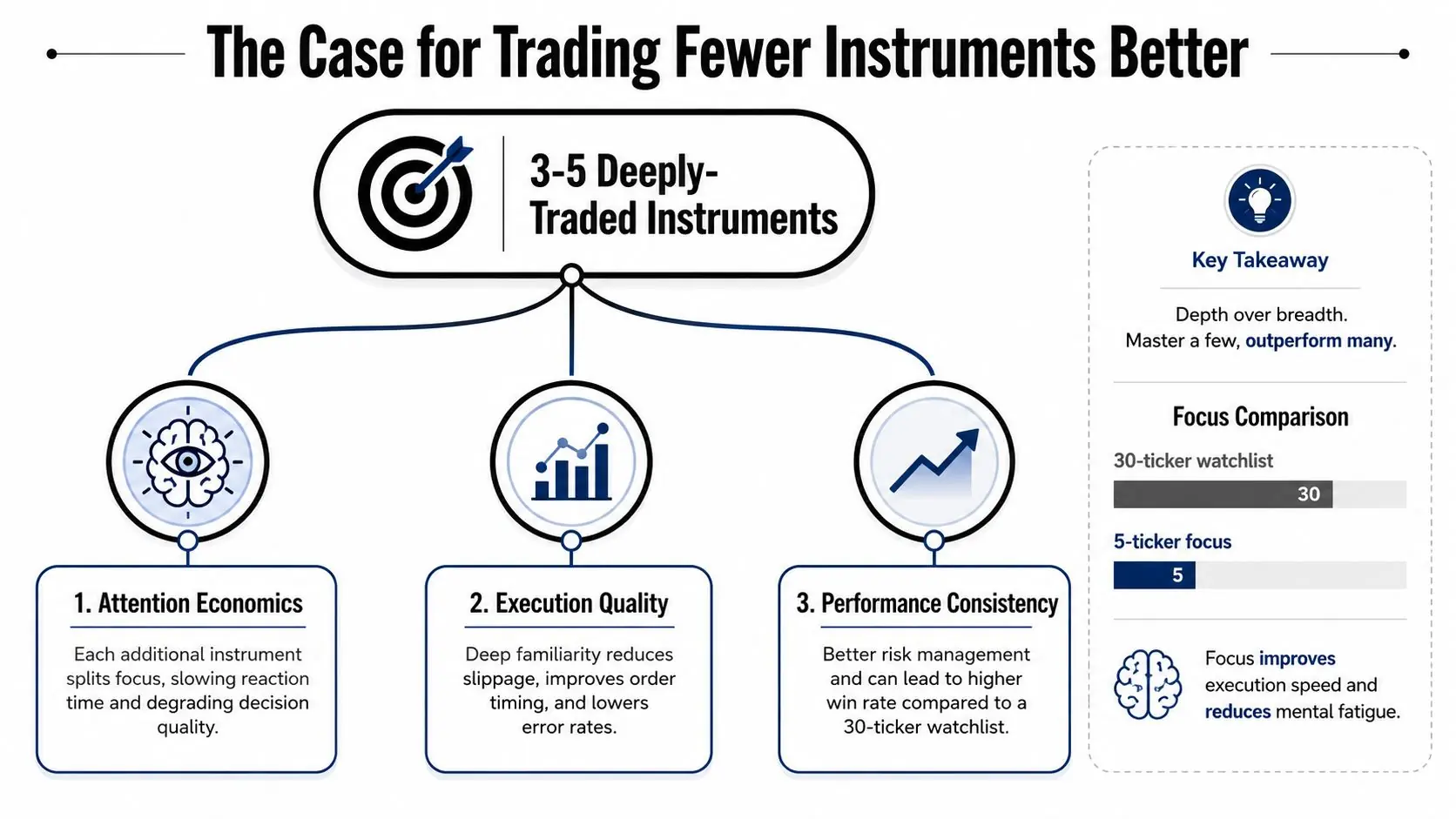
A 30-ticker watchlist creates the illusion of opportunity. For most prop traders, it creates context-switching, inconsistent execution, and accidental rule violations.
A focused book of 3 to 5 instruments is a stronger operating model. Recent prop-trading guidance commonly recommends that range while matching instruments to the strategy (focused instrument guidance). You learn how each market behaves at session opens, during rollovers, around news, and when liquidity disappears.
That familiarity has practical value. You recognize when EURUSD is moving normally, when NAS100 is overextended, and when XAUUSD is too expensive to chase. You also spend less time moving between majors, gold, indices, and crypto during high-volatility periods.
The best watchlist is the smallest one that gives your strategy enough valid opportunities.
Use a simple structure:
- Core book Three instruments you trade regularly and understand well.
- Backup book Two alternatives used only when the core market fails its session or liquidity test.
- Retirement rule Remove any instrument you haven't traded at least 20 times in a month.
The retirement rule prevents emotional attachment. A symbol stays because it earns its place through repeatable execution, not because it occasionally produces a large candle.
A smaller watchlist also reduces operational mistakes. You're less likely to forget a weekend crypto position, miss a news restriction, or misapply the stop distance from one market to another. Depth beats breadth when your account has strict drawdown limits.
Your Instrument Selection Checklist for This Week
Turn your watchlist into a pipeline. Every symbol must pass the same operational review before you risk it.
- Filter hard constraints. Remove markets that breach margin, news, weekend, holiday, or drawdown requirements.
- Record specifications. Save the platform symbol, contract size, minimum order size, trading hours, swap schedule, stop restrictions, and execution model.
- Measure cost and liquidity. Log median spread, slippage, commission, average range, and session-specific liquidity.
- Check portfolio exposure. Identify whether the new instrument duplicates an existing currency, index, commodity, or crypto factor.
- Validate with realistic trades. Paper-trade at the intended cadence, including latency, partial fills, and all costs.
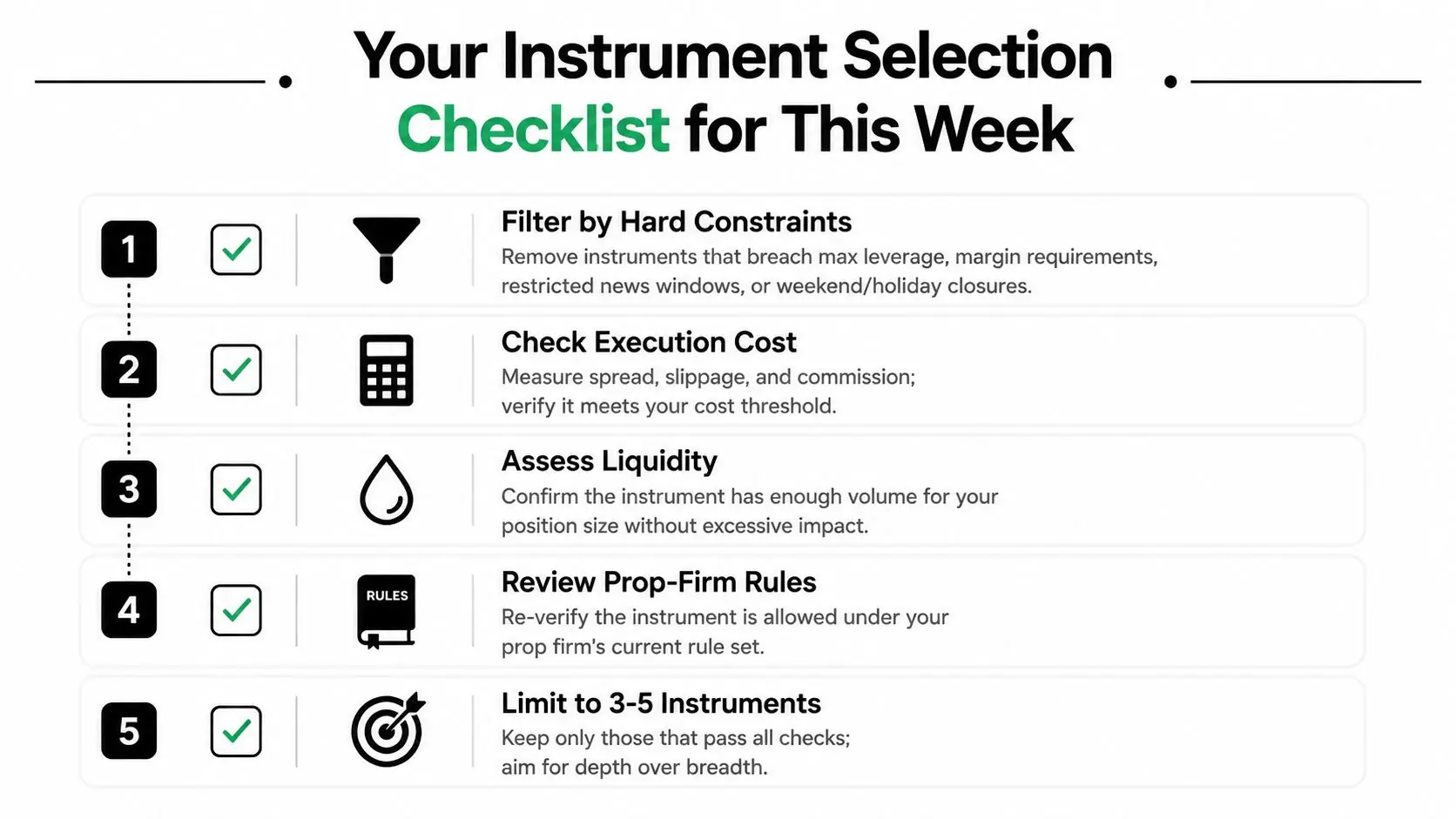
Keep three to five candidates with the cleanest execution and strongest strategy fit. Review the decision after at least 20 representative trades, then document the rule that keeps each instrument on the list. Repeat the audit whenever margin requirements, drawdown terms, or platform specifications change.
Common Questions and Next Steps With MFC
What matters most in instrument selection?
Choose by total execution cost, not headline volatility. Liquidity, spread, slippage, margin, session overlap, overnight charges, and correlation must work together. A market can move aggressively and still be unsuitable if fills and fees consume the strategy's edge.
Should I test on the same account conditions?
Yes. Use the same platform, account type, and position size you intend to trade. A $100,000 account and a $5,000 allocation can create different practical liquidity and margin conditions, so review lot steps, minimum volume, commission, swaps, market hours, and symbol restrictions in the official specifications.
How should I prepare for a challenge?
Narrow your list to one primary market, one substitute, and one diversification candidate. Run a two-week execution log, then recheck behavior around rollovers, major news, holidays, and the daily cutoff. Trading involves risk of loss, and this educational guidance isn't financial advice.
MyFundedCapital offers Instant Funding and 1-Step or 2-Step Challenges with access to forex, crypto, and commodities on supported platforms, subject to the current program rules. Visit MyFundedCapital to compare account types, verify instrument specifications, and choose a challenge that fits your execution-tested watchlist.