Most traders ask the wrong question about prop firms regulation. They ask whether a firm is “licensed,” as if that alone tells them whether payouts are safe, rules are fair, or disputes will get resolved. The harsher and more useful question is, what regulatory perimeter applies to this business model, and what protects you if the firm changes the rules after you've paid?
Why Prop Firms Regulation Matters More Than You Think
Regulated means safe” is bad trader logic. A firm can be legally incorporated and still sit outside the investor-protection framework that covers brokers, advisers, and customer funds, which is exactly where most prop-firm headaches start. In the U.S., there's no dedicated prop-firm-specific framework in 2026, and when the model is an evaluation plus simulated-funding service, the SEC, CFTC, and NFA don't supervise it the way they supervise traditional intermediaries, while the FCA has said it does not regulate prop firms, funded accounts, or trading competitions. The practical result is simple, dispute resolution usually falls back on contract terms and general consumer law rather than a dedicated financial regulator. That's why a good contract review matters, and why tools that help reduce contract risk are relevant before you ever click “buy.
The question that actually matters
You don't need a vague safety label. You need to know whether the firm is operating as a service business with firm-owned accounts, or drifting into regulated-broker territory by how it handles money, orders, or account rights. That distinction changes what protections exist, what disclosures you get, and how hard it is to recover money if the firm stalls.
Practical rule: if the answer starts with marketing language instead of a legal structure, you're already behind.
The rest of the industry is built on that confusion. Traders see challenge fees, funding promises, and profit splits, then assume they're dealing with something that looks like a broker. They're not. They're usually dealing with a service contract wrapped around trading rules, and that means the burden of proof sits on you, not the firm.
How the Evaluation Model Stays Outside Broker Regulation
The model stays outside broker regulation for one blunt reason, traders usually pay an evaluation fee and trade simulated or firm capital, not client deposits. That means the firm often isn't holding customer money in the way a broker does, so the usual fund-segregation, reserve-capital, and investor-protection rules don't automatically apply. It's more like a driving school than a licensed taxi company, you're paying for training and access, not handing over funds to be safeguarded like a brokerage account.
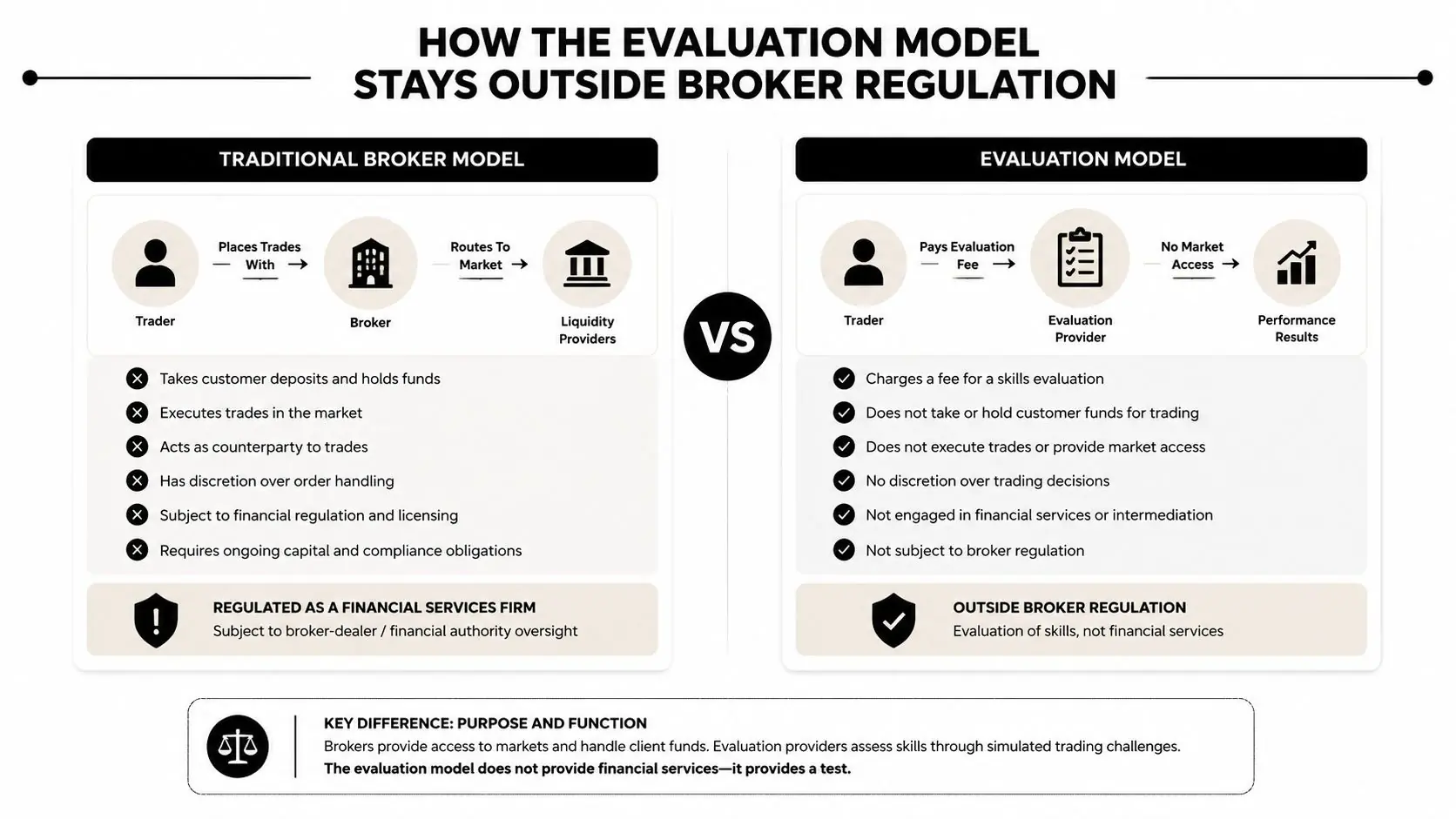
Prop Firm vs Regulated Broker at a Glance
| Dimension | Retail Prop Firm | Regulated Broker |
|---|---|---|
| Money held | Evaluation fee, not customer deposits | Customer funds and trading balances |
| Core activity | Evaluation plus access to simulated or firm capital | Order execution and account custody |
| Supervision | Often outside broker-style oversight | Supervised under market-regulator rules |
| Fund protection | No automatic segregation framework | Segregation and reserve obligations apply |
| Disputes | Contract terms and consumer law | Formal regulatory complaint channels |
That table is the core mechanic. If the firm isn't operating like a broker, it usually doesn't get treated like one. So the legal benchmark isn't “is it legal?” It's “what supervision regime applies to this exact business model?”
The consequence is ugly when things go wrong. If a payout is denied or an account gets closed, you usually don't get a tidy financial-regulator workflow. You get the contract, the support inbox, and whatever consumer-law path exists in the firm's jurisdiction. Cross-border disputes are especially messy because the trader, the company, and the payment processor may all sit in different places.
A lot of traders want broker-style protections without broker-style rules. That's not how this market works. If you pay for a challenge, you're buying access to a testing service with strict terms, not a custody relationship.
Four Regulatory Regimes Traders Actually Encounter
The first regime is the United States. Major federal bodies such as the SEC, CFTC, and NFA don't supervise the standard evaluation-plus-simulated-funding prop model the way they supervise brokers or advisers, so traders don't get the same protection stack they'd expect from a regulated intermediary. That matters because the sector has scaled anyway, with one industry estimate putting global prop trading at $20 billion, spread across more than 2,000 firms, and 62% based in the United States. At the same time, the sector saw 80 to 100 firms shut down in 2024, which the source estimates removed roughly 13 to 14% of all global operators in one year. Those closures tell you how fragile the field can be when the model is under pressure.
The United Kingdom is even clearer on the perimeter. The FCA has stated that it does not regulate prop firms, funded accounts, or trading competitions, and buyers of challenges don't get FCA protection or FSCS coverage. If you want a practical comparison point, the rules around a regulated financial service and the rules around a challenge platform are not the same universe. For a useful regional analogue on how regulators frame perimeter issues, traders can look at navigating Israeli financial regulations and see how classification changes the compliance burden.
The EU and offshore markets don't behave the same way
In the European Union, the trend is more scrutiny, especially for firms that start to look like unlicensed brokers. That doesn't mean every firm gets the same treatment in every member state, which is exactly why traders need to read local terms instead of assuming “EU” is a single rulebook. Offshore jurisdictions are a different story. A firm registered in places like Saint Vincent or the Seychelles may exist as a company on paper while carrying very little financial-services oversight in practice.
Simple check: if the firm's country of incorporation is doing all the heavy lifting in the sales pitch, that's a red flag, not a protection.
The regime you face depends on where the firm is registered, where you live, how the firm markets itself, and what it does with trader money. That's why the right diligence question is jurisdiction plus business model, not just a company name and a glossy website.
The Operational Choices That Pull Firms Into Broker Territory
The line between a prop firm and a regulated broker isn't drawn by branding. It's drawn by operational choices. If the firm starts treating trader money as margin, routing orders for traders, granting traders account-owner status, or layering copy trading and personalized recommendations into the service, it starts looking less like an evaluation company and more like an unlicensed broker. Compliance guidance from European sources frames these as perimeter tests for a reason, because regulators look at substance, not slogans.
What to read in the terms of service
The language that matters is usually buried in the contract. Look for who owns the account, who controls the execution, who can override rules, and whether the firm describes the relationship as a service contract or something that resembles customer-funded trading.
- Account ownership language If the trader is described as the owner of a live account, read that twice.
- Order-routing wording If the firm says it places or routes orders on your behalf, that can push the model closer to brokerage behavior.
- Recommendation language If the firm gives individualized trade suggestions, it may be moving beyond a neutral evaluation service.
- Capital language If trader money is described as margin or customer funds, the perimeter gets riskier fast.
For a practical rules reference, I'd also compare the firm's public terms against its internal framework, including the way it explains trading rules. If the marketing page, FAQ, and legal docs don't agree, assume the contract wins.
The nuance is this. Evaluation fees and profit splits are not the problem by themselves. The problem is whether the business is documented as a firm-owned trading service or disguised as a customer-funded trading product. That distinction is the difference between a commercial agreement and regulated financial activity.
A lot of firms don't cross that line cleanly. They drift. One product page says one thing, the legal page says another, and support answers a third way. That's when traders get burned, because regulators don't care what the banner headline said.
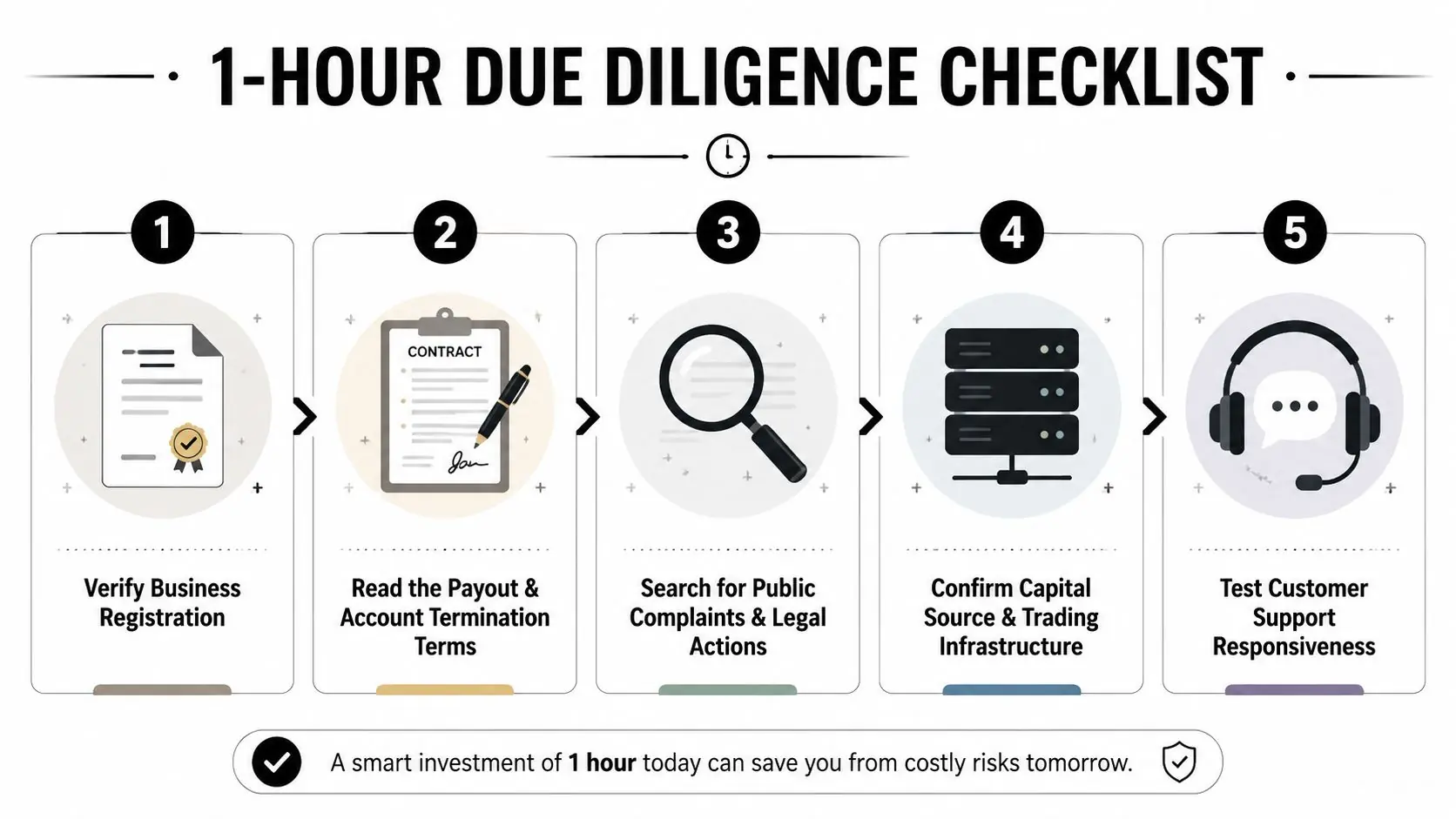
Your Due Diligence Checklist Before Paying Any Fee
Start with the boring stuff, because that's where bad firms slip. Verify the firm's business registration in an official registry, confirm the company name, status, and incorporation date, and for UK firms check Companies House. If the legal entity doesn't line up with the brand name on the homepage, pause immediately.
The one-hour workflow
First, read the written risk policy and make sure it names the actual limits in plain language. You want daily loss limits, position limits, overnight exposure rules, and halt rules written clearly, not wrapped in vague marketing phrases. If the firm can't explain what happens on a one-percent rule breach, it's not ready for your fee.
Second, verify payout mechanics before you pay anything. Check timelines, refund policy, and what happens if you request withdrawal after a rule change. Then test the contract against a bad day scenario, not a perfect one.
If the support team can't answer a payout question in writing, assume the payout process is less mature than the sales page suggests.
Third, check whether marketing, fee collection, and payout processing line up with local financial-promotion and AML/KYC rules. In the UK, financial promotions for services like this can trigger Section 21 FSMA issues if they're not issued or approved by an FCA-authorized firm. For a broader compliance reference on payment and identity controls, traders working in multi-jurisdiction setups can also review money laundering compliance in Dubai and compare that mindset with the firm's own onboarding process.
Screenshot checklist
- Confirm the legal entity Match the brand, registration, and domain owner where possible.
- Read the payout terms Look for payout dates, minimum thresholds, and denial clauses.
- Stress-test the rules Ask what happens after a small breach, not just a clean run.
- Check support speed Send one specific question and judge the answer quality.
- Save everything Screenshot rules, fees, and refund language before paying.
The firm's terms and conditions should be readable, internally consistent, and specific enough that you can spot a change later. If that document feels like a moving target, your risk just went up.
What Transparency Looks Like Without a Regulator
“Unregulated” doesn't automatically mean unsafe. It means you need visible operations, consistent rules, and enough documentation to judge whether the firm is a credible counterparty. The market has already shown how fragile this segment can be, with 80 to 100 firms shutting down in 2024 after the MetaQuotes crackdown and rising regulatory pressure, which the source estimates removed roughly 13 to 14% of global operators in a single year. That's not a normal brokerage dynamic. That's a business model under stress.

What good transparency actually looks like
The strongest firms publish clear rule sets, show how payouts work, disclose risk limits, and keep customer support reachable. They don't hide the mechanics behind vague language, and they don't change terms every time a challenge cohort gets too profitable. Public payout statistics help too, because they give traders something concrete to compare against the pitch.
A serious firm should also make its evaluation rules easy to find, easy to understand, and hard to reinterpret after the fact. If a rule set changes, the firm should document the change clearly. If support is fast but evasive, that's not transparency, that's choreography.
A useful contrast is MyFundedCapital's public setup, which is built around a 5 percent daily loss limit on its Challenges (3 percent on Instant Funding), up to 10 percent maximum drawdown, and payouts available every 7 or 14 days depending on the program, or on demand with the payout add-on, with average processing around 2 hours. That kind of visibility matters because it lets traders judge the rules before they pay, instead of learning them during a denial.
Good transparency is boring. It answers the same question the same way every time.
The point isn't that every unregulated firm is bad. The point is that the good ones leave a trail. If you can't verify the rules, the payout rhythm, and the support behavior, you're not evaluating a trading opportunity. You're paying for uncertainty.
FAQ on Prop Firms Regulation
Are prop firms legal? Yes, many are legal businesses, but legality and financial regulation are not the same thing. A firm can be incorporated and still operate outside broker-style supervision if it's built around evaluation fees and simulated or firm capital.
Can I recover money if a firm changes the rules or stops paying? Usually your recourse runs through the contract, consumer-protection channels, and general law, not a dedicated financial regulator. If the firm is offshore, recovery can get slow and expensive fast.
Do AML and KYC checks still apply? In practice, yes, many firms still use identity checks at onboarding or payout time even when they aren't regulated brokers. That doesn't turn them into brokers, it just means payment and fraud controls are still part of the process.
What should I do first if a payout is denied? Save every message, screenshot the relevant rules, compare the denial to the written contract, and escalate in writing. If the answer still doesn't make sense, move into consumer-law or payment-dispute channels rather than arguing in circles.
For a quick reference on common platform and account questions, the FAQ page is worth checking before you pay another evaluation fee.
If you want a prop firm that keeps its rules visible, its risk limits clear, and its payout structure easy to verify, visit MyFundedCapital and compare the funding paths before you spend a dollar on your next challenge. Trading involves risk of loss, and the smart move is to read the rules first, not after the payout gets delayed.