

 AR
AR
 NL
NL
 FR
FR
 DE
DE
 ES
ES
 PT
PT
 IT
IT
 PL
PL
 SV
SV

You're staring at a gap on the chart and trying not to guess. That's the right instinct, because gaps can be tradeable opportunities or fast ways to blow through a prop firm limit if you treat them like a sure thing. The edge comes from reading context, choosing the right setup, and controlling risk before you ever think about entry.
Gaps tempt traders because they look obvious. They're not, and how to trade gaps depends on whether the opening move is backed by structure, volume, and a plan that fits your drawdown rules.
Decoding Market Gaps Before You Trade
A gap is just the open showing up in a different place from the prior session close, but the trade decision starts with the story behind that move. Historical context matters more than the gap itself, because gaps usually react to overnight information, news, or a change in participation, not to the gap alone. Pepperstone's gap guidance makes that point directly, traders should review past price behavior, news catalysts, volume, and broader market conditions before acting on the open (Pepperstone on gapping).
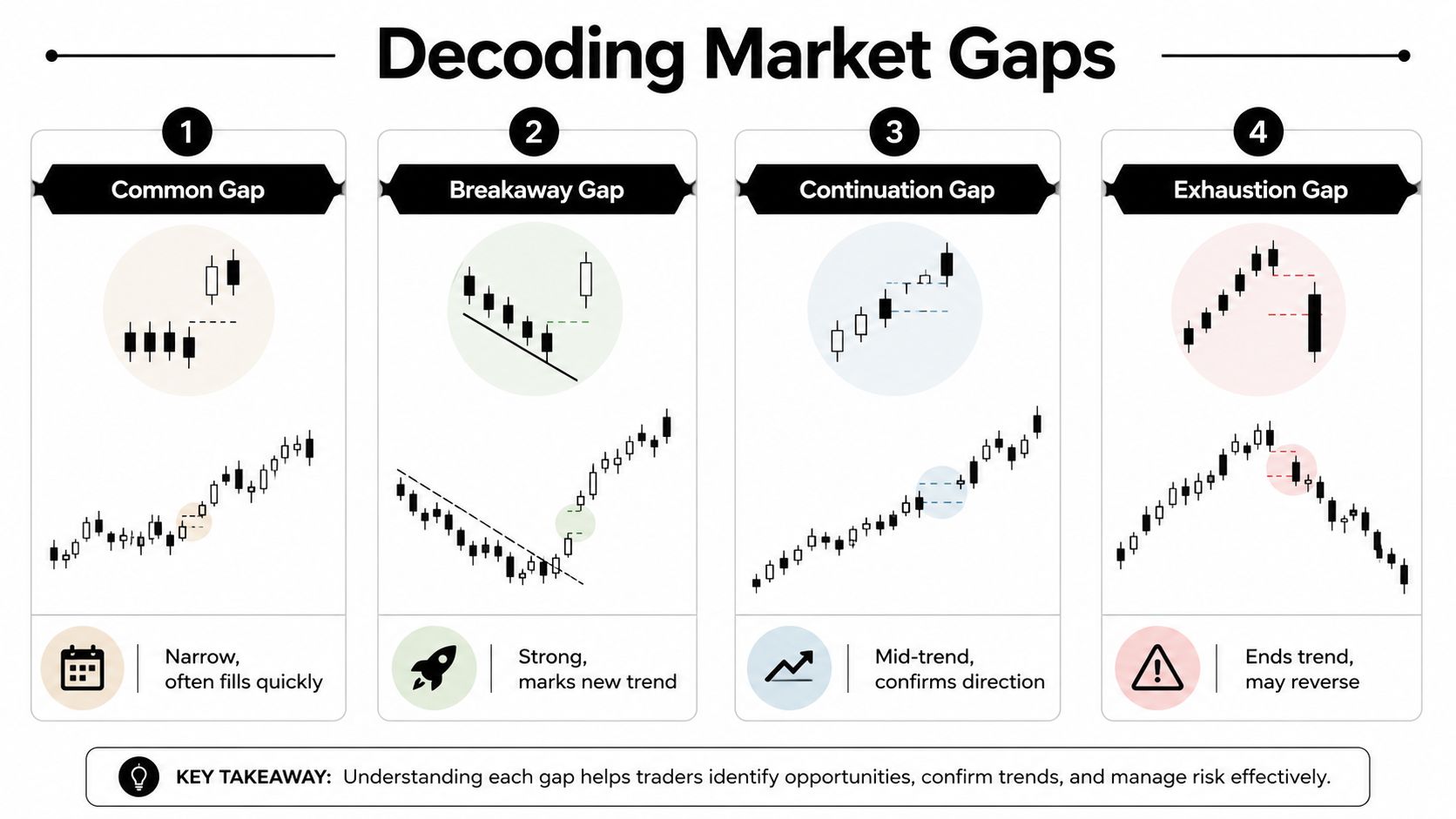
The four gap types and what they usually mean
A common gap is the small, routine one, similar to a car drifting a lane over. It often happens inside a range and can fill quickly, but that doesn't make it a free reversal trade.
A breakaway gap is the cleanest signal of a possible new trend. It appears when price jumps out of a consolidation or a trendline break, and the market is saying, “the old balance is gone.”
A continuation gap shows up mid-trend. It usually means the crowd is still committed, so the gap is less about a new idea and more about urgency inside an existing move.
An exhaustion gap tends to appear late in a move, near a peak or trough. That's the one that can trap late buyers or late sellers, which is why reversal traders watch it closely.
Practical rule: classify the gap first, then decide if you want momentum or mean reversion. If you skip that step, you're not trading a setup, you're just reacting to an open.
The visual cues matter. Breakaway gaps often leave obvious chart structure behind, like a trendline or range being left behind at the open. Exhaustion gaps often look stretched, with price already extended from recent value. Common gaps are the least dramatic, and continuation gaps usually sit in the middle of a move rather than at the start or end.
For FX traders who only think in terms of session opens, the weekend gap deserves special attention. MyFundedCapital has a useful primer on the timing of the forex week in when forex opens on Sunday, and that matters because the first print after the weekend can carry very different liquidity than a normal weekday open.
Your Pre-Trade Checklist for Every Gap Setup
A prop firm account punishes sloppy decisions faster than a retail account does, so the checklist has to come before the trade idea. If the setup fails the filter, you skip it. That's not being timid, that's preserving room to trade the next opportunity.
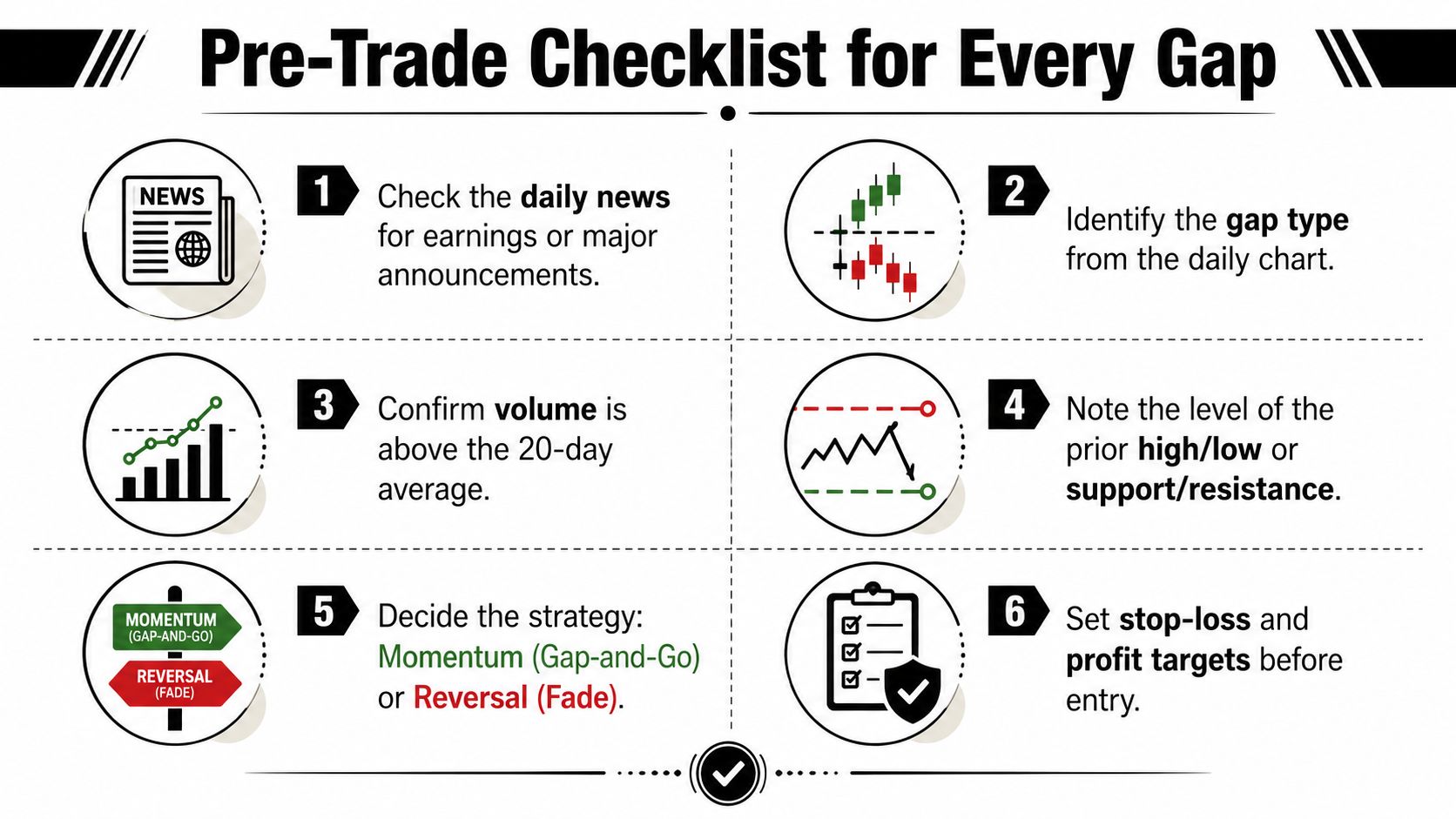
The pre-flight scan
Start with the catalyst. Earnings, a macro release, guidance, an index-level shock, or a weekend headline can all change the quality of the gap. If there's no clear reason for the open, that gap is often weaker than it looks.
Next, check the higher timeframe levels. Prior highs, prior lows, obvious support, and obvious resistance are where gap trades either stall or get accepted. Those levels matter because they create the battle zone where the first participants defend or reject price.
Then look at volume and liquidity. Gap-trading guidance notes that some setups are stronger when the opening move is supported by meaningful early activity, and a separate risk guide notes that first-hour ranges can expand materially on gap days, which is why you need room in both size and stop placement (gap risk and stops). That same source recommends overnight position size of 30–50% of normal, and budgets for a 2–3x normal gap scenario, with intraday ranges that can expand 3–4x on gap days (gap risk and stops).
If the stop has to sit where the trade idea breaks, the size has to shrink to fit the stop. If the size won't fit, the setup is too big for the account.
Use the first 5 to 15 minutes as a filter, not a trigger. Recent gap-and-go playbooks lean toward waiting for opening range confirmation and VWAP confirmation instead of hitting the open blindly (TradeZella gap-and-go guidance). That delay keeps you from paying the widest spread and the most emotional price of the session.
A simple checklist looks like this:
- Catalyst in place: know exactly why the market opened away from the prior close.
- Level mapped: mark the nearest support, resistance, or liquidity zone before the bell.
- Volume read: compare the opening activity with what the setup normally needs.
- Direction decided: choose momentum or fade before the candle forms.
- Risk fixed: set the stop, the size, and the invalidation point first.
- Prop rules checked: confirm the trade won't threaten daily loss or drawdown limits.
If you want a routine to compare against your own process, MyFundedCapital's daily trading checklist is a decent reference point for building that discipline into your day.
Strategy 1 The Gap-and-Go Momentum Play
Gap-and-go works when the open is not just a price jump, but a commitment. You want the market to show acceptance, not just enthusiasm. The setup is simple in theory, but it only works when you let the chart confirm the move instead of front-running it.

What qualifies a momentum gap
A useful trigger is waiting for price to break the opening range high on a gap-up, or the opening range low on a gap-down, with the stop just below or above that first range. One system guide specifies waiting for a 5-minute close above the first 30-minute high and volume at least 30% above average before taking the trade (Gap-and-go system guide).
That logic matters because the open is noisy. If price can't hold above the opening range, the gap may just be a liquidity event, not a trend day. If it does hold, the market is telling you buyers or sellers are still in control.
A practical rule set:
- Wait for the range: don't touch the opening print.
- Confirm the close: use a 5-minute candle or opening-range breakout, not a flicker.
- Check volume: weak participation often means weak follow-through.
- Place the stop: just beyond the opening range, where the idea is invalidated.
- Target the next major level: the next resistance on a gap-up, or the next support on a gap-down.
A trader looking at a US100 gap-up after a strong tech catalyst might mark the first 30-minute high, wait for a 5-minute close above it, then enter on the retest or breakout hold. If the opening range low breaks immediately after entry, the trade is wrong and the stop has to do its job. If price keeps accepting higher, you trail with structure rather than hoping.
What not to do
Do not buy the first green candle just because the pre-market looks strong. Do not widen the stop after entry because the move “should” work. And do not size the trade as if the open were a normal intraday entry, because the first hour can be violent and slippage can be brutal.
Gap-and-go is the more aggressive play, so it belongs in a small slice of your playbook. If the market gives you confirmation, you can press. If it doesn't, you leave it alone.
Strategy 2 Fading the Gap for Reversals
Fade trades are the other side of the gap coin. You're not betting against every opening move, you're betting that the market has overextended into an area where traders will take the other side. That's why gap fades work best when the open runs straight into a known liquidity zone, a prior swing, or a level where bigger players are likely to defend.

How to structure a fade
The clean workflow is to let the gap open, map the nearest higher-timeframe liquidity zone, and wait for price to test that zone. Only after that test do you look for a clear reversal candle, such as a bearish engulfing pattern at resistance or a bullish reversal pattern at support. The gap opening level then becomes the profit target, and the stop goes above the high of the confirmation candle (gap fade workflow).
That sequence protects you from guessing the top or bottom. You're not fading because the gap looks “too big.” You're fading because the market hit a zone where acceptance failed.
For a currency example, a weekend gap on a major FX pair can be tradable if it opens directly into a prior weekly level and then rejects that area on the first retest. The entry comes after the reversal candle confirms the rejection, not during the initial spike. If price reclaims the level and holds, the fade idea is over.
A short decision tree helps:
- Price opens into a known zone.
- The first retest fails.
- A reversal candle prints.
- The stop sits above the reversal candle's high.
- The target is the gap fill or the opening level.
Practical rule: never fade a gap just because it exists. Fade the location, the rejection, and the confirmation.
This style is usually more patient than momentum trading, but it can be cleaner on risk. The stop is often tighter, the thesis is more defined, and the target is easy to identify. The downside is that fades fail hard when the open is a breakaway gap, so the location has to be real, not imagined.
Execution and Prop Firm Considerations
Execution is where most gap traders lose money they didn't need to lose. The strategy can be fine, but if you chase the open, accept bad fills, or ignore prop rules, the account gets hit before the setup has time to work.
The current opening playbook is more selective than the old “buy every gap” style. Recent gap-trading guidance suggests waiting 5 to 15 minutes after the open and using VWAP or opening-range confirmation rather than chasing the opening print (TradeZella gap-and-go guidance). That shift makes sense in faster, more algorithmic opens, because the best trades are often the ones that survive the first wave of noise.
Market orders and limit orders each have a place. Market orders get you in fast, but they can be ugly on volatile opens. Limit orders reduce slippage, but they can leave you behind if the move rips without you. In prop firm trading, that trade-off matters because bad execution eats into your allowed loss just as fast as a bad thesis does.
For account protection, treat the prop rules like a hard constraint, not a suggestion. MyFundedCapital's challenge structure is built around defined risk limits, so if a gap trade requires oversized exposure to make sense, the trade probably doesn't fit the account. The firm's challenge model is useful to review before you test gap setups with live risk.
A few practical safeguards help:
- Reduce size at the open: use smaller size than your normal intraday trade.
- Avoid news you can't model: if the event is unstable, skip it unless your account and rules allow it.
- Set the invalidation level first: if you don't know where you're wrong, you're not ready.
- Journal the fill quality: slippage and spread are part of the edge calculation.
For traders who like to compare setups across markets, NomadCards futures setups is a useful external resource because it organizes futures trade ideas in a way that makes execution, not just direction, easier to review.
Gap trading also needs a backtesting mindset. Test opening range breakouts, gap fades, and catalyst-backed gaps separately. Keep the sample clean. If the rule set only works when you cherry-pick hindsight charts, it's not a setup, it's a story.
Frequently Asked Questions About Trading Gaps
Which markets are best for gap trading
Equities, indices, futures, and some FX weekend opens all gap, but the best market is the one with enough liquidity to give you clean execution and enough volatility to create a real move. If the product is thin, the spread and slippage can destroy the setup before it starts.
How do I find gaps before the open
Use pre-market scanners, watch the news flow, and mark the names or contracts that already have a clear catalyst. Focus on the move into the open, not just the size of the gap, because the reaction matters more than the number on the screen.
When should I fade a gap instead of trading momentum
Fade when the gap opens into a major level, stalls on the retest, and prints a reversal candle. Trade momentum when the market holds the opening range, volume confirms, and price accepts above or below the first structure.
Do all gaps fill
No. That's the mistake that gets traders in trouble. Some gaps fill quickly, some never fill, and some continue in the direction of the open once the market confirms the move.
MyFundedCapital gives traders a structured way to apply gap strategies under clear risk limits, with account types, challenge paths, and defined drawdown controls that suit this style of trading. If you want to trade gaps with tighter discipline and a prop firm framework that respects risk, visit MyFundedCapital and review the funding options before you take your next open.
