Trying to pinpoint when the forex market opens for the week can be confusing. You need to know exactly when trading starts to plan your strategy and manage risk. This guide provides a direct answer and explains the practical steps you can take to trade the Sunday open safely.
The short answer is the forex market opens at 5:00 PM Eastern Standard Time (EST) on Sunday. This is the official kickoff for the trading week, driven by the start of the business day in the Asia-Pacific region.
The Official Forex Market Sunday Opening Time
Think of the forex market as a global relay race. When the clock strikes 5:00 PM EST on Sunday, the Sydney and Wellington financial centers begin their Monday morning, and the first trades of the week are executed.
For traders, this is the earliest opportunity to react to weekend news. However, it's important to be aware of a few practical details:
- Interbank vs. Retail The official 5:00 PM EST opening is for the interbank market (where large banks trade).
- Broker Times Most retail brokers, like OANDA, may start their price feeds a few minutes after the official open, often around 5:05 PM EST. This slight delay allows them to ensure stable pricing and sufficient liquidity before opening trading to clients.
Knowing the exact opening time in your local time zone is crucial for weekly preparation.
Forex Market Sunday Opening Times (Standard Time)
This table shows the standard opening time for the forex market across key global time zones. Remember, these times do not account for Daylight Saving Time (DST), which can alter your local opening time.
| Time Zone | Abbreviation | Opening Time |
|---|---|---|
| Eastern Standard Time | EST | 5:00 PM Sunday |
| Coordinated Universal Time | UTC | 10:00 PM Sunday |
| British Summer Time | BST | 10:00 PM Sunday |
| Central European Summer Time | CEST | 11:00 PM Sunday |
| Australian Eastern Standard Time | AEST | 7:00 AM Monday |
| Japan Standard Time | JST | 6:00 AM Monday |
Being aware of your local equivalent to 5:00 PM EST ensures you are ready to analyze the market's opening sentiment from the very start.
Free resources: Forex Trading Cheat Sheet (major pairs, sessions and order types on one page).
Understanding Why the Market Follows the Sun
The forex market isn't tied to a single physical location like the New York Stock Exchange. It's a decentralized network of global banks and financial institutions, which is why we say it "follows the sun."
The trading week begins as Monday morning arrives in the Asia-Pacific region. Financial hubs like Wellington, New Zealand, and Sydney, Australia, are the first to start their business day, initiating the first currency trades of the week.
This creates a continuous, 24-hour trading cycle that runs from Sunday evening through Friday afternoon. As the day ends in one major financial center, another is just beginning, creating a seamless hand-off. Sydney passes the baton to Tokyo, which then hands off to London, and finally to New York.
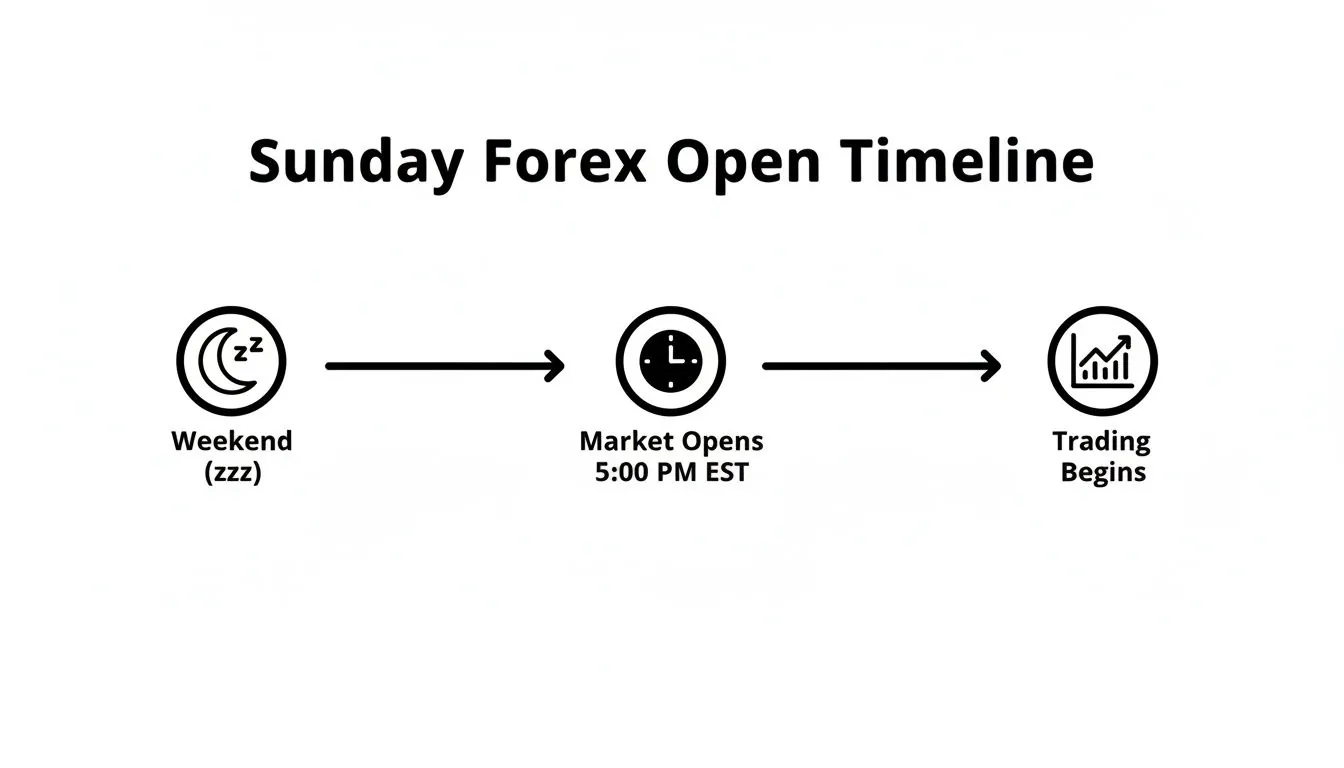
So, the official start at 5:00 PM EST on Sunday is simply the moment the first major financial hub (Sydney) comes online, kicking off this non-stop global cycle.
The Hand-Off Effect in Action
While the Sunday open is driven by the Sydney session, it sets the stage for the higher-volume sessions to follow.
The quiet Sunday open at 5:00 PM EST begins a chain reaction. The Sydney session itself has relatively low volume, but it builds the initial momentum that feeds into the week's most active periods, especially the London-New York overlap. During this overlap, 50-60% of all daily forex volume can be traded.
The New York session alone accounts for 17% of the $7.5 trillion traded daily. This massive volume originates from the quiet opening hours on Sunday evening, demonstrating how interconnected the global sessions are. You can learn more with these New York session insights on MarketMates.com.
Why Your Broker's Opening Time Might Differ
Have you ever logged in at 5:00 PM EST on Sunday, ready to trade, only to find your platform isn't active yet? This is a common experience for many traders.
While the official interbank market opens at 5:00 PM EST, your broker or prop firm might delay access until 5:05 PM EST or slightly later. This isn't a glitch; it's a protective measure. In the first few minutes of trading, liquidity is thin and price feeds can be erratic. Your broker waits for conditions to stabilize to protect you from extreme spreads and poor trade execution.
This is similar to a restaurant's soft opening—the kitchen needs time to warm up before the main rush. Brokers do the same, waiting for the interbank market to find its rhythm before allowing retail traders to enter.
Confirming Your Platform's Server Time
You must confirm your platform's specific server time rather than guessing. Every platform, whether it's DXtrade, cTrader, or Match-Trader, has its own server time. Here’s a quick checklist to find it:
- Check the Market Watch Most platforms display the current server time in the "Market Watch" or "Symbol" list.
- Look at Your Charts The timestamp at the bottom of your charts reflects the platform's server time, not your local time.
- Consult the Broker's Website Reputable firms list their trading hours and server time in an FAQ or trading conditions page.
Knowing your platform's precise opening time is a fundamental habit that helps prevent missed entries and costly errors. For details on our platform rules and timings, please review our live accounts and trading conditions.
The Impact of Daylight Saving Time
Daylight Saving Time (DST) adds another layer of complexity. Twice a year, many countries adjust their clocks, which directly impacts the forex market's opening time for you locally.
The main issue is that different regions change clocks on different dates. For a few weeks each spring and fall, the time difference between major financial centers like New York and London may be unusual. Always use a market clock tool that automatically adjusts for DST changes to be certain.
How to Trade the Sunday Open Without Getting Burned

Trading at the Sunday open can be risky due to low liquidity and the market's reaction to weekend news. Understanding these risks is the first step to protecting your account.
The most significant risk is the Sunday gap. This occurs when major news (e.g., election results, central bank announcements, geopolitical events) breaks while markets are closed. When trading resumes, the opening price can be significantly different from Friday's closing price, creating a literal "gap" on the chart that can lead to immediate and substantial losses.
Your Pre-Flight Checklist for the Sunday Open
The Sunday open requires a cautious and disciplined approach. Before placing a trade, run through this checklist to prepare for thin liquidity and potential price gaps.
- Scan the Weekend News Review major financial news sites for any headlines that could impact your currency pairs. Geopolitical tensions, for example, often increase demand for safe-haven currencies like the JPY, CHF, and USD.
- Know Your Gap-Prone Pairs Cross pairs and exotics are more likely to gap than major pairs due to lower trading volume. A volatile pair like GBP/JPY is known for significant weekend gaps.
- Give Your Stop Loss Room Spreads are always wider at the open. A tight stop loss can be easily triggered by a minor price flick. Widen your stop to give your trade more breathing room.
- Cut Your Position Size This is a non-negotiable rule. Using a smaller position size is your best defense against a surprise gap. If the market moves violently against you, the financial damage will be more manageable.
Using your standard weekday strategy on a Sunday night is a common mistake. The market conditions are completely different, and your normal tactics may not be effective.
Gaps That Fill vs. Gaps That Run
Not all gaps are created equal. Some are temporary imbalances caused by low liquidity, and the market often retraces to "fill" the gap by returning to Friday's closing price. Others, known as breakaway gaps, signal the start of a new, powerful trend.
The key is to understand the reason for the gap.
If there is a strong fundamental driver, like an unexpected interest rate decision, it is likely a breakaway gap. Trading against the gap's direction (fading) is extremely risky. However, if a gap occurs without any major news, it might be a liquidity vacuum, creating a potential opportunity to trade the "fill."
Trading these conditions requires experience and strict risk control. For more on this topic, review our guide on forex risk management strategies. Always remember that trading involves substantial risk of loss and is not suitable for every investor. This content is for educational purposes only and is not financial advice.
A Funded Trader's Playbook for the Sunday Open

For a funded trader, knowing what time forex opens on Sunday is a tactical advantage. We want our traders to use every edge possible.
Many prop firms require closing all positions by Friday afternoon. At MyFundedCapital, our optional Weekend Holding add-on allows traders in both our challenge and instant funding programs to keep trades open over the weekend. This feature creates an opportunity to potentially profit from market gaps on the Sunday open.
A well-researched trade that catches a Sunday gap can provide a significant head start on your weekly profit target. This is a valuable opportunity for traders who have analyzed weekend news and have a solid plan for the market open.
Trading Platforms and Risk Rules
When the market opens, our trading platforms—DXtrade, cTrader, and Match-Trader—are online and ready. You can begin analyzing price action and executing trades as liquidity returns. The 5:00 PM EST Sunday open is a key moment. Since 2001, average daily forex volume has grown from $1.2 trillion to $7.5 trillion in 2023, with Sunday evenings capturing an initial 8% of that daily activity. You can explore historical data on market hours at DailyPriceAction.com.
While we provide the freedom to trade these early hours, a disciplined approach is essential. All trades are subject to our clear risk parameters:
- 5% Daily Drawdown This rule protects your account from a single day of significant losses.
- 10% Maximum Drawdown This is a hard limit on your account to preserve capital over the long term.
These rules are not meant to restrict you; they are designed to reinforce the sound risk management habits that successful traders use. Combining the opportunity of the Sunday open with these core rules is key to long-term success with our funded forex trading accounts.
Frequently Asked Questions (FAQ)
1. What time does the forex market open on Sunday?
The forex market officially opens on Sunday at 5:00 PM Eastern Standard Time (EST). This corresponds with the beginning of the business day on Monday morning in Sydney, Australia. However, your specific broker may enable trading a few minutes after this time.
2. Is it a good idea to trade right at the forex open on Sunday?
Trading at the Sunday open is risky and not recommended for beginners. The market experiences low liquidity and wide spreads, which can lead to price gaps and unpredictable movements. Experienced traders who trade this session use smaller position sizes and wider stop losses to manage the increased risk.
3. How does Daylight Saving Time affect the forex market opening time?
Daylight Saving Time (DST) can change the market opening time in your local time zone. The forex market open is anchored to 5:00 PM New York time. When the US or your country adjusts its clocks for DST, the opening time for you will shift by one hour. It's best to use a forex market clock to track the precise opening time.
4. Which currency pairs are best to watch at the Sunday open?
If you decide to trade the Sunday open, it's safer to stick to major currency pairs like EUR/USD, USD/JPY, and GBP/USD. These pairs have higher liquidity compared to minor or exotic pairs, which may have extremely wide spreads or be unavailable to trade until later in the session.
Ready to apply your knowledge of market timing with a funded account? MyFundedCapital provides the capital and tools for skilled traders to succeed.
Explore our funding programs and compare our Instant Funding and Challenge accounts to find the right fit for your strategy.