

 AR
AR
 NL
NL
 FR
FR
 DE
DE
 ES
ES
 PT
PT
 IT
IT
 PL
PL
 SV
SV

Index trading is a way to trade the performance of an entire stock market basket, such as the S&P 500, instead of betting on one company. Traders usually do this through products linked to the index, not by buying the index itself, and that distinction matters for the financial exposure possible, costs, and risk.
If you've ever stared at a chart and wondered why the move feels broader than one stock, index trading is probably what you were looking at. The idea is simple, but the mechanics trip up a lot of new traders, especially when they're trying to apply the same habits they use on single stocks inside a prop firm environment.
What Are Stock Market Indices
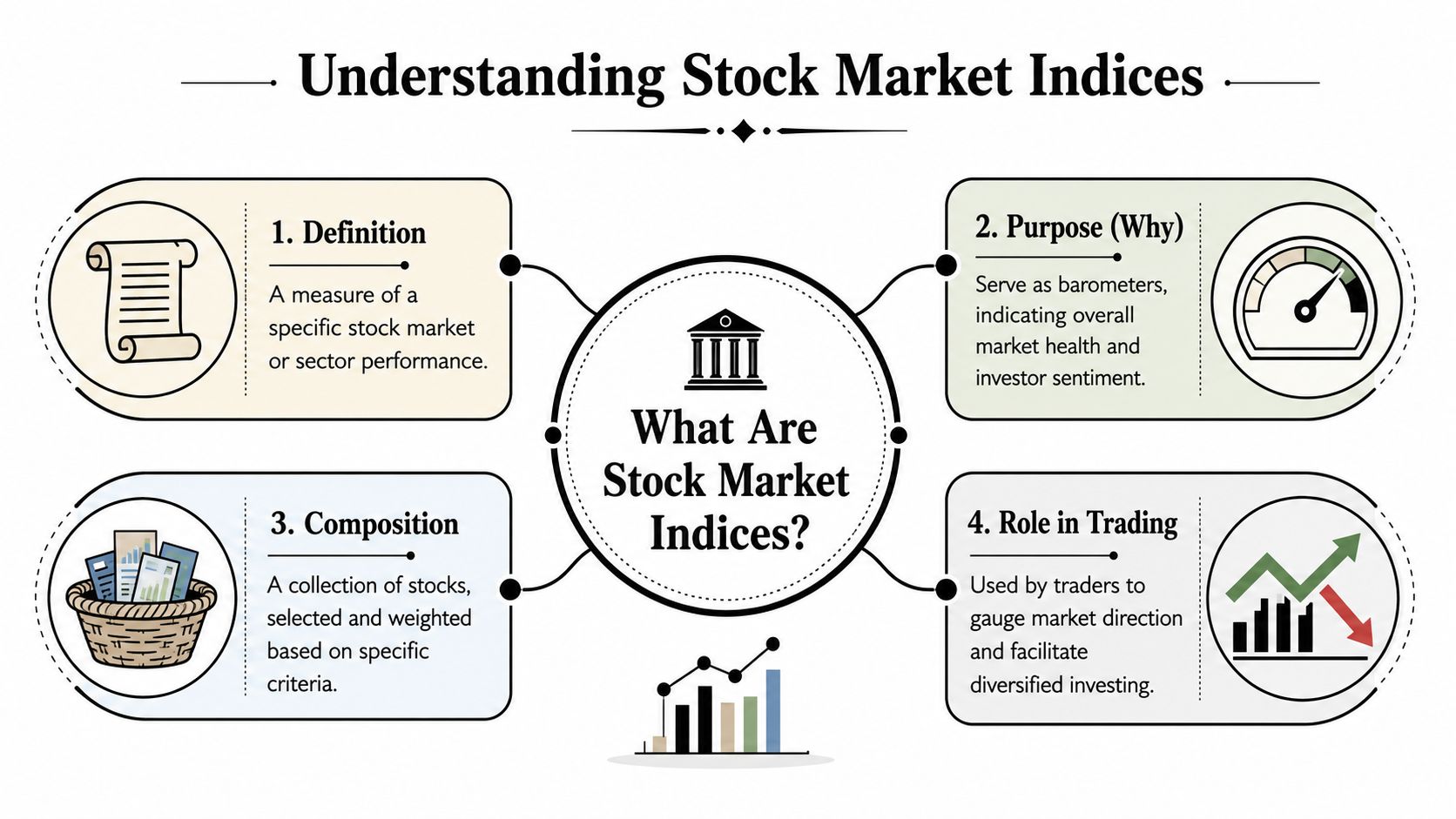
A stock market index is a benchmark basket of stocks. It bundles a group of companies into one number so you can track how that group is doing as a whole, rather than tracking every stock one by one. Major examples include the S&P 500, Nasdaq 100, Dow Jones Industrial Average, FTSE 100, DAX, and Nikkei 225 (iShares on what an index is).
The easiest way to think about it
An index functions as a market snapshot. It gives you a single price that reflects how a selected group of stocks is moving, which is easier to read than checking every company on the list one by one.
That is why traders use indices as barometers. A rising index usually means the broader group is attracting buyers. A falling index shows weakness spreading across the basket, even if a few individual stocks still look fine.
Practical rule: a trader on an index is usually expressing a view on the broader market or a sector, not on one company's balance sheet.
For prop traders, that distinction matters. A funded account challenge often rewards controlled risk and disciplined trade selection, so index trading can help you focus on one market driver instead of taking several separate stock positions. If you want to compare how index products differ in practice, this guide on crypto ETF market efficiency offers a useful framework for understanding how basket-based products stay tied to what they track.
Why traders care about the index itself
The point is not just convenience. A single index price condenses information from hundreds of stocks into one tradable series, which makes it easier to read the market's tone. The Dow Jones Industrial Average, created in 1896, is one of the oldest major stock indices and still serves as a global reference point for U.S. market direction (iShares).
Indices are also weighted, which means some names matter more than others. A large component can move the index even if many smaller members are flat or weak, so the headline number does not always reflect every stock equally. For a trader, the takeaway is simple, do not assume “the market” means every stock is moving in the same direction.
How You Can Actually Trade an Index
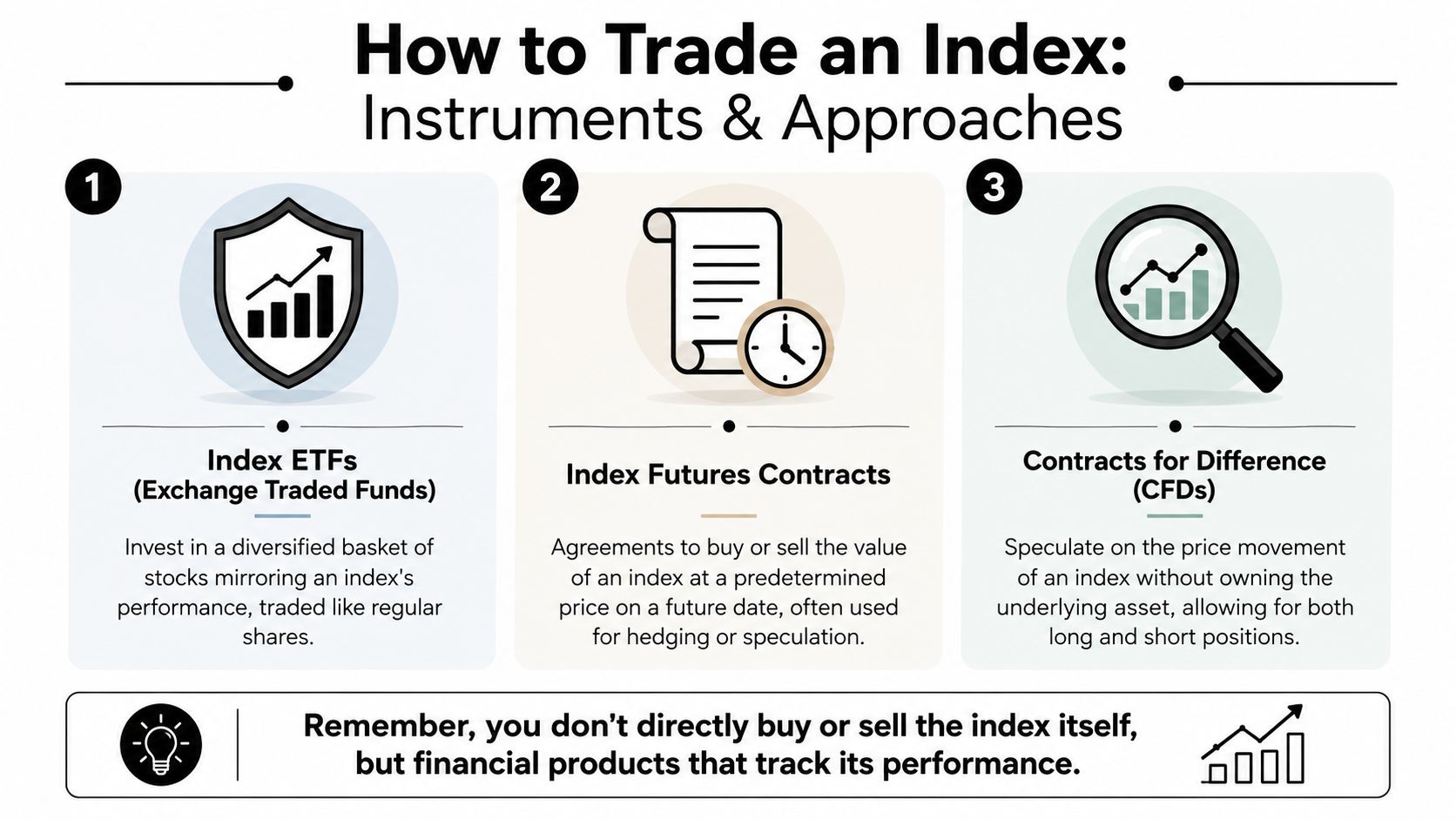
You can't usually buy an index directly. You trade products that track it, and the wrapper you choose changes everything, from ownership to the potential for amplified market impact to tax treatment. Educational sources point out that indices are accessed through derivatives or funds, while direct indexing is a separate approach that buys the underlying stocks (IG on how indices are traded).
The three common pathways
Index ETFs are the most familiar route for longer-term exposure. They track a basket of stocks that mirrors the index, and they trade like ordinary shares. That makes them useful for investors who want passive exposure rather than active speculation.
Index futures are contracts to buy or sell the index value at a later date. They're used for speculation and hedging, and they tend to matter more to active traders who want a more direct market view.
CFDs let you speculate on index movement without owning the underlying asset. Traders can go long if they expect the index to rise or short if they expect it to fall, with position sizing and amplified exposure capabilities handled on the platform (Capital.com on indices trading).
Why active traders usually care most about CFDs
For a day trader, the main draw is flexibility. CFDs let you act on short-term movement without taking delivery of the underlying basket, which is why they're common in prop trading setups. If you want a side-by-side comparison of futures and CFDs in a trading context, this CFD versus futures guide is a useful reference point.
If you want a deeper look at how fund wrappers and creation mechanics affect market efficiency, the crypto ETF creation and redemption process is a helpful companion read.
The decision is not “Which product is the most exciting?” It's “Which wrapper fits my goal?” A long-term allocator, a hedger, and a prop trader are usually looking for very different things.
Popular Strategies for Trading Indices
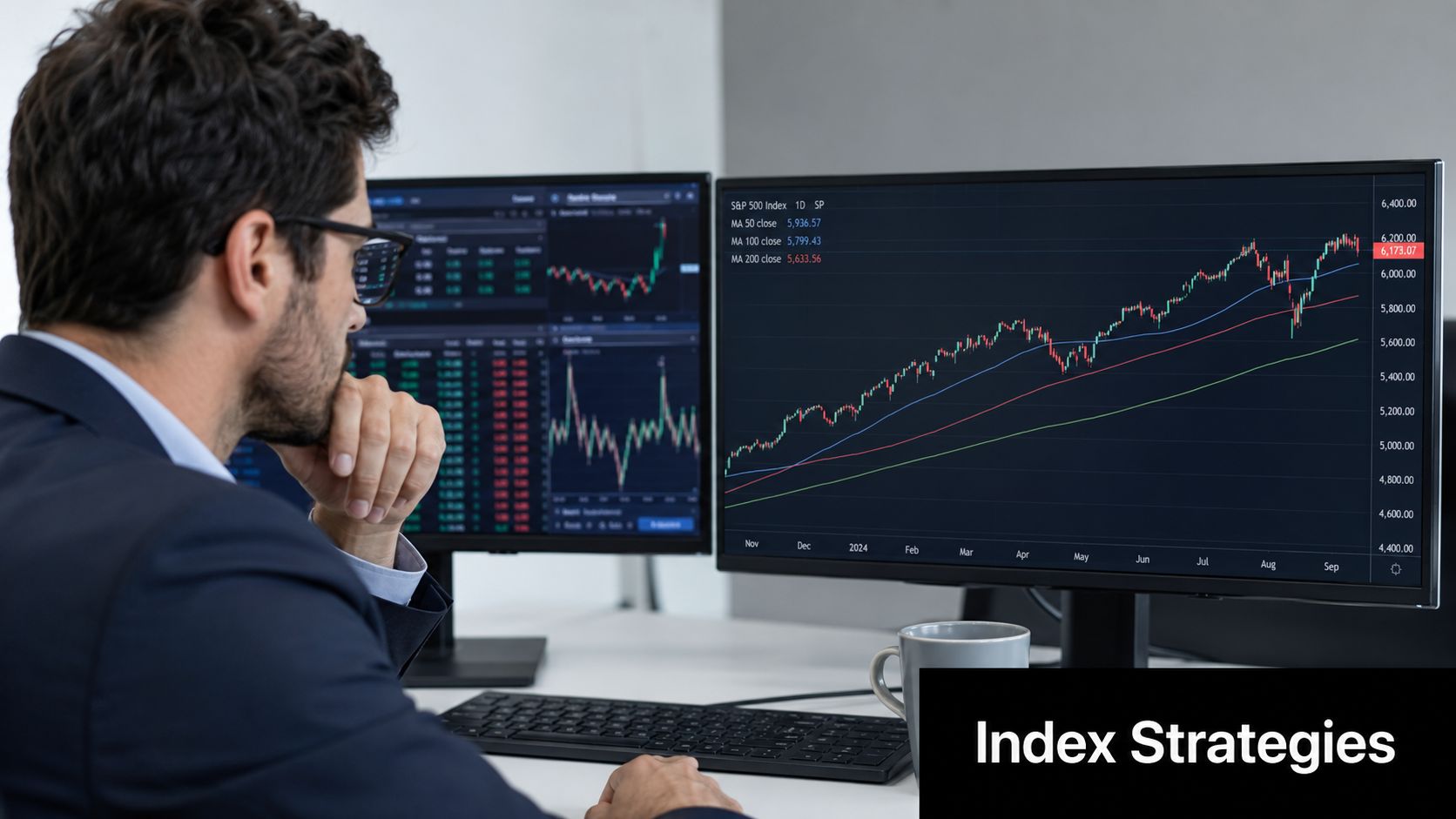
A trader staring at an index chart can see a clean trend, then lose the trade because the session was wrong. Index trading works better when you read the market's wider context first. Indices often react to macro events, not just company headlines, and traders use tools like moving averages, ATR, and support and resistance to tell trend conditions from range conditions. That matters because a setup that works on the Nasdaq 100 can fail in the DAX if the session tone is different. (IG)
Trend following
Trend following tries to capture directional movement that keeps going long enough to matter. Traders usually check whether price holds above or below a moving average, then look for pullbacks that stay controlled instead of turning into full reversals.
What to look for:
- Direction first. Check whether the index is making higher highs and higher lows, or the opposite.
- Trend filter. Use a moving average to see whether price is staying on one side of it.
- Entry on pullback. Wait for a retracement that respects the trend instead of chasing the first candle.
This approach often fits indices that trend cleanly during strong market sessions, especially when macro sentiment points the same way. For a prop trader, the appeal is simple. A clear trend can give defined entries and cleaner risk control, which helps when a funded account has strict drawdown rules. If you trade in that environment, a framework like the MyFundedCapital funded trader markets page can help you understand which instruments are available inside a prop setup.
Breakout trading
Breakout trading waits for price to move beyond a level the market has already respected. The main issue is confirmation. A brief spike is not the same thing as a real break. Independent guidance notes that breakout systems often work better when a candle closes beyond support or resistance and risk is defined with stops and ATR-based targets (AvaTrade).
What to look for:
- A visible level. Mark support or resistance that the market has respected more than once.
- A confirmed close. Don't act on a brief spike through the level.
- Controlled risk. Place the stop where the setup is invalidated, not where you hope it comes back.
This style is common on the US30 and NAS100 when volatility expands after consolidation. It also fits prop trading well because the invalidation point is usually clear, which makes position sizing easier to plan before you enter.
News-driven trading
Indices can move hardest around scheduled macro releases. That happens because the index is a basket, so traders react to events that affect the whole market, such as central-bank rate decisions, GDP, inflation, and employment data (IG). The reaction can be fast, messy, and unforgiving.
What to look for:
- The calendar. Know when the release hits, especially for the U.S. session.
- The first reaction. Let the initial spike or drop print before deciding anything.
- The follow-through. Trade only if price keeps direction after the first burst of volatility.
This approach is often watched in US30 and NAS100, because those indices are sensitive to U.S. macro data and large constituent moves. It also tests discipline in a prop trading account, since news swings can blow through careless stops if position size is too large.
Index Trading Compared to Single Stock Trading
Trading an index and trading a single stock are different decisions, even if the chart patterns look similar. An index expresses a view on a broader market or sector. A stock expresses a view on one company's earnings, management, and business execution.
Diversification versus concentration
An index gives you built-in diversification because it is made up of a basket of companies. That does not remove risk, but it spreads that risk across more than one business. A single stock can gap sharply after one earnings report, one lawsuit, or one management surprise, while an index usually reflects a wider mix of forces.
Macro drivers versus company drivers
Indices often move on macro events and on the biggest constituents, not on one quarterly report from a smaller company. Single stocks can react much more directly to company-specific headlines, guidance changes, and earnings misses. Your trade thesis has to match the instrument, or you may be reading the wrong signal.
An index is the better instrument for an economy view, a rates view, or a sector rotation view. A single stock is the better instrument for a company-specific view, such as expectations about execution or earnings quality.
Ownership, leverage, and structure
A point that gets missed often is that the instrument determines ownership, magnified exposure, and tax treatment. Indices themselves cannot be bought directly, and direct indexing is a separate structure that buys the underlying stocks and can support tax-loss harvesting (IG). That is different from CFD trading, where the trader is speculating on price movement rather than owning the basket.
If you are comparing markets while building a prop trading plan, it helps to see where index exposure fits inside a broader skill set. This funded trader markets overview shows how indices sit alongside other instruments traders commonly use. For traders who are trying to qualify for funding, that context matters because prop firms often evaluate whether you can choose the right market for the idea, size the trade correctly, and keep risk aligned with the account rules.
That is why index trading is such a useful core skill in a funded account path. It trains you to separate broad market moves from company-specific noise, and that discipline carries over to other instruments when you trade them later.
The same need for restraint shows up in other products built for amplified exposure, and Kons Law for leveraged ETF losses is a useful reminder that exposure cuts both ways.
Managing Risks and Costs in Index Trading
Index trading can look smoother than single-stock trading, but the ability to control a larger position makes it dangerous if you size carelessly. The same feature that lets you control a larger position also makes losses move faster than many beginners expect. That's why prop traders who ignore risk rules usually don't last long.
The costs that matter
For CFD traders, the obvious costs are spreads, commissions, and overnight swap fees. Those costs don't always look large on a chart, but they matter once you start trading frequently or holding positions beyond the session. A small edge can disappear if the cost structure doesn't fit your style.
Risk rules are guardrails, not obstacles
Prop firm rules like daily loss limits and maximum drawdown aren't there to frustrate you. They force the same habits professional desks care about, position sizing, capital preservation, and consistency. If your index strategy can't survive those guardrails, it's too fragile for funded trading.
For a cautionary perspective on products designed for amplified exposure, the Kons Law overview of leveraged ETF losses is a useful reminder that amplified exposure cuts both ways.
Practical rule: if you don't know where your stop belongs before entry, the trade isn't ready.
If you're trying to build a funded account path, this is where the work gets real. Re-read your risk management checklist before increasing size, because surviving the challenge matters more than being right on one trade.
FAQ and Your Next Steps
Which index is best for beginners?
Start with the one whose session pattern and news flow you can follow. Many traders begin with the S&P 500, Nasdaq 100, or Dow Jones Industrial Average because they are widely watched, heavily discussed, and easier to study when you are still learning how index prices react to market headlines. As Charles Schwab explains, broad, liquid indices are often the simplest place to build that first layer of understanding.
Can I hold an index trade overnight?
Yes, but only if your product, margin, and swap costs fit that plan. Holding overnight changes the risk profile because you are exposed to what happens while your screen is off, so check the instrument terms before you size the trade or leave it open.
Do I need to trade every market move?
No. Good index traders wait for a session setup, a macro catalyst, or a clean technical level. A quiet day with no valid setup is often better than forcing a trade, especially in a prop account where every mistake is measured against a rule set.
If you want to turn index trading into a funded skill, use a prop environment that makes risk visible and rules explicit. Test your execution, track your discipline, and compare challenge paths before you increase size. The goal is not to prove you can press buttons on every move, it is to show that you can repeat a process, protect capital, and trade within the limits a prop firm expects.
