The popular advice is simple: add contracts after a winning streak and let the position grow. That approach confuses recent performance with capacity. Scale trading commodities works only when liquidity, contract value, margin stress, event risk, and account drawdown limits are treated as one risk problem. This guide shows how to build exposure gradually without turning a controlled trade into an oversized directional bet.
Redefining What It Means to Scale Commodity Positions
Scale trading commodities means building exposure through planned entries rather than placing the full intended position at once. The difficult part is deciding whether the market can absorb that exposure and whether the account can withstand the path against it. A winning streak provides little evidence of capacity. The next position still has to survive a gap, wider spread, margin increase, or abrupt loss of liquidity.
The practical question is how much adverse movement the account can absorb before the trade, session, or strategy becomes invalid. That standard applies to futures, CFDs, and simulated funded accounts. Borrowed capital measures exposure relative to posted capital. It does not measure safe trading capacity.
The CFTC's market data describes scale trading as a position-management method that distributes exposure across multiple entries. The framework also requires a predefined maximum position, loss limit, and exit rule. Those limits keep additional entries tied to a plan instead of allowing each new fill to increase the size of the original opinion. For a fuller treatment of commodity-specific constraints, see the commodities trading guide.
Capacity is more than account size
A trader's usable capacity is limited by several factors:
- Liquidity Thin markets and volatile sessions can make planned entries and exits more expensive.
- Margin stress Brokers and exchanges may demand more collateral when conditions deteriorate.
- Slippage A stop price is an objective, not a guarantee, especially around inventory releases and geopolitical headlines.
- Correlation Related commodities can lose together even when each position appears reasonable by itself.
- Drawdown rules A prop account may terminate the strategy before price reaches its technical stop.
Available margin can accommodate a position that still carries excessive risk. A trade that looks small alone can become large after correlated contracts are added or a scheduled event is held through.
Practical rule: Set the maximum loss before setting the maximum position.
Scaling into a losing position deserves particular scrutiny. If the original thesis is failing, adding contracts reduces the average entry price while increasing the amount exposed. That structure can suit a range-bound market, but it remains an active risk decision. A persistent trend can turn several modest entries into one substantial loss, while tighter liquidity makes the final exits more difficult.
Written answers to four questions separate a scale plan from improvisation:
- What market condition justifies each additional entry?
- What is the maximum aggregate position?
- At what price or event is the thesis invalid?
- What account-level loss forces an immediate reduction?
Those answers should exist before the first order. Without them, adding contracts is improvising with leverage.
Navigating Contract Specifications and Margin Mechanics
A winning streak does not tell you how many contracts the market can absorb. Before adding a tranche, verify the contract unit, price multiplier, tick value, expiration, rollover treatment, and current margin requirement. Two instruments can show the same percentage move while producing very different account results because their contract quantities differ.
WTI crude oil makes the point clearly. CME lists the standard futures contract at 1,000 barrels, with an estimated notional value of roughly $90,100 in the cited product snapshot. The same specifications list smaller contracts representing 100 barrels and 500 barrels, with estimated margins of approximately $907, $4,536, and $9,052 for the 100-barrel, 500-barrel, and 1,000-barrel contracts. These figures come from CME's WTI crude oil futures specifications, and current requirements can change.
Posted margin is only the collateral requirement. The underlying price exposure determines how quickly a position can damage the account. A one-dollar-per-barrel move affects all 1,000 barrels in a standard WTI contract. Moving from one contract to two doubles that price exposure and usually increases the margin tied to the trade. Smaller contracts allow finer entry increments, which can help manage capacity, but they do not make a bad exit affordable.
Margin is collateral, not a stop-loss
Margin is cash held to support a position, not a ceiling on the loss. The National Futures Association's investor guidance notes that futures losses can exceed the initial deposit, leaving traders responsible for margin calls and account deficiencies.
Test every scale-in plan against the account's weakest operating conditions:
- An adverse move before the planned stop executes
- A wider spread during a fast market
- Higher maintenance margin
- Overnight or weekend price gaps
- Several correlated positions moving against you
If equity falls below the applicable minimum margin requirement, positions may be liquidated at a loss. The NFA notes that a trader can remain liable for a deficit, and liquidation may occur without prior notice under the broker's procedures. NFA Rule 9 highlights how temporary volatility can become a forced exit when unused account capacity is thin.
Record the contract size, value per price unit, stop distance, planned slippage allowance, commissions, initial margin, maintenance margin, and remaining cash capacity before placing the order. If any input is unknown, the position is not ready to scale. A prop firm adds another constraint: broker capacity may permit the trade while the firm's drawdown limit cannot absorb its normal price swings.
Building a Risk-First Position Sizing Framework
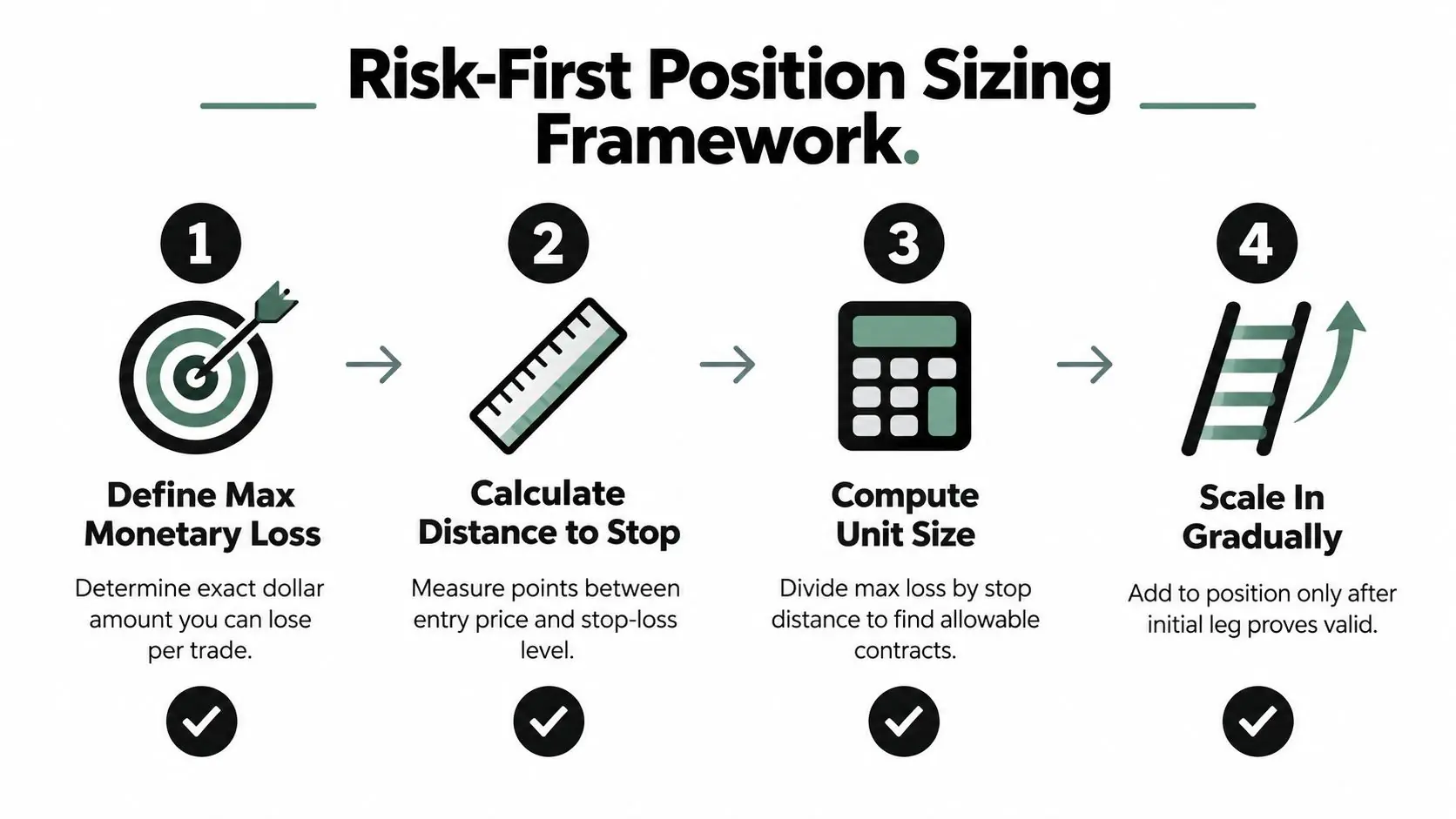
Maximum contracts = maximum monetary loss ÷ (stop distance × contract value per price unit). Work backward from that result, not forward from the platform's contract list. The calculation sets a ceiling for the trade, while liquidity, margin stress, and the prop firm's drawdown limit may require an even smaller position.
Start with a fixed risk budget
Write down the maximum monetary loss for the complete trade idea, including the initial order and every possible add-on. If the first tranche consumes most of that budget, later entries are unavailable unless the stop moves in a way that materially reduces total risk. A winning streak does not justify expanding the budget. Capacity must come from the plan, not recent results.
Define the invalidation point before choosing size. The stop should mark the price or condition that disproves the thesis, rather than an arbitrary distance selected to permit more contracts. A tighter stop increases the permitted contract count mathematically, but it also raises the chance of being stopped by normal market noise. A wider stop may better reflect the commodity's structure while sharply reducing allowable size.
Calculate the contract limit, then round down. Include commissions and a realistic allowance for slippage:
Maximum contracts = maximum monetary loss ÷ (stop distance × contract value per price unit)
If the result is less than one standard contract, use a smaller contract where available or skip the trade. A platform margin calculator can confirm collateral requirements, but it cannot determine whether the planned loss fits the account. A position size calculator can organize the arithmetic, provided the contract multiplier, tick value, stop distance, and fees are accurate.
Give each entry a job
Every tranche needs a defined purpose. The first entry might test a breakout, the second might follow a confirmed retest, and the final entry might require a new high with adequate liquidity. These conditions prevent “add one more” from becoming an emotional response to a losing position.
Use this checklist before and during execution:
- Define the full position first Set maximum aggregate exposure before sending the initial order.
- Set the invalidation rule Identify the price, inventory change, or event outcome that cancels the thesis.
- Reserve capacity Keep margin and drawdown room for adverse movement instead of committing every available unit.
- Add only on evidence Require predefined confirmation, not a feeling that the market must reverse.
- Recalculate after every entry Treat the open position, stop, and remaining risk as one portfolio.
- Stop scaling when conditions change A wider spread, headline shock, or failed structure can invalidate the next tranche.
Adding to a losing position can be valid, but it must pass the same total-risk calculation as any other entry. If the stop stays unchanged, each additional contract usually increases the loss at that stop. If the stop moves farther away, total risk rises again. Thin order books can make the realized loss larger because several contracts may fill across progressively worse prices.
Traders seeking a separate discussion of sizing logic can find better position sizing rules, then adapt those principles to the commodity's contract multiplier and the prop firm's drawdown rules. The average entry price does not measure risk. Total dollars at the invalidation point do.
The average entry price is not a risk metric. Total dollars at the invalidation point are.
Risk capital must also be disposable. The NFA's best-practices guidance advises using only money that can be lost without threatening essential financial obligations. A trade funded by emergency reserves or borrowed money is oversized before the first fill. A broker may allow the order, yet the firm's loss limit may not absorb an ordinary adverse swing, leaving liquidity and drawdown capacity as the actual constraints on scale.
Adapting to Volatility and Commodity Market Regimes
Fixed-distance scaling assumes that equal price intervals carry roughly comparable risk. Commodity markets routinely disprove that assumption. A move through the same number of price units can represent ordinary noise in one regime and a major repricing in another.
A 2013 study of energy futures analyzed 178,389 trader-day observations covering 382 energy-futures traders. It found that mean hedger profits were negative while speculators, particularly hedge funds, earned positive average profits. More relevant to scaling, the study reported that profits on long positions varied inversely with inventories and directly with price volatility. The research is available through the Review of Financial Studies.
That relationship makes a fixed scale grid dangerous. When inventories are changing rapidly or volatility expands, the same entry spacing can produce much larger mark-to-market swings and margin pressure. The trader must adapt the size, spacing, or decision to participate.
Classify the move before adding
Before increasing exposure, identify what is driving the market:
- Inventory-driven trend Check whether storage data and the futures curve support continuation.
- Macro-demand move Ask whether the price action reflects a durable change in consumption expectations or a short-lived repricing.
- Geopolitical shock Treat headline gaps and uncertain liquidity as central risks, not exceptions.
- Tariff front-running A move ahead of an implementation date may reverse when participants unwind stockpiling or hedges.
- Seasonal supply event Agricultural and energy markets can respond to timing, weather, transport, and delivery conditions that a chart alone won't show.
Bloomberg's 2025 commodity market review identified tariff announcements, stockpiling ahead of implementation dates, volatility spikes, and divergence between metals and other commodity groups as important market forces. It also reported broad commodity volatility rising above 20 around the April 2 tariff announcement. Those facts illustrate why an apparently clean trend can be event-driven rather than structurally stable.
The World Bank reported that commodity-price volatility since 2020 exceeded the average of the previous five decades. Its April 2025 outlook projected a 5% decline in commodity prices for 2025, led by oil, while expecting natural gas to rise and metals and agricultural raw materials to remain comparatively stable. These cross-commodity differences are detailed in the World Bank commodity outlook.
Use asymmetric scaling rules
During headline-sensitive periods, reduce the initial exposure or wait for the event to pass. Don't widen the invalidation level merely to avoid a stop. If the stop must be wider, reduce contracts so the dollar risk remains within the original budget.
Gold, crude oil, natural gas, and agricultural contracts shouldn't share one automatic scale-in rule. The correct response may be smaller size, wider spacing, a longer wait for confirmation, or no position at all. Staying flat is a valid form of risk management when the catalyst hasn't been properly repriced.
Scaling Within Prop Firm Drawdown Constraints
A personal account and a prop firm account impose different failure conditions. In a personal account, a trader may decide to tolerate a drawdown, add funds, or hold through a recovery, although borrowed capital can still produce losses beyond the initial deposit. In a prop environment, a daily loss rule or maximum drawdown can end the account before the market returns.
MyFundedCapital uses a flat 5% daily loss limit and up to 10% maximum drawdown, according to its published account information and drawdown rules. Those limits make commodity scaling an account-engineering problem. A position that looks reasonable against the full nominal account can be excessive against the remaining daily loss allowance after open losses, commissions, and correlated trades.
The account label also doesn't determine usable risk. An account described as $10K, $100K, or larger still needs a position size based on the applicable drawdown budget, instrument volatility, stop distance, and execution conditions. A larger headline balance doesn't make a standard crude oil contract less volatile.
Compare the operating constraints
| Feature | Personal Account | Prop Firm Funded Account |
|---|---|---|
| Loss tolerance | Defined by available risk capital and personal limits | Defined by daily loss and maximum drawdown rules |
| Margin response | Trader may deposit additional funds, subject to broker terms | Additional funding generally isn't a substitute for rule compliance |
| Position scaling | Can be adjusted according to personal plan | Must remain inside firm limits and account conditions |
| Overnight gap | Can create a margin call or forced liquidation | Can breach drawdown rules before a planned exit |
| Correlated exposure | Managed by the trader's portfolio policy | Counts against the account's effective loss capacity |
| Best sizing reference | Maximum tolerable monetary loss | Remaining rule-compliant loss capacity |
Micro-contracts and CFDs can provide finer increments where the platform and account rules allow them. That doesn't make them safe by default. A smaller contract can still be oversized if the stop is wide, volatility is expanding, or several positions are exposed to the same macro driver.
Build a prop-specific buffer
Calculate the worst-case loss of every open commodity position against the firm's daily threshold. Then account for slippage, spread expansion, and open profit that may disappear. Don't use unrealized gains as permission to increase size unless the rules and risk plan explicitly allow it.
A workable prop-firm checklist includes:
- Check the daily limit before trading Include realized losses, open losses, fees, and correlated exposure.
- Set an internal stop below the firm limit The firm's breach line should never be your trading stop.
- Reduce overnight exposure A gap can bypass the price where you intended to exit.
- Use smaller increments Build exposure in units that allow the account to remain operational after one failed add-on.
- Stop after a rule-relevant loss Emotional recovery trading often converts a manageable session into a breach.
- Review contract permissions Confirm whether the platform supports the instrument, holding period, news conditions, and order type you plan to use.
A scale plan that works in a cash account may fail immediately in a funded environment because the account has less tolerance for variance. The right objective is not maximum exposure. It's repeatable execution inside the firm's risk boundary.
Executing Your Long-Term Capital Growth Plan
Capital growth comes from surviving enough trades to let a valid edge compound. It doesn't come from maximizing the size of the next entry. Commodity markets offer attractive movement, but that movement can punish a trader who treats a temporary streak as proof of permanent capacity.
A durable routine begins before the session:
- Review the market driver: Record whether the setup is inventory-led, macro-driven, seasonal, geopolitical, or event-sensitive.
- Check the contract: Confirm expiry, rollover, multiplier, tick value, liquidity, and current margin.
- Set the risk budget: Write the total loss allowed for the complete scale-in plan.
- Map the entries: Define what must happen before each tranche is added.
- Mark the invalidation: Include both technical failure and fundamental conditions that cancel the thesis.
- Stress-test the account: Consider a gap, spread expansion, correlated loss, and margin increase.
- Stop when the plan ends: Don't add because the position is close to breakeven or because the market “should” turn.
Track execution, not just profit
A profitable outcome can still come from poor process. A losing outcome can follow a well-executed plan. Record the details that reveal whether the scaling method is sound:
- Entry number and reason for entry
- Planned versus actual size
- Stop distance at each tranche
- Slippage and spread conditions
- Volatility and inventory context
- Maximum favorable and adverse movement
- Whether the trade stayed inside the account rules
- Reason for closing or stopping the scale
Review the log by market and regime rather than combining everything into one performance figure. A method may behave differently in oil, gold, and natural gas because their contract structures, liquidity patterns, and fundamental catalysts differ. If the results depend on one narrow condition, reduce the scope of the strategy instead of increasing size.
Treat discipline as a capacity test
The most difficult decision is often refusing to scale. A trader who can follow the plan after a fast win demonstrates more capacity than a trader who doubles size impulsively. The same applies after a loss. Preserving the next trading opportunity is more valuable than forcing the current position to recover.
Structured funding programs can provide a defined environment for traders who already have a repeatable process, but they don't eliminate market risk or replace sizing discipline. Whether the account is personal or simulated, the operating standard remains the same: know the contract, define the loss, reserve capacity, and scale only when the evidence supports the next tranche.
Trading commodities involves a real risk of loss and isn't financial advice. Futures and other margin-intensive products can produce losses beyond posted margin, while prop-firm accounts can be closed when their rules are breached. Treat every scale plan as a risk experiment with a hard failure point, not as a promise of larger profits.
MyFundedCapital offers simulated trading accounts with commodity access and structured paths through Instant Funding, 1-Step, and 2-Step Challenges, with account sizes from $5K to $100K and scaling paths up to $500K. If your position sizing and drawdown process are ready for a rule-based environment, visit MyFundedCapital to compare account options and start a challenge.