You're probably here because you've watched oil rip higher on a news headline, seen gold react to inflation fears, or noticed natural gas move harder than most forex pairs. You know there's opportunity in commodities, but the market can feel opaque, fast, and unforgiving.
This commodities trading guide breaks the market down into plain language. You'll learn how commodity markets work, what moves prices, which strategies fit different market conditions, and how to approach risk with the discipline a funded trader needs. Trading involves risk of loss. This is educational only, not financial advice.
An Introduction to the World of Commodities Trading
A lot of traders first meet commodities through headlines. Crude oil spikes after a supply disruption. Gold rallies when traders get nervous. Wheat drops into harvest season. The moves look clean from a distance, but once you open a chart, the price action can feel wild.
That mix of interest and confusion is normal.
Commodities are more fundamental to the economy than many new traders realize. You're not just looking at a ticker. You're looking at fuel, metals, and crops that businesses and households use. That's why this market reacts so sharply to weather, logistics, policy, and seasonal demand.
For an active trader, that creates two things at once:
- Opportunity Commodities often produce strong directional moves and event-driven volatility.
- Responsibility If you don't understand what you're trading, you can get run over by a move that seemed irrational but wasn't.
Most new commodity traders don't fail because the market is too complex. They fail because they treat it like a generic chart instead of a market tied to physical supply and demand.
The good news is that you don't need an institutional background to trade commodities well. You need a framework. Start with what the asset is, how it trades, what moves it, and how much risk your account can tolerate. Then build a repeatable method around that.
That's the right way to approach this market. Not with profit fantasies. With process.
What Are Commodities and How Do Their Markets Work
A new prop trader sees gold moving fast during New York hours, opens a position, and then gets stopped out before the move really develops. The problem often is not the chart. It is a weak grasp of what is being traded, how that market is priced, and how the account's loss rules change the way you should approach it.
That matters more in commodities than in many other markets.
A commodity is a raw material with real economic use. Oil powers transport. Gold sits at the intersection of jewelry, reserve demand, and risk sentiment. Wheat feeds people. Because these markets are tied to physical goods, price does not move on technical patterns alone. It also reflects the constant tug-of-war between producers, commercial hedgers, institutions, and short-term traders.
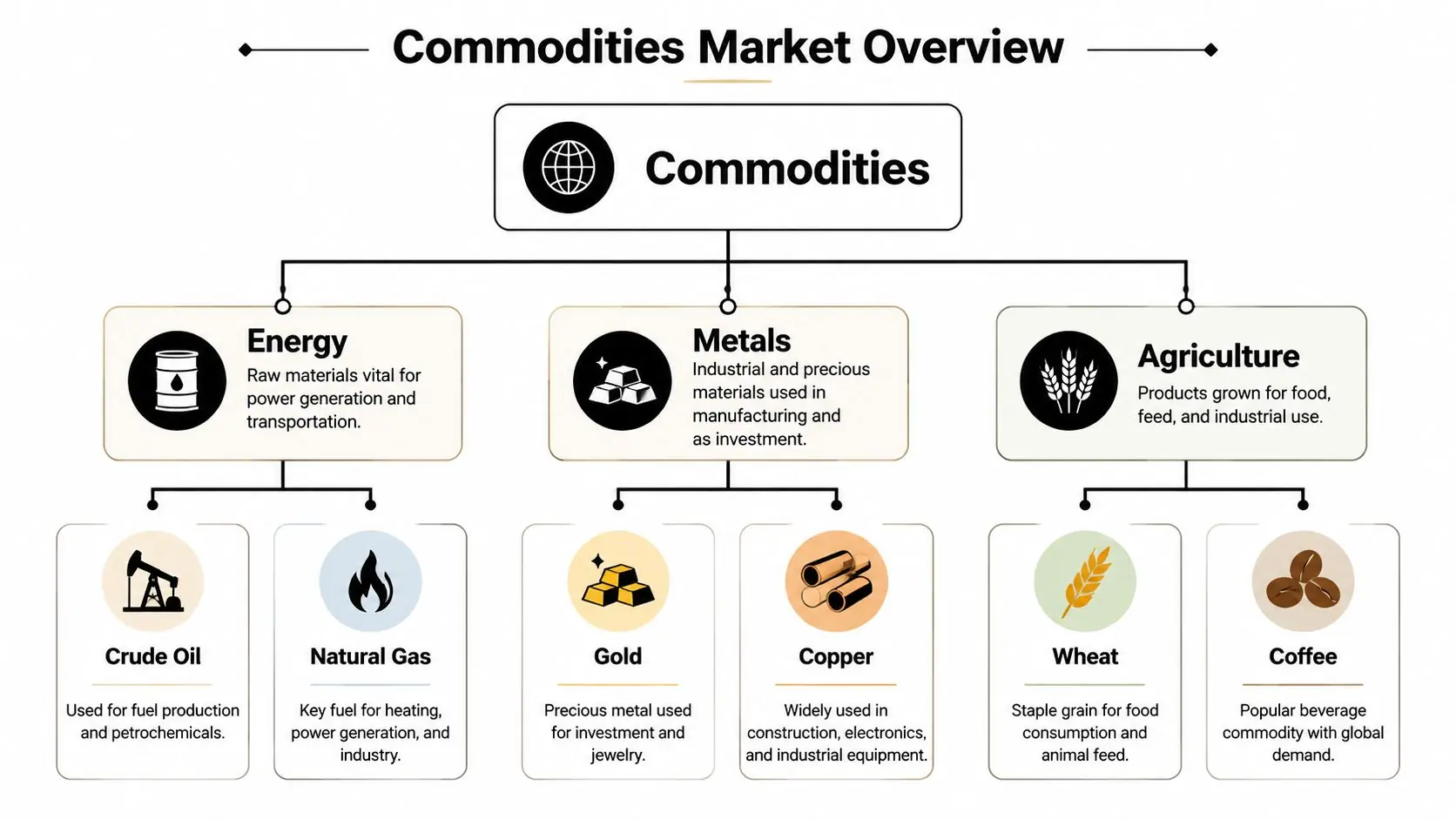
The Main Commodity Groups
Most commodities fall into four broad groups, and each tends to behave differently:
- Energy Crude oil and natural gas often react sharply to supply interruptions, inventory shifts, and political tension.
- Precious metals Gold and silver are widely watched during inflation worries, rate changes, and broader risk aversion.
- Industrial metals Copper and aluminum are closely tied to manufacturing, construction, and global growth expectations.
- Agricultural products Wheat, corn, coffee, cotton, and similar markets respond to planting cycles, weather, disease, and harvest conditions.
A useful way to study them is to treat each group like a different personality. Oil can be aggressive and headline-sensitive. Gold often respects macro events and yield expectations. Agricultural markets can stay quiet, then reprice quickly when weather changes the production outlook.
If you trade through a prop firm, this distinction is practical, not academic. A market with frequent intraday spikes can put pressure on a daily drawdown limit much faster than a steadier one. Choosing the instrument is part of risk management.
Spot Markets and Futures Markets
Commodity pricing usually comes from either the spot market or the futures market.
The spot market reflects the price for immediate purchase or delivery. It is the closest thing to the cash price.
The futures market is built on standardized contracts for delivery at a later date. Futures work like agreeing on a price today for a shipment scheduled for the future. That structure matters because much of the benchmark pricing, volume, and institutional participation in commodities sits in futures, even if a retail trader accesses the market through CFDs or another derivative.
Here is the practical difference:
| Market type | Simple analogy | What matters to a trader |
|---|---|---|
| Spot | Buying produce at today's farmer's market price | Immediate pricing and current conditions |
| Futures | Agreeing today on a price for next month's delivery | Expectations, contract month, and future supply and demand |
Many traders say, “I trade oil” or “I trade gold,” but they are often trading an instrument that tracks a futures contract or a broker's cash product derived from it. That is normal. It still creates one obligation. You need to know what your platform's symbol is following.
The interface should make that product structure visible before an order is placed. Use this commodity trading platform checklist to compare supported markets, execution, costs, charting, and risk controls.
Why New Traders Get Tripped Up
The confusion usually starts with the instrument itself.
A chart may look simple, but the product behind it can include contract months, roll dates, spread differences, and session-specific behavior. If you do not know whether your symbol tracks spot pricing, front-month futures, or a broker-specific synthetic feed, your analysis can be right while your execution is poorly timed.
Contract naming adds another layer. Commodity symbols use month codes and expiration conventions that can look cryptic at first. This reference on futures contract codes and month symbols helps decode what you are looking at.
For prop firm traders, mechanics and risk rules converge. If your funded account allows commodity trading but enforces strict daily loss limits, you cannot treat all commodity products as interchangeable. A gold setup around a central bank event behaves differently from a crude oil setup ahead of inventory data. The market structure affects volatility, and volatility affects position size, stop placement, and whether the trade fits your account rules at all.
A Better Way to Read the Market
Before you place a trade, answer three plain questions:
What is the underlying commodity?
Know whether you are trading energy, metals, or agriculture, because each has different drivers and rhythm.What pricing structure is behind your chart?
Find out whether your instrument follows spot, a futures contract, or a broker-derived product.When is this market usually active?
Some commodities move hardest around inventory reports, major exchange hours, or contract roll periods.
That small routine saves traders from avoidable mistakes. It also helps funded traders stay inside the rules. A prop account gives you access to products and tools many retail traders want, sometimes including EAs and a wider instrument list, but access is only useful if you understand the engine under the chart.
Key Market Drivers That Influence Commodity Prices
Commodity charts don't move randomly. They move because the market is constantly repricing physical availability, future expectations, and risk.
That sounds abstract until you break it into a few concrete drivers.
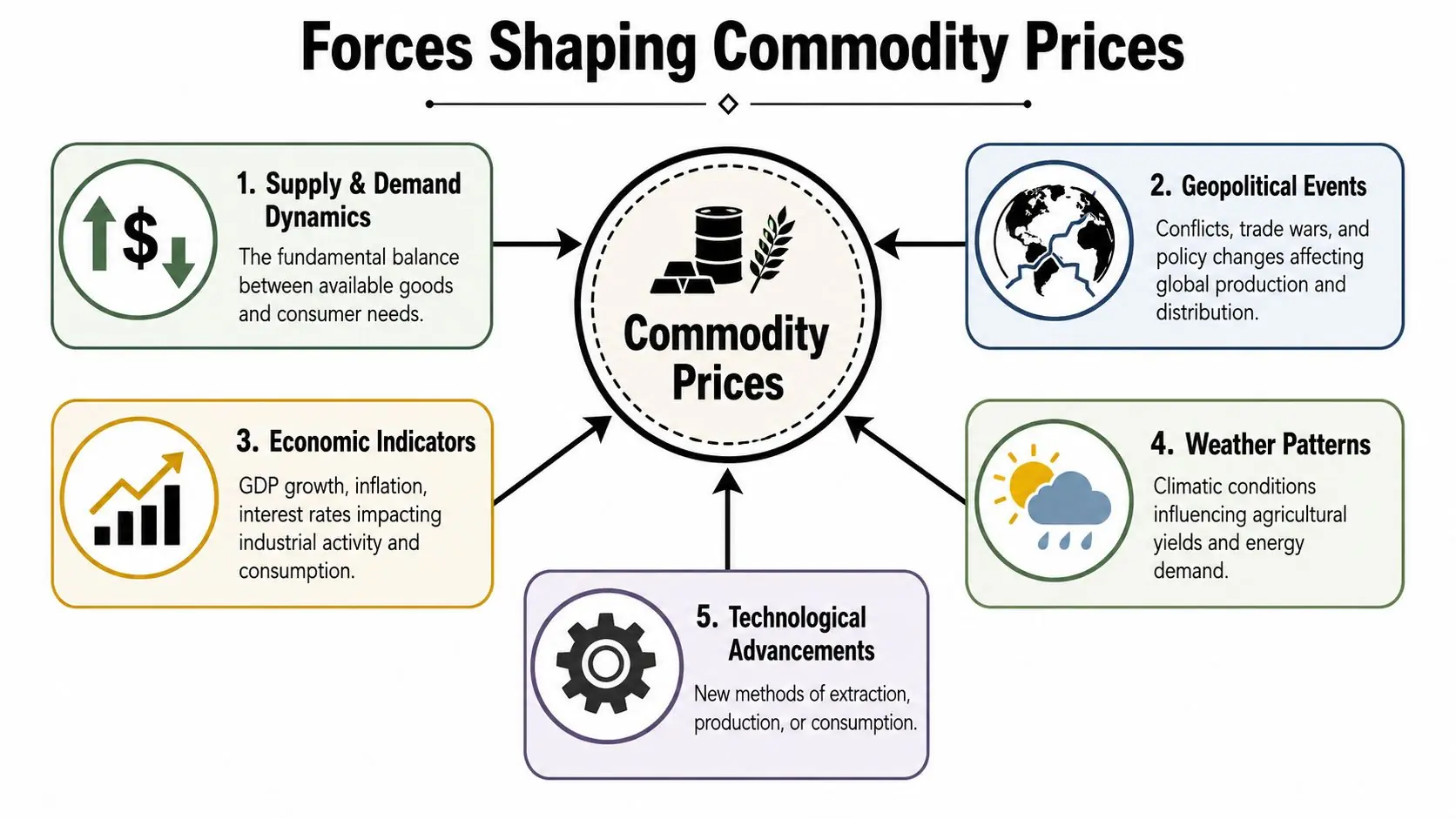
Supply and Demand Still Run the Show
This is the engine underneath everything else.
If buyers need more of a commodity than producers can deliver, price usually rises. If supply floods the market faster than demand can absorb it, price usually falls. That's true whether you're looking at crude oil, copper, or coffee.
In practice, traders should watch for imbalances such as:
- Production disruptions outages, transport bottlenecks, or export restrictions
- Demand shifts stronger industrial use, weaker consumer spending, or substitution
- Inventory expectations whether the market thinks supply is tightening or loosening
A lot of price movement comes from expectation, not just current conditions. The market doesn't wait for a shortage to become obvious. It often reacts as soon as traders believe one is coming.
Geopolitics Can Reprice a Market Fast
Commodities are deeply global. Production may happen in one region, shipping in another, refining somewhere else, and end-use somewhere else again. That makes these markets especially sensitive to conflict, sanctions, trade policy, and transport risk.
Energy is the clearest example. If traders think supply routes could be disrupted, price can jump before any confirmed shortage hits end users. Metals can react to export controls. Agriculture can move on tariff changes or weather-related policy decisions.
Many technical traders get blindsided. The chart setup may look fine, but the market is reacting to a headline with real supply implications.
Seasonality Is a Real Edge in Commodities
One of the most useful things in any commodities trading guide is seasonality, because commodities often follow recurring patterns tied to weather, planting cycles, harvests, and energy demand.
Corporate Finance Institute's guide to commodity trading notes that nearly all major commodity markets follow established seasonal price patterns. It highlights examples such as crude oil and natural gas often seeing winter demand strength, while wheat and corn often reach seasonal lows during harvest periods when supply peaks.
That doesn't mean you buy every winter rally or sell every harvest dip. It means seasonality gives you context.
Use it like this:
- Identify the seasonal tendency for the commodity you trade.
- Check the current trend. Seasonality works better as a confirming factor than as a blind signal.
- Watch for divergence. If a market refuses to follow its usual seasonal path, that can be information too.
A seasonal pattern isn't a trade by itself. It's a clue about when pressure tends to build.
Other Drivers That Deserve Your Attention
Not every price move comes from a dramatic headline. Some are quieter, but still tradable.
Economic conditions
Industrial metals often care about growth expectations, manufacturing demand, and inflation trends. If traders expect stronger industrial activity, they may bid up metals tied to production and infrastructure.
Weather
Agricultural traders live with this. A change in rainfall, heat, or frost risk can quickly alter crop expectations.
Technology and substitution
New extraction methods, efficiency improvements, or changes in energy use can shift the long-term balance of a market.
If you only read the chart, you'll see movement. If you understand the driver, you'll understand why the move is happening, and whether it's likely to continue.
Core Strategies for Trading Commodity Markets
Different commodity markets reward different styles. A trader who does well in a clean crude oil trend may struggle badly in a choppy metals market. That's why strategy selection matters as much as entry timing.
You don't need a giant playbook. You need a few approaches that match the market conditions in front of you.
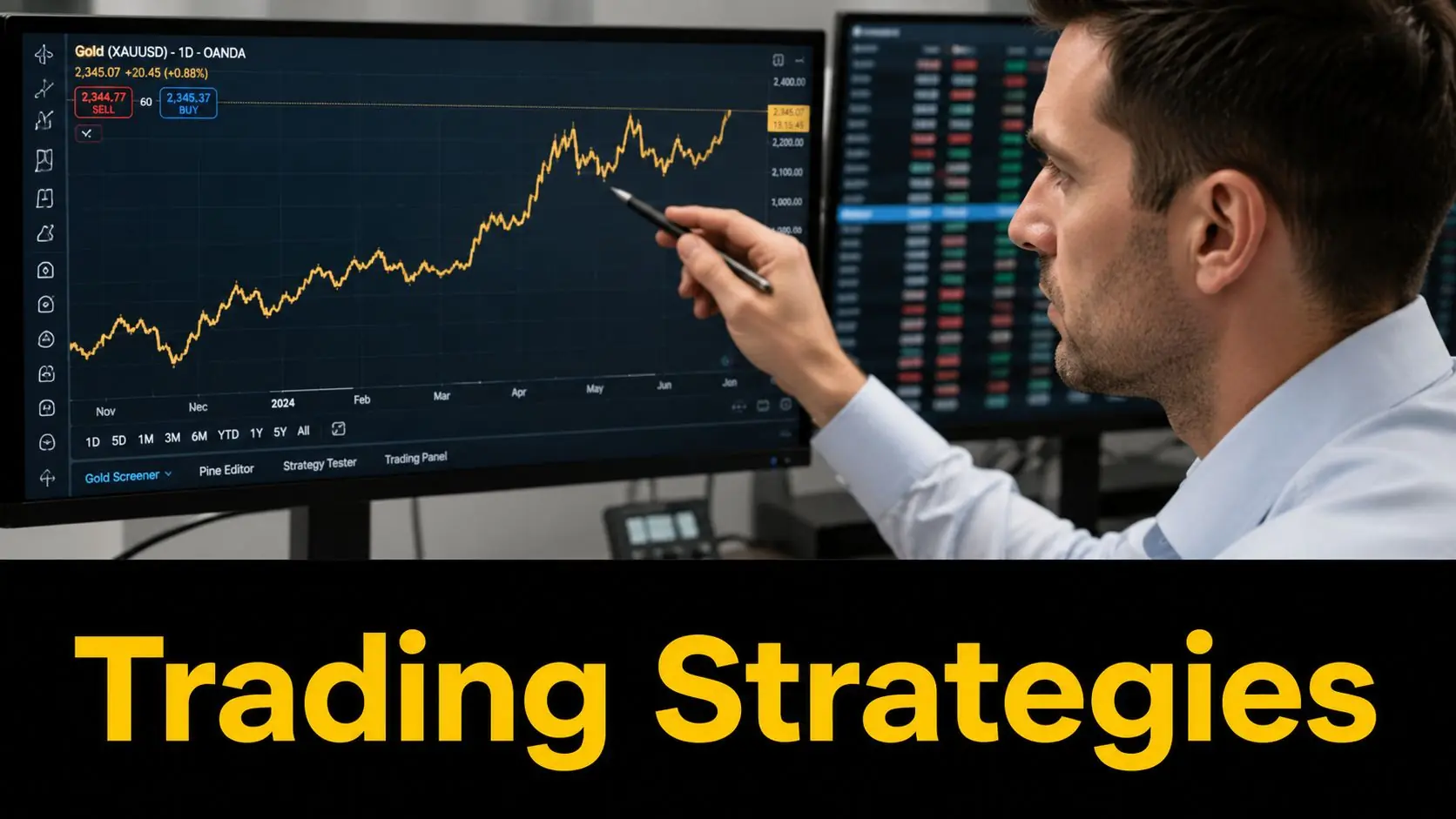
Trend Following
Trend following is the most intuitive strategy for many traders. You identify a market that's already moving with strength, then look for continuation.
This style often fits commodities well because supply shocks and demand shifts can create persistent directional moves.
A simple trend-following process might look like this:
- Find a market making higher highs and higher lows, or the reverse in a downtrend
- Wait for a pullback or breakout
- Enter when price confirms continuation, not when you merely hope it will continue
- Place your stop where the trade idea is invalidated
Crude oil is a classic example. If price breaks above a well-defined range after a supply-driven headline and then holds that breakout, a trend trader may look for continuation rather than trying to fade the move.
This style suits traders who are patient enough to let winners run and disciplined enough not to chase late entries.
Mean Reversion
Mean reversion is the opposite mindset. You're looking for markets that have pushed too far, too fast, and may snap back toward a more normal price area.
This can work in commodities when a short-term panic or euphoric burst stretches price away from recent balance. Gold and some agricultural markets can sometimes offer cleaner reversion setups than traders expect, especially after sharp emotional moves.
But there's a catch. Commodities can stay extended longer than you think.
That means a mean reversion trader needs stronger filters than “price looks too high” or “this candle is huge.”
Good mean reversion filters
- Location Is price stretched into a major historical level?
- Context Was the move caused by noise, or by a real fundamental shift?
- Confirmation Is price stalling, rejecting, or losing momentum?
If the move came from a serious supply shock, fading it too early can be expensive. Mean reversion works best when you can separate emotional overreaction from structural change.
Spread Trading
Spread trading is less common among beginners, but it deserves a place in a serious commodities trading guide.
Instead of betting only on absolute direction, spread traders focus on the relationship between two contracts or related markets. They may compare different delivery months, related commodities, or nearby versus deferred contracts.
This can help reduce some pure directional exposure, but it introduces another challenge: relative pricing behavior. You need to understand why two related markets should widen or narrow.
Spread thinking is useful even if you don't trade formal spreads. It teaches you to ask better questions:
- Is this move unique to one commodity, or broad across the sector?
- Is the front month reacting more aggressively than later pricing?
- Is the market signaling short-term stress or longer-term repricing?
Which Strategy Fits You
| Strategy | Best in | Trader personality | Main risk |
|---|---|---|---|
| Trend following | Strong directional markets | Patient, systematic | Entering too late |
| Mean reversion | Overextended, emotional moves | Fast, selective | Fading real structural shifts |
| Spread trading | Relative value opportunities | Analytical, detail-oriented | Misreading the relationship |
Backtest Before You Trust Yourself
Commodity traders have access to deeper historical context than many realize. Quantpedia's research on extended commodity data describes a 100-year period from 1926 to 2022 built for long-term commodity analysis, giving traders broader visibility into market cycles and more reliable strategy testing across very different economic conditions.
That matters because a strategy that looks great in one regime can fall apart in another.
If you're building a rules-based approach, test it across different environments. Strong trends, recessions, inflationary periods, quiet periods, harvest cycles, and panic phases all matter. If you use indicators, keep them simple and transparent. For example, many traders use the Commodity Channel Index indicator to help identify momentum shifts or overextended conditions, but it should support your framework, not replace it.
Build a strategy you can explain in one minute. If you can't explain why it should work, you probably won't trust it under pressure.
A Modern Approach to Risk and Money Management
Most traders say they respect risk. Far fewer manage it in a way that matches how commodity exposure behaves.
The standard advice is fine as far as it goes. Use a stop-loss. Size positions conservatively. Don't revenge trade. All true. But if you trade multiple commodities, use EAs, or run several positions at once, isolated rules can give you false confidence.
Start With Basic Survival Rules
Before anything advanced, get the basics right.
- Position sizing comes first Don't decide size based on how convinced you feel. Decide it from your predefined account risk.
- Stops need a market reason A stop should sit where the setup is invalid, not at a random distance.
- Correlated exposure counts Long gold, long silver, and long copper may not be three separate ideas in risk terms if the same macro driver is moving them.
A lot of traders break daily loss limits not because one trade was huge, but because several “small” trades all pointed in the same direction.
Why Siloed Risk Rules Break Down
Here's the blind spot. A trader may think, “I only risk a small amount per trade, so I'm safe.” But the account may still carry concentrated exposure across instruments, sessions, or systems.
That problem gets worse for traders using automation or copy-trading logic. One system may be short energy while another is long a related instrument. A third may add exposure during volatility. On paper, each strategy follows its own rules. In reality, the account can still drift into a fragile state.
A more durable approach is to treat risk as a single budget, not a list of disconnected limits.
Use a Unified Risk Budget
A McKinsey report on the commodity trading risk triangle highlights that many commodity traders saw significant return drops since 2023 due to unmanaged blind spots. The report argues for a unified risk budget that tracks market, credit, liquidity, and operational risk together, rather than handling them in isolation.
That framework matters for active traders because losses don't always come from being wrong on direction.
They can also come from:
- Market risk price moves harder or faster than expected
- Liquidity risk you can't get filled cleanly when volatility expands
- Operational risk execution errors, duplicate orders, misconfigured EAs, wrong symbol selection
- Credit-style exposure in practice not in the institutional sense alone, but in how platform, instrument, or execution dependencies affect your ability to manage trades
Risk checkpoint: If one market spikes, one platform lags, and one EA misfires at the same time, your account should still survive.
That's the standard you want.
A Practical Risk Framework for Active Traders
Use this checklist before the trading day starts:
List total open exposure
Don't review each trade in isolation. Review the account as one book.Group positions by driver
Ask what's moving them. Inflation, growth expectations, weather, energy supply, safe-haven demand, or something else.Set a daily stop for the account
Not just per trade. If several trades go wrong together, you need a hard line.Audit your execution process
Check symbol names, order size, session timing, and automation settings before volatility picks up.Reduce complexity when conditions change
When news flow gets chaotic, fewer positions often beats more diversification theater.
For traders still refining stop placement, this guide on setting stop losses effectively is worth reading because it focuses on practical stop logic instead of generic slogans.
What Good Risk Management Actually Looks Like
Good risk management doesn't feel exciting. It feels a bit boring, and that's the point.
A disciplined trader can take a loss, step back, and still execute the next trade cleanly. An undisciplined trader treats every setup like a referendum on their skill. That emotional pressure leads to oversized trades, sloppy exits, and rule-breaking.
In commodities, where volatility can expand quickly, discipline isn't a personality trait. It's a system.
Your Practical Guide to Getting Started Trading Commodities
You open your platform before the London session. Gold is moving, crude is active, and natural gas has already made a sharp premarket push. It feels like opportunity. For a new trader, that same screen can become a trap within minutes.
A solid start is narrower than people expect. Especially in a funded account.
Prop firm traders do not get paid for being busy. They get paid for staying within rules, protecting the account, and repeating a process under pressure. Commodity markets can give you clean trends and strong intraday movement, but they can also hit a daily loss limit fast if you treat every headline like a trading signal.
Choose the Right Trading Vehicle
Commodity traders usually participate through price-based instruments, not physical ownership. You are trading exposure to moves in gold, oil, silver, or agricultural markets, not arranging delivery of barrels or bushels.
For many short-term traders, that means using products tied to the underlying spot or futures market. The practical point is simple. You want an instrument that matches your account type, your platform, and your risk limits.
That matters even more in prop trading. A funded trader has to think beyond chart setup quality. You also need to know how the instrument behaves around rollover, how spreads change during active sessions, and whether your firm allows automated trading or restricts certain styles. If you are comparing account models, study the structure of futures prop trading programs before you choose a market.
Start Small and Build Depth
New commodity traders often try to study everything at once. That approach usually produces shallow knowledge and inconsistent execution.
Start with one market.
Gold works well for many beginners because news coverage is easy to follow and the market usually reacts to recognizable drivers such as the dollar, yields, and risk sentiment. Crude oil is another strong candidate, but it can become disorderly around inventory data and geopolitical headlines. Natural gas often moves with the temperament of a power tool. Useful in skilled hands, expensive in careless ones.
Your first job is familiarity. Learn how one market breathes before you ask it to pay you.
Learn the Instrument Like a Craftsperson Learns Tools
A carpenter does not blame the saw for a crooked cut if he never learned how it bites through wood. Commodity traders need the same attitude toward their instruments.
Before your first live trade, know these basics:
- What the symbol tracks
- Which session brings the best liquidity
- What scheduled events move it
- How wide spreads get during quiet periods
- Whether its average movement fits your stop size and account rules
If you want another plain-English reference while building that foundation, Alpha Scala's commodity guide is a useful companion read.
Write a One-Page Trading Plan
Your first plan should be short enough to use in real time. If it reads like a research paper, you will ignore it as soon as volatility picks up.
Keep it to one page and include:
- Market: the one commodity you trade
- Setup: breakout, pullback, trend continuation, or mean reversion
- Context filter: what must be happening before you enter
- Entry trigger: the exact signal you act on
- Risk rule: position size, stop placement, and maximum loss
- Exit rule: where you take profits or cut the trade
- No-trade conditions: low liquidity, major news, or unclear structure
For prop firm traders, add one more line. State the maximum loss you are willing to take before the firm forces the decision for you. That number should sit well inside your daily drawdown limit. If the account rule is the guardrail, your personal rule should be the lane marker.
Rehearse the Process Before You Trade Live
Simulation matters, but only if you treat it seriously.
Do not use demo trading to click around and call it practice. Use it to prove that you can follow your plan with the correct symbol, order type, size, and stop placement. That is especially important in commodities, where one wrong contract size or one mistimed entry around news can distort your results.
A simple pre-trade routine helps:
- Confirm the market you are allowed to trade.
- Check the session and any scheduled reports.
- Mark the level that invalidates your idea.
- Calculate size based on account rules, not on conviction.
- Enter only if the setup matches your written plan.
That routine sounds simple because it is. Good trading often is.
Common Beginner Errors in Commodity Trading
These mistakes show up often, and funded traders pay for them faster than everyone else:
| Mistake | What it looks like | Better move |
|---|---|---|
| Too many markets | Watching gold, crude, silver, and gas at the same time | Trade one market until its behavior feels familiar |
| Ignoring firm rules | Taking a normal retail-style loss in a funded account with a tight daily cap | Size positions around the account rule first |
| Trading the headline, not the setup | Chasing every inventory number or inflation release | Wait for price action to confirm the idea |
| Using inconsistent size | Risking small on average setups and large on emotional ones | Use a fixed risk model |
| Changing methods every week | Breakouts on Monday, reversals on Tuesday, scalping on Wednesday | Keep one approach long enough to judge it honestly |
One last point. Your goal at the start is not to prove that you can catch every move. Your goal is to become reliable. In commodities, and especially in prop trading, reliability keeps you in the game long enough to develop skill.
Commodities Trading FAQ and Your Next Steps
Is commodities trading harder than forex or indices
It can be. Commodity markets often respond to physical supply, seasonality, and event risk in ways newer traders don't expect. The upside is that once you understand the drivers, the moves often make more sense.
Which commodity should a beginner start with
Start with the one you can follow consistently. Many beginners begin with gold or crude oil because there's plenty of market coverage and the instruments are widely available. The best choice is usually the market whose behavior you're willing to study in depth.
Do I need to trade futures directly to trade commodities
No. Many active traders access commodity price movement through CFDs linked to the underlying spot or futures market. That makes it easier to speculate on price without dealing with physical ownership.
What matters most in a commodities trading guide for funded traders
Risk discipline. Not just trade-by-trade risk, but total account exposure, correlation, and execution consistency. Commodity markets can move hard and fast, so sloppy risk management gets exposed quickly.
The big takeaway is simple. Learn the asset. Respect the driver behind the move. Pick one strategy that fits your personality. Keep risk under control across the whole account, not just one trade at a time. That's how traders stay in the game long enough to improve.
Trading involves substantial risk of loss and isn't suitable for everyone. This article is educational only and not financial advice.
If you want to apply this commodities trading guide in a structured environment, take a look at MyFundedCapital. You can compare funding programs, review account types, and start a challenge that rewards discipline instead of hype.